
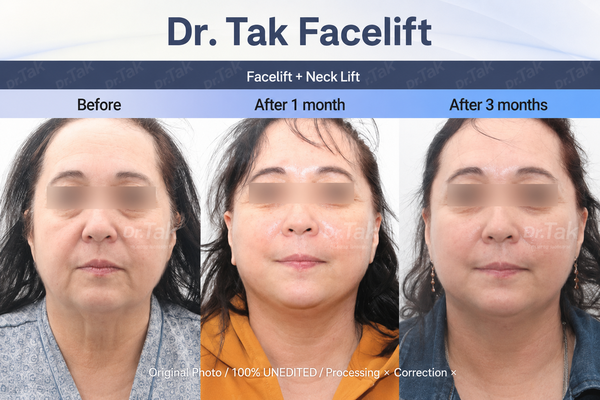
The feeling that lifting never seems to last — there is a reason for it
If you have had lifting done again and again and still felt everything slid back within months, I believe many of you know that frustration. You tried threads, you tried lasers, and you wondered why nothing held for you.
That is not because you managed your recovery poorly. It is because the layer those treatments reach and the layer where your face actually sags are two different things.
A face does not droop simply because the skin stretches. Beneath the skin, the muscular fascia (the SMAS) and the ligaments that once anchored it to bone loosen together. Pulling skin alone leaves this underlying structure untouched and only makes the surface tight. It looks good at first. The problem is what comes next.
Over more than 15 years of working with facial tissue, I have confirmed again and again that what you pull matters far more than how hard you pull. This is exactly why the deep plane facelift, done in Korea and worldwide, is described as longer-lasting. Today I want to walk through that anatomy with you, and explain why the same deep plane surgery can still give different results from clinic to clinic.
The face is built in four layers — where sagging truly begins
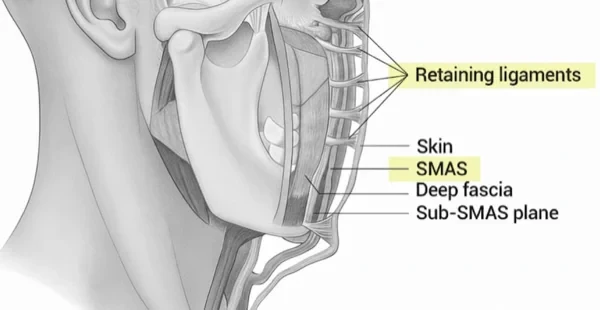
To understand facial tissue, you have to start with the layers. From outside to inside, there are four.
① Skin — the outermost surface we touch.
② Subcutaneous fat — the fat layer just beneath the skin.
③ SMAS (superficial musculoaponeurotic system) — the tough fascia wrapping the facial muscles. This is the true stage of any lift.
④ Deep fat, periosteum and retaining ligaments — the structures that fix tissue to bone below the SMAS.
The main culprits of aging are not layer ①, the skin, but layers ③ and ④. As the SMAS stretches and the ligaments anchoring tissue at the cheekbone and jaw loosen, the whole cheek slides downward. Deepening nasolabial folds and jowls are, in the end, the result of that slide.
📌 The point: the reason skin-only procedures fade quickly is simple. The cause of sagging sits in the SMAS and ligaments, yet only the skin is touched.
One question remains. It means that how you handle the SMAS and ligaments changes everything — even within the same facelift.
What it means to lift the SMAS "without separating it"
A traditional SMAS facelift dissects skin and SMAS separately and pulls each. The skin is lifted first, then the SMAS beneath is folded or trimmed and fixed. It is a proven, safe technique, but separating the two layers cuts the vascular network between them, and much of the pulling force ends up on the skin suture line.
The deep plane takes a different route. It dissects skin and SMAS together as a single composite flap and lifts them as one. And the dissection proceeds in the deep plane beneath the SMAS, where the retaining ligaments live.
This difference produces three outcomes.
First, because skin and SMAS stay attached, the blood supply between them is preserved. Tissue heals soundly and recovery is stable. Second, because the pulling force rests on the deep SMAS and ligaments, the skin suture line carries almost no tension. Third, lifting the cheek fat and fascia as one restores the sunken mid-face volume naturally.
📍 Bottom line: the essence of the deep plane is not "pulling harder." It is moving the pulling force away from the skin and into the deep layers.
Why the retaining ligaments must be released — this is where longevity is decided
The most important and most demanding step of the deep plane is handling the retaining ligaments.
Retaining ligaments are tough fibrous bundles that anchor facial tissue to bone. The main ones are the zygomatic ligament at the cheek, the mandibular ligament along the jawline, and the masseteric cutaneous ligament supporting the cheek. In youth they hold tissue in place; with age they hold stretched tissue down low. They become, in effect, an anchor.
The problem is that unless you release this anchor, no amount of pulling from above will lift the tissue past the point the ligament grips. The nasolabial fold is the classic example. It is held firmly by ligaments, so pulling without releasing them only tightens the skin above it and can make the fold itself look more unnatural.
The deep plane locates these ligaments precisely and releases them safely. It unties the anchor. Only then does tissue rise to the height it should, without excessive force.
📌 This is where longevity comes from. When the ligaments are released and fixation is set in the deep layer, the result is held by the new deep anchor points. Because the structure itself is repositioned rather than relying on skin elasticity, it collapses far more slowly over time. That is the basis on which clinical studies report deep plane techniques as favorable for longevity compared with SMAS plication.
A one-on-one consultation you can start now
✅✅ We compare honestly whether the deep plane suits your stage of aging, or whether another approach is better
✅✅ Regardless of whether surgery is right for you, we tell you plainly what you actually need now
📲 Official Dr.Tak website, chat icon at the lower right → connect to a live consultation
Same deep plane, different results — the three principles I keep
Even under the same name, the deep plane is a surgery with wide variation in outcome. I believe that variation comes from three points.
Dissection extent is designed differently for every face
A deep plane does not mean the same dissection for everyone. Someone with mid-face sagging and someone whose jawline and neck have also collapsed need different ligaments released and different areas dissected. Rather than pulling a face uniformly, I adjust the extent to that person's vector of sagging. Dissect wider than needed and recovery only lengthens; dissect too little and the fold remains.
Fixation is set on the SMAS and ligaments, not the skin
This is the core of longevity. Anchor the result to the skin and sagging returns within months as the skin stretches. I set the fixation points on the deep SMAS and the repositioned ligaments, and close the skin tension-free.
Scars are designed into positions where they are not seen
Incisions follow the natural crease in front of the ear and the border behind it. And because no tension sits on the skin, the risk of a suture line widening or spreading is reduced. The "pixie ear" many people worry about also comes from excessive skin tension. That is another reason fixation belongs in the deep layer.
📍 Bottom line: the quality of a deep plane is decided not by the name of the technique but by three executions — dissection extent, fixation layer, and incision design.
Deep plane, dual plane, and SMAS facelift — how they differ
The point is not that one is "better," but that the right choice differs by stage of aging and tissue condition. The table below summarizes it.
| Comparison | Deep plane | Dual plane | Traditional SMAS |
|---|---|---|---|
| Dissection layer | Deep, below SMAS, to ligaments | Skin and SMAS, each | Skin and SMAS separated |
| Skin–SMAS relation | Move together as one flap | Separated, moved each | Separated |
| Retaining ligaments | Actively released | Partly released | Mostly untouched |
| Mid-face volume | Excellent natural restore | Good | Limited |
| Suture-line tension | Very low | Moderate | Relatively high |
| Nasolabial fold | Excellent | Good | Limited |
| Recovery difficulty | Moderate to high | High (wide dissection) | Moderate |
| Longevity | Favorable | Favorable | May be shorter |
| Best suited for | Mid-face sag, natural look | Broad, severe sagging | Mild sag, partial correction |
📍 Bottom line: if your sagging is centered on the mid-face and you want a natural look, the deep plane may fit; if the whole face has collapsed broadly, the dual plane may suit better. This cannot be decided without photos and a hands-on exam.
How recovery unfolds — laid out by stage
Recovery is asked about as often as the surgery itself. Since this involves an incision and deep dissection, it is best to know the realistic course in advance.
| Stage | Condition | The focus of this stage |
|---|---|---|
| Day of surgery–day 3 | Swelling and bruising peak | Cold compress, head elevated, rest |
| Day 4–week 1 | Swelling begins to ease past its peak | Some sutures out, avoid strenuous activity |
| Around week 2 | Visible swelling markedly reduced | Many begin returning to social life here |
| Week 3–4 | A natural impression returns | Scar care begins in earnest |
| Month 3–6 | Scars mature, final contour settles | Continue scar care through month 6 |
Bruising and swelling largely subside within two weeks. But it takes several months to become fully natural and for the final result to settle. This part I say honestly. The claim that "it is over in a week" does not match reality.
Honestly, this is not a surgery I recommend for everyone
If you have read this far, the advantages of the deep plane may feel considerable. Yet the phrase I say most often in consultation is "not now."
When sagging is still mild, or the main issue is loss of skin elasticity, there are many cases where you do not need to go as far as an incisional surgery. The same is true when your situation cannot afford the recovery period, or when the change you hope for lies beyond what a facelift can do. In those cases I first suggest a non-surgical alternative or a change of timing. Because surgery is hard to undo, I believe the most important thing is to do it precisely at the moment it is needed.
Why you should look at the surgeon as much as the technique
The deep plane is performed in the deep layer where branches of the facial nerve run. So how precisely that layer has been handled, rather than the name of the technique, governs the result and the safety.
Dr.Tak Plastic Surgery has built more than 15 years of experience in delicate tissue surgery centered on the lips and philtrum, holding to a principle of incision, suture and scar design at the millimeter level. That precision is reflected in over 190 Google reviews at a perfect five-star rating.
💬 "To make people smile." This is why we focus on the person, not the procedure.
The Dr.Tak 4S patient care system
We focus not on the procedure, but on the person receiving it.
Solution
Instead of pulling the face uniformly, we design the dissection extent and fixation points to the direction and degree of sagging.
Support
We discuss expectations and limits fully before surgery, and follow the course together throughout recovery.
Scar Care
We design incisions into unseen positions and manage scars in stages through six months after surgery.
| Stage | Scar-care focus |
|---|---|
| Weeks 1–2 | Suture-line hygiene, minimal tension |
| Week 3–month 2 | Managing redness and firmness |
| Months 3–6 | Pigment and mature-scar finishing |
Service
Regardless of whether surgery is the answer, we hold to the principle of telling you honestly what you need now.
If you would like to know more — official channels
🌐 On the official website drtakprs.com you can find procedure information and cases.
📝 For questions, use the chat icon at the lower right of the website for a live inquiry.
📹 We also explain surgical principles and recovery through video.
Five things to sort out for yourself before deciding
✅ Have you been diagnosed on whether your sagging is a skin problem or a SMAS–ligament problem?
✅ Have you heard the deep plane compared with other options?
✅ Can you afford the recovery period (at least 2–3 weeks) and the scar course?
✅ Have you confirmed that the change you want is within what a facelift can do?
✅ Does the surgeon have deep-layer experience and a scar-care principle?
If any of the five leaves you uncertain, I suggest starting the consultation with that item.
Frequently Asked Questions (FAQ)
These are the questions I am asked most while consulting on the deep plane facelift.
Q1. Does it hurt a lot during surgery? How is anesthesia handled?
The deep plane is usually done under sedation with local anesthesia, or under general anesthesia when the extent is wide. Pain during surgery is controlled by anesthesia, and for a few days afterward you may feel tightness and soreness. More people report a sense of pressure from swelling than sharp pain. It is managed with prescribed analgesics in most cases.
Q2. When can I return to work or go out?
Swelling and bruising peak in the first three days, and by around two weeks the visible swelling subsides considerably. So most people begin returning to social life somewhere between two and three weeks. Since a fully natural impression takes three to four weeks, I suggest allowing generous time if you have an important event.
Q3. Roughly how much does it cost?
Facelift cost varies widely by dissection extent (mid-face only or including the neck), anesthesia method, and any combined procedures. So an exact figure can only be given after examining your actual condition. That said, before setting a price, I hold to the principle of first discussing whether this surgery is truly needed at this point.
Q4. Will I be left with a scar or a "pixie ear"?
Since an incision is involved, a scar cannot be entirely absent. But designing the incision along the natural crease in front of the ear and the border behind it can make it hard to notice. The pixie ear people worry about arises from excessive skin tension, and because the deep plane sets fixation in the deep layer and lowers skin tension, that risk is relatively reduced.
Q5. What if it looks obviously done, or so pulled that I seem like a different person?
This is the fear I hear most, and the one I watch most closely. An unnaturally pulled face usually comes from forcing the skin. Because the deep plane repositions deep tissue rather than skin, expressions stay natural and the "pulled" look is lessened. If anything, I guard against over-correction and hold to stopping at the line that keeps your original impression.
Dr.Tak Plastic Surgery | A Korean lip and philtrum specialty clinic
"To make people smile"