
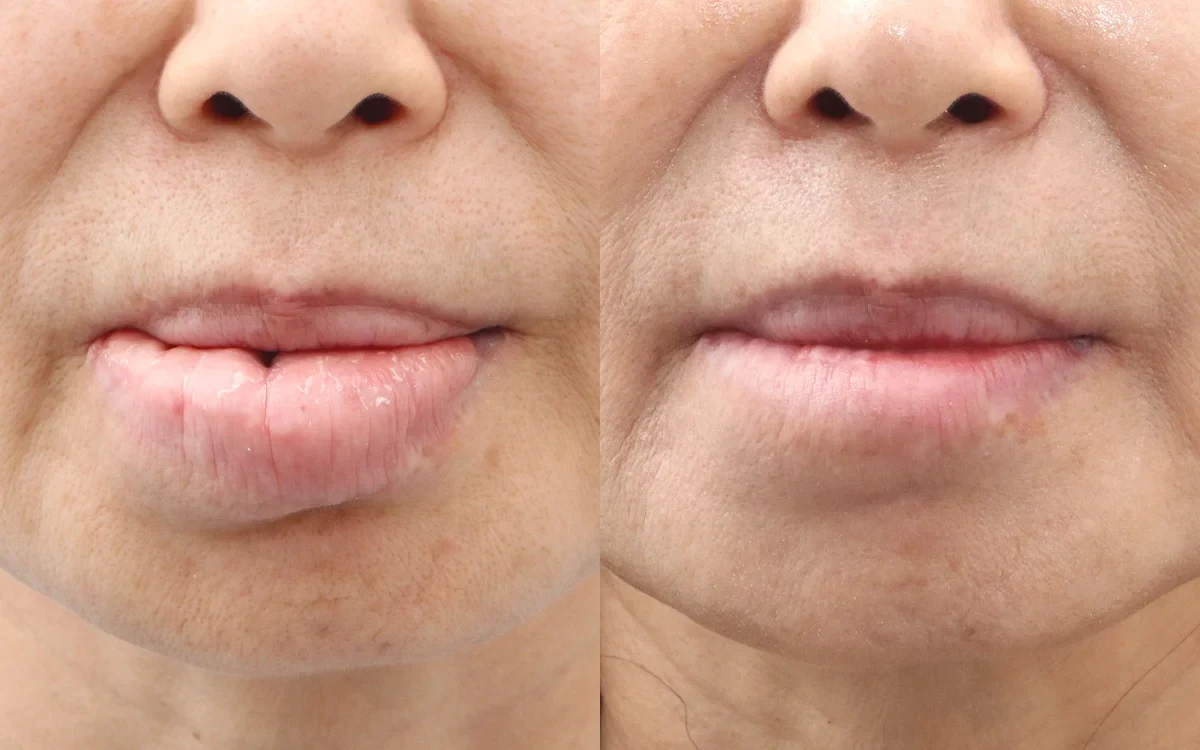
Patients often come to Dr.Tak saying, "I don't know exactly what was injected." They tell us their lips gradually hardened, became painful, and changed shape so much that even looking in the mirror became difficult. On examination, we frequently find that the foreign substance has fused severely with the surrounding tissue, often forming a granuloma. This is one of the most difficult areas to treat — and precisely because of that, one in which patients suffer a great deal.
What Are Illegal Foreign Substances?
Illegal foreign substances are materials never approved for medical use, or substances injected through illegal procedures by non-professionals at unlicensed salons/premises (non-medical places) rather than at a medical facility. Common examples include industrial silicone, paraffin, vaseline (petroleum jelly), and cooking oil. These materials were never intended to be injected into the human body in the first place, and because they are often administered in unsanitary environments, they can cause serious complications. As a rule, they should be removed as soon as they are discovered.
If the injected material was a medical filler, a different approach may be more appropriate: hyaluronic acid (HA) fillers are better suited to Soluble Filler Removal, while non-dissolvable fillers such as PMMA and Aquamid are better suited to Permanent Filler Removal. Even if you don't know what was injected, we will identify it through examination and testing to find the safest possible method.
Leaving It Untreated Is Dangerous — The Complications of Illegal Foreign Substances
Unlike medical fillers, illegal foreign substances provoke unpredictable reactions within the body and, over time, can lead to the following problems.
- Chronic inflammation and infection: A foreign-body reaction can cause persistent inflammation or infection.
- Tissue necrosis: The substance may block blood vessels or prove toxic, damaging or causing necrosis of the surrounding tissue.
- Migration and deformity: Over time, gravity and muscle movement can cause the substance to migrate to other areas, producing unexpected deformities.
- Paraffinoma: When paraffin is injected, the foreign-body reaction can cause skin discoloration, swelling, itching, and fever, gradually progressing to chronic dermatitis, abscesses, ulcers, and skin necrosis.
- Slowly progressing long-term complications: Complications tend to develop slowly, and problems may not become apparent until years or even decades later. One study reported the average interval before complications appeared after foreign-substance injection to be 8.8 years.
Why Removal Is Especially Challenging
- Unpredictable distribution: Because it is difficult to know the exact composition and how far the substance has spread, surgical planning is complex.
- Severe tissue adhesion: Having remained in the body for a long time, the substance binds firmly to the surrounding tissue, making removal difficult.
- Risk of infection: Infection or additional inflammation can arise during removal, requiring meticulous care.
- Potential tissue damage: Achieving complete removal may require taking out a considerable amount of healthy tissue as well.
Complete 100% Removal Is Difficult — We'll Be Honest With You
Illegal foreign substances often seep into the surrounding tissue and harden together with it, making it difficult to isolate and remove the substance alone. It is much like trying to pick out only the gravel from concrete in which cement and gravel have set together. For this reason, the goal of surgery at Dr.Tak is "to safely remove as much of the foreign substance as possible," and during this process some healthy tissue may be removed along with it. Paraffinoma in particular requires removing as much of the infiltrated substance as possible — because even a small amount left behind can cause complications to recur, we approach it with even greater caution.
Our Surgical Approach — Precise Diagnosis and Staged Removal
Because the exact composition of the substance is unknown and how far it has spread is difficult to predict, precise pre-operative diagnosis is more important than anything else.
- Before surgery, we determine the location and extent of the substance and, if necessary, check the patient's overall condition with blood tests before establishing a removal plan.
- For safety, removal is often performed in stages; when removing all of the substance at once would be dangerous or impossible, the procedure is carried out over several sessions.
- Areas where a granuloma has formed are removed together with the inflamed tissue, and substance that has spread to the surrounding area is removed as fully as possible. Throughout surgery, we proceed carefully while monitoring the condition of the tissue.
Removal → Reconstruction → Aftercare, All in One
Removal is not the end. Because some tissue is removed along with the foreign substance, changes in the shape and volume of the lips can occur, and in some cases reconstruction/restoration through procedures such as mucosal advancement is needed. In addition, because preventing infection is especially important in illegal foreign-substance removal, we monitor recovery regularly after surgery and respond immediately if any complication arises. Caring for you all the way — scar management, taping, and laser treatment — until the day your lips return to a natural state: this is the Dr.Tak one-stop system.
Early Detection Matters
Because the complications of illegal foreign substances progress slowly, patients often feel no symptoms at first. This is even more true of the lips, which rarely cause pain even when something is wrong. Over time, however, the substance penetrates deeper into the tissue and adhesion and inflammation worsen, making removal more difficult. Rather than reassuring yourself that "there's no pain, so it must be fine," the sooner you seek a consultation — especially if your lips frequently chap, harden, change shape, or swell when you are tired — the wider your options and the better your outcome.
We Recommend This For
- Those experiencing complications after receiving an unidentified injectable in the past
- Those who underwent an illegal procedure at an unlicensed salon/premises (non-medical place)
- Those who were injected with non-medical materials such as industrial silicone, paraffin, or vaseline
- Those whose lips have hardened or become severely deformed
- Those with recurring pain or inflammation, or whose lips frequently chap
- Those who wish to correct a misguided past procedure and return to healthy lips