
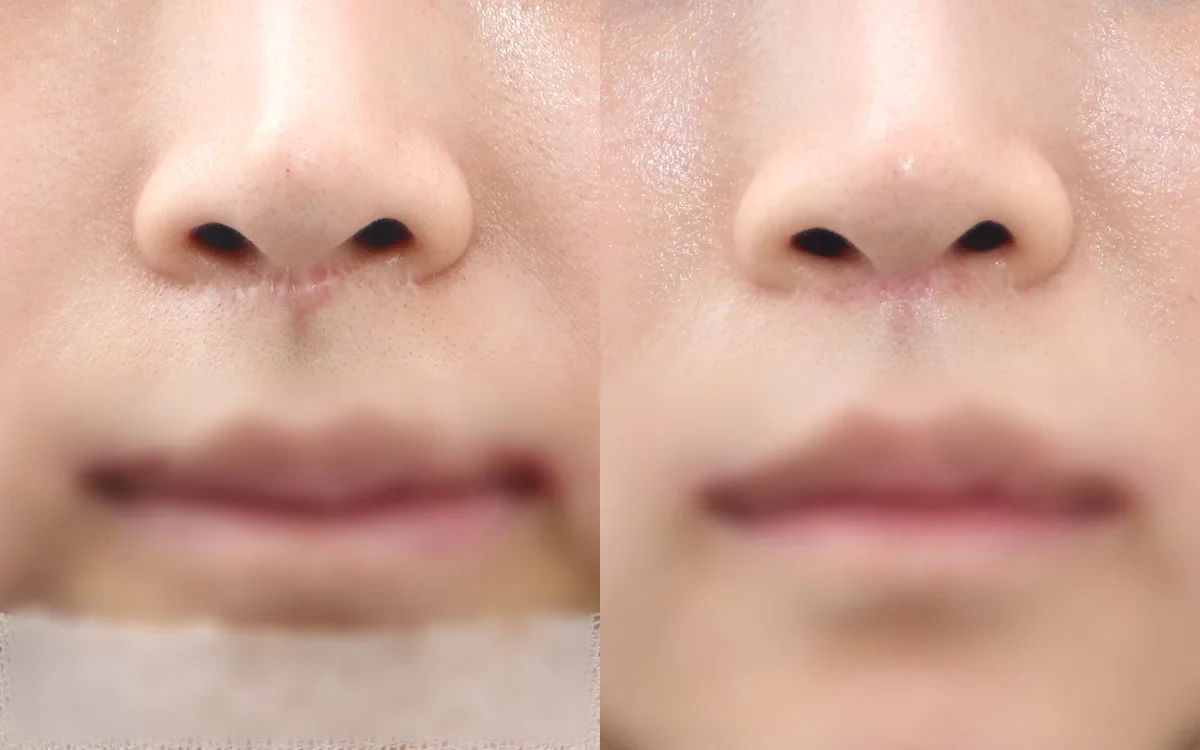
"This time, you don't want to be left with regrets." To help you move past the disappointment of a first surgery and smile freely once more — Dr.Tak precisely analyzes the outcome of your initial procedure and tells you honestly what can and cannot be achieved. No unnecessary treatment — only the corrections you truly need, performed by the safest method possible.
Who This Is For
- Those whose philtrum has lengthened again, or never shortened as much as they had hoped
- Those left with an asymmetric philtrum or lip line after surgery
- Those whose scar is prominent, or sits in an unnatural position or direction
- Those whose upper lip is excessively lifted, creating an overcorrected look (gum exposure)
- Those whose face looks even more awkward at rest, as if it is smiling unnaturally
Why Philtrum Revision Is More Difficult
Revision surgery around the mouth is far more complex than the first (initial) procedure because of existing scar tissue, altered muscle structure, and adherent ligaments. The philtrum in particular sits directly against the muscles that move the upper lip — an area where a difference of just 1mm can change one's entire expression.
Revision is more demanding for the following reasons:
- The presence of scar tissue — Tissue that has already been incised and sutured once becomes firm, making incision and dissection harder than the first time.
- Altered muscles and ligaments — The first surgery shifts the position and tension of the muscles, so simple suturing alone cannot restore natural movement.
- A changed blood-flow environment — Once-operated tissue no longer has the same circulation, calling for a far more meticulous approach to recovery and scar management.
- Limited spare tissue — With skin already removed, there is less tissue left to work with, making precise calculation essential.
For these reasons, revision demands a higher level of analytical insight and technical skill than an initial procedure. As a specialized clinic devoted to the lips and philtrum, Dr.Tak Plastic Surgery meets this challenge with accumulated clinical experience and proprietary techniques.
Dr.Tak's Principles for Philtrum Revision
Revision begins with first understanding 'why it happened.' Dr.Tak adheres to the following four principles.
- Precise scar-tissue analysis — We thoroughly assess the shape, depth, and degree of adhesion of the scar at the previous surgical site. Accurate revision is only possible when we understand not just the scar visible on the surface, but how the tissue beneath the skin has changed.
- One-on-one root-cause consultation — We first clarify exactly why the result was unsatisfactory. Rather than simply operating again, we identify 'why it happened' so the same problem is not repeated. Dr.Tak personally analyzes the method and outcome of your first surgery.
- Setting realistic expectations — We honestly explain both the possibilities and the limits of revision. Accurate goal-setting, rather than excessive expectations, is what leads to genuine satisfaction. It is Dr.Tak's principle to speak confidently about what is possible and honestly about what is difficult.
- Micro-suturing — We improve the scar's position, direction, and thickness together, minimizing any trace of the revision. Suturing stitch by stitch with precision, so the scar fades naturally over time.
Dr.Tak's Distinctive Revision Expertise
The quality of a revision ultimately comes down to the details of the technique. Dr.Tak delivers stable, lasting results through two core techniques that set the procedure apart from a first surgery.
Clean and all but invisible — micro-suturing
The concern those considering revision worry about most is, 'What if this leaves even more scarring?' Dr.Tak addresses this concern with meticulous suturing that minimizes skin tension and optimizes the healing process. After excising the existing scar tissue itself, we suture stitch by stitch so that the newly forming scar settles naturally along the lip line and the skin's natural creases. Comments from our clients — "I was amazed at how clean the scar was" and "the suturing is truly delicate" — reflect Dr.Tak's suturing skill.
So it never sags again — ligament-hook fixation
Recurrence (reverting to the original state) is one of the most common concerns in philtrum revision. Dr.Tak's proprietary 'ligament-hook fixation' firmly anchors the skin tissue of the philtrum to the surrounding ligaments, markedly reducing the risk of the surgical site sagging or deforming again over time. Unlike simple suturing, this secure fixation helps relieve the worry of 'what if it relapses again' and maintains a stable result over the long term. The more it is a revision, the more the stability of this fixation determines the outcome.
Timing of Revision
It is safest to perform revision only after the tissue has fully stabilized — at least six months following the initial surgery. Proceeding too early raises the risk of insufficient blood flow and worsened scarring. We carefully plan the procedure by precisely understanding the method and outcome of the previous surgery, so that the same problem is not repeated.
Surgical Method
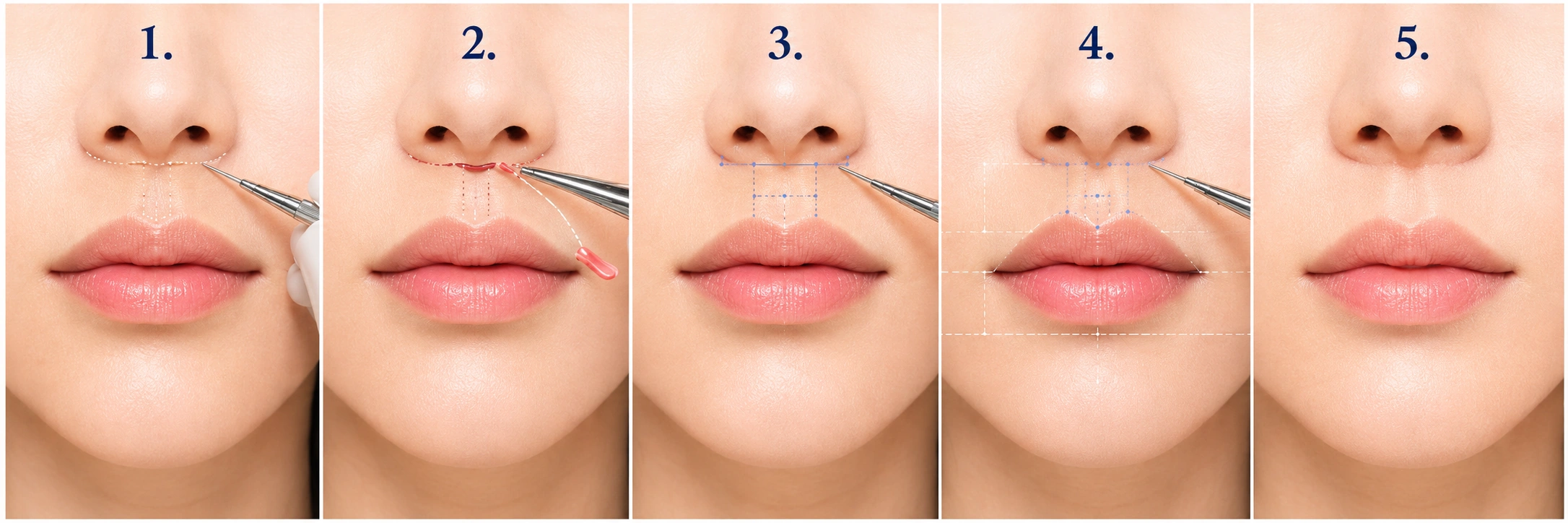
- Precise re-incision along the previous incision line — We use the existing incision line so as not to create unnecessary new scarring.
- Excision of scar tissue — Rather than simply re-suturing, we remove the deformed scar tissue itself, improving the scar's position, direction, and thickness together.
- Redesigning left-right symmetry — If asymmetry is present, we redesign the balance of the left and right sides from the very beginning.
- Comprehensive correction including the lip line — We analyze even the subtle proportional differences in the lip line that were overlooked in the first surgery, correcting the philtrum and lips as one harmonious flow.
- Micro-suturing & secure fixation — We finish with stable fixation to prevent recurrence, together with meticulous suturing that minimizes any trace.
Aftercare — It Determines the Result
Scar management after revision is even more important than after an initial surgery. Taping in the appropriate direction along the incision line can prevent the scar from widening. Because smoking impairs blood circulation and delays wound healing, we recommend refraining from smoking for at least three months after surgery, and ideally for six. To prevent the scar from hardening and protruding, periodic massage may be combined with scar-injection treatment when necessary.
An Honest Account of Expected Results and Limitations
Revision involves more demanding conditions than an initial procedure. In particular, because skin has already been removed in the previous surgery, cases of overcorrection — where the philtrum has become too short — leave little spare tissue to work with, and may be difficult to fully reverse. Some scarring may also remain because of the existing scar tissue; depending on the tissue's condition, the procedure may need to be carried out in stages; and the pace of recovery and the results vary from person to person. Dr.Tak proceeds only after precisely diagnosing the method of your first surgery and the condition of the scar, and honestly distinguishing for you between what can be reversed and what is difficult.