
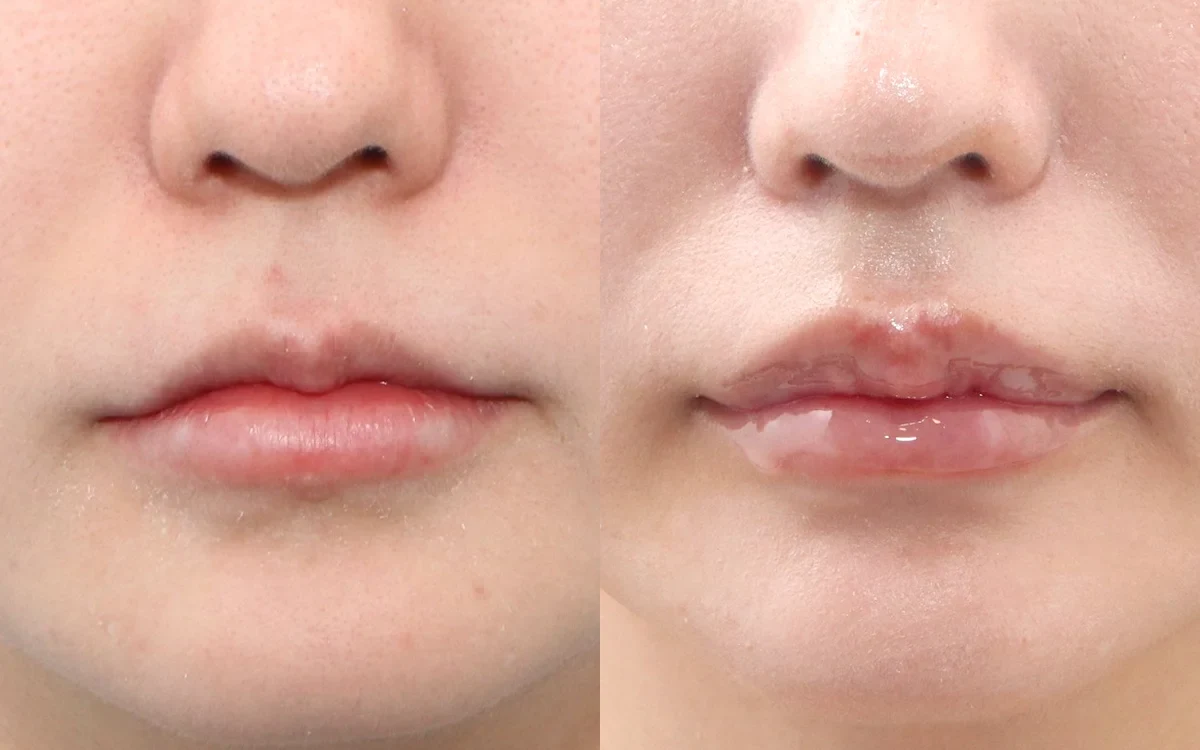
The lips are a key feature that shapes the overall impression of the face. At Dr.Tak Plastic Surgery, we find the most ideal lip line by considering each individual's facial harmony and beauty. Going beyond simply filling in volume, we draw out your hidden charm through delicate design and skilled technique.
Why Mucosal Advancement? — Addressing the Root Cause
Thin, inward-rolled lips are most often caused not simply by a lack of volume, but by a problem with the direction and position of the tissue that makes up the lips. That is why continually adding filler only increases the volume while the lips remain rolled in, producing an unnatural result. Dr.Tak's mucosal advancement solves the problem at its root by advancing the inner-lip mucosal tissue forward to widen the area of the red lip (vermilion) itself.
It gives the lips a plump, projected look that adds three-dimensional definition, and naturally increases the size and length of the lips to create fuller lips.
How Is It Scarless? — The Incision Stays Inside the Mouth
The lip is a three-layered structure: skin, the orbicularis oris (lip muscle), and mucosa. The red part we call the "lip" is the dry vermilion, while the moist inner surface you see when you open your mouth is the wet mucosa.
The incision for mucosal advancement goes into that wet mucosa only — a place that is out of sight once your mouth is closed. Neither the outer skin nor the border where skin meets the red lip is touched. That is why there is no externally visible scar after surgery, and why we call it scarless.
This is what sets it apart from the lip lift, which is often grouped together with it as "surgery to enlarge the lips." A lip lift is incised under the nose, so an incision line remains on the outside and, depending on your skin, the scar can be noticeable. With mucosal advancement the incision is entirely inside the mouth, so that burden does not apply.
- If you have been hesitating because you scar easily, this is particularly worth considering.
- The sutures are inside the mouth too, so they are not visible from the outside.
Filler vs. Mucosal Advancement — What's the Difference
Many people are torn between lip filler and mucosal advancement. The two approaches are fundamentally different.
- Filler is a method of 'filling' volume by injecting hyaluronic acid. The procedure is simple and recovery is quick, but it is usually absorbed within 6 months to 1 year, requiring repeat procedures and the associated cost. Over time it can migrate or spread, and if too much is injected the lips can look unnatural — the so-called 'duck lips.' In particular, if the lips are rolled inward, adding filler only increases the volume while they remain rolled in.
- Mucosal advancement (V-Y) is a structural surgery that 'moves the lip tissue forward.' By widening the area of the red lip (vermilion) itself, it creates natural, three-dimensional volume; the effect lasts a long time after a single surgery; and because it uses your own tissue rather than an external substance, there is little concern about a foreign-body sensation or migration.
In short, if you simply want to add a bit of volume, filler is suitable; if you want to fundamentally transform thin or rolled-in lips and maintain the result over the long term, mucosal advancement is the right choice. If your lips have become firm from repeated filler injections, you can achieve a more natural result by first removing the filler and then proceeding.
We Recommend This For You
- Those with naturally thin lips or a severe inward roll
- Those whose mouth appears relatively recessed due to skeletal structure, or whose lips look thin
- Those whose lips have become thinner or appear recessed after orthodontic treatment, two-jaw (orthognathic) surgery, or facial contouring surgery
- Those who have lost lip volume due to aging
- Those who have received repeated filler injections but whose lips have gradually become firmer while still appearing thin (mucosal advancement after filler removal is more effective)
- Those whose thin, sparse lips give a cold impression
- Those who want a more attractive, vibrant smile
E-Line Balance That Transforms Even Your Profile
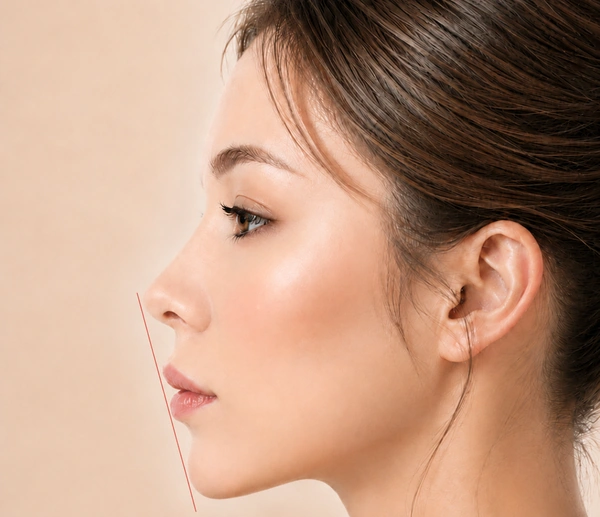
The lips shape the impression not only from the front but also in profile. The E-Line is the line that runs from the tip of the nose past the lips to the tip of the chin, and a profile is considered aesthetically ideal when this flow connects naturally. If the lips are skeletally recessed or thin, the profile can look flat or the mouth can appear sunken.
Mucosal advancement moves the lips forward to improve this profile balance. It is especially helpful for restoring overall balance when the internal structure has changed after orthodontic treatment, two-jaw (orthognathic) surgery, or facial contouring surgery, leaving the lips looking thinner or more recessed.
Mucosal Advancement, Not Philtrum Reduction, May Be the Answer
Some patients come in thinking about philtrum reduction because their philtrum looks long, but when we examine the oral and skeletal structure, mucosal advancement to bring the lips forward turns out to be more appropriate. Even when the outward concern looks the same, a different underlying cause calls for a different surgery. Rather than recommending whatever procedure is trending, Dr.Tak first determines 'why it looks that way' through accurate diagnosis and then proposes the most suitable method.
Surgical Method — V-Y Plasty
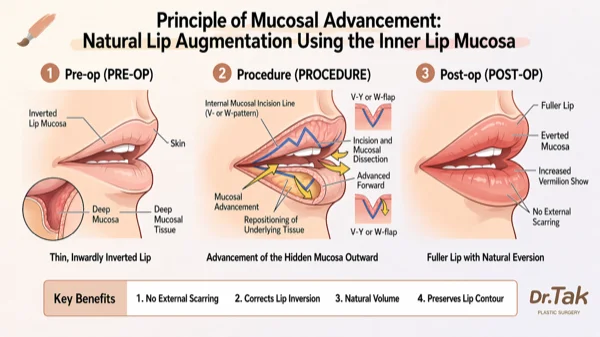
Mucosal advancement applies V-Y plasty, a foundational plastic-surgery technique, to the lips. Rather than packing anything into the lip, it draws the mucosa that had rolled inward back out, widening the area of the red lip itself.
Both the incision and the suturing take place in the mucosa inside the mouth. The hidden mucosa is advanced forward, and the line is refined with micro-suturing. How far to advance it and which parts to bring out more are planned at your consultation, matched to the horizontal width of your lips, the volume you want, and your overall facial proportions.
Because this repositions your own tissue rather than inflating the lip with a foreign material like filler, once you have healed the lips feel as soft as they always did.
Dr.Tak's Unique Design and Experience
Rather than applying a one-size-fits-all standard, we comprehensively analyze each client's face shape, features, and desired image to propose the most natural and harmonious lip design. Because the lips are an area where even the slightest change dramatically alters one's impression, we accurately understand the anatomical structure of the lips and operate with great precision. Drawing on more than 1,500 cases of specialized clinical experience with lips, we design for each individual's skeletal structure and desired impression — from the natural proportions of Korean patients, to the clean precision favored by Japanese patients, to the fuller volume preferred in Western countries. All instruments undergo strict disinfection, and through thorough sterilization and hygiene management we ensure that you can have your procedure in a safe environment.
Recovery After Surgery
Most of the major swelling subsides within 5~7 days, while fine swelling gradually disappears over 1~3 months. The sutures are removed after 7 days, and normal daily activities are possible. For 1 month after surgery, you should avoid strenuous exercise, saunas, and smoking, and it is best to eat mainly soft foods.
Honestly Sharing the Expected Results and Limitations
Mucosal advancement lasts a long time after a single surgery, but because it is not a procedure that can be 'dissolved and reversed' like filler, it is important to carefully decide on the desired volume through thorough consultation. Immediately after surgery, the lips may look somewhat thick due to swelling, and it takes time for the fine swelling to subside and for the lips to reach their final shape. It also does not prevent the natural aging that progresses with age, and the achievable volume varies from person to person depending on the original skeletal and tissue condition of the lips. Dr.Tak honestly explains what is possible and what is difficult before proceeding.