
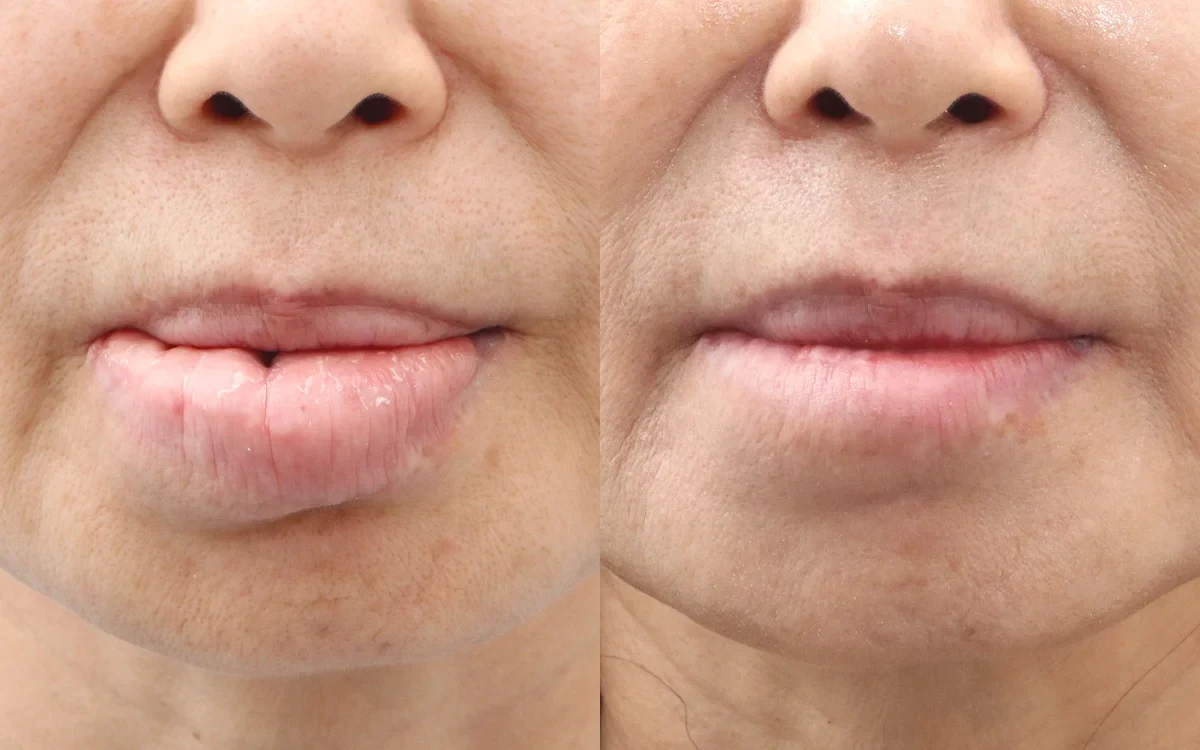
Non-absorbable substances such as silicone, Aquamid, and Aquafilling do not break down inside the body. They may look fine at first, but over time the lips often grow progressively harder, become painful, and even change shape. One study reported that the average time for complications to appear after foreign-material injection was 8.8 years. As a plastic surgery clinic specializing in the lips, Dr.Tak Plastic Surgery helps you reclaim healthy lips by removing non-degradable foreign material as safely as possible.
Which fillers are the "non-dissolvable" kind?
The method of removal differs completely depending on a filler's composition. The only fillers that dissolve with an enzyme (hyaluronidase) are hyaluronic acid (HA) fillers; all others must either be left to absorb over time or removed surgically. Non-dissolvable filler removal targets the non-absorbable and semi-permanent fillers listed below.
Permanent fillers (non-absorbable) — candidates for surgical removal
- Polyacrylamide gel (PAAG): Aquamid, Aquafilling — in the lips, these are prone to late complications such as clumping and migration years later.
- PMMA: Bellafill, Artefill — the microspheres remain permanently and carry a risk of granuloma and nodule formation.
- Medical liquid silicone — permanent, with a comparatively high risk of complications.
Semi-permanent fillers (not HA, so they will not dissolve with an enzyme)
- Calcium hydroxylapatite (CaHA, Radiesse), PLLA (Sculptra), PCL (Ellansé, etc.) — these are absorbed over time but cannot be dissolved with an enzyme. If problems such as clumping or nodules occur, surgical removal is considered.
If you have a hyaluronic acid (HA) filler, soluble filler removal using an enzyme is more appropriate, and if you have illegal foreign material such as industrial silicone or paraffin, illegal filler removal is the better fit. Even if you do not know which filler you received, we identify the type through examination and a review of your medical history and then decide on the approach.
100% complete removal may not be possible — we tell you honestly
Foreign material becomes intermingled with the surrounding tissue inside the skin, much like water soaking into a sponge. Just as you cannot pick out only the gravel from hardened concrete in which cement and gravel have set together, it is difficult to perfectly separate out only the foreign material that has seeped into the tissue. For this reason, Dr.Tak's surgical goal is "to remove as much of the foreign material as safely as possible." We clearly explain what is achievable and what is difficult, helping each patient approach surgery with realistic expectations.
Surgical methods — non-incision and incision
If the foreign material was injected relatively recently, it can sometimes be removed using a non-incision method. On the other hand, when the material has settled deep within the lips or has hardened into a granuloma, direct removal through a micro-incision is required. The key is to remove the foreign material while preserving as much normal tissue as possible. Because the lips are more vascular and more sensitive than other areas, we proceed carefully, one stitch at a time. When the volume is large or the spread is extensive, we do not push to do everything at once but remove the material in stages.
Why removing foreign material from the lips is especially demanding
The lips require a special approach unlike other areas of the face.
- Sensitive and highly vascular: There are many capillaries just beneath the skin and the tissue is thin, so removal calls for particular care.
- Functionally important: The lips are directly involved in speaking, eating, and facial expression, so preserving function is essential.
- Methods vary by area: For the cheeks or forehead, it is sometimes possible to dissolve the material with a laser and express it out without an incision, but for the lips — especially the inner lip — removal may require an incision depending on the location.
This is why the earlier it is detected, the greater the chance that even the inner lip can be treated without an incision, making early diagnosis important.
Dr.Tak's expertise in non-dissolvable filler removal
- Precise preoperative diagnosis: We carefully assess the location, volume, and distribution of the foreign material, as well as the degree of adhesion to surrounding tissue.
- Minimally invasive approach: We choose an incision site that minimizes scarring while still allowing effective removal.
- Selective, meticulous removal: We apply microsurgical techniques to selectively remove only the foreign material while preserving the surrounding normal tissue as much as possible.
- Staged removal: When the volume is large or the spread is extensive, we remove the material over several sessions for safety.
The process
- In-depth consultation & diagnosis — We assess the condition of the lips; the type, location, volume, and degree of adhesion of the foreign material; and your history of prior procedures, performing imaging studies as well when needed.
- Establishing the removal plan — We decide whether to use a non-incision or incision approach and whether removal should be done in stages.
- Removing the foreign material — We selectively remove the foreign material while preserving normal tissue.
- Follow-up & reconstruction if needed — We monitor recovery and, if there are changes in shape or volume, consider a reconstruction procedure.
What to know before surgery
- For safety, several staged surgeries may be necessary.
- Because some tissue is removed along with the foreign material, there may be changes in the shape or volume of the lips after surgery, and in some cases a reconstruction procedure may be needed following removal.
- During the recovery period, diligent care — taking antibiotics, refraining from smoking and alcohol, and avoiding irritation — is what determines the outcome.
Early detection and prompt action matter
Because complications from foreign material progress slowly, patients often do not notice any symptoms at first. If your lips frequently become chapped or cracked, if they swell whenever you are tired, or if a foreign-body sensation persists even more than a year after the procedure, be sure to consult a specialist. The longer time passes, the deeper the foreign material penetrates the tissue and the harder it becomes to remove, so the earlier it is detected and addressed, the wider your range of options and the better the outcome.
We recommend this for
- Those whose lips have grown progressively harder after receiving non-dissolvable fillers such as silicone or Aquamid in the past
- Those whose lip shape has become distorted or who experience a persistent foreign-body sensation after filler
- Those whose lips swell when they are tired, or who often experience chapping and cracking
- Those who still have discomfort more than a year after the procedure
- Those who wish to correct misguided past procedures and return to healthy lips
Dr.Tak's promise
Dr.Tak Plastic Surgery never exaggerates surgical results. Operating entirely by appointment, we take ample time to examine the condition of your lips in detail and ask carefully about your history of past procedures. Even after surgery is complete, we regularly check on your progress and carry out any additional care needed, staying with you to the very end until you have fully recovered and returned to everyday life.