
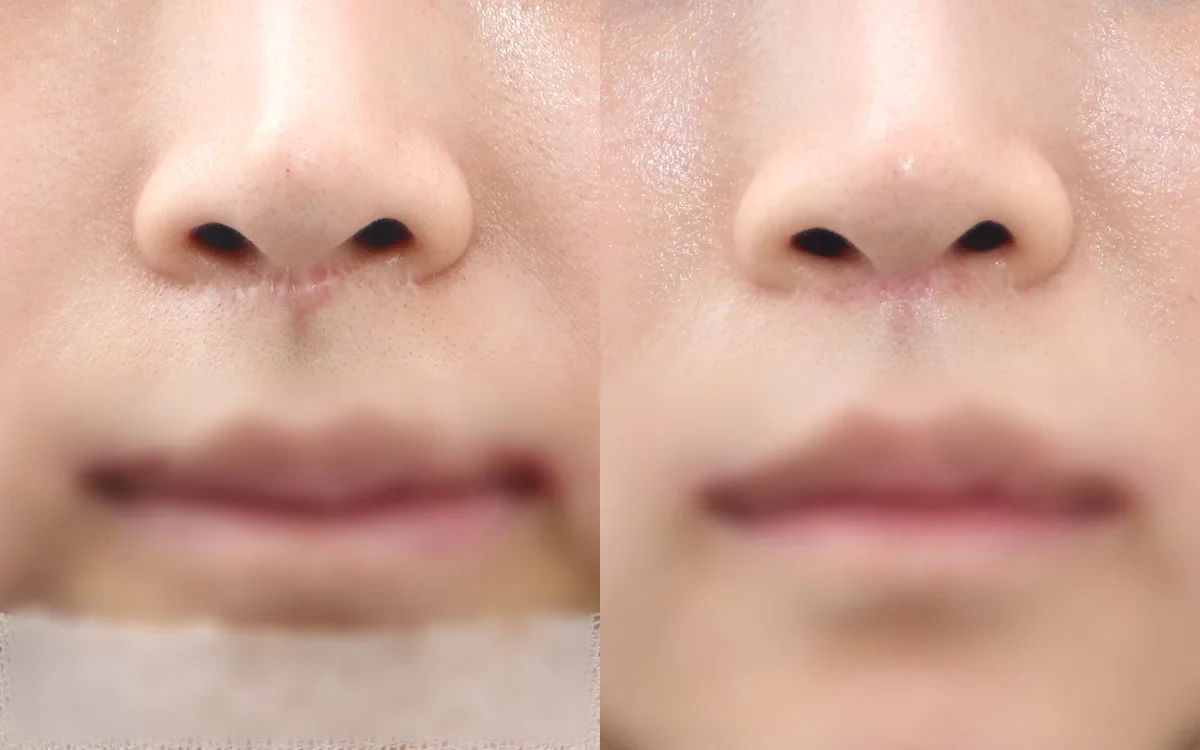
No matter how good a surgery is, satisfaction drops when the scar stands out. Dr.Tak precisely analyzes the scars from previous surgery and uses surgical and non-surgical methods together to minimize the scar and restore a natural skin texture. We recommend only the care you genuinely need, without overtreatment.
Who This Is For
- Those whose lip or philtrum incision scar stands out or remains red
- Those whose scar is firm and raised (hypertrophic) or looks sunken
- Those whose lip or philtrum line is pulled or looks asymmetric because of the scar
- Those with residual pigmentation at the scar site
- Those who want to improve only the scar after surgery at another clinic
Why Scars Stand Out — The Nature of Lip & Philtrum Scars
Scars do not simply disappear when you cut them out. The condition of a scar is determined by a few principles.
- Tension (the pulling force): When a force works to pull the scar apart perpendicular to the incision line, the scar tends to thicken and protrude. The area around the mouth in particular moves constantly while speaking, eating, and smiling, so tension is high — and with existing scar tissue and adhesions added on top, it becomes even more challenging.
- Maturation period: A scar is red and firm at first, then gradually matures to become softer and lighter, usually over a period of six months or more.
- Color: Because the lips are naturally a red area, managing the redness of the scar and changes in pigmentation is especially important.
- Smoking: Cigarettes impair blood circulation and are very detrimental to scar healing.
As a clinic specializing in the lips and philtrum, Dr.Tak Plastic Surgery performs the revision while taking the scar's texture, facial expression movement, and direction of tension all into account.
Dr.Tak's Principles of Scar Revision
- Precise scar analysis — We make a detailed diagnosis of the scar's shape, depth, color, degree of adhesion, and underlying cause.
- One-on-one cause-analysis consultation — We start by identifying why the scar became prominent (tension, aftercare, constitution).
- Setting realistic expectations — We honestly explain that the goal is not to "erase" the scar but to make it "less noticeable."
- Integrated surgical + non-surgical care — We combine micro-suturing with laser, scar (steroid) injection, and taping to elevate the outcome.
How We Revise Scars — Integrated Surgical and Non-Surgical Care
Depending on the condition of the scar, we use surgical and non-surgical methods either alone or in combination.
Surgical revision
For a scar that stands out or has widened, we excise the scar tissue itself and reorganize it with micro-suturing aligned to the skin texture and the direction of tension. The key is to improve the scar's position, direction, and thickness together.
Non-surgical care
- Taping: We tape in a direction that draws the incision line together, reducing tension and preventing the scar from widening. We generally recommend this for 3 to 6 months, for at least 12 hours a day, and discontinue it if dermatitis develops.
- Scar (steroid) injection: For a firm, raised scar, a steroid-class injection is given at monthly intervals over several months to soften the scar.
- Massage: Gently massaging along the incision line for about 10 minutes a day can help (do this after applying ointment).
- Laser: For a scar with residual redness or pigmentation, we manage the color with laser (usually at monthly intervals).
- Scar ointment & medication: A scar ointment or oral medication may be used as needed; for oral medication, we confirm whether it is suitable based on your individual condition.
When to Have the Revision
It is safe once at least six months have passed since the initial (first) surgery, when the scar has matured sufficiently. A red, firm early-stage scar is first managed with non-surgical care while we coordinate the timing.
Aftercare — It Determines the Outcome
With scar revision, aftercare during the recovery period determines the outcome as much as the procedure itself. We reduce tension with taping aligned to the direction of the incision line, and for a firm or red scar we consistently combine injections and laser. Because smoking delays healing, we recommend not smoking for at least 3 months, and 6 months if possible. Since UV rays worsen pigmentation, thorough UV protection is necessary throughout the recovery period.
An Honest Word on Expected Results and Limitations
A scar cannot be removed 100%. The goal of revision is not to "erase" the scar but to improve its position, direction, thickness, and color to make it "less noticeable." Results also vary widely from person to person. In particular, those whose constitution is prone to keloids or hypertrophic scars may see limited results, so we approach these cases more cautiously, and the degree of improvement also differs depending on the scar's location and tension. Because a scar matures over a period of six months or more, consistent care is needed, and in some cases several rounds of treatment may be required. Dr.Tak honestly distinguishes between what is achievable and what is difficult, explains it to you, and only then proceeds.