
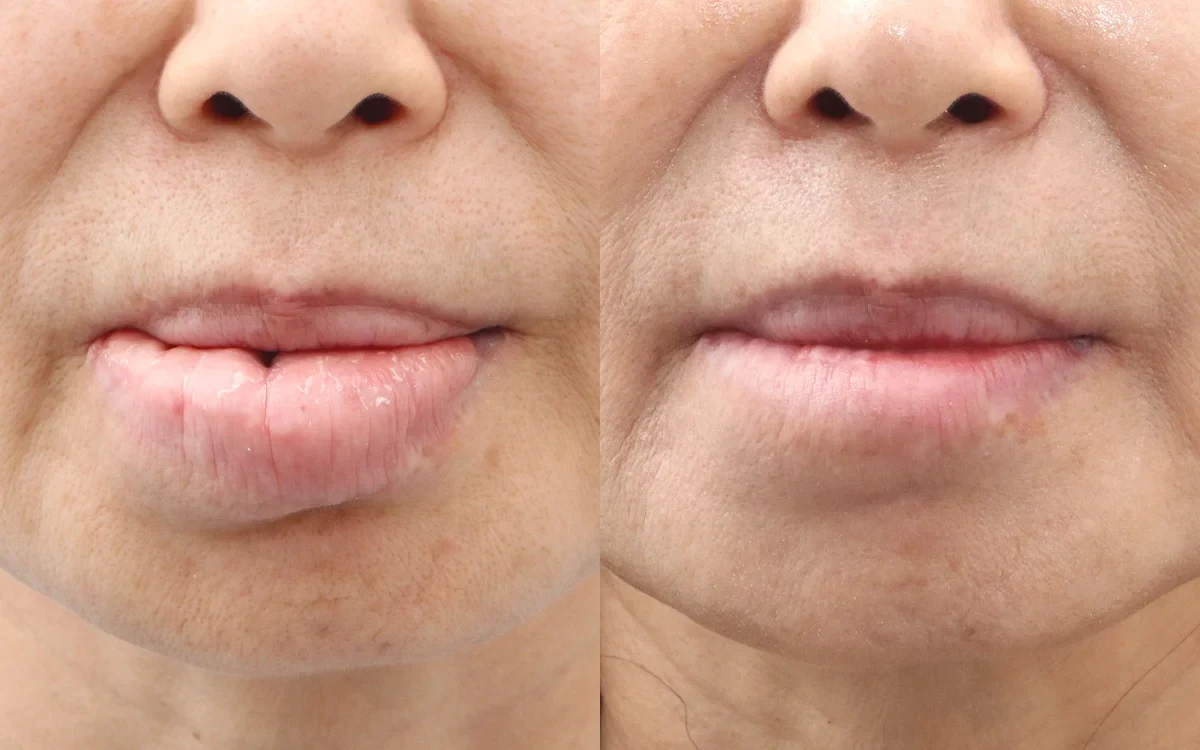
Hyaluronic acid (HA)–based soluble fillers are gradually absorbed over time, but they sometimes linger longer than expected or lead to side effects such as lumping or migration. Removal may be necessary in particular when the filler was over-injected or placed in an inappropriate area. As a plastic surgery clinic specializing in lips, Dr.Tak Plastic Surgery draws on extensive clinical experience to help you safely remove filler and restore naturally healthy lips.
Early Signs of a Foreign-Substance Reaction
A distinctive feature of the lips is that they cause little to no pain even when a foreign-substance reaction develops. However, when a side effect impairs blood circulation, the following symptoms may appear.
- Lips that crack frequently for no apparent reason
- Side-effect symptoms that progress slowly over several years
- Swelling that appears when you are tired or in poor condition
- Discomfort that persists even more than a year after the procedure
If you notice these signs, it is best to seek a consultation promptly. The earlier the problem is detected, the more safely it can be removed using a non-incision method.
First, We Confirm Exactly Which Type of Filler You Have
The key to soluble filler removal is the dissolving enzyme hyaluronidase — and this enzyme works only on hyaluronic acid (HA) fillers. Because the removal method differs completely depending on the filler's composition, the most important first step is to confirm exactly which type of filler you have.
1. Soluble fillers (hyaluronic acid / HA–based)
- Representative products: Juvederm, Restylane, Belotero, and others. As the most widely used fillers, they typically last 6–24 months.
- They can be dissolved and removed with hyaluronidase — these are the fillers covered on this page.
2. Semi-permanent fillers (non-HA compositions — not dissolved by the enzyme)
- Calcium hydroxylapatite (CaHA, Radiesse): mineral microparticles similar to the components of bone, lasting roughly 12–18 months.
- PLLA (Sculptra): a biostimulatory filler that stimulates collagen production, lasting about 2 years.
- PCL (Ellansé, etc.): a biostimulatory filler that helps stimulate collagen production.
- These are not dissolved by the enzyme; we either wait for them to be absorbed or, when necessary, approach them by other means.
3. Non-dissolvable (permanent) fillers (non-absorbable)
- PMMA (Bellafill, Artefill): the microspheres remain permanently and carry a risk of granuloma and nodules.
- Polyacrylamide gel (PAAG, Aquamid): in the lips it can cause late complications such as lumping and migration years later.
- Medical liquid silicone: permanent and tends to carry a high risk of complications.
- Because they are not dissolved by the enzyme, surgical removal is required → Non-Dissolvable Filler Removal
4. Illegal/industrial foreign substances (not for medical use)
- Industrial silicone, paraffin, petroleum jelly, cooking oil, and other substances not approved for medical use.
- They can cause serious side effects such as inflammation, tissue necrosis, migration, and paraffinoma, so removal is required as soon as they are discovered → Illegal Foreign-Substance Removal
Even if you believe you received an 'HA filler,' the actual substance may be different, or several substances may have been mixed together. For an accurate diagnosis, please be sure to tell us your history — when you had previous procedures, what was injected, and where you had it done. After examination and a review of your history, Dr.Tak determines the type, location, amount, and degree of adhesion of the filler and then selects the most suitable removal method.
How Soluble Fillers Are Removed — Non-Incision by Default, Incision When Necessary
Most soluble fillers can be removed without an incision.
- Hyaluronidase injection (non-incision, the first choice) — a method that dissolves the filler by directly injecting the enzyme that breaks down hyaluronic acid. It is relatively simple and quick and leaves little to no scarring. Depending on the amount and type of filler, several sessions may be required.
- Surgical removal (when necessary) — when the filler has clumped together or become encapsulated and does not dissolve well with the enzyme, removing it directly through a fine incision may be more reliable. We proceed while minimizing damage to the surrounding tissue.
Which method is appropriate is decided during the consultation based on the condition of the filler and the degree of adhesion.
The Process
- In-depth consultation & diagnosis — we check the condition of the lips and the type, location, amount, and degree of adhesion of the filler, along with your medical history.
- Allergy pre-test — we proceed after confirming whether you have an allergic reaction to hyaluronidase.
- Removal procedure — we remove the filler with a hyaluronidase injection (non-incision) or through a fine incision.
- Follow-up observation — we check for swelling and reactions and, if necessary, schedule additional sessions.
Advantages of Soluble Filler Removal
- Removal is relatively straightforward, and in many cases it can be done without an incision.
- The recovery period is short, so the return to daily life tends to be quick (usually 1–3 days).
- It leaves little to no scarring.
- The likelihood of side effects is relatively low.
- When needed, restoring firmness through skin lifting can also be considered.
Precautions When Using Hyaluronidase
- An allergic reaction may occur depending on the individual, so we proceed after a pre-test.
- Depending on the amount and type of filler, several sessions may be required.
- When the filler has penetrated deep into the tissue, complete removal may be difficult, so a step-by-step approach is needed.
- Temporary swelling or an inflammatory reaction may occur after the procedure, but it usually subsides naturally within a few days.
Post-Procedure Care
- Keep the treated area clean and, if you have been given a prescription, follow it exactly.
- Temporary swelling or redness may occur and usually subsides within a few days.
- It is best to avoid excessive stimulation (vigorous massage, hot compresses, etc.) during the recovery period.
- If you notice any abnormal symptoms, contact us immediately, and we will check your progress at the scheduled time.
Dr.Tak's Distinctive Expertise
Dr.Tak Plastic Surgery is a plastic surgery clinic specializing in the lips. Because we thoroughly understand the complex anatomical structure of the lips, the distribution of blood vessels, and even the movement of the muscles, we aim for foreign-substance removal that is both safe and reliable. Since every patient's lip condition and the type and distribution pattern of the filler are different, we find a removal method tailored to each individual's situation through precise diagnosis rather than a one-size-fits-all approach. We comprehensively analyze factors such as the location and amount of the foreign substance and its degree of adhesion to the surrounding tissue to choose the safest and most effective method.
We Recommend This For
- Those who feel that hyaluronic acid filler placed previously seems to be hardening
- Those whose lips frequently chap or crack
- Those whose lip shape has become unnatural after filler
- Those who want to naturally dissolve their filler and return to their original lips
- Those who want a non-incision procedure with fast recovery
An Honest Word About Expected Results and Limitations
Soluble fillers can be removed relatively safely, but there are a few things it is best to understand in advance.
- When the filler has soaked deep into the tissue or is old, it may not be completely removed in a single session, so several sessions may be required.
- Because hyaluronidase works only on HA fillers, if other substances are mixed in, the enzyme alone has its limits.
- After removal, the lip shape may change as the volume that had been filled by the filler decreases, and when necessary, restoring firmness or an additional procedure can be considered.
- There are individual differences, such as enzyme allergies, so we prioritize safety through a pre-test and a step-by-step approach.
Dr.Tak proceeds only after accurately diagnosing your condition and fully explaining the expected results and limitations.