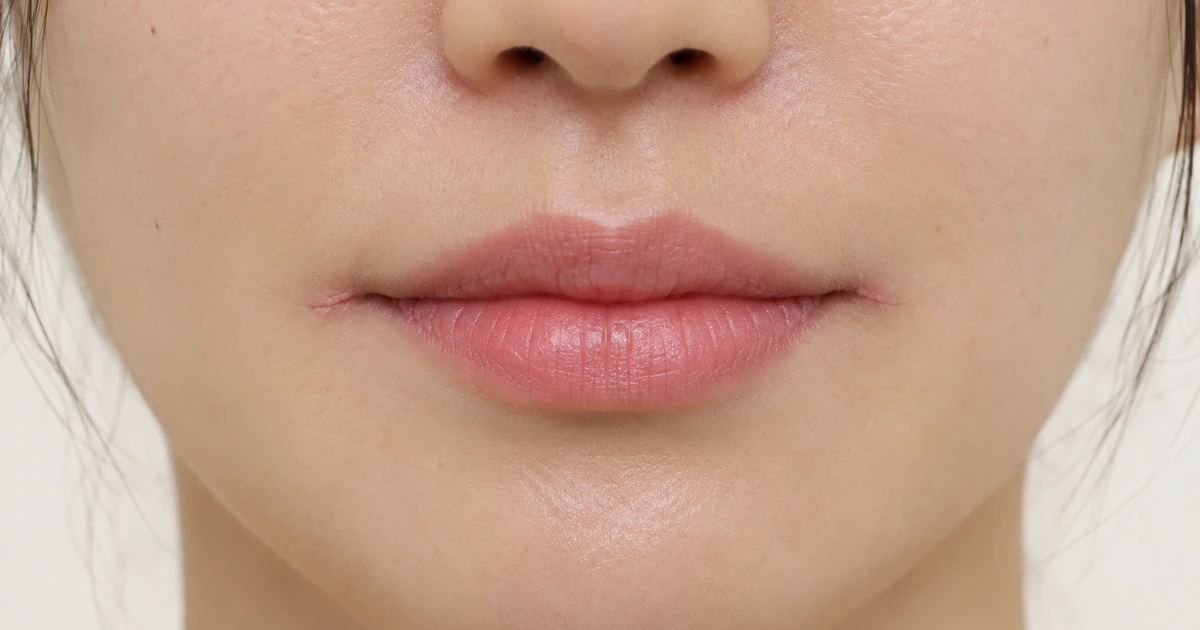
"Will the line under my nose still show after a year?" — the question I hear most before surgery
You are sure you want a shorter philtrum, yet one line under the nose has probably kept you hesitating for months, maybe years. Search for "lip lift surgery scar" and you find regret stories mixed with reassuring ones, and the more you read, the more confusing it gets.
When I am asked this in consultation, there is one thing I do first. I hand you a mirror and touch the shadowed crease that already sits under the base of your nose. In most lip lifts the incision is hidden inside that shadow. Then I explain, date by date, how that hidden line changes over time.
This article follows the same order. We will look at exactly where a lip lift scar forms, follow how it changes from surgery day to one year, see why some scars widen or sink, and separate healing you can wait out from signs that need a consultation.
Let me be honest about one thing up front. A scar never becomes zero. What you can control is how much less visible it becomes — and more of that is decided in advance than most people expect.
What exactly is a lip lift scar — a fine line in the crease under the nose
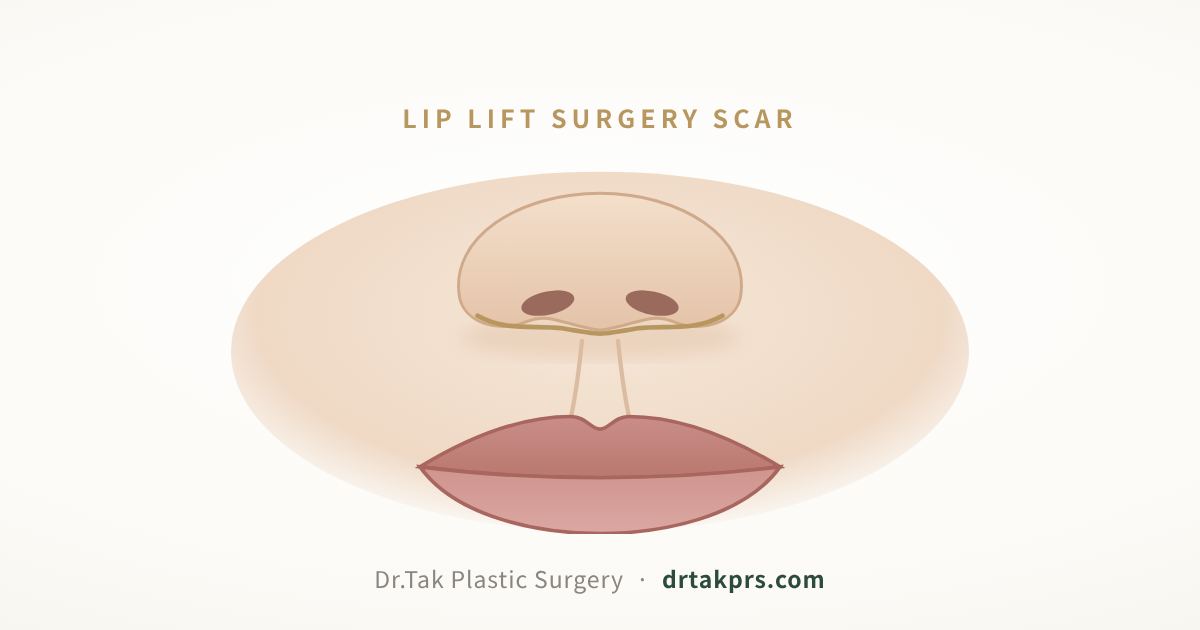
To put it simply, a lip lift surgery scar is the line left where a strip of skin under the nose was removed and stitched, running along the crease under the columella and around the rims of both nostrils. From the front it is mostly hidden in the shadow of the nose tip; it shows most when you tilt your head back or when someone looks up at you.
The procedure goes by several names. In Korea it is called philtrum reduction (injung-chukso) or philtrum shortening; in English it is a lip lift, subnasal lip lift, or, after the shape of the incision, a bullhorn lip lift. All of them leave a scar in the same place. If you add a corner lip lift to raise the mouth corners as well, there is one more short line above each corner of the mouth — worth keeping in mind.
The scar usually runs from one nostril base to the other, rarely wider than the nostrils. Right after stitching it is as thin as a thread, but it does not stay the same for a whole year.
That change is where most of the misunderstanding comes from.
From surgery day to one year — this is how the scar changes
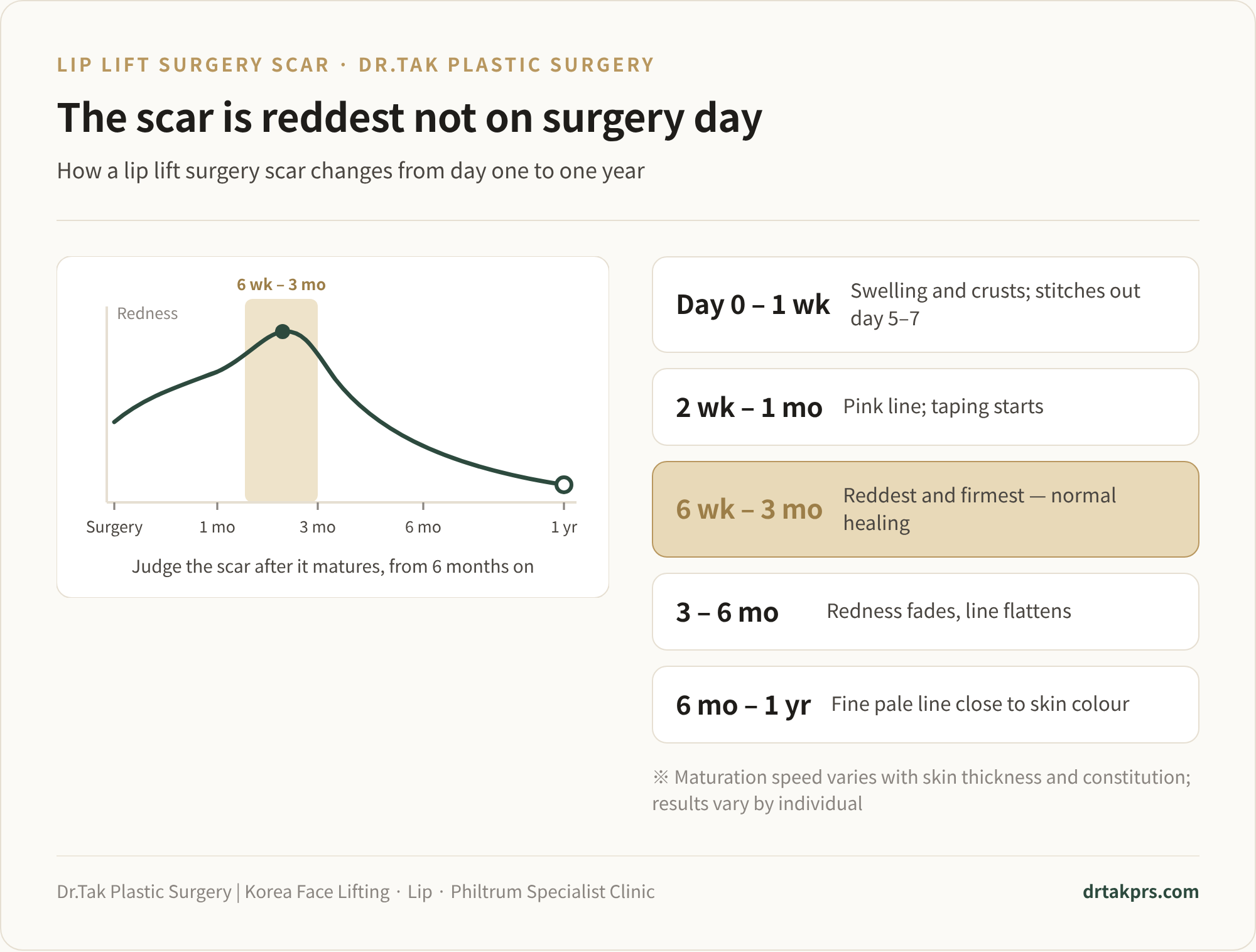
To put it simply, a lip lift scar looks its reddest and firmest not right after surgery but between 6 weeks and 3 months. After that the redness fades and the line flattens, and around one year it usually settles into a pale line close to your skin colour.
| Stage | What the scar looks like | Care at this stage |
|---|---|---|
| ⏱ Day 0 to 1 week | The stitch line is swollen and crusted. The whole area under the nose is puffy, so the philtrum can even look too short | Wound cleaning, stitches out around day 5–7 |
| ⏱ 2 weeks to 1 month | Stitch marks disappear and a pink line remains. A pulling feeling when you smile | Start control taping, sun protection |
| ⏱ 6 weeks to 3 months | The line is at its reddest and firmest. It may itch or rise slightly | Continue taping; scar-softening injections or laser if needed |
| ⏱ 3 to 6 months | Redness fades and the line flattens. Makeup covers most of it | Finish the six-month intensive care |
| ⏱ 6 months to 1 year | Matures into a fine pale line close to skin colour | Check progress, decide whether revision is needed |
※ Scar maturation depends on skin thickness and constitution, and in some people the line keeps fading slowly for up to a year and a half.
There is a reason I always show this table before surgery. Many people are relieved right after the stitches come out — it looks better than they feared — and then contact us in alarm about a month later when the line turns redder. The scar is not getting worse; this is the stage when new tissue is being made most actively.
People who know about this stage in advance and people who meet it unprepared feel completely different anxiety looking at the very same scar.
📍 Bottom line: The scar you see at 2–3 months is not the final scar. The judgement is made after six months.
So why, after the same surgery, is the line almost invisible for some people a year later, and wide for others?
A 1:1 consultation you can start right now
✅✅ Before a lip lift, we compare incision placement, whether to add a corner lip lift, and non-incision options for the structure under your nose
✅✅ We give you an honest opinion, whether or not you choose surgery
📲 Chat icon at the bottom right of the Dr.Tak Plastic Surgery official site → live consultation
Three reasons a scar stays — tension, incision placement, constitution and care
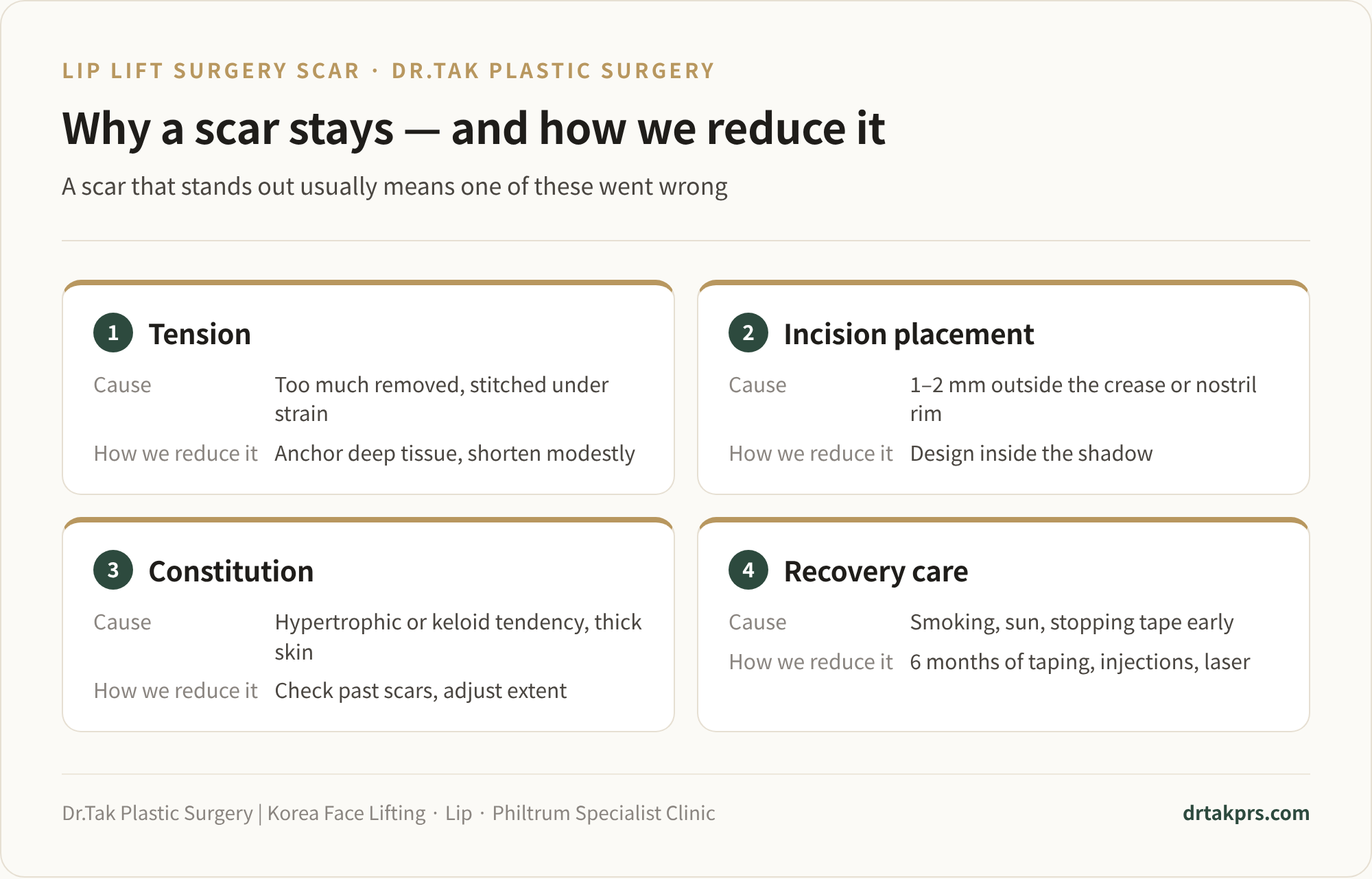
When a scar widens or sinks, there is usually a reason. Looking at people who come to us because of a scar from surgery elsewhere, the cause almost always falls into one of these three.
① Tension — remove a lot and pull hard, and the line spreads
Remove a wide strip of skin to shorten the philtrum a lot, and the stitch line is pulled up and down constantly. When that pull lasts for months, a thin line slowly spreads into a wide scar. So I do not rely on the skin alone: I anchor the deeper tissue first so it shares the tension, and I do not get greedy about how much to shorten.
② Incision placement — step outside the shadow and it shows
The crease under the columella and the rims of the nostrils are naturally shadowed. If the incision drifts even 1–2 mm out of that border onto brighter skin, the line is far easier to see. If it goes too deep into the nostril, the nostril shape can look pulled instead. Where the incision is placed is covered separately in incision placement that keeps lip surgery scars less visible.
③ Constitution and care — the same stitching heals differently
Scars thicken more easily in people prone to hypertrophic scars or keloids, in thick, oily male skin, in smokers, with sun exposure during recovery, and when taping is stopped too early. Surgical skill alone cannot prevent all of this, so in consultation I always ask about scars from earlier surgery or from ear piercings.
To be honest, even when all three are handled well, a scar does not become zero. But a scar that stands out is usually the result of one of these three going wrong.
Healing you can wait out, and signs that need a consultation
To put it simply, a red, firm scar within the first three months is usually normal healing you can wait out; a scar that keeps thickening or widening after six months is a sign to get it checked.
Healing you can wait out
✅ The line stays pink or red until around three months
✅ The area under the nose pulls when you smile and feels firm to the touch
✅ It itches now and then, rises slightly, then gradually flattens
Signs that need a consultation
⚠️ After six months the line is getting thicker or raised rather than flatter
⚠️ The line has become noticeably wider than at first, or has sunk in and casts a shadow
⚠️ One nostril looks lifted, or the two sides have become different in shape
⚠️ The scar spreads beyond the incision line and keeps growing (possible keloid)
If any of these apply, do not wait for the next appointment — send photos and consult first. What can be settled with injections or laser when seen early can, if left late, end up needing revision surgery.
Making the scar less visible — what to do, and when
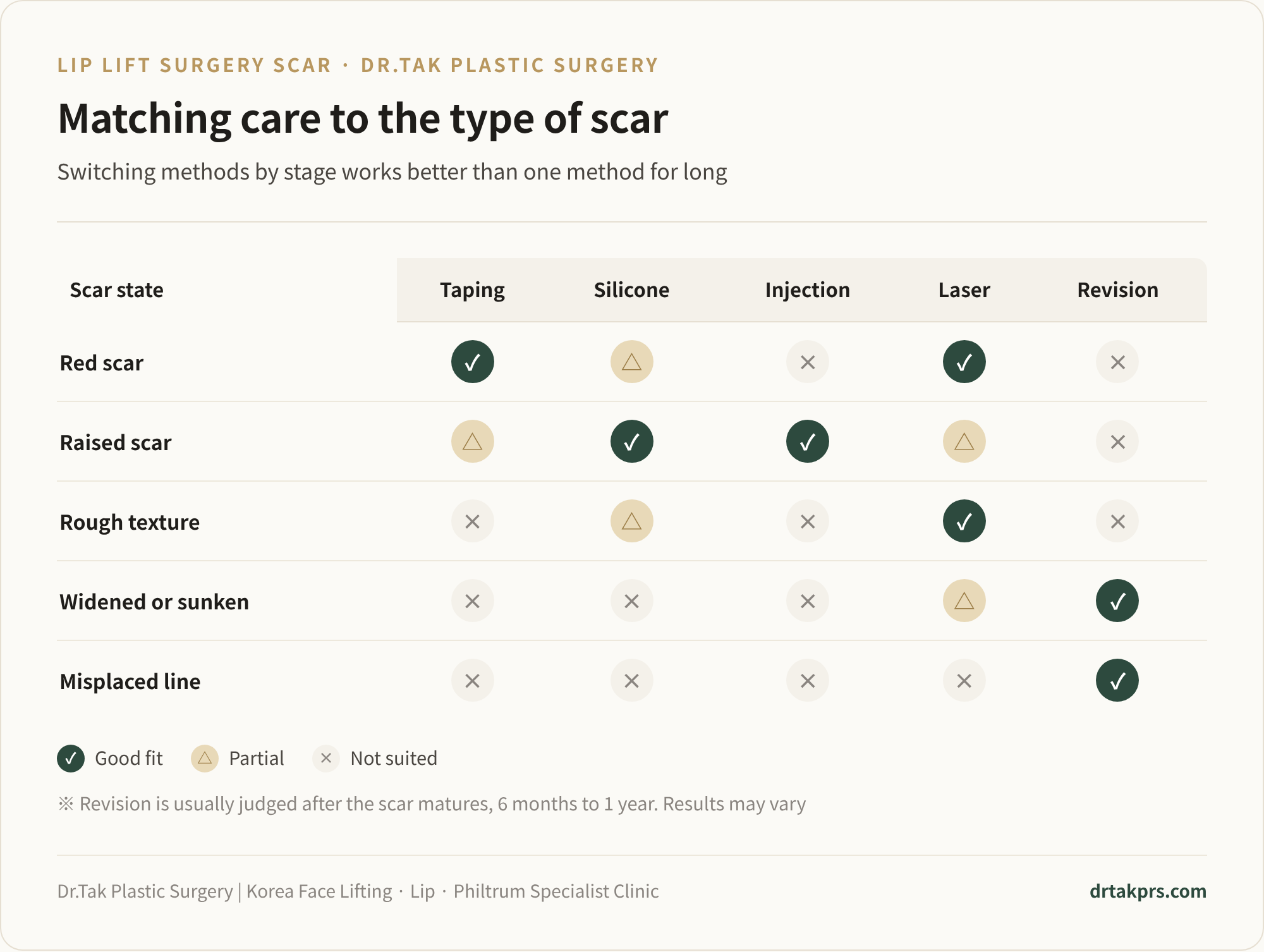
There are several ways to manage a scar, but each has its own starting time and suits a different kind of scar. Switching methods as the stages change works better than doing one thing for a long time.
| Item | Control taping | Silicone gel or sheet | Scar-softening injection | Laser | Scar revision surgery |
|---|---|---|---|---|---|
| Purpose | Spread tension so the line does not widen | Keep moisture in to flatten the scar | Settle a raised scar | Improve redness and texture | Re-stitch a wide or sunken scar |
| When to start | Right after stitch removal | Once the wound has closed after stitch removal | When it starts to rise (usually after 1 month) | Usually after 1 month | Usually after 6 months to 1 year |
| Duration | 3–6 months | 3–6 months | Once a month, several sessions | Several repeated sessions | One operation + aftercare again |
| Suited to | Every scar (baseline) | Every scar (supporting) | Raised scars, early hypertrophic scars | Red scars, rough-textured scars | Widened, sunken or misplaced scars |
| What it cannot do alone | Fix a scar that has already widened | Flatten a thick scar | Narrow a widened scar | Lift a sunken scar | Prevent recurrence of constitutional keloid |
| Pain or discomfort | Almost none | Almost none | Injection pain | Stinging | Surgical recovery |
| Back to daily life | Immediately | Immediately | Immediately | 1–3 days of redness | About 1 week until stitches out |
| Watch out for | Stopping too early | Applying consistently | Too much can cause a dip | Sun protection is essential | The cause (tension, placement) must be corrected too |
| Included in Dr.Tak six-month care | Included | Advised when needed | Included | Included | Separate consultation |
📍 Bottom line: For the first six months, taping is the baseline with injections and laser added; revision surgery is decided after the scar has fully matured, together with its cause.
Hiding a line within a millimetre — a principle kept for over 15 years
The time I spend thinking hardest about a lip lift is not during surgery but in the design before it. I draw the line along the shadow under the columella and the rims of the nostrils, and check again and again whether it sits even 1 mm further inside that shadow. If a single line strays out of the shadow, the impression a year later changes.
The amount to shorten follows the same principle. The more you shorten, the more tension there is, and the more tension, the wider the scar. So between the length you want and the length the scar can hold, I lean a little toward the scar.
🏥 Briefly, here is why we can keep this principle.
Over 15 years of experience focused only on this area as a lip and philtrum specialist clinic in Korea
200+ Google reviews, rated 5 out of 5 — covering not only results but also the aftercare process
We manage the scar ourselves for six months after surgery with taping, injections and laser
For anyone worried about scarring, we check skin constitution before talking about a surgery date
💬 "To make people smile." For anyone who has smiled with their head down because of the line under the nose, this sentence is a promise that includes scar care.
Before & after photographs are on our official page
Dr.Tak Plastic Surgery complies with medical advertising regulations, so we do not place before-and-after photographs inside blog articles. Actual pre- and post-operative changes are collected on the official before & after page.
🔗 View before & after — Dr.Tak Plastic Surgery official page
Results may vary from person to person.
Dr.Tak 4S Patient Care System — focused on people, not procedures
We focus on people, not procedures.
Solution — 1:1 master plan with Chief Director Dr. Tak Seung-wan
- Sincere empathy and communication: your wishes fully reflected in the surgery
- Precise golden-ratio facial analysis (personalised): philtrum length, the position of the crease under the columella and your scarring tendency are checked to plan the incision line and the amount to shorten
- Simulation of the expected post-operative change
Support — Global 1:1 dedicated coordinator
- A dedicated coordinator assigned for each country (no language barrier)
- With you through the whole process, from consultation to surgery to aftercare
- 100% advance reservation (private clinic environment)
Scar Care — 6-month intensive scar management
| Care item | Period | Details |
|---|---|---|
| Control taping | 3–6 months | Prevents the scar from widening |
| Scar-softening injection | 6 months (once a month) | Softens raised scars |
| Laser treatment | 6 months | Reduces redness at the surgical site |
Service — 1-year free A/S guarantee
- Free A/S within 1 year after surgery
- Care that takes responsibility to the end
- ※ A basic anesthesia fee may apply if sedation is used
Want to know more? — Official channels
🌐 The Dr.Tak Plastic Surgery official website has detailed guides for each lip and philtrum procedure
📝 The blog collects articles by procedure, including lip lift types, V-Y advancement and mouth corner correction
📹 Videos show the surgical process and the recovery course
Five things to sort out before deciding on surgery
✅ Has a scar ever healed thick at an earlier surgery or wound? — ear piercing and C-section scars are useful references too
✅ How much do you want to shorten, and is that amount worth trading for a scar? — look at the length you want and the safe length together
✅ Do you also want to raise your mouth corners? — adding a corner lip lift adds another line
✅ Can you stop smoking before and after surgery? — it affects the scar most directly
✅ Can your schedule hold 6 weeks to 3 months, when the scar is reddest? — tell us about any important dates
You do not need answers to every item. Anything you are unsure of, we can check together in consultation.
Frequently Asked Questions (FAQ)
These are the questions Dr.Tak Plastic Surgery hears most often.
Q1. My lip lift scar has sunk or widened — can it be fixed?
In most cases, yes. A widened or sunken scar is narrowed by revision — removing the scar tissue and re-stitching it with less tension — and the reason the scar widened in the first place has to be corrected at the same time, or the same thing happens again. I usually judge the timing of revision after six months to a year, once the scar has matured enough. However, if the philtrum has already been shortened a lot and little skin slack remains, I may first recommend refining the texture with laser or injections rather than cutting again.
Q2. When should laser for the scar start, and how many sessions are needed?
It often starts around one month after surgery, once the wound has fully closed and redness appears. A laser that reduces blood vessels suits red scars, and one that supports skin renewal suits rough-textured scars, so the type changes with the state of the scar. There is no fixed number of sessions; within our six-month care period we adjust the interval according to how the scar responds. During laser treatment, sun protection is essential so no colour is left behind.
Q3. Does adding a corner lip lift make the scar more visible?
It does add another line. A corner lip lift places a short incision just above each corner of the mouth, and unlike the area under the nose, this spot is not hidden in shadow, so it can be easier to see without makeup. That is why I recommend it only to people whose mouth-corner shape truly needs to change together, and if only the corner angle is the issue, I suggest other approaches first. The incision differences by method can be seen with illustrations in a comparison of bullhorn, Italian and corner lip lift types.
Q4. I have read many lip lift regret stories — is it mostly because of the scar?
I fully understand how unsettling it is to read those stories. Among people who come to us after surgery elsewhere, though, it was more often shortening too much — so the upper lip looks flipped up or too much of the teeth show — that led to bigger regret than the scar itself. The scar and the change in appearance actually share the same root. The more you shorten, the greater the tension, the wider the scar, and the more unnatural the lip shape. So in consultation we first look together not at how much you want to shorten, but at how much is natural.
Q5. Can I have a lip lift if I scar easily? How is the cost decided?
Scarring easily does not automatically rule you out. But for people who have actually developed a keloid, or whose wounds always heal raised and thick, I do not recommend incision surgery straight away; I check earlier scars first, then reduce the extent of surgery or compare other options. I cannot state an exact price; the range depends on how much is shortened, the incision type (standard or bullhorn), whether a corner lip lift is added, whether it is a revision, and whether sedation is used. We confirm these conditions in consultation first, then give you the range.
Dr.Tak Plastic Surgery | Korea Face Lifting · Lip · Philtrum Specialist Clinic
"To make people smile"