
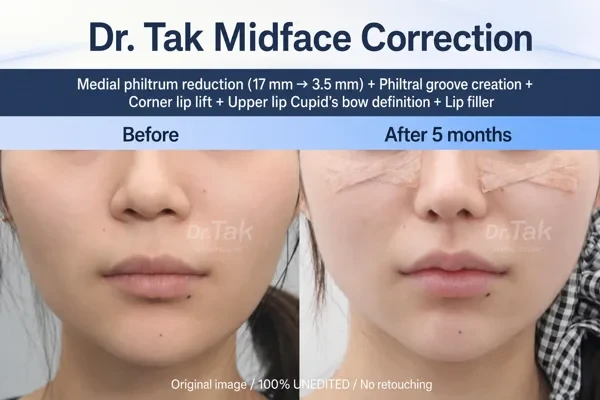
What you fear most is a knife mark staying for life
When you research lip surgery, the thing that holds you back to the very end is rarely the result or the cost. It is one sentence: "What if the scar shows?" It sits in the center of your face, on a spot that moves every time you talk or smile.
I have spent more than 15 years in Korea focused on nothing but lips and the philtrum. The expression I meet most often in my consultation room is exactly that anxiety. I have seen many people put off surgery for years over a single online photo of a "knife scar above the lip."
But those photos have one thing in common. The scar almost always sits in the same place. That is no coincidence.
Let me say it plainly: in lip surgery, whether a scar shows is not luck — it depends on where the incision is placed. Today I will walk you through that principle from start to finish. If scar fear has made you postpone, please read to the end.
Why scars show on some people and not others — the decisive skin-versus-mucosa difference
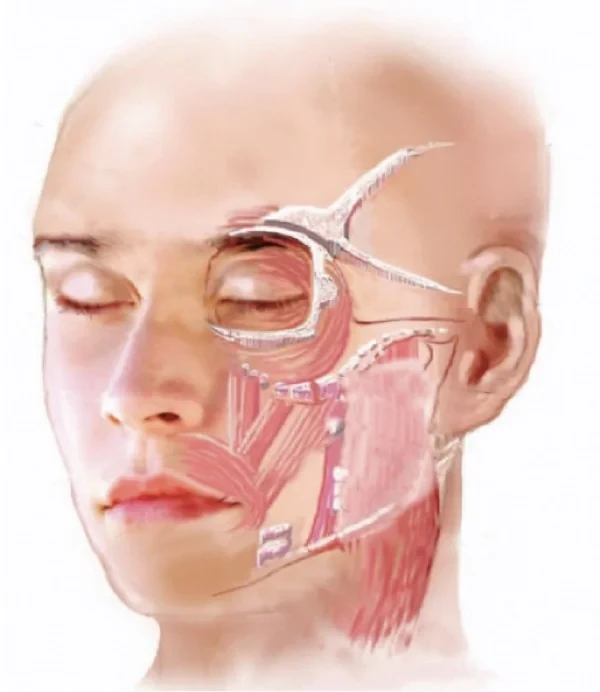
Even with the same lip surgery, some scars are nearly invisible while others stand out. To understand this, you first have to know that the lip is actually made of two kinds of tissue.
The lip is where three zones meet: ① the ordinary outer skin, ② the red lip body (vermilion), and ③ the moist mucosa inside the mouth. How visible a scar becomes depends entirely on which of these is cut.
Skin is the tissue where scars show most. It reflects light, pigments easily, and above all it faces forward. The inner mucosa? It is always wet with saliva, regenerates quickly, and — most importantly — disappears from view the moment you close your mouth. The same scar, placed either on stage or backstage.
So in consultations I always say: designing the scar into a hidden place comes before "erasing" it. This is the first principle you must understand before deciding on surgery.
How scars differ by type of lip surgery
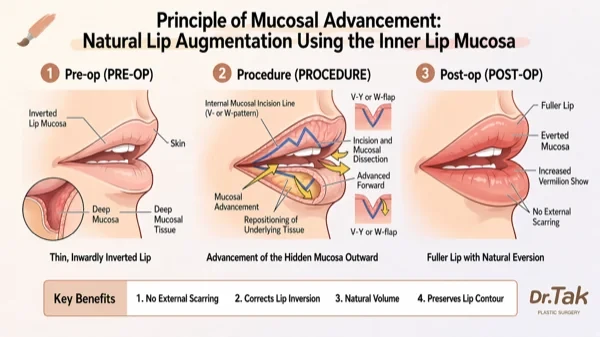
"Lip surgery" is not one operation but a family of procedures with different goals. So the scar story must be told by type. The table below summarizes the incision location and scar traits of the main lip procedures.
| Comparison | Lip augmentation (mucosal advancement) | Lip reduction | Lip lift (philtrum) | Corner lift | Lip filler (non-surgical) |
|---|---|---|---|---|---|
| Main goal | Make thin lips fuller | Make thick lips slimmer | Shorten long philtrum, show upper lip | Correct downturned corners | Temporary volume |
| Incision site | Inner mucosa | Inner mucosa | Crease under the nose | Corner mucosa/border | None |
| External scar | Almost none | Almost none | Hidden in nose crease | Along the lip corner line | None |
| Scar visibility | Very low | Very low | Low (location-dependent) | Low | N/A |
| Permanence | Permanent | Permanent | Permanent | Permanent | 6–12 months |
| Feel | Natural tissue kept | Natural tissue kept | Natural | Natural | Possible foreign sensation |
| Recovery | About 2 weeks | About 2 weeks | About 2 weeks | About 1–2 weeks | Almost none |
| Swelling | Peaks 1–2 weeks | Peaks 1–2 weeks | 1–2 weeks | 1 week | 1–2 days |
| Scar care needed | Mucosa-focused | Mucosa-focused | 6-month skin care | 6-month skin care | None |
The table makes one thing clear: many lip procedures that work on the lip body place the incision inside the mouth, in the mucosa. There is simply no structure for a knife mark on the outside.
📍 Bottom line: The "knife scar above the lip" people picture usually appears when an under-the-nose incision is poorly designed in a procedure that also addresses the philtrum. Augmenting or reducing the lip body happens inside the mucosa, far from any front-facing scar.
The medical reason a mucosal incision hides scars
So why is an inner-mucosa incision so favorable for scars? It is not only "because you can't see it." The mucosa itself has properties that fade scars.
① It heals fast. Oral mucosa is one of the fastest-healing tissues in the body. The faster it closes, the less room thick scar tissue has to settle in.
② It sees no UV light. A big reason skin scars turn red or dark is pigmentation, and inside the mouth no sunlight reaches it, so that process never starts.
③ It stays moist. The key to scar care is keeping a wound moist. The mucosa is always bathed in saliva, so the ideal scar environment is maintained naturally, with no extra effort.
On top of this, I design the incision line inside a mucosal fold that tucks away naturally when the mouth is closed — so that even if a scar forms, it hides in that fold. In the end, location is everything.
One thing I must say honestly, though: a mucosal incision does not make the scar "zero." Scars cannot be medically erased completely. But they can be placed where they are unseen, and made as faint as possible. Knowing the difference between these two is where a wise decision begins.
A 1:1 consultation you can start now
✅✅ We compare and explain the scar and incision location of every lip procedure before surgery, and give you an honest opinion whether or not surgery is involved
📲 Tap the chat icon at the bottom right of the official Dr.Tak Plastic Surgery website for a live consultation
The time when scars fade most — the 6-month recovery
Many people see only the scar right after surgery and feel disappointed. But a scar is the product of time. Its first appearance is not its final one.
Below is the typical timeline of how a lip surgery scar settles, based on a mucosal incision.
| Period | Condition | Care / notes |
|---|---|---|
| Day 0–3 | Swelling, slight bleeding, awkward speech | Cold compress, avoid irritating food |
| Day 4–7 | Swelling peaks, then begins to fade | Suture care, soft diet |
| Week 1–2 | Over 70% of swelling gone, sutures removed | No smoking or alcohol |
| Week 3–4 | Talking and eating feel natural again | Avoid opening the mouth too wide |
| Month 2–3 | Scar tissue begins to mature | Massage may begin (if directed) |
| Month 6 | Scar largely faded and stabilized | Final result assessment |
Over 70% of swelling resolves within two weeks. That is why I always urge patients not to judge the result within those first two weeks. The real result shows at six months.
At suture removal, I often see patients look in the mirror and relax, saying it looks more natural than they expected. That look of relief is why I keep doing this work.
Same surgery, different result — why Dr.Tak obsesses over scars
If you have read this far, one question must arise. If a mucosal incision is so favorable for scars, why do some clinics' results still leave a clear mark?
The difference lies in the details. Even with the same mucosal incision, the scar at six months changes completely depending on ① the depth and angle of the incision, ② how many layers and what suture material are used, and ③ how much tissue tension is relieved.
In the suturing stage I spend a lot of time dispersing tension not only at the mucosal surface but in the muscle layer beneath it. Stitch only the surface and it looks clean at first, but the inner tension remains and the scar widens over time. This single step decides the outcome.
💬 "Lips and the philtrum, for over 15 years. I take more pride in a result so scar-free that no one knows there was surgery than in any dramatic change."
More than 15 years focused on the lip and philtrum region, and over 190 Google reviews near a perfect 5 out of 5 — I believe these are the result of an insistence on exactly these invisible details, here in Korea.
The Dr.Tak 4S Patient Care System
We focus on the person, not the procedure.
Solution
Lip surgery has no single right answer. Looking at overall facial proportion, lip-philtrum balance, and skin and mucosa condition together, we design the option — augmentation, reduction, lip lift, or filler — with the lowest scar burden.
Support
From pre-surgery anxiety to recovery, we make it easy to ask anything through chat at any time.
Scar Care
This is what we care about most in lip surgery. We keep the scar in mind from the incision-design stage, and guide stage-by-stage scar care through recovery.
| Care period | Key care |
|---|---|
| 0–2 weeks | Keep moist, block irritation, no smoking/alcohol |
| 3–4 weeks | Check suture-site stability |
| 1–3 months | Scar massage (if directed), sun protection |
| 4–6 months | Assess scar maturity, extra care if needed |
Service
The same medical team follows you consistently, from consultation to recovery checks.
Want to know more — official channels
🌐 Official site: find lip and philtrum surgery information at drtakprs.com
📝 Live consultation: message us directly via the chat icon at the bottom right of the website
📹 We regularly share surgical cases and recovery on our official channels
Five things to sort out before deciding on surgery
✅ Have you clarified whether you want to change lip "size," "shape," or "length (philtrum)"?
✅ Have you decided between temporary change (filler) and permanent change (surgery)?
✅ Are you ready to confirm in consultation whether the scar sits in the inner mucosa or the outer skin?
✅ Have you allowed for the roughly two weeks of recovery in your schedule?
✅ Do you have the patience to judge the result at six months, not right after surgery?
If any of the five gives you pause, that is exactly what to ask about first in your consultation.
Frequently Asked Questions (FAQ)
Here are the questions we receive most at Dr.Tak Plastic Surgery.
Q1. Is a lip surgery scar really invisible from the outside?
Augmentation and reduction of the lip body place the incision in the inner mucosa, so when your mouth is closed it cannot be seen from outside. This is the question I have been asked most over 15-plus years. The accurate phrasing is not that the scar is "gone" but that it "remains faintly, in an unseen spot." When the philtrum is also treated an under-the-nose incision can appear, so in that case do confirm the scar location during consultation.
Q2. What if my lips don't feel like mine after surgery?
I understand this is the deepest fear. That is exactly why I do not recommend dramatic change. My principle is to adjust within overall facial proportion, in 1–2 mm increments, so the most common reaction afterward is "it feels like it was always this way." If naturalness is your goal, it matters to find a team that approaches conservatively.
Q3. How much does it cost?
Lip surgery cost varies widely by type (augmentation, reduction, lip lift, corner lift) and by individual condition. As a rule we give an exact figure only after examining your condition in person, so it is hard to state a number in an article. Rather than deciding on price alone, I encourage you to weigh the incision and suturing details that govern the scar.
Q4. Is recovery very uncomfortable? When can I return to work?
Honestly, the first 3–4 days are uncomfortable with swelling and awkward speech. But a mucosal incision leaves no external scar, so daily life is relatively free even without a mask. Since over 70% of swelling subsides within two weeks, unless your work involves a lot of talking, many people return around 3–5 days after surgery.
Q5. If a scar remains, can it be managed or revised later?
Yes. A mucosal scar fades over six months, and we guide stage-by-stage care during that time. We assess at the six-month mark and discuss extra care together if needed. But because the incision and suturing design of the first surgery matters most, I would say it is far better to decide carefully on the first surgery than to plan on a revision.
Dr.Tak Plastic Surgery | A Korean lip & philtrum specialist clinic
"To make people smile"