"If I have it done again, will it be all right this time?"
You have probably asked yourself this question many times, every time you notice the line left under your nose. Taking off a mask makes you self-conscious, and in photos that is the first place your eye goes. Yet the thought of another operation brings a bigger fear: what if it only leaves one more scar?
What I hear most often in revision consultations is much the same. Many patients were told the first time that the scar would hardly show, and they want to know whether they can really trust that this time. I don't answer that question with a quick yes. I look at the scar first.
The reason is simple. A scar stays for a reason, and if that reason is left untouched when the skin is stitched again, the same scar comes back in the same place. Today I will divide those reasons into four, and explain which scars improve with a second operation and which call for a different path.
What is philtrum reduction scar revision — not erasing a line, but fixing its cause
To answer first: philtrum reduction scar revision is an operation that removes the existing scar tissue, corrects whatever made the scar widen or show, and closes the skin again. It is also called scar re-correction or philtrum reduction revision, and many clinics in the US and Europe call it lip lift scar revision.
There is one thing you should know at the outset. Scar revision does not make the line disappear. Wherever skin has been cut, a line remains. What revision does is turn a wide line into a fine one, and move a line that sits in plain view into the shadow.
I have explained separately how the scar changes over time after the first operation in how a philtrum reduction scar changes over one year and why some scars remain. This article is for those whose line is still visible after that time has passed.
So why does one person barely show a line after the same operation, while another is left with a wide one?
Four causes of a remaining scar — each leaves a different shape
When I look at a scar in a revision consultation, I check four causes. More often than not, two or three overlap rather than one acting alone.
① Tension — the line is wide and shiny white
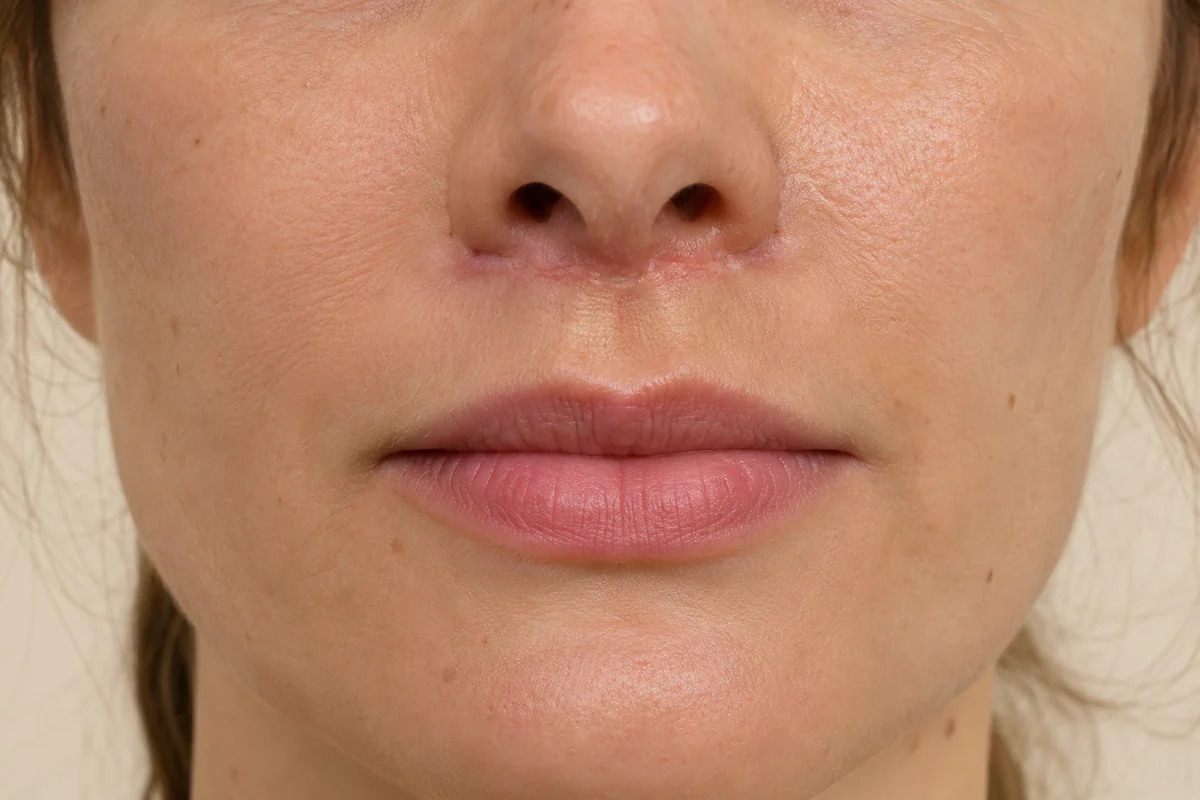
A scar caused by tension is wide, and over time it becomes whiter and smoother than the skin around it. The skin under the nose is pulled up and down constantly as you talk, smile and eat. If a lot of skin is removed and only the skin edges are pulled together, that single line takes the full force and slowly spreads over several months.
Even after a wound has healed, it only regains around 80% of the original skin's strength. That is why a scar under heavy tension does not narrow just by waiting. This kind of scar has the most room to improve with revision. However, we make it a condition that the tension is moved onto the deeper tissue instead of the skin.
② Incision position — the line sits outside the shadow
A scar whose cause is position is thin, yet visible straight from the front. Under the nose there is a natural border along the columella and the base of the nostrils, and a line is hard to see only when it sits in the shadow just below that border. If the line drops even 1–2mm, it shows on brighter skin.
In this case I plan the revision to move the line toward that border. The place where the scar is cut out becomes an opportunity to correct its position. But this comes at a price. I will explain it below, together with the question of remaining skin.
③ Closure — the line is sunken or stepped
A scar caused by closure has a groove along the line, or the two sides sit at different heights like a step. If the layers beneath the skin are not brought together separately and only the surface is matched, the space beneath sinks or one side rises. A small notch where the line turns at the corner under the nostril is often this case too.
Sunken and stepped scars also mostly improve with revision. At this stage I spend the most time matching the height of each layer again.
④ Skin type — the line is red, thick and raised
A scar whose cause is skin type is red and thickly raised, and it may itch or feel tight. These are people prone to hypertrophic scars or keloids. Here I have to be frank. Even if the scar is cut out again, the same reaction can return.
So with this type of scar we first give injections and laser a fair trial before surgery. Even when surgery is done, aftercare is planned much more closely from the day of the operation. This fourth cause shows most clearly why identifying the cause comes first.
Reading the cause backwards from the shape of the scar — and the first choice
Starting from the shape you see in the mirror, you can roughly guess the cause. The table below is meant to help you gauge it before a consultation; the actual judgement needs the scar to be seen and felt in person.
| Scar shape | Most likely cause | Room to improve with revision | What to try first |
|---|---|---|---|
| Wide and shiny white | ① Tension | Large | Plan revision (laser does not narrow width) |
| Thin but visible from the front | ② Incision position | Medium–large | Check remaining skin, then adjust position |
| Sunken or stepped along the line | ③ Closure | Large | Revision (layered re-closure) |
| Notch at the corner under the nostril | ③ Closure + ② Position | Medium | Revision, though full correction may be difficult |
| Red, thick and raised | ④ Skin type | Small–medium | Injections and laser first |
📍 Bottom line: A widened or sunken scar has a lot of room to improve with revision; a red, raised scar needs care before surgery.
A 1:1 personalised consultation you can start now
✅✅ We check the scar's width, position, height and the remaining skin in person, and decide together first whether revision is right for you
✅✅ We give you an honest opinion, whether or not you have surgery
📲 Dr.Tak Plastic Surgery official site, chat icon at the bottom right → live consultation
The remaining skin decides — why scar correction and philtrum length collide
The first thing I measure when planning a revision is not the scar but the skin left above and below it. When the scar is cut out, the philtrum becomes shorter again by the width removed.
For example, removing a scar 2mm wide makes the philtrum roughly 2mm shorter. If enough was already removed in the first operation, those 2mm become a problem. The upper lip can lift too much, so many upper teeth show even with the mouth closed, or the lip can look turned outward.
So in the consultation I ask this. Are you happy with your philtrum length now, or would you like it a little shorter? Even for the same scar, the plan changes completely depending on the answer.
For someone who wanted it a little shorter, this is actually an opportunity. While cutting out the scar, the length can be brought to what they wanted. For someone happy with the current length, as little scar as possible is removed, and the remaining tension is left to the deeper tissue. For someone whose philtrum is already too short, I sometimes do not recommend cutting again at all.
Skin can be reduced, but it is hard to add back. That is why in scar revision, what you choose not to do often decides the result more than what you add.
What revision can do, and honestly what it cannot
This is not to lower your expectations, but to tell you in advance so you are not disappointed later.
✅ Narrowing a widened scar into a fine line — the part that improves most when the tension cause is corrected at the same time
✅ Levelling a sunken or stepped scar — the height of each layer is matched again
✅ Moving the line toward the shadow under the nose — possible within the limit the remaining skin allows
✅ Shortening the philtrum a little more, as you originally wanted — can be combined with scar correction only when there is enough skin
⚠️ A notch under the nostril or a change in nostril shape — some improvement is possible, but returning it fully to the original is difficult. Why the nostril area changes is covered in detail in why the nostrils can change shape after philtrum reduction
⚠️ Scars in people prone to keloids or hypertrophic scars — the same reaction may return after excision, so care comes first
⚠️ Making a philtrum that is too short longer again — stretching skin back is very difficult, and this is the most limited of all revision cases
⚠️ Removing the line completely — no revision removes the line itself. The goal is a line that does not draw attention
Revision is not the answer for everyone. In consultations I quite often tell patients that it would be better not to operate right now.
Laser and injections, re-closing only the scar, or scar correction with further shortening
The three paths have different purposes. Looking at the cause of your scar and how you feel about your current philtrum length shows which one fits.
| Comparison | Laser · scar-softening injection | Re-closing only the scar (revision) | Scar correction + further shortening |
|---|---|---|---|
| What it changes | Redness, thickness, texture | Scar width, height, position | Both scar and philtrum length |
| Suited causes | ④ Skin type, early red scars | ① Tension ② Position ③ Closure | ①–③ + philtrum still feels long |
| Does width narrow? | Hardly | Yes | Yes |
| Change in philtrum length | None | Slightly shorter by the scar width | As much as desired (within available skin) |
| Skin reserve needed | None | A little | Must be sufficient |
| Return to daily life | Immediately to 1–3 days | About 1 week until stitch removal | About 1 week until stitch removal, swelling around 2 weeks |
| When to start | From 1 month after the first surgery | After the scar matures, 6 months–1 year | After the scar matures, 6 months–1 year |
| Not suitable when | The scar is already widened or sunken | Keloid tendency, philtrum already too short | Philtrum already short, many upper teeth showing |
| Aftercare | Repeated sessions | Another 6 months of scar care | Another 6 months of scar care |
📍 Bottom line: If the scar is wide or sunken, surgery comes first; if it is red and thick, laser and injections do. Whether to shorten further is decided by the remaining skin.
When can it be done again — after the scar has fully matured
Revision is usually done 6 months to 1 year after the first operation. A scar becomes red and firm in the first few months, then slowly flattens and fades. Operating again before that process ends means laying a new scar on top of one that is still changing.
| Time after first surgery | Scar condition | What to do in this period |
|---|---|---|
| Up to 3 months | Red and firm, looks most prominent | Keep taping and scar care; too early to judge revision |
| 3–6 months | Redness starts to fade | Refine colour and texture with laser and injections |
| 6 months–1 year | Mostly flat and faded | Judge revision by the remaining width, position and height |
| After 1 year | Scar has nearly settled | A good time to plan revision if it is needed |
I fully understand the impatience. Even so, I tell most people who come around the 3-month mark to wait a little longer. Quite a few scars improve more than expected in that time.
The principles I have kept in revision after 15+ years with lips and philtrum
Having performed lip and philtrum surgery for 15+ years, I have learned first-hand that revision demands more care than the first operation. The first operation has skin to spare; by revision, that reserve has already shrunk. It means there are not many chances to cut once more.
So in a revision consultation I check three things in order. Whether the scar has matured, what made it stay, and how much skin is left. If that order changes, the result wavers too.
Dr.Tak Plastic Surgery has more than 200 Google reviews with a 5-star rating. A theme that often appears in reviews from revision patients is gratitude that we did not rush them into surgery.
💬 "To make people smile." In revision, I believe a good result is not a line that disappears, but no longer having to think about the area under your nose.
Before & after photographs are on our official page
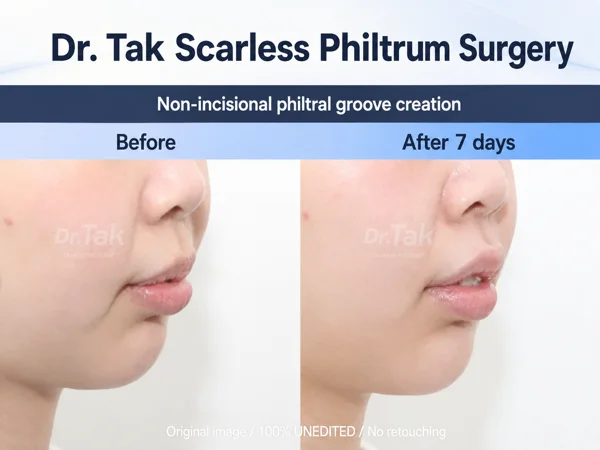
Dr.Tak Plastic Surgery complies with medical advertising regulations, so we do not place before-and-after photographs inside blog articles. Actual pre- and post-operative changes are collected on the official before & after page.
🔗 View before & after — Dr.Tak Plastic Surgery official page
Results may vary from person to person.
Dr.Tak 4S Patient Care System — focused on people, not procedures
We focus on people, not procedures.
Solution — 1:1 master plan with Chief Director Dr. Tak Seung-wan
- Sincere empathy and communication: your wishes fully reflected in the surgery
- Precise golden-ratio facial analysis (personalised): scar width, position and height, remaining skin and current philtrum length measured together
- Simulation of the expected post-operative change
Support — Global 1:1 dedicated coordinator
- A dedicated coordinator assigned for each country (no language barrier)
- With you through the whole process, from consultation to surgery to aftercare
- 100% advance reservation (private clinic environment)
Scar Care — 6-month intensive scar management
| Care item | Period | Details |
|---|---|---|
| Control taping | 3–6 months | Prevents the scar from widening |
| Scar-softening injection | 6 months (once a month) | Softens raised scars |
| Laser treatment | 6 months | Reduces redness at the surgical site |
Service — 1-year free A/S guarantee
- Free A/S within 1 year after surgery
- Care that takes responsibility to the end
- ※ A basic anesthesia fee may apply if sedation is used
Want to know more? — Official channels
🌐 The Dr.Tak Plastic Surgery official website has detailed guides for each lip and philtrum procedure
📝 The blog collects articles by procedure, including philtrum reduction scars, swelling and nostril changes
📹 Videos show the surgical process and the recovery course
Five things to sort out before a revision consultation
✅ The date of your first surgery — whether 6 months have passed is the first criterion
✅ Whether the scar is wide, sunken or raised — photos in good light, from the front and from below, are helpful
✅ Whether you like your current philtrum length or want it a little shorter — the revision plan divides on this answer
✅ Whether your skin tends to form raised scars — think of whether other wounds or piercings ever left a thick scar
✅ Your first surgery records — knowing the incision method or how much was removed helps a great deal. It is fine if you don't know
You don't need to bring an answer to every item. Anything you are unsure of, we can look at together at the consultation.
Frequently Asked Questions (FAQ)
We have gathered the questions Dr.Tak Plastic Surgery hears most often.
Q1. What if I have revision and a scar remains again?
This is the question I am asked most, and the one that needs the most honest answer. If the same cause is left as it is, the same scar can come back. So in revision I decide where the tension will be carried and where the line will sit before deciding how to cut out the scar. After revision, the same 6-month scar care as after the first operation starts again. Scars raised because of skin type, however, can still recur after revision, and in that case I tell patients before the operation.
Q2. Can a philtrum reduction be reversed completely, back to the original length?
Returning fully to the original length is very difficult. Skin once removed does not grow back, and lengthening would require moving tissue from elsewhere, which itself creates a new scar. What I actually do in such consultations is look for ways to reduce how lifted the lip looks at the current length, rather than reversing it. Because such cases exist, I keep to the principle of shortening conservatively from the start, in first operations and revisions alike.
Q3. My scar still looks the same after a year. Isn't laser alone enough?
A scar that is still wide or sunken after a year rarely changes much with laser alone. Laser is effective for refining colour and texture, but it cannot narrow a width that has already spread. On the other hand, if the line is thin but redness or uneven texture remains, laser and injections often bring enough improvement. That is why I feel the scar myself and check its height and width first.
Q4. Can my philtrum be shortened a little more during revision?
If there is enough skin, it can be shortened together with the scar correction. For those who feel the first operation removed less than expected, it can even be a good opportunity. However, the slight shortening that comes from removing the scar's width has to be factored in, and anyone whose upper teeth already show with the mouth closed is better off not shortening further. In the consultation, I decide only after matching the current and desired lengths in numbers.
Q5. My first surgery was at another clinic — how is the cost of revision decided? Are there cases where revision is not suitable?
An exact amount is hard to state in advance; the range depends on whether only the scar is corrected, whether length is adjusted too, whether the area under the nostril needs correction, and whether sedation is used. Even if your first operation was elsewhere, you can receive the consultation and surgery in exactly the same way. What to check when choosing a clinic is set out in 7 things to check in the consultation room before choosing a philtrum reduction clinic in Korea. There are cases where revision is not suitable. For those less than 6 months after their first operation, those whose philtrum is already too short, and those with a keloid tendency whose scar keeps growing, I recommend other approaches before surgery.
Dr.Tak Plastic Surgery | Korea Face Lifting · Lip · Philtrum Specialist Clinic
"To make people smile"