"My philtrum is shorter, but my nose looks different"
At some point while researching a lip lift, a worry tends to appear. You want a shorter philtrum, but what if your nostrils look bigger or your nose looks wider afterwards? Read lip lift stories in international forums and the same topics keep coming up: nostril shape, nostril width, and numbness under the nose.
I do not think this is an overreaction. A lip lift is performed directly under the nose, and depending on where the incision sits, the lower part of the nose can genuinely change.
One approach carries the incision inside the nostril sill so the scar is less visible. That does help hide the scar. But something is given up in return. Today I want to be honest about what that is, and why I do not use that approach.
What a lip lift is — and three structures under the nose you need to know
To give you the answer first: whether your nostrils change after a lip lift depends largely on whether the incision goes into the nostril sill or ends on the skin outside it.
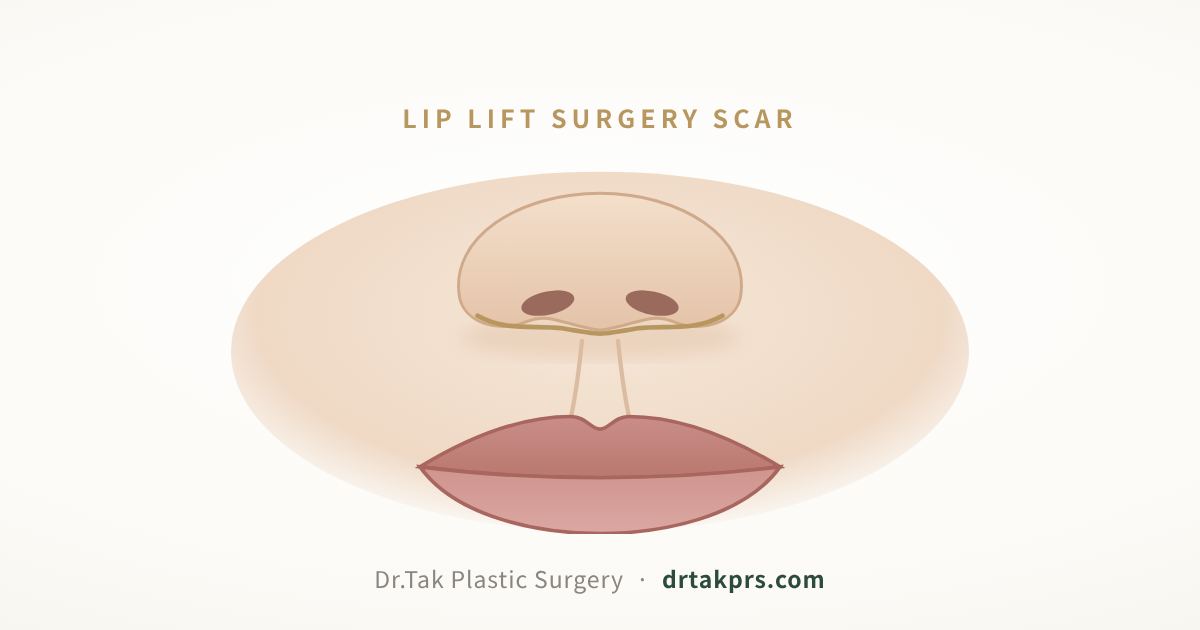
A lip lift is also called a subnasal lip lift or bullhorn lip lift, and in Korea it is known as philtrum reduction (인중축소). A narrow strip of skin just under the nose is removed and closed, shortening the distance between the nose and the upper lip, the philtrum. To see how this relates to your nostrils, three structures under the nose matter.
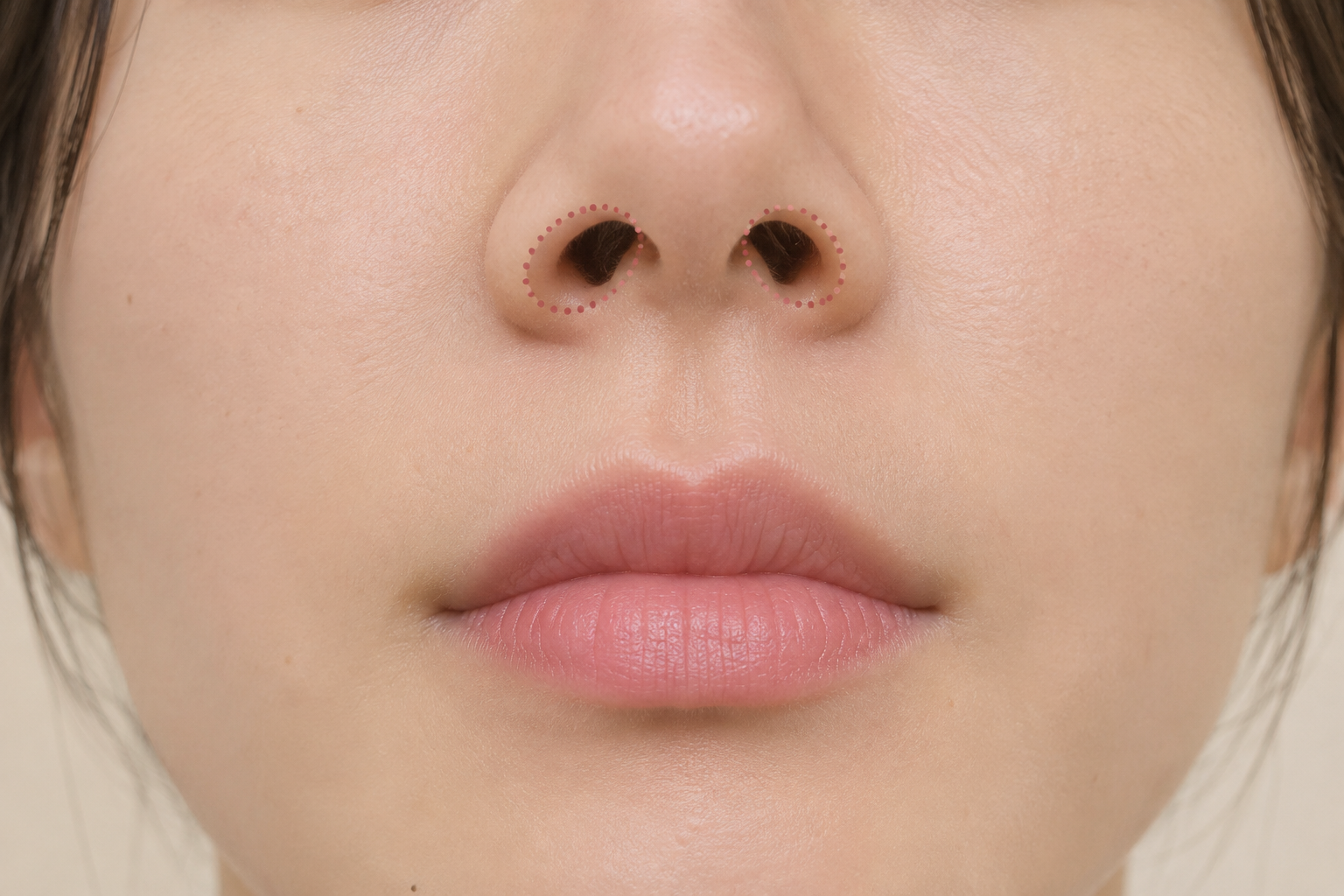
① The nostril sill — the low threshold at the bottom of the nostril opening. It supports the round rim of the nostril from below, so its height and width decide how your nostrils look from the front and from below.
② The nasal base line — the line running from the crease under the columella to the rims of both alae. It is naturally shaded, which makes it a good place to hide a scar.
③ The fullness under the nose — the soft volume just below the nasal base that joins the nose smoothly to the upper lip. It is what creates the natural curve from nose to lip in profile.
All three sit within about one finger-width. That is why a difference of just 1–2 mm in the incision line can change the character of the result.
What an incision inside the nostril gains — and what it gives up
An incision inside the nostril does not stop at the nasal base line; it continues into the nostril sill so part of the scar hides inside the nostril. The scar is less visible from the front. But remember that a lip lift removes skin and pulls the upper lip upward before closing. Once you picture that, you can see where the pulling force lands.
If the incision sits inside the nostril sill, the upward pull grips and drags the sill itself. Two things can follow.
First, the nostril shape changes. When the threshold that supports the nostril rim from below is removed or lowered, the nostril opening can look wider and rounder. More nostril shows from the front, and the alae can give the impression of flaring outward.
Second, the fullness under the nose collapses. If the sill and the tissue beneath it are removed together, the volume joining nose and lip shrinks. In profile the area under the nose can look shaved flat, and the curve between nose and upper lip becomes stiff.
To be honest, unlike a scar, these two changes do not return on their own with time. The removed threshold and volume do not grow back. A scar fades with care; shape is hard to restore with care. That difference is why I look at shape before the scar when I decide where the incision goes.
The two incision approaches side by side
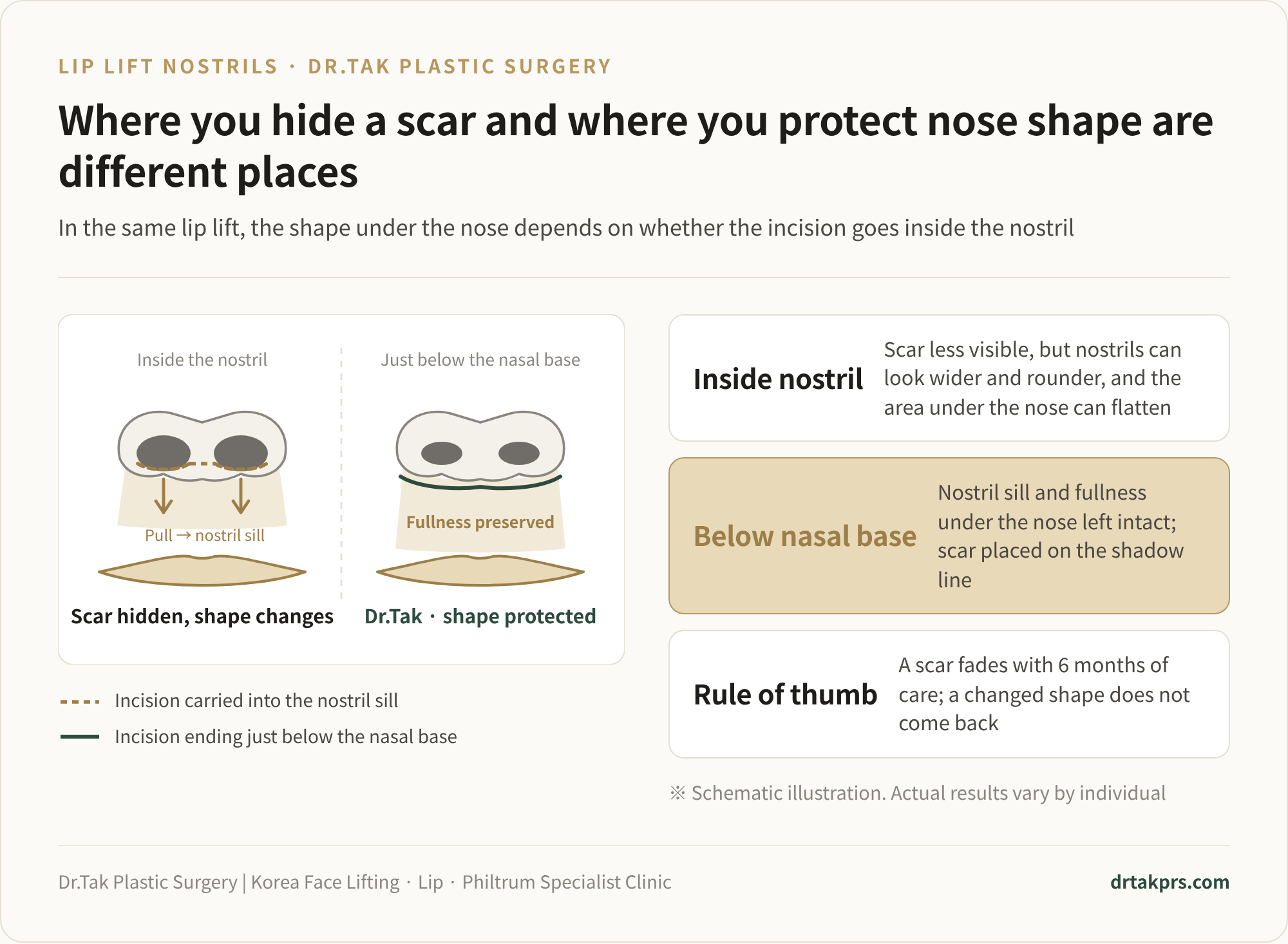
The table below summarises what I draw out for patients in consultation. The point is not that one approach is always better, but that the choice depends on what you prioritise.
| Item | Incision carried inside the nostril sill | Incision ending just below the nasal base (Dr.Tak) |
|---|---|---|
| Incision position | Into the nostril sill | Skin just below the columella crease and alar rims |
| Scar from the front | Relatively less visible | Follows the shadow line and is mostly inconspicuous; a red line may show early on |
| Scar from below | Partly hidden inside the nostril | May be visible along the nasal base line |
| Nostril shape | Sill lowers; can look wider and rounder | Sill untouched; better for keeping the original shape |
| Nostril width | Pull lands on the sill; alae can look spread | Pull lands on the skin side; relatively less effect on the alae |
| Fullness under the nose | Can flatten if removed together | Preserved |
| Profile curve | Nose-to-lip curve can stiffen | Natural transition kept |
| Reversibility | Removed sill and volume are hard to restore | Scar fades with 6 months of care |
| What it prioritises | Hiding the scar as much as possible | Protecting nose shape and the fullness under the nose |
📍 Bottom line: A scar fades with time; a changed nostril shape does not come back. So I protect the part that is hard to change first.
A 1:1 consultation you can start today
✅✅ We measure philtrum length, nostril shape and the fullness under the nose together, and explain the incision line and how much to shorten for your face
✅✅ We give you an honest opinion, whether or not you choose surgery
📲 Dr.Tak Plastic Surgery official site, chat icon at the bottom right → live consultation
Why Dr.Tak ends the incision just below the nasal base
I do not carry the lip lift incision inside the nostril. It follows the crease under the columella and the rims of both alae and ends on the skin just below the nasal base line. The nostril sill is left as it is, and so is the fullness under the nose.
This principle is built into the order in which I plan surgery.
| Step | What we look at | Why |
|---|---|---|
| 1. Measurement | Philtrum length, nostril width, alar width, fullness under the nose | If your nostrils already show a lot, even a little pull can be noticeable |
| 2. Drawing the line | The shadow line at the nasal base | To hide the scar in shadow, not inside the nostril |
| 3. Deciding how much to shorten | Within one quarter to one third of philtrum length | The more you shorten, the more force reaches the nostrils |
| 4. Fixation | Spreading the pull onto deeper tissue rather than the skin | To reduce the force acting directly on the alae and the scar |
| 5. Scar care | Taping, injections and laser for 6 months | Making the outer scar fade is part of the surgery |
This approach has a cost too. Because the scar sits at the nasal base rather than inside the nostril, a red line may be visible for the first few months if you tilt your head back or look closely. I do not hide this in consultation. Instead, I place that line exactly where shadow naturally falls and manage it intensively for six months. You can read how the scar fades in our article on how lip lift scars change over a year.
In the end it is a choice. I choose to manage the scar a little more and to keep the nose as it is. Even with this principle, though, there are cases where the nostrils can still change.
Three cases where the nostrils can still change
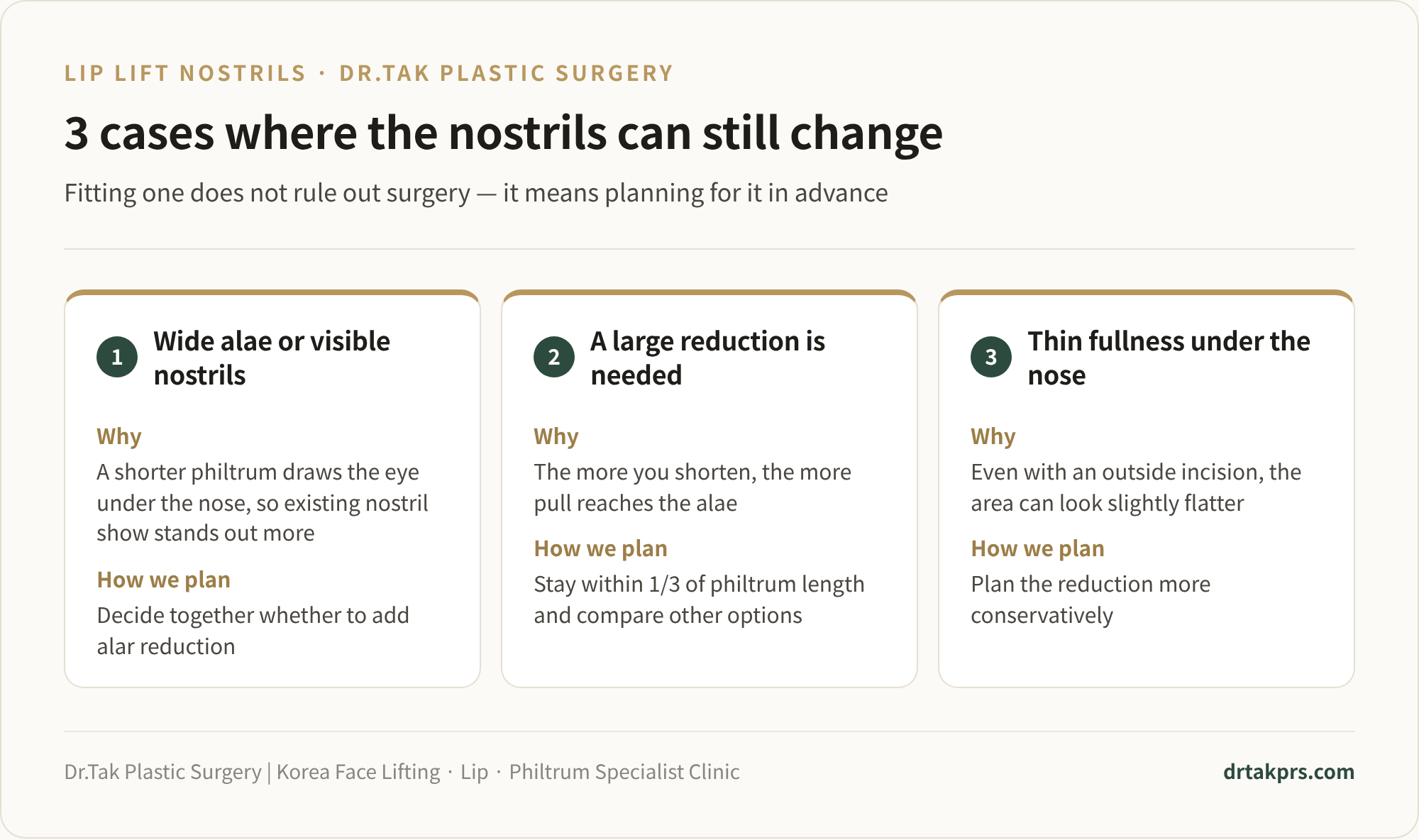
Placing the incision outside the nostril does not mean I can promise everyone's nostrils will stay exactly as before. This surgery is not right for everyone, either. There are three cases where I become especially careful in consultation.
⚠️ Wide alae, or nostrils that already show a lot from the front — when the philtrum gets shorter, attention moves to the area under the nose, and existing nostril show can become more noticeable. For these patients we discuss together whether to add alar reduction.
⚠️ Patients who need a large reduction — the more you shorten, the stronger the pull, and some of it reaches the alae. I keep to the principle of never exceeding one third of philtrum length; if the change you want goes beyond that, we compare other options rather than doing it all at once.
⚠️ Thin fullness under the nose to begin with — if there is little volume there from the start, the area can look slightly flatter even with the incision outside. In that case I plan the reduction more conservatively.
Fitting one of these does not mean you should not have surgery. It means this possibility needs to be part of the plan beforehand. Measuring in person is more accurate than judging from photos.
Early changes and lasting changes are different
Right after surgery, the alae can look slightly wider regardless of the incision method. If you mistake this stage for a lasting change, you will worry more than you need to.
| Period | What you may see around the nostrils | Nature |
|---|---|---|
| 🩹 Right after surgery to 2 weeks | Swelling extends to the alae; nostrils look wider from the pull | Temporary — swelling and tension |
| ⏱ 2 weeks to 3 months | As swelling goes down, alar width mostly returns; numbness or tingling under the nostrils | Temporary — sensory nerves recovering |
| 📅 3–6 months | The scar is firm, then softens; nostril shape settles | Mostly stable |
| ⭐ After 6 months | If the nostrils still look wide and round, or the area under the nose looks hollow | Possibly lasting — the cause should be checked |
📍 Bottom line: Nostrils that look wide at week two are mostly swelling. Judging at three to six months is not too late.
The day-by-day course of swelling is covered in our article on lip lift swelling and recovery, day by day.
A principle kept for over 15 years — the 1–2 mm under the nose is part of the result
After more than 15 years of lip and philtrum surgery, I no longer judge a lip lift by philtrum length alone. Even if the philtrum is exactly as short as wanted, a patient does not feel it was a success if the nostrils look different. So from the first measurement, I treat the 1–2 mm under the nose as part of the result.
Dr.Tak Plastic Surgery holds a 5-out-of-5 rating from over 200 Google reviews. Reading them, I often see "no one can tell" and "my nose is the same, but my face looks different" — and that is also why I keep this principle.
💬 "To make people smile." A face where only the philtrum has changed and the nose is the same, so no one notices the surgery, is what I consider a good result.
Before & after photographs are on our official page
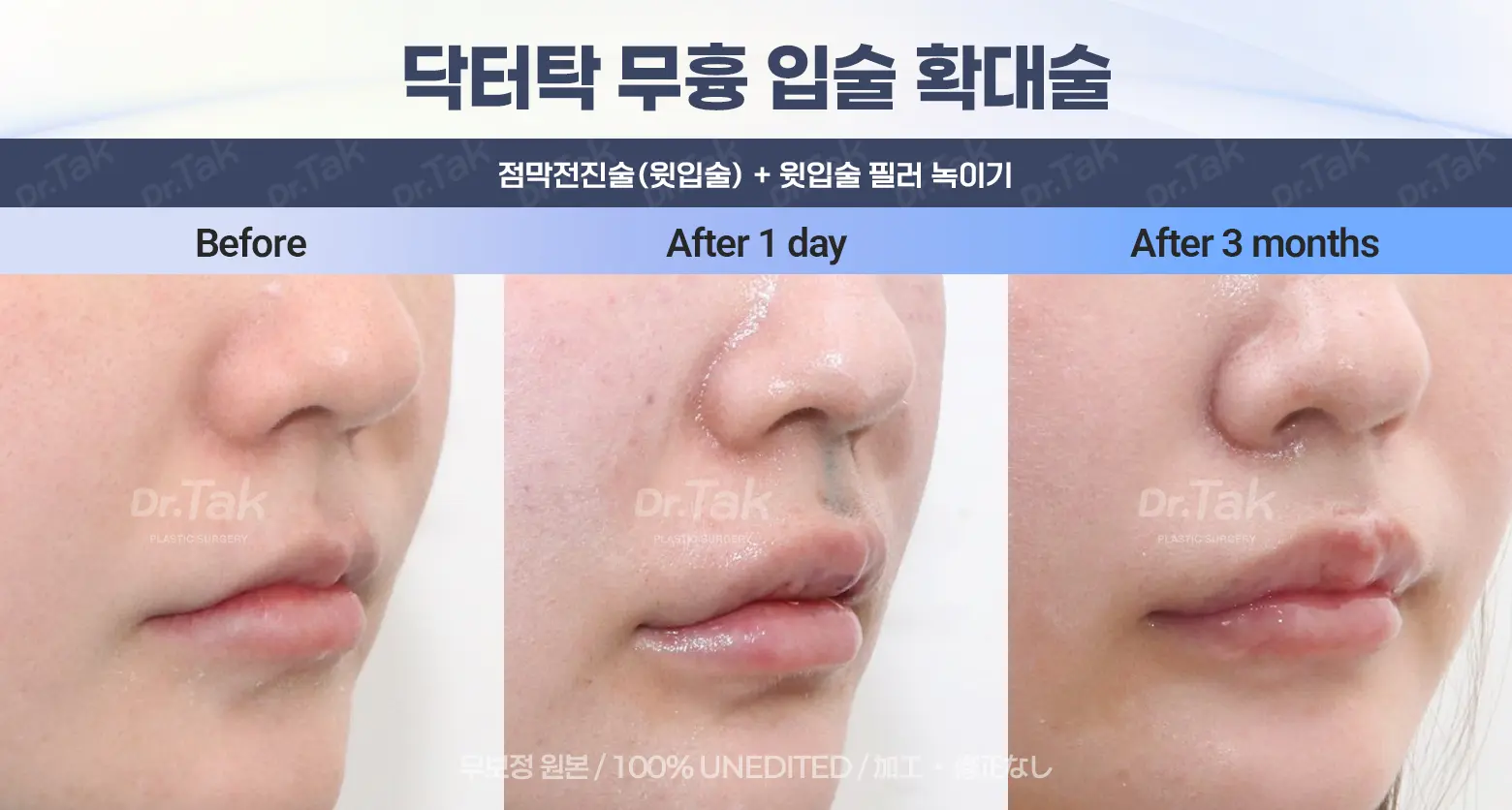
Dr.Tak Plastic Surgery complies with medical advertising regulations, so we do not place before-and-after photographs inside blog articles. Actual pre- and post-operative changes are collected on the official before & after page.
🔗 View before & after — Dr.Tak Plastic Surgery official page
Results may vary from person to person.
Dr.Tak 4S Patient Care System — focused on people, not procedures
We focus on people, not procedures.
Solution — 1:1 master plan with Chief Director Dr. Tak Seung-wan
- Sincere empathy and communication: your wishes fully reflected in the surgery
- Precise golden-ratio facial analysis (personalised): philtrum length, nostril width and the fullness under the nose are measured to plan the incision line and how much to shorten
- Simulation of the expected post-operative change
Support — Global 1:1 dedicated coordinator
- A dedicated coordinator assigned for each country (no language barrier)
- With you through the whole process, from consultation to surgery to aftercare
- 100% advance reservation (private clinic environment)
Scar Care — 6-month intensive scar management
| Care item | Period | Details |
|---|---|---|
| Control taping | 3–6 months | Prevents the scar from widening |
| Scar-softening injection | 6 months (once a month) | Softens raised scars |
| Laser treatment | 6 months | Reduces redness at the surgical site |
Service — 1-year free A/S guarantee
- Free A/S within 1 year after surgery
- Care that takes responsibility to the end
- ※ A basic anesthesia fee may apply if sedation is used
Want to know more? — Official channels
🌐 The Dr.Tak Plastic Surgery official website has detailed guides for each lip and philtrum procedure
📝 The blog collects articles by procedure, including lip lift types, V-Y advancement and mouth corner correction
📹 Videos show the surgical process and the recovery course
Five things to sort out before deciding on surgery
✅ How much of your nostrils shows in a front-facing photo? — If they already show a lot, please mention it in consultation
✅ What does the curve between your nose and upper lip look like in profile? — It helps to check in advance whether the fullness under your nose is thin
✅ Which matters more to you: hiding the scar or keeping your nose shape? — The explanation of incision methods changes with this answer
✅ Does the philtrum length you want mean shortening by a third or more? — If so, comparing other options as well is safer
✅ Are you planning rhinoplasty? — Setting the order and interval in advance keeps scars and swelling from overlapping
You do not need answers to every item. Anything you are unsure of, we can check together in consultation.
Frequently Asked Questions (FAQ)
We have gathered the questions Dr.Tak Plastic Surgery hears most often.
Q1. Does a lip lift make your nose wider?
Right after surgery, swelling and tension usually make the alae look a little wider, but this generally returns to normal within a few weeks to three months. Lasting widening mainly happens when the incision went into the nostril sill, or when a large reduction put a lot of force on the alae. We measure alar width separately before surgery so there is a baseline to compare against afterwards.
Q2. The area under my nostrils feels numb and tingly after surgery. Will it come back?
In most cases, yes. Very fine sensory nerves run around the nasal base, and while they reconnect after the incision, the area under the nostrils and toward the nose tip can feel numb or tingly. It usually recovers gradually over a few weeks to three months, sometimes up to six. When I review progress, I check whether the numb area is slowly getting smaller. If it is spreading or the skin colour changes, please contact us right away.
Q3. I'm also considering rhinoplasty. Should I get a lip lift or a nose job first, or both together?
Changing the height and angle of the nose tip also changes how long the philtrum looks, so in most cases I suggest settling the nose first and measuring the philtrum afterwards. If both are done on the same day, overlapping swelling makes the result harder to judge, and if the nose tip surgery uses an open approach, there will be a separate scar across the columella. That scar comes from a different operation, not from the lip lift. The safest order and interval are decided by looking at the scope of both surgeries together.
Q4. An incision inside the nostril leaves an almost invisible scar — isn't that the better approach?
Looking at the scar alone, it is true that an incision inside the nostril is less visible from the front. But a scar moves toward fading with six months of care, while a nostril shape changed by removing the sill, and lost fullness under the nose, do not come back with time. And nostril shape actually shows more in photos taken from a lower angle. So in consultation I help you choose based on which would bother you longer, and for my own part I choose to protect the shape.
Q5. My nostrils already look wide after a lip lift. What if it stays like this? How is the cost of correction decided?
First, how long ago the surgery was matters. Before three months, swelling and tension are likely still present, so I do not rush correction at this stage and we watch the progress together. If the nostrils still look wide and round after six months, corrections such as alar reduction or nostril sill reconstruction can be considered, though I will be honest that the more tissue was removed, the harder it is to fully restore. An exact amount is hard to state in advance; the range depends on whether alar reduction is included, whether scar revision is needed and whether sedation is used. If the scar is still red and firm, or you are prone to keloids, I do not recommend correction right away.
Dr.Tak Plastic Surgery | Korea Face Lifting · Lip · Philtrum Specialist Clinic
"To make people smile"