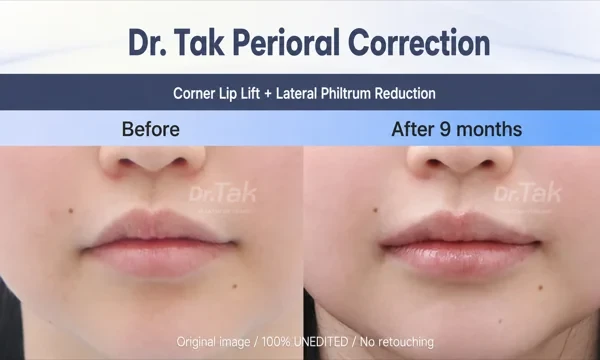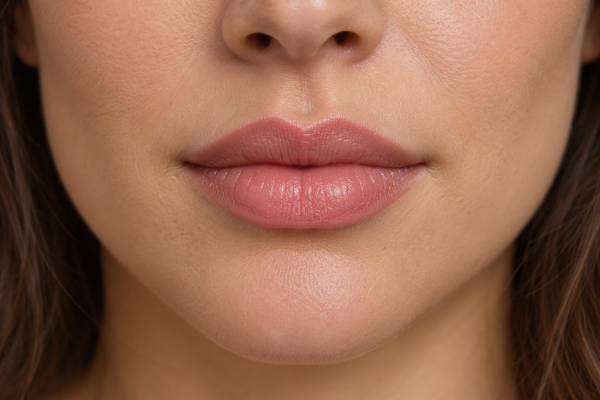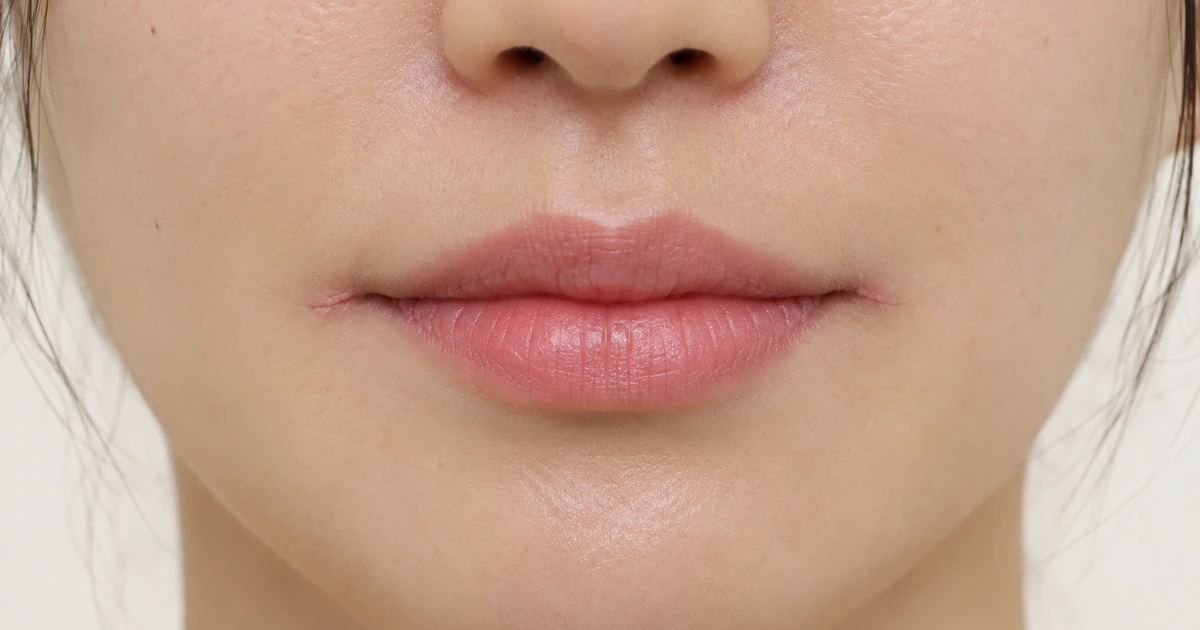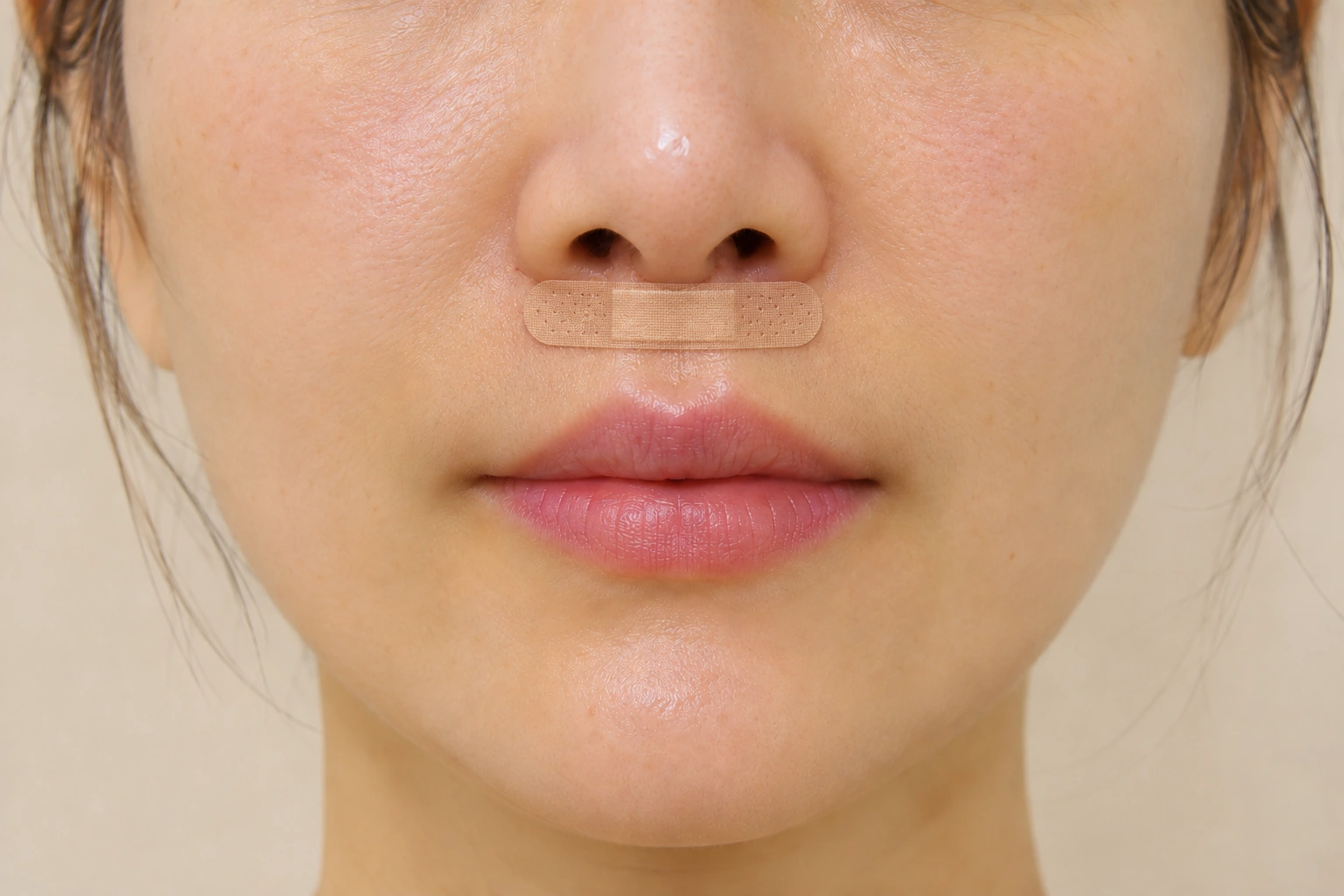
"It's still this swollen — is that normal?"
Surgery is over, yet the upper lip in the mirror looks fuller than you expected, the area under your nose feels tight, and your mouth will not move the way you want when you try to smile. Looking at that, you have probably wondered, "What if it sets like this?"
Before a lip lift, I spend more time in consultation talking about this stage than about the result. What patients find hardest is usually not pain but the anxiety of not knowing whether what they see is normal. The same swelling feels completely different when you know it is coming.
So in this article I will walk you through what you will actually see in the mirror, from surgery day to three months, in date order. I will not only tell you the good parts. I will tell you first when the most worrying stage arrives.
What lip lift swelling actually is — and why the upper lip stays swollen longer
To put the conclusion first: lip lift swelling is a normal healing response around the incision under the nose and in the upper lip. Most visible swelling settles by around two weeks, while subtle residual swelling and tightness ease slowly over 1–3 months.
A lip lift, also called a subnasal lip lift or philtrum reduction, removes a narrow strip of skin along the base of the columella and the nostrils and closes it to shorten the philtrum. Blood and fluid gather to repair that wound, and that is what you see as swelling.
There are reasons the upper lip looks swollen longer than other parts of the face.
① Its lymphatic drainage is short and narrow. The upper lip is soft tissue where fluid collects easily, but there is little room for it to drain.
② It moves thousands of times a day. Every time you talk, eat or smile, the orbicularis oris muscle moves and stimulates the healing tissue.
③ The suture line carries an upward pull. Shortening the philtrum means lifting the upper lip and fixing it higher, so early on that tension makes the lip look more flipped.
When I explain recovery after surgery, I always mention these three together for a reason. Because they overlap, two weeks after a lip lift can feel more swollen than two weeks after eye or nose surgery. Yet the moment patients truly start to worry is not the day the swelling is worst.
From surgery day to three months — what you will see, day by day
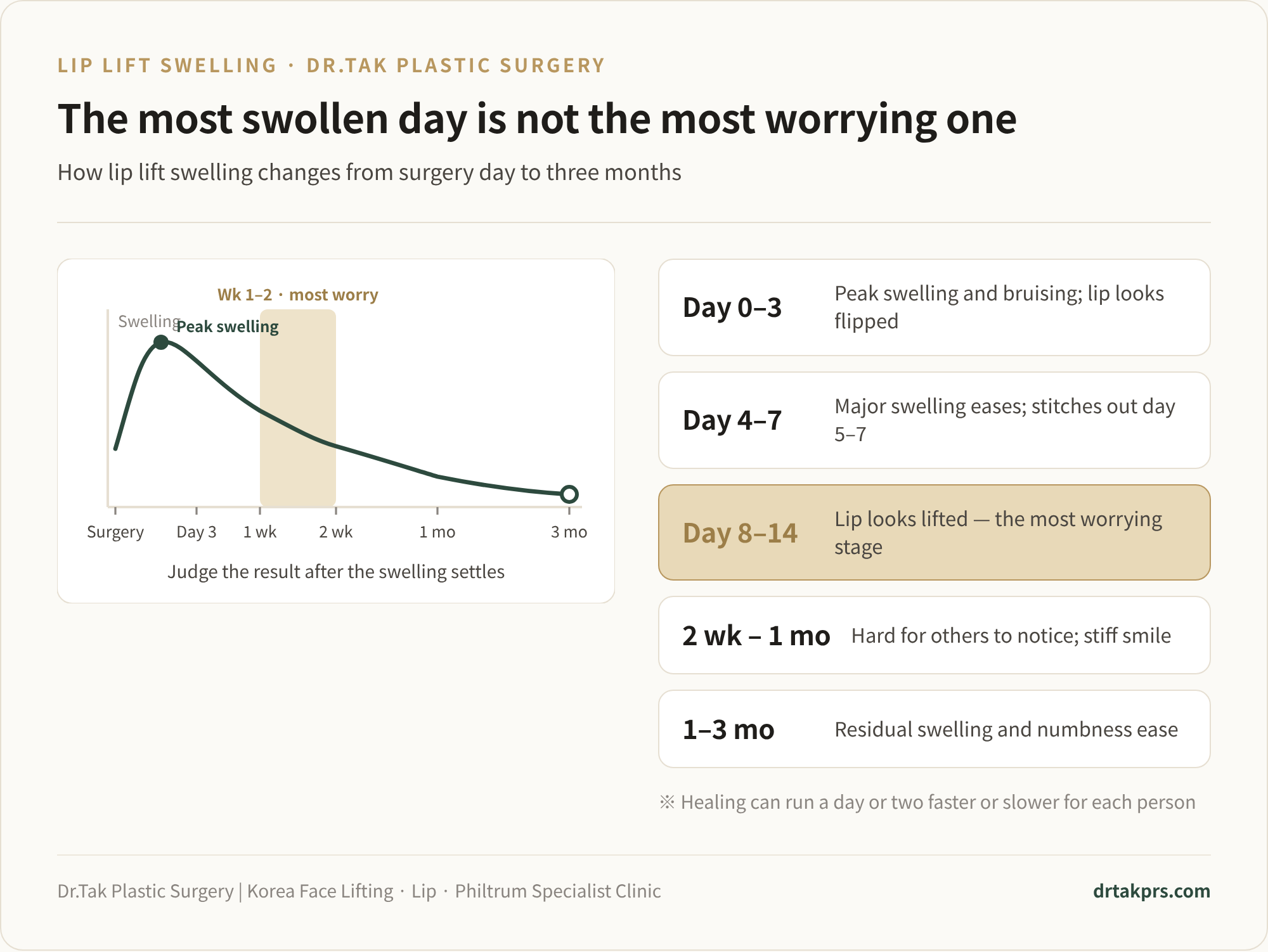
This is the timeline I show patients before surgery. Individual healing can run a day or two faster or slower, but the overall flow follows this order in most cases.
| Period | In the mirror | How it feels | What to do now |
|---|---|---|---|
| 🩹 Surgery day–Day 3 | Swelling and bruising at their worst. Upper lip full and flipped forward | Numb and tight under the nose, hard to open wide | Cold compresses, sleep with head raised, take prescribed medication |
| ⏱ Day 4–7 | Major swelling starts to go down. Bruises fade to yellow | Still tight, but talking gets easier | Ointment care, avoid opening the mouth wide |
| ✂️ Day 5–7 | Stitches removed. The incision shows as a pink line | Noticeably lighter once stitches are out | Start taping, short outings with a mask are possible |
| 📝 Day 8–14 | Surface swelling much reduced, but the lip still looks lifted | The peak of "Is it too short? Did it go wrong?" | Hold off on judging and wait |
| 📅 2 weeks–1 month | Hard for others to notice swelling | Upper lip stiff when smiling, expressions feel awkward | Keep taping, avoid alcohol and saunas |
| 🗓 1–3 months | Lip shape settles | Residual swelling and numbness ease gradually | Scar care (injections, laser) |
| ⭐ After 3 months | Close to the final shape | Most people stop noticing it in daily life | The scar keeps fading for close to a year |
📍 Bottom line: Swelling is worst on days 2–3, but the most worrying days are weeks 1–2, when much of the swelling is already gone.
A 1:1 consultation you can start today
✅✅ Before a lip lift, we compare philtrum length, incision type and recovery schedule for your face and your calendar
✅✅ An honest opinion, whether or not you choose surgery
📲 Chat icon at the bottom right of the Dr.Tak Plastic Surgery website → live consultation
Weeks 1–2, when the lip looks flipped — why I tell you in advance
In my experience, this is when the most patients get in touch. Once the stitches are out and you look closely in the mirror, the upper lip sits forward and the philtrum looks much shorter than you expected. When you smile, more of your upper teeth may seem to show.
To be honest, this look is mostly a temporary combination of swelling and tension along the suture line. Swelling inside the lip pushes it outward, and the tension that holds the lip higher has not relaxed yet, so the philtrum looks short.
That is why I always ask patients not to judge the result at this stage. If you conclude "too short" or "strange" based on week two, it is likely to differ from how it looks once swelling and tension have settled.
That does not mean every discomfort ends at two weeks. The sense that the upper lip moves stiffly when you smile, or that the skin under the nose feels numb, can last a few weeks and sometimes close to three months. As I tell patients each time, numbness is the very fine sensory nerves around the incision recovering, and it usually returns with time.
This is not an easy surgery for everyone. If your schedule cannot absorb this period, it is better to choose a different date.
Swelling you can wait out, and signs that need a call right away
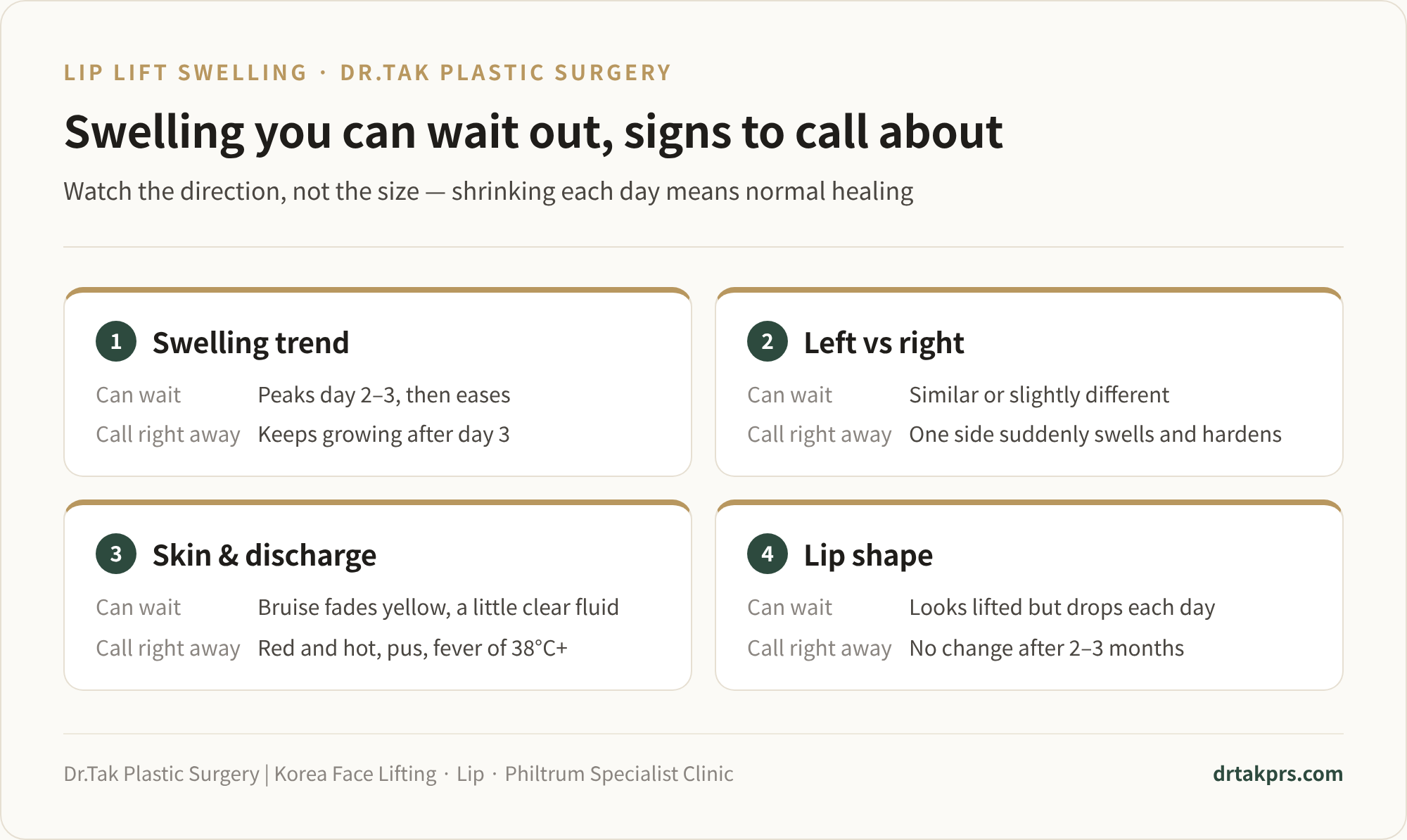
Most of the swelling we see resolves with time. Symptoms in the right-hand column below, however, mean you should contact the clinic that performed your surgery without waiting.
| Item | Swelling you can wait out | Call right away |
|---|---|---|
| Swelling trend | Peaks on days 2–3, then eases gradually | Keeps getting bigger after day 3 |
| Left vs right | Similar, or slightly different | One side suddenly swells and turns firm |
| Pain | Aching that painkillers control | Pain that is hard to bear even with painkillers |
| Skin color | Bruises fade from purple to yellow | Area around the incision grows redder and hotter |
| Discharge | Small amount of clear or slightly pink fluid | Yellow or cloudy pus, odor |
| Temperature | Normal, or a mild fever for a day or two | Fever of 38°C (100.4°F) or higher that persists |
| Suture line | A pink line where the stitches were | The line opens or gaps after stitch removal |
| Sensation | Under the nose and upper lip feel numb or tingly | Sensation keeps decreasing, or the skin turns dark |
| Lip shape | Looks lifted but drops a little each day | No change at all after 2–3 months |
📍 Bottom line: Look at the direction of the swelling rather than its size. If it is a little smaller each day, it is most likely normal healing.
How the scar itself fades over time is covered in detail in our guide to how a lip lift surgery scar changes over the first year.
What helps reduce swelling, and what does not
One of the questions I hear most is, "Is there a way to get rid of the swelling faster?" To put the conclusion first: there are ways to keep swelling from building up, but no way to skip the recovery period.
✅ Cold compresses for the first 2–3 days — wrap them in cloth so they do not touch the wound, and apply briefly several times
✅ Sleep with your head above your heart — one extra pillow already means less swelling in the morning
✅ Avoid opening your mouth wide — for the first two weeks, a small spoon and soft food are easier
✅ Pause alcohol, smoking, saunas and hard exercise for at least a month — they affect both swelling and scarring most directly
✅ Keep taping after the stitches come out — it spreads the tension on the suture line and reduces both swelling and scar widening
Some things do not help. Overdoing anti-swelling teas or supplements, leaving cold packs on too long, and touching the area often to check it all irritate the tissue. That is also why we give patients written aftercare instructions.
Work, going out without a mask, flying home — plan your schedule like this
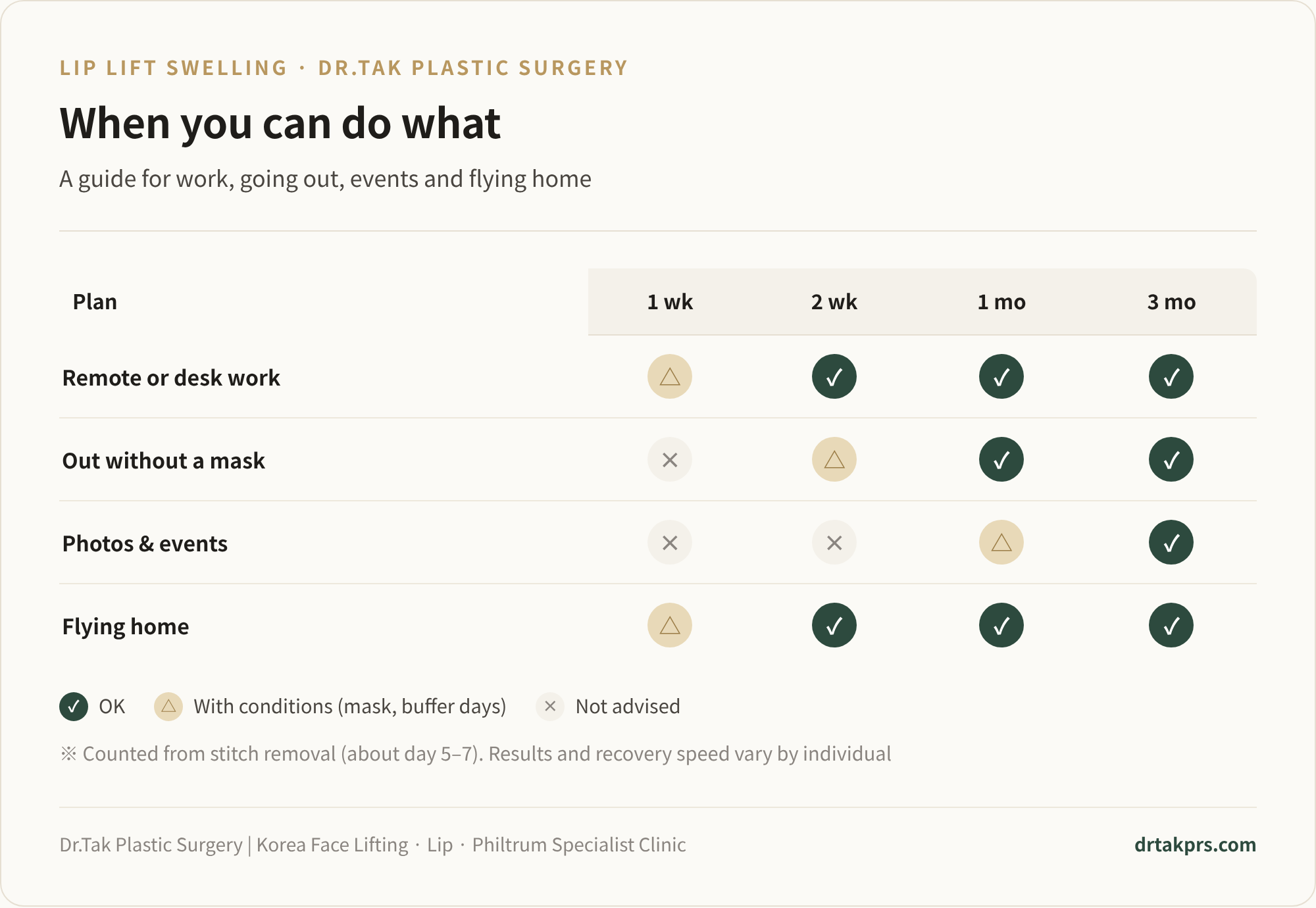
From what I feel in consultations, the real question behind "How long is recovery?" is usually "When can I face other people?" Here is a schedule-based summary.
| Plan | Approximate timing | Notes |
|---|---|---|
| Remote or desk work | After stitch removal, about 1 week | With a mask, it is rarely noticeable |
| Seeing close people without a mask | About 2 weeks | People who know you may sense some swelling |
| Photos, presentations, big events | After 1 month recommended | Smiling may still feel awkward |
| Flying home (international patients) | After stitch removal | At least about 1 week in Korea; about 10 days is more comfortable |
I advise international patients not to book their flight for the day right after stitch removal. Having the area checked once more a day or two after the stitches come out makes the trip home far more relaxed.
A principle kept for over 15 years — swelling is part of the design
Over more than 15 years of lip and philtrum surgery, I have seen many times that how swelling is handled changes the result, even with the same operation. Before surgery, I decide how much to shorten based on the length after swelling settles; after surgery, I follow the course with patients so no one judges too early while swelling is still high.
Dr.Tak Plastic Surgery holds a 5-star rating from more than 200 Google reviews. What means most to me is that many of those reviews talk about being well informed during anxious days of recovery, not only about the result.
💬 "To make people smile." I believe the surgery is not finished until you can smile comfortably after the swelling is gone.
Before & after photographs are on our official page
Dr.Tak Plastic Surgery complies with medical advertising regulations, so we do not place before-and-after photographs inside blog articles. Actual pre- and post-operative changes are collected on the official before & after page.
🔗 View before & after — Dr.Tak Plastic Surgery official page
Results may vary from person to person.
Dr.Tak 4S Patient Care System — focused on people, not procedures
We focus on people, not procedures.
Solution — 1:1 master plan with Chief Director Dr. Tak Seung-wan
- Sincere empathy and communication: your wishes fully reflected in the surgery
- Precise golden-ratio facial analysis (personalised): philtrum length, upper lip show and the length after swelling settles are all calculated to plan how much to shorten
- Simulation of the expected post-operative change
Support — Global 1:1 dedicated coordinator
- A dedicated coordinator assigned for each country (no language barrier)
- With you through the whole process, from consultation to surgery to aftercare
- 100% advance reservation (private clinic environment)
Scar Care — 6-month intensive scar management
| Care item | Period | Details |
|---|---|---|
| Control taping | 3–6 months | Prevents the scar from widening |
| Scar-softening injection | 6 months (once a month) | Softens raised scars |
| Laser treatment | 6 months | Reduces redness at the surgical site |
Service — 1-year free A/S guarantee
- Free A/S within 1 year after surgery
- Care that takes responsibility to the end
- ※ A basic anesthesia fee may apply if sedation is used
Want to know more? — Official channels
🌐 The Dr.Tak Plastic Surgery official website has detailed guides for each lip and philtrum procedure
📝 The blog collects articles by procedure, including lip lift types, V-Y advancement and mouth corner correction
📹 Videos show the surgical process and the recovery course
Five things to sort out before deciding on surgery
✅ Can you clear about a week until stitch removal? — If you are coming from abroad, decide your length of stay first
✅ Do you have important plans or photos within two weeks? — If so, it is better to adjust the surgery date
✅ Can you pause alcohol, smoking and saunas for a month? — These affect swelling and scarring most
✅ What philtrum length do you want? — We decide it together in consultation, based on how it will look after swelling settles
✅ Are you ready to go through the anxious weeks 1–2, knowing in advance? — You may want to save the table in this article
You do not need answers to every item. Anything you are unsure of, we can check together in consultation.
Frequently Asked Questions (FAQ)
These are the questions Dr.Tak Plastic Surgery hears most often.
Q1. When can I smile normally after a lip lift?
Talking and eating get comfortable within 1–2 weeks, but a big smile usually takes 4–6 weeks, sometimes up to about three months, to feel natural. The suture line that holds the upper lip higher needs time to adapt to the movement of the orbicularis oris muscle. When I check progress, I deliberately ask patients to smile so we can follow that change together.
Q2. Will my philtrum get longer again as the swelling goes down?
As swelling and tension relax, looking slightly longer than right after surgery is common and normal. It is the lip that looked too short in weeks 1–2 settling to a natural length. We calculate this change before surgery when deciding how much to shorten. If, however, the philtrum has returned close to its original length after several months, the suture fixation may not have been sufficient, and a consultation is worthwhile. How results differ by technique is covered in our comparison of bullhorn, Italian and corner lip lift types.
Q3. My nose tip and nostrils are swollen after the lip lift. Is that normal?
Yes. Because the incision sits right under the columella and the nostrils, swelling can spread up to the nostril base, making the nose look briefly wider or the nostrils a different shape. This swelling usually fades over 2–4 weeks, at about the same pace as the lip. If one nostril base keeps swelling and turns firm, red or hot, do not wait — contact your clinic right away.
Q4. It's week two and my lip looks flipped — I feel like it went wrong. What if it sets like this?
This is exactly the stage when that feeling is strongest. Once the stitches are out and swelling has eased, the lip shape becomes clearer, and the worry grows. But a lifted lip at week two is mostly swelling that fills the inside of the lip plus tension that has not yet relaxed, and it comes down over 1–3 months. During this stage we compare photos together to confirm it is changing day by day. If there is still no change after three months, we will decide together whether correction is needed.
Q5. If I come from abroad, how long do I need to stay in Korea? How is the cost decided?
You need at least about one week until stitch removal, and staying about ten days is more comfortable so the area can be checked once more afterward. The exact cost is hard to state in advance; the range depends on how much is shortened, the incision type (bullhorn, with or without corner lift), whether it is a revision, and whether sedation is used. For people who have had keloids, who cannot clear a week, or whose philtrum is already short with a lot of upper teeth showing, we do not recommend surgery right away and compare other options together.
Dr.Tak Plastic Surgery | Korea Face Lifting · Lip · Philtrum Specialist Clinic
"To make people smile"