
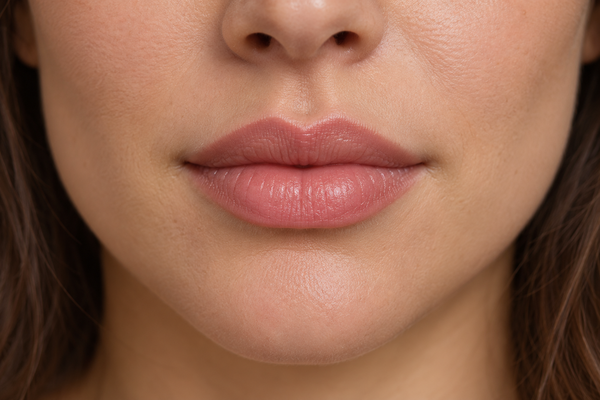
Fine in the mirror, blurred in every photo?
Fine in the mirror, but the upper lip smears into a blur the moment a photo is taken. I hear that sentence in my clinic in Korea almost every week. Lipstick refuses to hold an edge, and the face reads oddly flat from the front. Many of you have already tried changing the angle, assuming it was the lighting.
Yet when I actually measure those lips, the cause splits cleanly into three groups even though the complaint sounded identical. In some, the lip itself has lost volume. In others the volume is fine but the upper lip has lengthened downward. In a third group the thickness and the length are both normal, and a single boundary line has collapsed.
These three look almost the same from the outside. They are not treated the same way at all.
So if you are weighing filler against a lip lift against a lip peak tattoo, the order is reversed. Choosing a procedure does not come first. Working out why your lip peak went blurry does. Today I will start with that triage, then walk through how the three options differ, how recovery actually runs, and the point where filler most often goes wrong.
What a cupid's bow actually is, and why one line changes a face
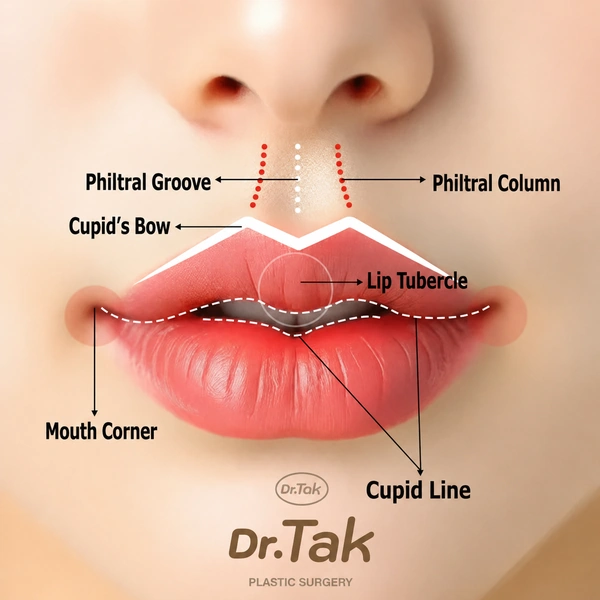
Let me give the conclusion first. A cupid's bow is produced by contrast at a border, not by the amount of tissue. That is why adding volume alone sometimes fails to bring the line back.
The cupid's bow is the curved upper border of the upper lip. In Korea it is also called the lip peak or the M line, and anatomically it is defined by the two points where the philtral columns meet the vermilion border, plus the dip between them. Three elements make that bow readable.
① The white roll — the thin raised ridge between vermilion and skin. It is barely 1mm wide, but it catches light and creates a highlight, so when it is intact the lip outline reads clearly even from a distance.
② The philtral columns — the two ridges descending from beneath the nose. Where they meet the vermilion becomes each peak of the bow.
③ The step between the peaks and the central dip — on measurement, a step of roughly 1.5 to 3mm reads as a distinct bow. Below 1mm the lip looks almost straight from the front.
In other words, a cupid's bow is not built by filling tissue in. It is revealed by uncovering a line that already exists. That single fact decides every fork in the road described below.
Three reasons a lip peak looks blunt — which one is yours
A mirror and three minutes will usually tell you. Work through them in order.
Type A — volume has gone
✅ The central vermilion of the upper lip is thin (clearly thinner than the lower lip from the front)
✅ Part the lips slightly and the bow is still visible
✅ The lips feel thinner overall than they did in your twenties
Central upper vermilion height varies widely, but by the measurements I have taken in clinic the line starts disappearing in front-on photos once it drops below about 8mm. Here the line has not vanished. The thickness supporting it has.
Type B — the upper lip has lengthened
✅ The distance from the base of the nose to the upper lip border feels long
✅ At rest, almost no upper teeth show
✅ You look fine smiling, but older with a neutral expression
Philtrum length in Korean adult women generally falls between 15 and 18mm, and past 20mm the upper lip drapes downward and presses the bow flat. Put filler into this lip and the length stays the same while the weight increases, which can make it hang lower still. This is where the choice diverges most sharply.
Type C — the line itself has collapsed
✅ Thickness and length are both acceptable, yet only the outline is vague
✅ Lipstick bleeds past the border
✅ The line became blunter after filler, not sharper
The white roll has flattened with age, or filler has crossed above it and buried the ridge. Type C is the group that has grown fastest in my clinic over the past few years. When people who have had repeated filler elsewhere say "the more it is filled, the stranger it looks", this is almost always what they mean.
📌 The three types overlap. Even so there is always one dominant cause, and releasing that one first lets the rest follow naturally.
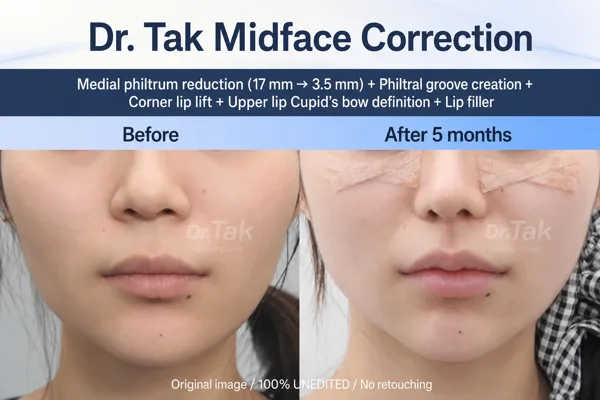
The first choice splits by cause
| Type | Main cause | First choice | Why | When it is not enough alone |
|---|---|---|---|---|
| A | Thin vermilion | Lip filler or mucosal advancement | The line is intact; only thickness needs support | If the lip is also long, consider B alongside |
| B | Excess upper lip length | Lip lift (philtrum reduction) | The bow is pressed flat and must be released by shortening | If still thin afterwards, add A |
| C | Lost white roll | Precise white roll work, or dissolving and redesigning | The line must be restored, not filled | Dissolving comes first if migration is marked |
📍 Bottom line: Putting filler into a Type B lip, and performing a lip lift on a Type A lip, are the two mismatches I see most often in revision consultations.
A 1:1 consultation you can start now
✅✅ We compare every option — filler, lip lift and lip peak tattoo — before anything is decided
✅✅ We give an honest opinion whether or not surgery is involved
📲 Dr.Tak Plastic Surgery official site — chat icon at the bottom right for a live consultation
Filler, lip lift and lip peak tattoo across 11 points
| Comparison | Lip filler | Lip lift (philtrum reduction) | Lip peak tattoo |
|---|---|---|---|
| What it changes | Vermilion thickness | Upper lip length and tooth show | A pigment illusion of the border |
| Suited to | Type A (low volume) | Type B (excess length) | Part of Type C (colour contrast only) |
| Incision | None | Beneath the nose | None |
| Anaesthesia | Topical or local | Local (± sedation) | Topical |
| Procedure time | 15–30 minutes | 40–60 minutes | 60–90 minutes |
| Back to daily life | Same day to 2 days | 5–7 days, to suture removal | Same day |
| When the result is readable | 2 weeks | 3 months (scar matures at 6) | Colour settles at 4–6 weeks |
| Duration | 6–12 months (varies by product and metabolism) | Permanent, structural | 1–3 years as pigment fades |
| Front-on bow improvement | Limited | Large | Moderate, at a distance |
| Side profile improvement | Large | Moderate | None |
| Reversibility | Dissolvable | Difficult; a scar remains | Requires removal treatment |
📍 Bottom line: These three are not competitors. They cover different territory — thickness, length and colour — and what is missing decides the answer.
If you choose the lip lift, recovery runs like this
| Stage | What happens | Care |
|---|---|---|
| Day 0–3 | Peak swelling; the upper lip looks lifted | Cold packs, sleep with the head elevated |
| Day 5–7 | Sutures out, more than half the swelling gone | Avoid opening the mouth wide |
| Week 2–4 | The scar turns its reddest | Strict sun protection |
| Month 2–3 | Shape largely settled | Continue taping |
| Month 6 | Scar mature; time to judge the result | Scar care programme completes |
The point where people waver most is not day three. It is week three, the stretch where swelling drops away while the scar is at its most red. That is exactly why I describe this window before surgery rather than after. Meeting it knowingly is a different experience from meeting it unprepared.
Where filler most often goes wrong on a cupid's bow
Honestly, sharpening a cupid's bow with filler is harder than it sounds.
The reason is anatomical. The white roll is a shallow structure only about 1mm wide, and filler is considerably bulkier than that. If any product crosses above this narrow line it buries the ridge and the outline becomes blunter instead. The superior labial artery also runs beneath the mucosal layer in most people, so the more precisely and superficially you work to sharpen the line, the more careful the judgement of plane has to be.
That is why I often do not recommend more filler to someone who arrives as a Type C. Clearing what is already in there, seeing how much of the line survives, and designing again from that point tends to give a better result.
And one more thing I want to say plainly. This procedure is not right for everyone. Some people have a naturally shallow cupid's bow, and on their face it creates a softness that suits them. Force the bow upward and the mouth can read as sharp, and some people genuinely feel it is no longer their own face. There are days when I send someone home without recommending surgery at all.
How we have worked with this line
🏥 Why patients trust us
✅ Over 15 years of experience in a clinic specialising in lips and the philtrum — the cupid's bow sits at the centre of that
✅ Over 200 Google reviews with a 5-star rating
✅ A steadily rising share of revision consultations requiring filler clearance and redesign
✅ 100% appointment-only, so each person gets full measurement and consultation time
💬 "To make people smile"
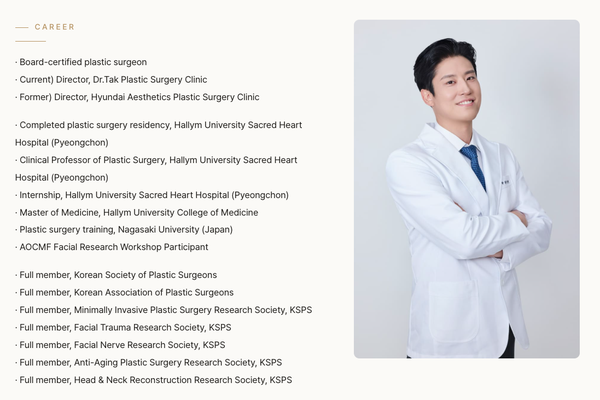
The Dr.Tak 4S Patient Care System — focused on the person, not the procedure
We focus on the person, not the procedure.
Solution — a 1:1 master plan with Dr. Seungwan Tak
- Sincere empathy and communication: your wishes are carried fully into the operation
- Precise facial golden-ratio analysis, individually tailored: vermilion thickness, philtrum length and white roll condition measured separately to confirm whether the cause is A, B or C
- A simulation of the expected change after surgery
Support — a global 1:1 dedicated coordinator
- A dedicated coordinator assigned by country, with no language barrier
- Accompaniment through consultation, surgery and aftercare
- 100% appointment-only, for a private clinical environment
Scar Care — six months of intensive scar management
| Item | Period | Content |
|---|---|---|
| Control taping | 3–6 months | Prevents scar widening |
| Scar-softening injection | 6 months, monthly | Softens raised scar |
| Laser treatment | 6 months | Reduces redness at the surgical site |
Service — a one-year free revision guarantee
- Free revision within one year of surgery
- We see your care through to the end
- ※ Where sedation is used, a basic anaesthesia fee may apply
If you would like to know more — official channels
🌐 The official site carries material on lips and the philtrum, along with consultation information
📝 Clinical columns written by the surgeon himself cover white roll and philtral column design in more detail
📹 Video material on the operation and the recovery course is also available
Five things to settle before you decide
✅ Which bothers you more, the front view or the profile (profile means thickness, front means the line)
✅ Do your upper teeth show at rest, or not
✅ Do you remember the type and timing of every filler you have had
✅ Would you change the structure even at the cost of a scar, or would a reversible option sit easier with you
✅ Is what you want a distinct bow, or simply a mouth a little tidier than it is now
Settling the fifth item alone cuts consultation time in half.
Frequently Asked Questions (FAQ)
These are the questions that reach Dr.Tak Plastic Surgery most often.
Q1. Can filler alone give me a cupid's bow
If you are Type A, with the line intact and only thickness lacking, yes. The condition I feel decides it in practice is not volume but plane. A small amount placed precisely in the shallow layer just beneath the white roll lets the ridge stand; the moment product crosses above it, the line is buried and reads blunter. That is why I prefer to place little at the first session and review at two weeks.
Q2. My cupid's bow is too pronounced — can it be reduced instead
Reduction consultations come up more often than you would think, since a very deep bow can read as sharp or displeased. The approach is not to carve the bow away but to narrow the step between the peaks and the central dip. Placing a very small amount centrally to soften that step comes first, and only where the philtral columns are structurally overdeveloped do we discuss the next stage.
Q3. How is this different from Russian lips
Russian lip technique injects vertically from inside the vermilion to raise height, while cupid bow surgery restores contrast at the upper border of the lip. The goals differ, so the results do. People do come to me after Russian lips saying the height improved but the line is still vague, and that is because raising height does not sharpen a border.
Q4. What does it cost, and what makes the cost vary
I would rather give you the range and the variables than a single figure, because that is the honest answer. Three things move the cost: whether it is filler or surgery, whether existing filler has to be cleared first, and whether philtrum length adjustment is included. The same phrase "cupid bow surgery" covers very different price brackets depending on that combination, so treat any quote given without measurement as indicative only. Specific figures are given at consultation.
Q5. What if I sharpen the line and it no longer looks like my face
This is the question I am asked most, and the one I weigh most heavily. So in consultation I ask not how sharp you want it, but where the edge of your own face lies. Where the philtrum is already short and tooth show is ample, where a lot of gum shows on smiling, and where a shallow bow is what gives a face its softness, I do not recommend the procedure. The harder something is to reverse, the more conservative the judgement should be.
Dr.Tak Plastic Surgery | Korea Face Lifting · Lip · Philtrum Specialist Clinic
"To make people smile"