Your upper lip looks thin — but should the lower lip be done too?
Every time you look in the mirror, the upper lip seems noticeably thin, and you have probably hesitated over whether the lower lip should be done as well. One lip alone feels like it might look odd; both feels like it might be too much.
This is the question I hear most often in mucosal advancement consultations. And I do not answer it straight away. The answer only appears after we look at three views together: the front, the profile and the smile.
Even with the same V-Y plasty, the upper and lower lips are shaped differently from the start. So the place where I draw the Vs, and the change you can expect, are different too. In this article I will first look at how the two lips differ, then set out three criteria for deciding which lip to treat, and finally put the three options side by side in one table.
By the end, you will see why "which lip" comes before "how much".
What V-Y plasty on the upper and lower lip means — the same V-Y, a different design
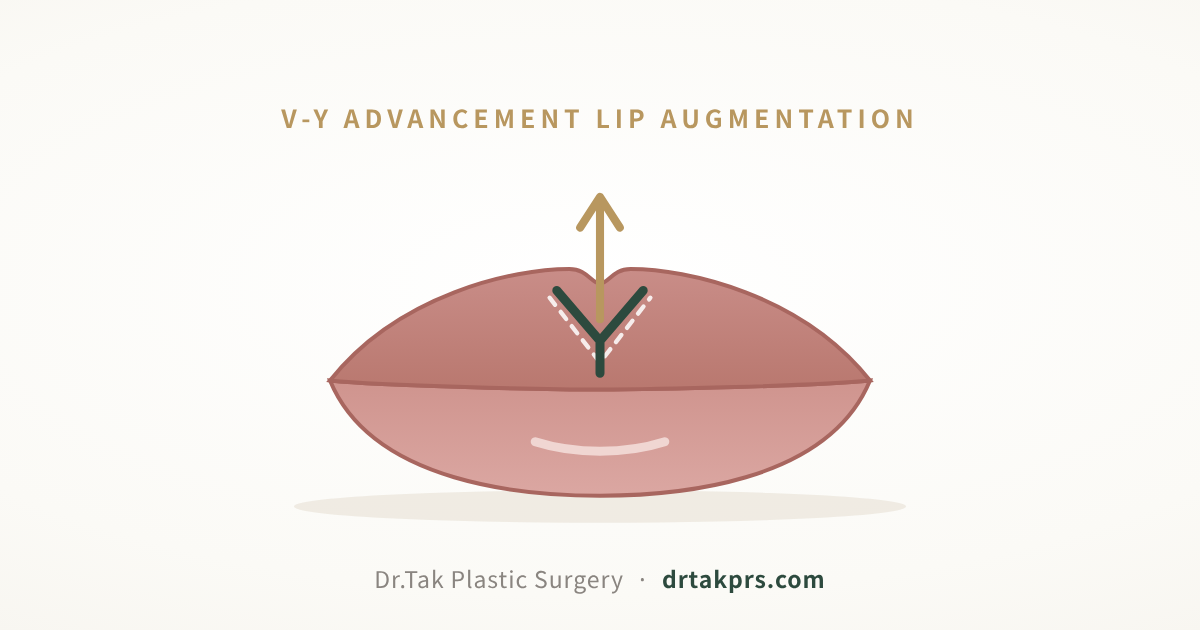
The short answer: V-Y plasty on the upper and lower lip is lip augmentation that places a V-shaped incision in the inner lining of the lip and closes it as a Y, moving tissue forward and outward — with the design set differently for the upper lip and the lower lip. It is also called V-to-Y lip augmentation, V-Y lip advancement or mucosal advancement.
The principle is single. Inner mucosa is drawn out so more red lip shows, and the lip comes forward in profile. Because no foreign material is added and only the direction of your own tissue changes, the result is permanent and every incision stays inside the mouth. I have explained step by step where the tissue actually moves in how V-Y advancement lip augmentation works.
The difference comes from where it is applied. On the upper lip it is closer to shaping; on the lower lip it is closer to support. Let us see where that difference comes from.
The upper and lower lips are built differently
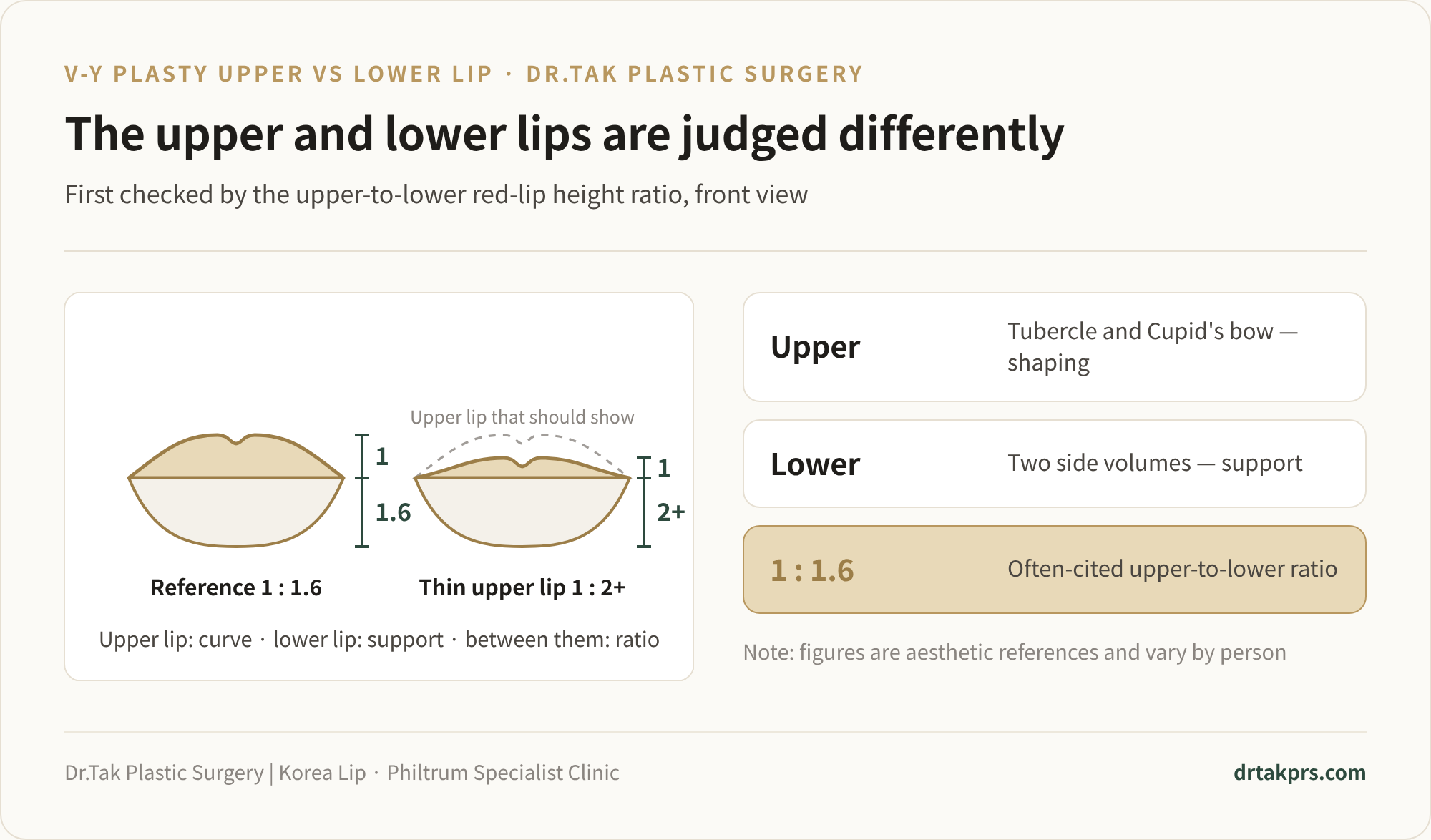
The short answer: the upper lip is a "three-dimensional lip" with a central tubercle and the curve of Cupid's bow, while the lower lip is a "broad lip" supported by two side volumes. That is why the number and position of the Vs change, even with the same V-Y.
① The upper lip — central tubercle and Cupid's bow
At the centre of the upper lip sits a small downward bulge, the tubercle, and the border above it curves like a bow. What makes an upper lip attractive is this curve more than its volume. So before placing Vs on the upper lip, I first decide whether to preserve the central tubercle or fill the sides. If the tubercle is already well defined and a large central V is added, the lip can look pointed and pushed forward.
② The lower lip — two side volumes
The lower lip is slightly hollow in the middle with two full volumes on either side. So on the lower lip I usually place one V on each side to support both volumes together. Enlarging only the centre tends to make the lower lip look heavy, as if it were drooping forward.
③ How the two relate — front ratio and profile angle
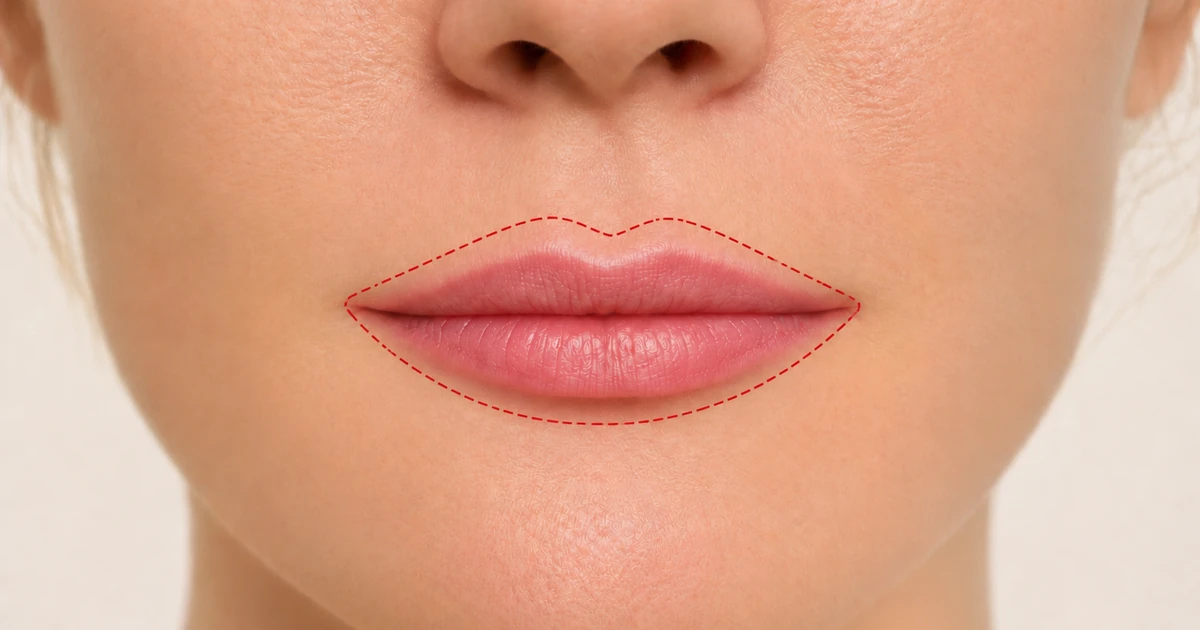
From the front, a lower lip slightly fuller than the upper looks natural; the upper-to-lower red-lip ratio often cited as an aesthetic reference is about 1:1.6. In profile, balance looks best when the upper lip sits just slightly ahead of the lower. When only one lip is treated, keeping this relationship intact is what I watch most closely.
📌 In short: for the upper lip we look at the curve, for the lower lip the support, and between them the ratio.
So which lip is actually lacking in your case? There are three things I really check.
Three criteria for choosing which lip — front, profile and smile
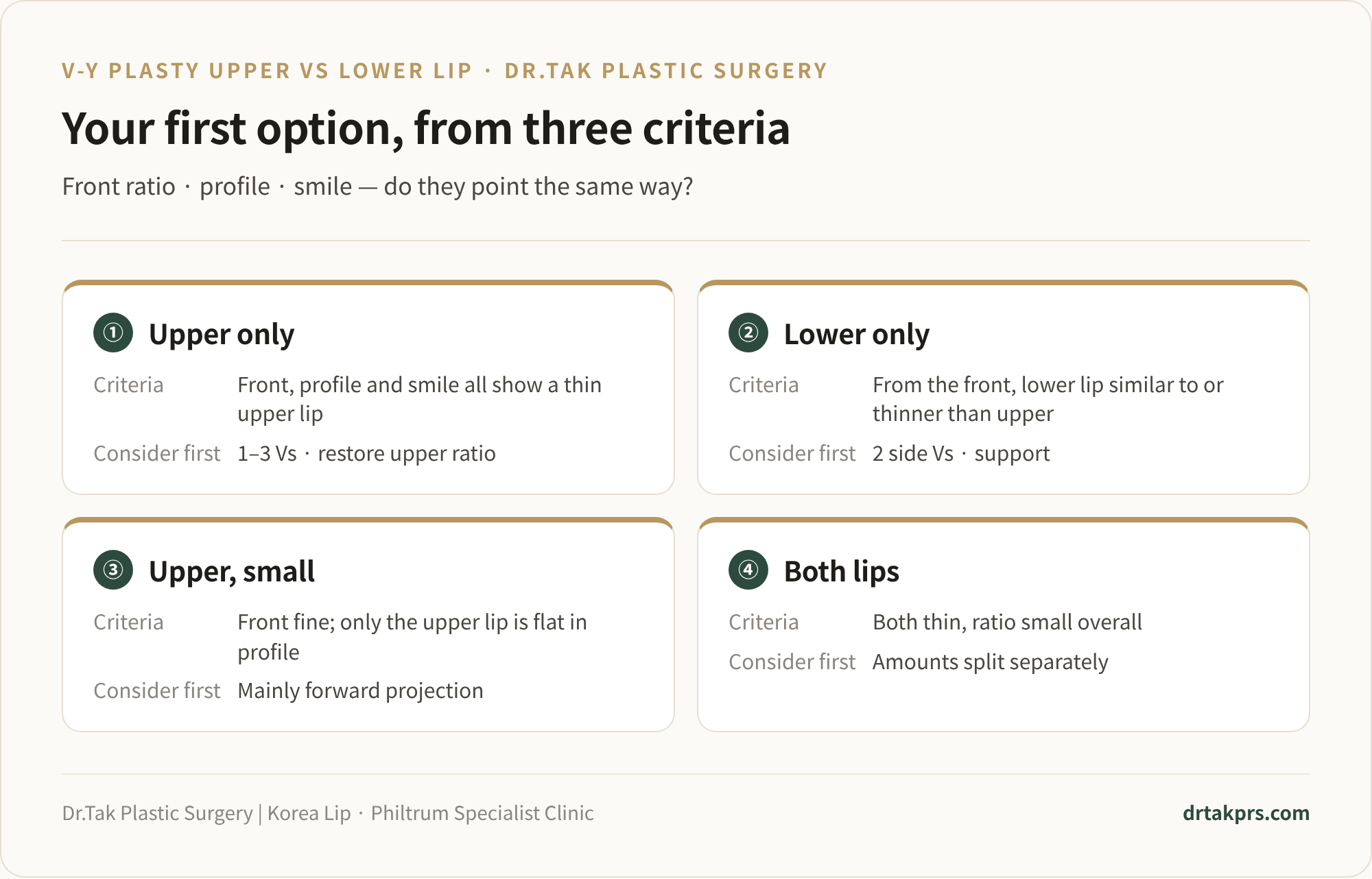
The short answer: which way the front ratio leans, which lip sits back in profile, and which lip disappears when you smile. If all three point the same way, we treat that lip only; if they point different ways, we consider both.
① Front ratio — the height of the upper and lower red lip
With the mouth relaxed and closed, I measure the height of the upper and lower red lip from the front. If the lower lip is well over twice the upper, the upper lip is the one lacking; if the two are nearly equal or the upper is fuller, the lower lip is the one lacking. In consultation I mark these numbers directly on your photo. Seeing the figures makes a vague worry much clearer.
② Profile — which lip sits back
The profile shows what the front view hides. More people than you might expect have a fine front ratio but an upper lip that looks flattened from the side. For them, adding only forward projection to the upper lip is enough; touching the lower lip as well can make the mouth look protruding.
③ Smile — which lip disappears
When you smile, the upper lip is pulled up and thins out. Some people tell me their lips look fine at rest, but the upper lip becomes thread-thin when they smile, so they have avoided photos. If that frustration is the core of the worry, V-Y on the upper lip comes first. The lower lip does not shrink much on smiling, so this criterion is used mainly to judge the upper lip.
| What the three criteria show | The option I consider first |
|---|---|
| Front, profile and smile all show a thin upper lip | Upper lip only |
| From the front, the lower lip is similar to or thinner than the upper | Lower lip only |
| Front is fine; only the upper lip is flat in profile | Upper lip, small, mainly forward projection |
| Both lips are thin and the ratio is small overall | Both lips |
This table is only a starting point. Even with the same result, the answer changes with how much mucosa there is and the state of the teeth and jaw.
Start with a 1:1 tailored consultation
✅✅ Upper only, lower only or both — the three options compared against your own lip ratio and profile
✅✅ An honest opinion, whether or not you choose surgery
📲 Chat icon at the bottom right of the Dr.Tak Plastic Surgery official site → live consultation
Comparing the three options — upper only, lower only, both
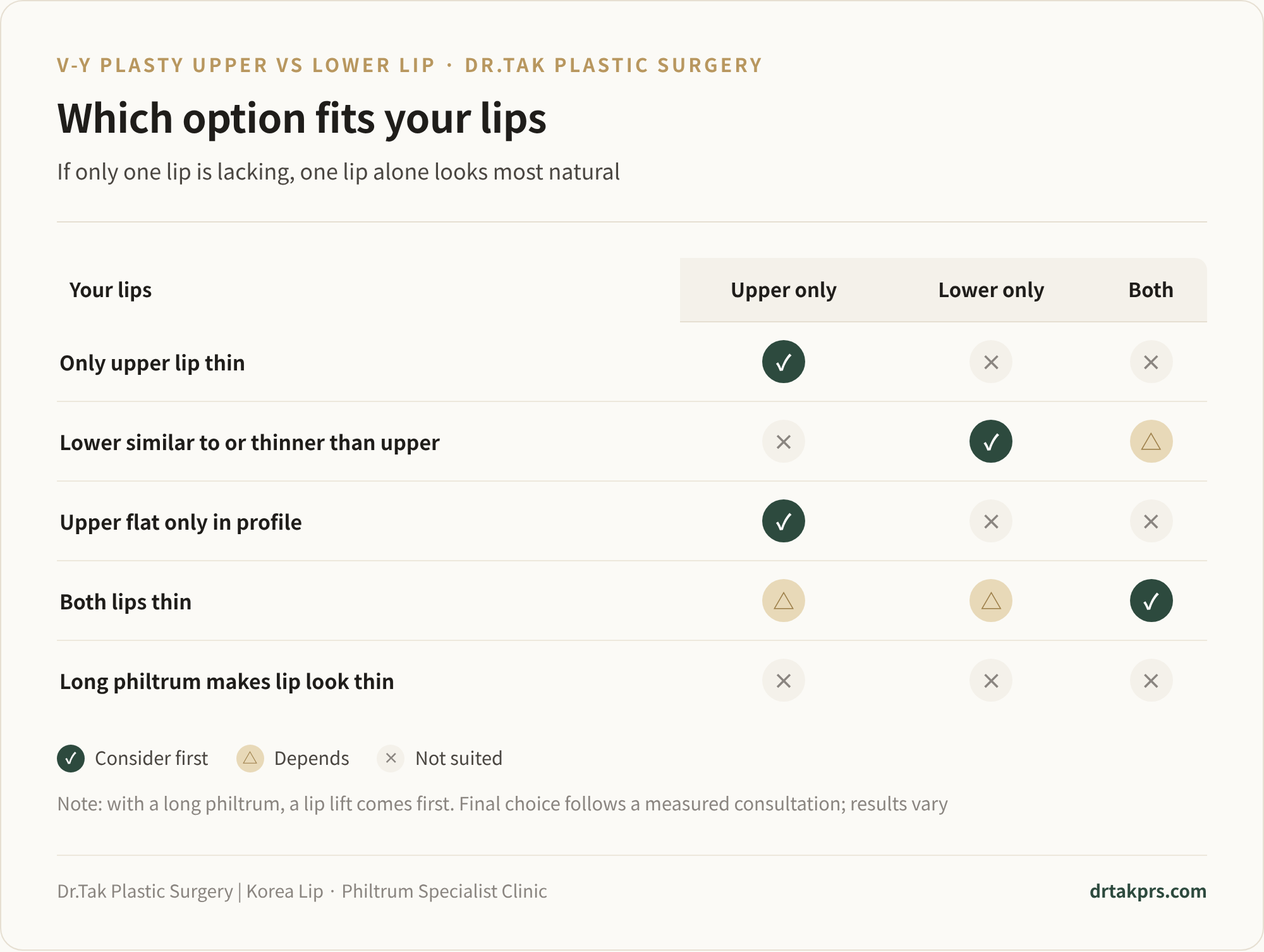
The short answer: upper only changes the impression most, lower only is the option that fits least often, and both makes the ratio easiest to protect but carries more recovery.
| Item | Upper lip only | Lower lip only | Both lips |
|---|---|---|---|
| Usually suits | Lower lip is full enough; only the upper is thin | Upper lip is fine; lower is similar or thinner | Both thin, ratio small overall |
| V placement (typical) | 1–3 Vs, central and/or sides | 2 Vs, one each side | 1–3 upper + 2 lower |
| Change from the front | Large — the centre of the face looks defined | Moderate — the mouth looks more settled | Large — the whole lip looks fuller |
| Change in profile | Upper lip comes forward | Lower lip is supported | Whole lip comes forward |
| Risk to the ratio | Overdone, the upper looks heavy | Overdone, the lower looks droopy | Lowest, as both are adjusted together |
| Swelling | About 2–3 weeks | About 2–3 weeks | About 2–3 weeks, but feels more uncomfortable |
| Eating and speaking | About 1 week of discomfort | About 1 week of discomfort | About 1 week, more noticeable |
| Adding the other lip later | Lower lip can be added | Upper lip can be added | Not applicable |
| Effect on cost | One lip | One lip | Both lips, so the range rises |
📍 Bottom line: doing both lips is not automatically the right answer. If only one lip is lacking, treating that lip alone looks most natural, and both lips make sense only when the ratio itself is small.
In my own consultations, upper lip only is the most common and lower lip only the least. Korean patients often have a naturally full lower lip. But there are cases where none of these three is the answer.
When something else should come before mucosal advancement
To be honest, a thin-looking upper lip does not always mean mucosal advancement is the answer. If the reason the lip looks thin lies outside the lip, adding Vs to either lip will not give the change you expect.
⚠️ The upper lip looks thin because the philtrum is long — when the distance from nose to lip is long, the red lip looks short. A lip lift comes first, and V-Y is judged again on the lip that remains
⚠️ The mouth is pushed forward (bimaxillary protrusion) — teeth and gum bone are already pushing the lips forward, and adding volume makes the mouth look more protruding
⚠️ The upper lip is flat because the upper jaw sits back — this is a problem of the supporting structure, not the lip, so an orthodontic consultation comes first
⚠️ The lip itself is narrow from side to side — V-Y brings the lip forward and outward, so it barely changes width. If width is your concern, start with why narrow lips happen and how they are corrected
⚠️ Filler remains, or there is a lot of scarring in the mucosa from earlier surgery — remaining filler is cleared first, and heavy scarring can leave too little mucosa to draw out
If any one of these applies, I talk about the cause before which lip to treat. It is not postponing surgery; it is choosing the right one.
How recovery differs — one lip versus both
The short answer: doing both lips at once does not double the recovery time. Swelling goes down at almost the same pace; what changes is the discomfort of the first one to two weeks.
| Period | One lip | Both lips |
|---|---|---|
| Day 0–3 | Pulling and swelling on the treated lip | The whole mouth swells; opening wide is hard |
| About day 7 | Stitches removed | Stitches removed (upper and lower on the same day) |
| 2 weeks | About 70% of swelling gone | About 70% of swelling gone |
| 3–6 weeks | Firmness felt under the suture line | Both lips firm; the smile feels a little stiff |
| 3 months | Close to the final shape | Close to the final shape |
What people who have both lips done find hardest is eating in the first few days. Before surgery I explain the soft foods you can have then, and how to use a spoon instead of a straw. Knowing in advance makes it far less unsettling.
📌 During recovery: for the first week avoid spicy and hot food, straws and puckering your lips hard, and please pause smoking and drinking until the suture lines have healed.
Upper and lower amounts set separately, in millimetres — a principle kept for over 15 years
When both lips are treated, what I guard against most is giving both lips the same amount. The two lips start at different thicknesses, so the same 3 mm looks large on the upper lip and small on the lower.
So I measure and design each lip separately. Advancement is mostly set within 3–4 mm, but the amounts are divided differently between the two lips so the ratio gathers near 1:1.6. Too little can be added to later; too much is hard to take away. I start small.
🏥 Briefly, here is what lets us keep to this principle.
- Over 15 years of experience focused on this area alone as a lip and philtrum specialist clinic
- Over 200 Google reviews, 5.0 out of 5 — reflecting the consultation process as well as the results
- In every consultation we first show the upper and lower measurements and the V design as a drawing before discussing surgery
- If we judge the cause to be philtrum length or the teeth and jaw, we tell you about that cause before mucosal advancement
💬 "To make people smile." For someone who avoided photos because the upper lip vanished when smiling, this sentence becomes a fairly concrete goal.
Before & after photographs are on our official page
Dr.Tak Plastic Surgery complies with medical advertising regulations, so we do not place before-and-after photographs inside blog articles. Actual pre- and post-operative changes are collected on the official before & after page.
🔗 View before & after — Dr.Tak Plastic Surgery official page
Results may vary from person to person.
The Dr.Tak 4S Patient Care System — focused on the person, not the procedure
We focus on the person, not the procedure.
Solution — a 1:1 master plan with Dr. Tak Seung-wan
- Genuine empathy and communication: your wishes reflected fully in the surgical plan
- Precise facial golden-ratio analysis, personalised: upper-to-lower red-lip ratio, profile lip position and lip show when smiling measured separately for each lip, to decide which lip to treat and by how much
- Post-operative change simulation provided
Support — a global 1:1 dedicated coordinator
- A dedicated coordinator assigned by country, no language barrier
- Accompanies you through consultation, surgery and aftercare
- 100% appointment-only, for a private clinical environment
Scar Care — six months of intensive scar management
| Item | Period | Content |
|---|---|---|
| Control taping | 3 to 6 months | Prevents scar widening |
| Scar-softening injection | 6 months, monthly | Softens raised scars |
| Laser treatment | 6 months | Reduces redness at the surgical site |
Service — one year of complimentary A/S
- Complimentary A/S within one year of surgery
- We see it through to the end
- Note: basic anaesthesia costs may apply when sedation is used
If you want to know more — official channels
🌐 The Dr.Tak Plastic Surgery official site carries detailed guides for each lip and philtrum procedure
📝 The blog collects articles by procedure — mucosal advancement, lip lift, lip augmentation, mouth corner correction
📹 Video lets you follow the surgical process and recovery course
Five things to settle for yourself before deciding
✅ In a front photo, which red lip looks thinner, upper or lower? — take it with your mouth relaxed and closed
✅ In a profile photo, which lip sits back? — the answer may differ from the front view
✅ How much upper lip remains when you smile? — one smiling photo is a strong hint
✅ Is your philtrum on the long side, or does your mouth look pushed forward? — if so, the cause may lie outside the lip
✅ Have you had lip filler? — if so, bring the date of your last treatment and your photos from before
You do not need to bring the right answers. Even just these three photos make the consultation much more concrete.
Frequently Asked Questions (FAQ)
These are the questions Dr.Tak Plastic Surgery hears most often.
Q1. What if I do only the upper lip and the lower lip then looks too thick?
This is the most common worry, and an entirely reasonable one. So when I set the amount for the upper lip, I do not look at the upper lip alone — I work backwards from the thickness of the lower lip. If the upper lip is enlarged only up to the point where the ratio does not tip heavier than 1:1.6 on top, the lower lip often ends up looking more naturally balanced. In the pre-operative simulation we show the front and profile with only the upper lip enlarged, so you can decide after seeing that screen.
Q2. After surgery there is mucosa folded like wrinkles inside my mouth. Will it stay?
Around one to two weeks after surgery, many people are surprised to feel with their tongue that the mucosa around the inner suture line is folded like wrinkles. This happens because the mucosa gathered into the Y is still settling, and in most cases it flattens over 4–8 weeks as the swelling goes down. If both lips were done you feel it on both, so it can be more bothersome, but it cannot be seen from outside. If a fold is still clearly there and uncomfortable after three months, we decide together whether to tidy it.
Q3. If both lips are done at once, is it more painful and is recovery longer?
During surgery there is hardly any pain because of anaesthesia, and for a few days afterwards both lips feel tight, so it is more uncomfortable than one lip. But the pace at which swelling goes down and the time the final shape appears are almost the same as for one lip, so recovery does not double. In my experience, splitting the two lips into separate operations means going through swelling and the firm stage twice, so for people who need both I tend to recommend doing them together.
Q4. If V-Y makes my upper lip longer, will less gum show when I smile?
There is research reporting that as V-Y brings the upper lip slightly forward and down, gum exposure on smiling is reduced a little. But the change is small, and if a gummy smile comes from the length of the upper jaw or the muscles that lift the lip, V-Y will not solve it. So I do not set gum exposure as a goal of V-Y; I describe it only as a change that may come as a bonus. If gum show is the centre of your concern, the right order is to find its cause first.
Q5. Can I do the upper lip first and the lower lip later? And what about cost, and when it does not suit?
Yes. Watching the upper lip result for about three months and then deciding whether the lower lip is needed is something we do often. The exact cost is hard to state definitively; the range depends on whether it is one lip or both, how many Vs are placed, whether remaining filler must be cleared, whether it is a revision, and whether sedation is used. Doing them separately means two single-lip procedures, so the total can be structured differently from doing both at once. On the other hand, for people whose cause lies outside the lip — a long philtrum or a protruding mouth — or who lack enough mucosa, I tell them the operation does not suit them before talking about cost.
Dr.Tak Plastic Surgery | Korea Face Lifting · Lip · Philtrum Specialist Clinic
"To make people smile"