A V drawn inside the lip — it sounds strange at first
Many people researching mucosal advancement stop at the letters "V-Y." It is hard to picture what drawing letters on a lip looks like, and even harder to see why it would make the lip fuller. I imagine that is where you are now.
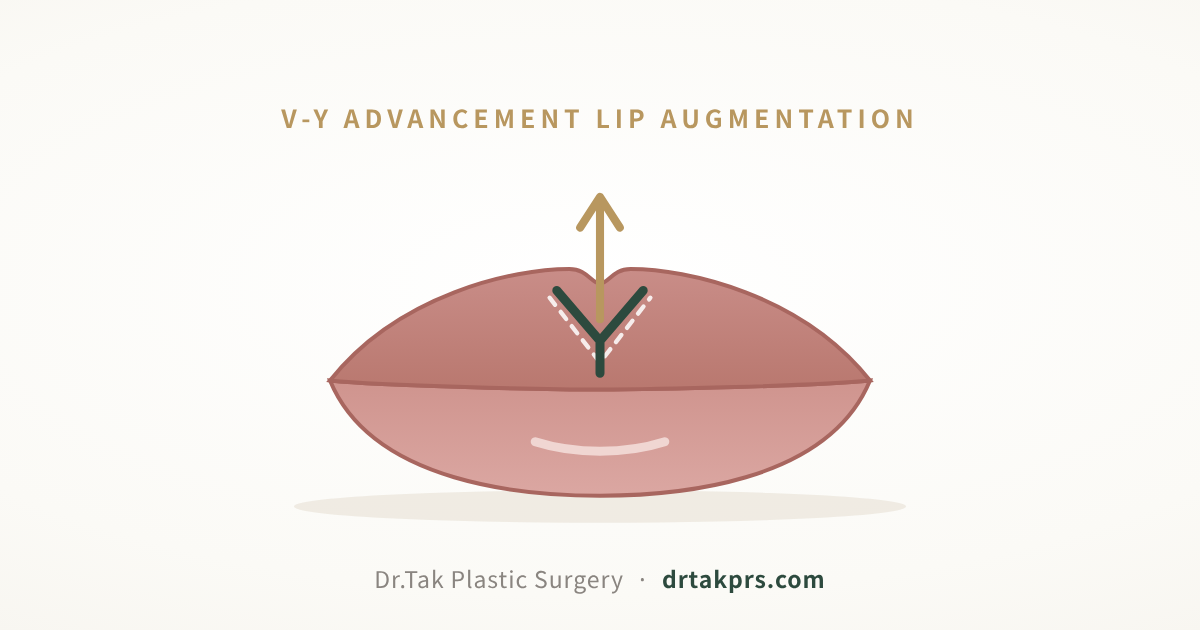
When I explain this surgery in consultation, the first thing I reach for is a pen and paper. I draw a V, then bring its two arms together in the middle to turn it into a Y. People immediately see that as the tail of the Y grows longer, tissue is pushed out in one direction. This article simply moves that paper explanation onto the lip.
Here is the order. I will define V-Y advancement lip augmentation, look briefly at the layers of the lip, then follow step by step where the tissue moves when a V becomes a Y. After that I will show how the number and position of the Vs change the shape of the lip, and put it side by side with other lip augmentation methods in a table.
Once you understand the principle, your questions in consultation change. Before asking how much bigger your lips will get, you start asking which direction your lips need to come out.
What exactly is V-Y advancement lip augmentation — volume made from inside the lip
To put it plainly, V-Y advancement lip augmentation is a surgery that places a V-shaped incision in the wet inner lining of the lip (the labial mucosa) and closes it in a Y shape, moving the inner tissue forward and outward. Nothing foreign is injected — your own tissue is repositioned — so the result is permanent, and because every incision is inside the mouth, no scar is left on the outer skin.
It goes by several names, which makes it easy to confuse. You will see V-Y advancement, V-to-Y lip augmentation, V-Y mucosal advancement and V-Y lip lift; in Korea it is often simply called mucosal advancement. Because of the words "lip lift," many people assume it is the same as the lip lift that removes skin under the nose to shorten the philtrum — but the two are entirely different surgeries, with different incision sites and different goals.
V-Y advancement lip augmentation changes two things. One is how much red lip shows from the front. The other is how far the lip projects when seen in profile. If filler "fills" the lip, this surgery is closer to "drawing out" tissue that is already there.
So what is drawn out, and from where? Looking first at how many layers the lip has makes the answer much easier.
The lip has three layers — mucosa, red lip and orbicularis oris
Imagine cutting the lip and looking at it from the side: three layers overlap. V-Y advancement moves the innermost layer to change how the outer layer looks.
① Labial mucosa (the wet inner surface)
The moist inner surface that touches the teeth. It has room to stretch and a rich blood supply, so it heals well. Every V-Y incision is placed in this layer. Before surgery I always turn the lip out with my fingers to check the thickness and slack of this mucosa myself. Without slack here, there is no tissue to draw out.
② Red lip (vermilion)
The part where you apply lipstick. There is a boundary where the dry outer surface meets the wet inner surface — the wet-dry line — and how far out that line sits when you smile decides whether the lip looks full or thin. V-Y advancement pushes this boundary outward so more red lip shows.
③ Orbicularis oris
The ring-shaped muscle around the mouth that supports the shape and movement of the lips. The surgery is designed to move the mucosa over this muscle without cutting it. That is how speaking and smiling return to natural movement after surgery.
📌 In short: move the inside (①) to change the outside (②), and protect the muscle that carries movement (③). That is the design principle of V-Y advancement lip augmentation.
Now let us follow how the tissue actually moves when a V is drawn and closed as a Y.
The moment a V becomes a Y — four steps of tissue movement
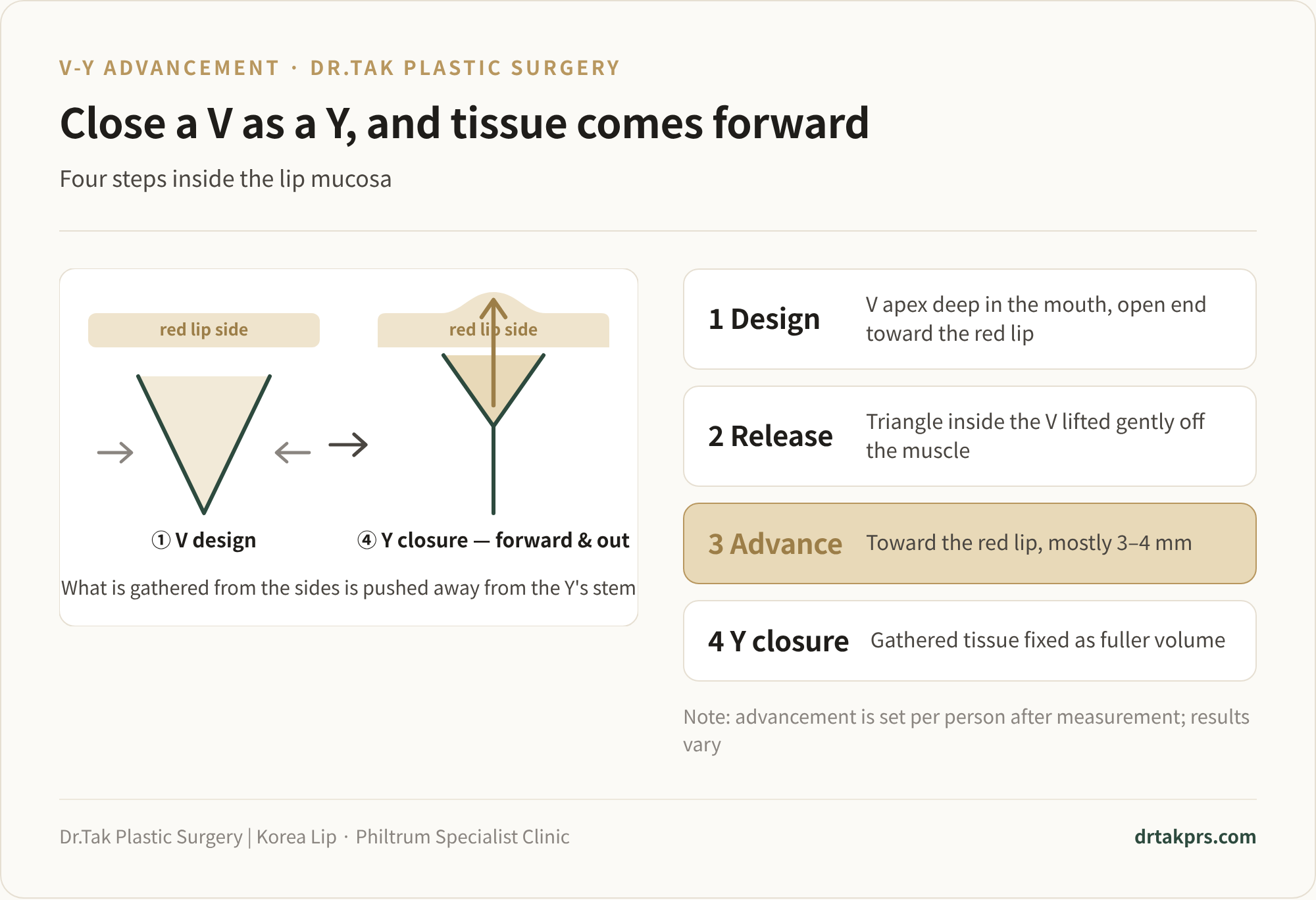
To put it plainly, V-Y closure gathers tissue from both sides toward the center and pushes the gathered tissue in the direction of the Y's tail — outward toward the lip. Width narrows, and forward length increases.
| Step | What is done | What happens to the tissue |
|---|---|---|
| 🖊 1. Design | A V is drawn on the labial mucosa. Its apex points deep into the mouth; its open end faces the red lip | No change yet. The size, angle and position of the V decide most of the result |
| ✂️ 2. Incision and release | The mucosa is cut along the V, and the triangle inside the V is lifted gently off the muscle beneath | The triangle of tissue becomes free to move |
| ⬆️ 3. Advancement | The triangle inside the V is pushed up toward the red lip | Tissue moves forward and outward. I usually set this distance within 3–4 mm |
| 🧵 4. Y closure | The two arms of the V are joined in the middle and the remaining lower part is closed in a line, forming a Y | The new position is fixed, and the gathered tissue stays there as fuller volume |
The numbers make it clear. At 3 mm the lip looks naturally unrolled; closer to 5 mm, anyone can see it is fuller. A single millimetre changes an impression.
📍 Bottom line: the volume from V-Y advancement lip augmentation is not added volume but redirected volume. That is why the direction matters as much as the distance.
And what decides that direction is how many Vs are drawn, and where.
Start with a 1:1 tailored consultation
✅✅ Before V-Y advancement lip augmentation, we compare horizontal excision, vermilion advancement, filler and fat grafting against the structure of your own lips
✅✅ An honest opinion, whether or not you choose surgery
📲 Chat icon at the bottom right of the Dr.Tak Plastic Surgery official site → live consultation
How many Vs, and where — the design decides the shape of the lip
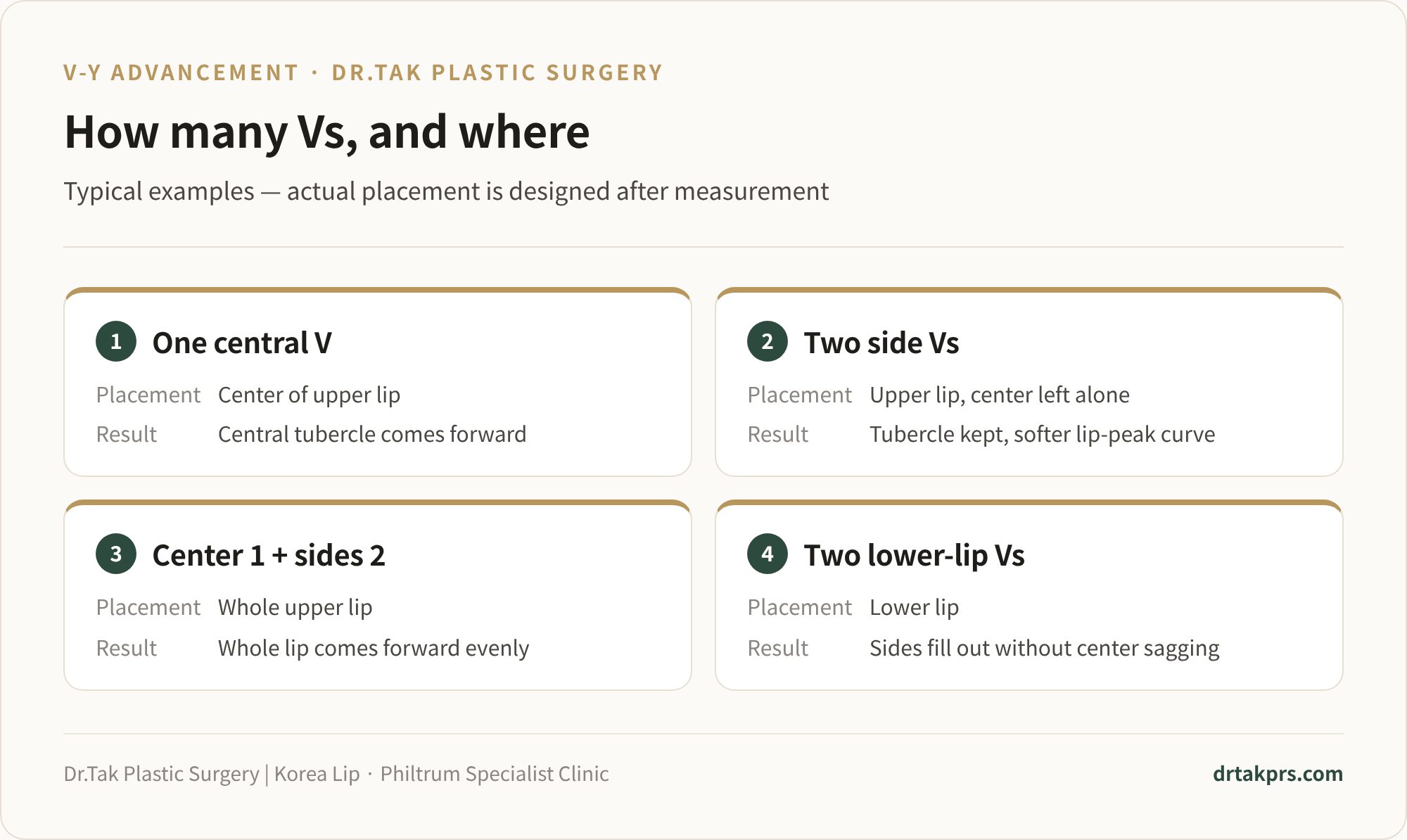
This is the biggest reason the same V-Y advancement can look different from person to person. The V is not always a single cut; its number and position are designed around the shape of the lip.
| V placement | Mainly used on | Resulting shape |
|---|---|---|
| One central V | Center of the upper lip | The central tubercle (the small bulge in the middle of the upper lip) comes forward more clearly |
| Two side Vs, center left alone | Upper lip | Keeps the central tubercle while the sides fill out, softening the curve of the lip peaks |
| One central + two side Vs | Whole upper lip | The whole lip comes forward evenly. Usually the largest change in volume |
| Two side Vs | Lower lip | The sides of the lower lip fill out together without the center sagging too much |
Note: these placements are typical examples. The actual number, size and angle are designed individually to match lip length and mucosal slack.
Before deciding the design I measure three things first: ① the height ratio of upper to lower red lip from the front, ② the angle at which the upper lip projects in profile, and ③ how much red lip shows when smiling. The upper-to-lower red-lip ratio often cited as an aesthetic reference is roughly 1:1.6, and where that ratio breaks down determines where the Vs go.
Take someone whose front-view ratio is fine but whose profile looks flat. Placing many Vs for this person would make the front view heavier. In that case I choose to add a little forward projection, centered on one middle V. Someone whose upper lip looks thin across the whole front view, on the other hand, gets Vs spread evenly.
💡 What to ask in consultation: "How many Vs, and where, do you plan for my lips?" The answer should come as a drawing — that is how you can see the result together in advance.
So how does it differ from other methods that also go by the name "lip augmentation"?
V-Y and other lip augmentation methods — nine items side by side
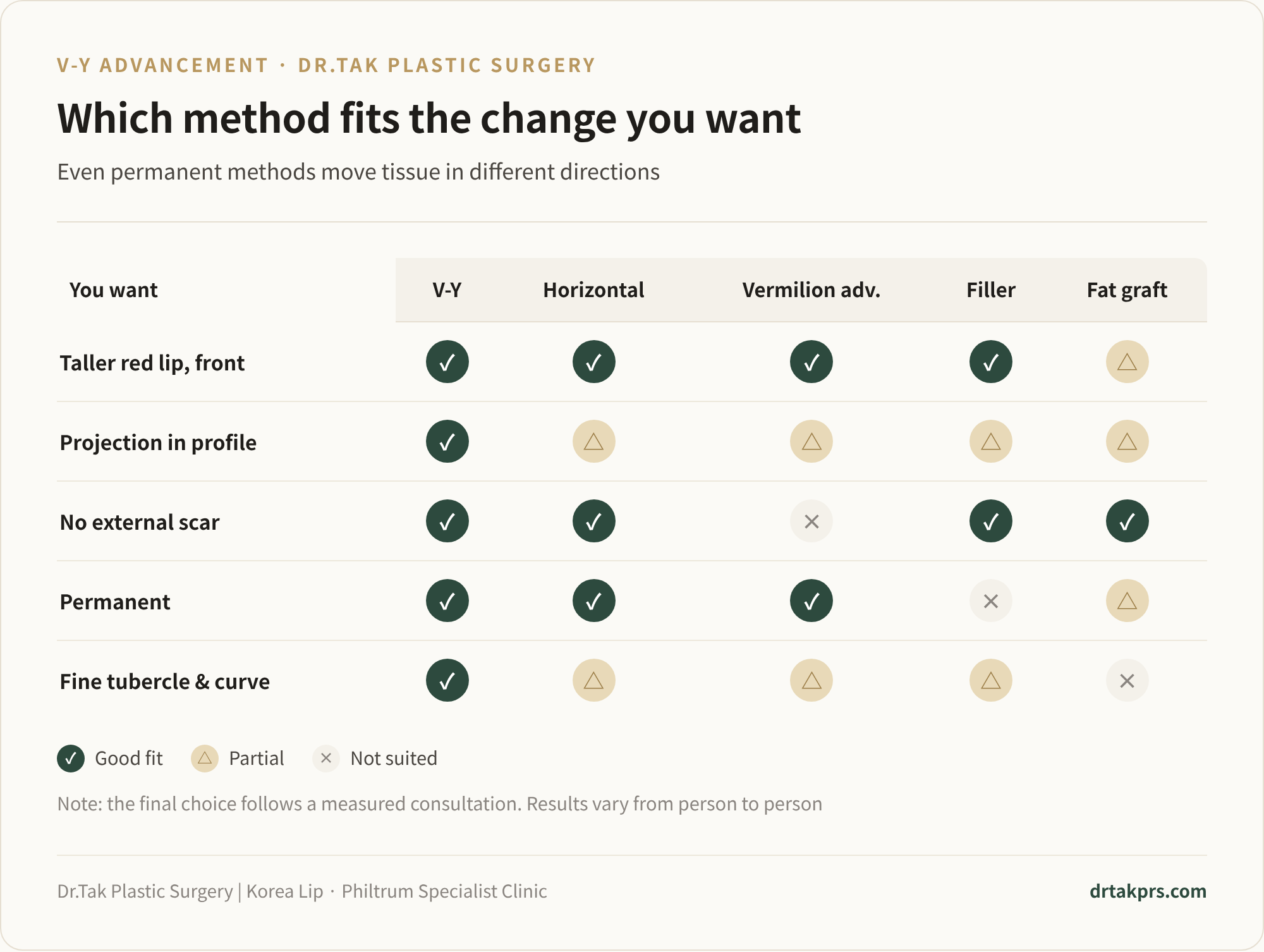
To put it plainly, even among permanent lip augmentation methods, the incision site and the direction the tissue moves are different. V-Y moves tissue forward from inside the mouth, horizontal excision moves it upward from inside the mouth, and vermilion advancement pulls the lip up toward the skin from the outer lip border.
| Item | V-Y mucosal advancement | Horizontal excision advancement | Vermilion advancement | Lip filler | Fat grafting |
|---|---|---|---|---|---|
| Incision site | Inner mucosa (V shape) | Inner mucosa (horizontal strip) | Outer border of the red lip | None | Needle points |
| Direction of tissue movement | Forward and outward | Mainly upward and outward | Pulled up toward the skin | Swells where injected | Swells where injected |
| Forward projection | Large | Small to moderate | Small | Adjustable | Adjustable |
| External scar | None | None | Possible fine line scar | None | None |
| Duration | Permanent | Permanent | Permanent | 6–12 months | Depends on graft survival |
| Reversibility | Difficult | Difficult | Difficult | Possible with dissolving injection | Difficult |
| Control of tubercle and curve | Fine control through V placement | Limited | Mainly the lip line | Possible, with migration risk | Limited |
| Swelling period | About 2–3 weeks | About 2–3 weeks | About 1–2 weeks | 1–3 days | 1–2 weeks |
| Best suited when | The profile is flat too and you want permanent volume | You only want a little more red-lip height | The lip border is indistinct | You want to try first | Combined with fat grafting elsewhere |
📍 Bottom line: if you only want more height from the front, other options are enough. But if you want your lips to look more projected in profile, the structural advantage of V-Y — redirecting tissue forward — becomes clear.
That advantage does not apply to every lip, though.
Lips this principle suits, and lips it does not
To be honest, V-Y advancement lip augmentation is not right for everyone. There has to be tissue to draw out, and the reason the lips look thin has to lie in the lips themselves.
It suits you when
✅ Your lips look flat from both the front and the side, and you want a permanent result
✅ You are tired of filler that fades quickly or spreads above the lip (leftover filler is cleared first) — how to choose surgery over filler, and what it costs, is covered separately in why people choose mucosal advancement for permanent lip augmentation, and its cost
✅ There is plenty of slack in the inner mucosa when the lip is turned out
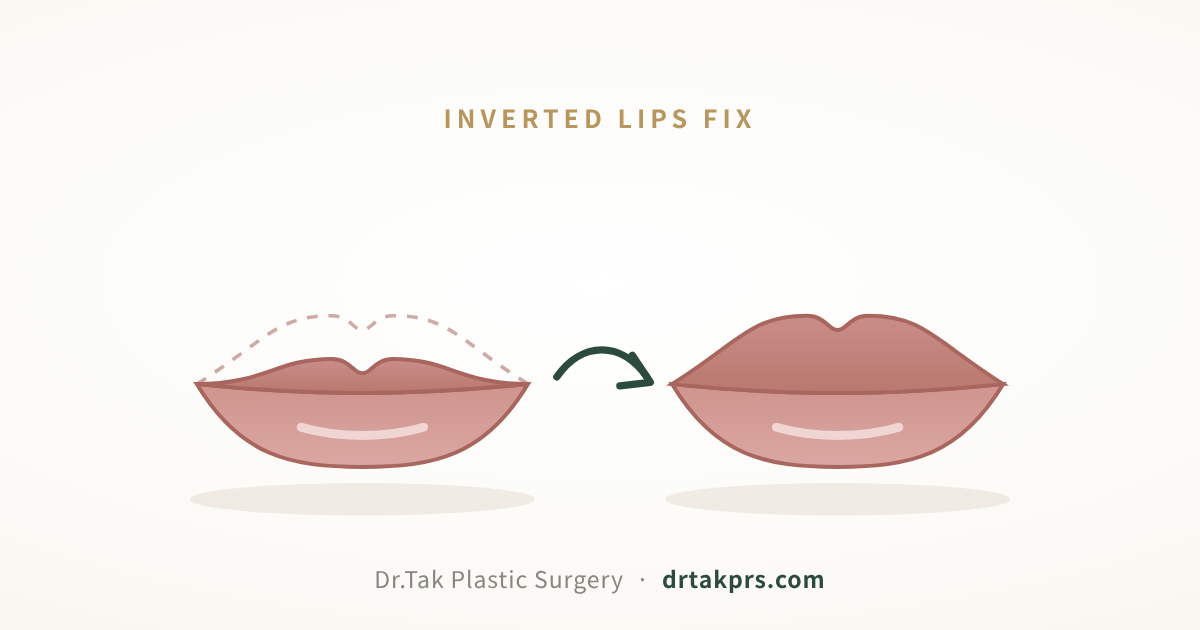
✅ Your red lip looks rolled inward — if the cause is structural, V-Y also unrolls the lip outward (whether your lips are the inverted type can be checked in the 3 causes of inverted lips and a self-check)
I do not recommend it now when
⚠️ The upper jaw sits back or tooth alignment makes the lips look flat — the problem is the supporting structure, not the lip, so an orthodontic consultation comes first
⚠️ Scarring from previous lip surgery has left no slack in the mucosa
⚠️ You find it hard to stop smoking, or inflammation or herpes inside the mouth keeps recurring
⚠️ A long philtrum is what makes the lips look thin — a lip lift (philtrum shortening) may come before mucosal advancement
If even one of these four applies, I talk about the cause before any surgery date. It is not postponing surgery; it is choosing the right one.
How the Y-shaped suture line heals after surgery
To put it plainly, the suture line is inside the mouth so it cannot be seen from outside, but inside the mouth you will feel a Y-shaped pull and firmness for a while. This is not failure — it is the moved tissue settling into place.
| Period | Suture line inside the mouth | Visible change outside |
|---|---|---|
| Day 0–3 | Pulling at the suture site; stitches can be felt with the tongue | Swelling at its peak; lips look much bigger than they will be |
| About day 7 | Stitches removed | Swelling starts to go down |
| 2 weeks | Suture line mostly healed | About 70% of the swelling gone |
| 3–6 weeks | Firmness felt beneath the suture line | Lips slightly stiff, movement a little less natural |
| 3 months | Firmness eases | Close to the final shape |
The question I am asked most often in this period comes around weeks 3 to 6: the swelling has gone, but the lips still feel firm, and people worry. I explain in advance that tissue firming beneath the Y-shaped suture line is normal, and that it usually softens by around three months. Knowing this beforehand makes that stretch far less anxious.
📌 During recovery: for the first week avoid spicy and hot food, straws and pursing your lips hard, and take a break from smoking and alcohol until the suture line has healed.
Advancement measured in millimetres — a principle kept for over 15 years
The most common failure in V-Y advancement lip augmentation is moving too much. The longer someone has worried about thin lips, the more they want a "definite" change, and I fully understand that. But over-advancement makes the lip look flipped outward, and that is much harder to undo.
So I always start small when sizing the V. The incision range is planned within about 15–20 mm on each side of the upper lip, and the advancement mostly within 3–4 mm. We look at that range together in simulation before surgery. A little more can be added when less was moved; taking away after too much was moved is difficult.
🏥 Briefly, here is why we can keep this principle.
- As a lip and philtrum specialist clinic, we have focused on this area alone for over 15 years of experience
- Over 200 Google reviews, rated 5 out of 5 — covering not only results but the consultation process
- In every consultation we show the measurements and the V design as a drawing first, before talking about surgery
- When we judge the cause lies in the teeth, jaw or philtrum length, we explain that cause before mucosal advancement
💬 "To make people smile." For someone who used to cover their mouth because their lips looked thin when they smiled, this sentence becomes a very concrete goal.
Before & after photographs are on our official page
Dr.Tak Plastic Surgery complies with medical advertising regulations, so we do not place before-and-after photographs inside blog articles. Actual pre- and post-operative changes are collected on the official before & after page.
🔗 View before & after — Dr.Tak Plastic Surgery official page
Results may vary from person to person.
The Dr.Tak 4S Patient Care System — focused on the person, not the procedure
We focus on the person, not the procedure.
Solution — a 1:1 master plan with Dr. Tak Seung-wan
- Genuine empathy and communication: your wishes reflected fully in the surgical plan
- Precise facial golden-ratio analysis, personalised: upper-to-lower red-lip ratio, profile lip angle and lip show when smiling measured on three axes
- Post-operative change simulation provided
Support — a global 1:1 dedicated coordinator
- A dedicated coordinator assigned by country, no language barrier
- Accompanies you through consultation, surgery and aftercare
- 100% appointment-only, for a private clinical environment
Scar Care — six months of intensive scar management
| Item | Period | Content |
|---|---|---|
| Control taping | 3 to 6 months | Prevents scar widening |
| Scar-softening injection | 6 months, monthly | Softens raised scars |
| Laser treatment | 6 months | Reduces redness at the surgical site |
Service — one year of complimentary A/S
- Complimentary A/S within one year of surgery
- We see it through to the end
- Note: basic anaesthesia costs may apply when sedation is used
If you want to know more — official channels
🌐 The Dr.Tak Plastic Surgery official site carries detailed guides for each lip and philtrum procedure
📝 The blog collects articles by procedure — mucosal advancement, lip lift, lip augmentation, mouth corner correction
📹 Video lets you follow the surgical process and recovery course
Five things to settle for yourself before deciding
✅ Is the change you want in the front view or the profile? — this is where V placement divides
✅ Is there plenty of inner mucosa when you turn your lip out? — V-Y needs tissue to draw out
✅ Have you had lip filler? — if so, bring the date of your last treatment and your photos from before
✅ Have you had orthodontic treatment, or is your philtrum on the long side? — if so, the cause may lie outside the lip
✅ Can your schedule hold 2–3 weeks of swelling and a three-month firm stage? — tell us the dates of any important events
You do not need to bring the right answers. Come with the ones you do not know, and we will work them out together.
Frequently Asked Questions (FAQ)
These are the questions Dr.Tak Plastic Surgery hears most often.
Q1. Is a V-Y lip lift the same as a bullhorn lip lift?
Because the names are similar, this is the most common confusion — but they are entirely different surgeries. V-Y cuts the inner mucosa to bring the lip forward, while a bullhorn lip lift removes a bullhorn-shaped strip of skin under the nose to shorten the philtrum. So V-Y leaves no external scar but does not change philtrum length, and a bullhorn shortens the philtrum but leaves an incision line under the nose. The differences between lip lift methods, including the bullhorn, are covered in a comparison of bullhorn, Italian and corner lip lift types. For people with both a long philtrum and thin lips, the two surgeries are sometimes planned together; in that case I decide the amount of V-Y again after seeing the lip shape left once the philtrum is shortened.
Q2. Why is V-Y advancement lip augmentation less common than filler?
Filler takes a few minutes and you go straight back to daily life, while V-Y is surgery with 2–3 weeks of swelling. The other reason is the difficulty of the design. The number and angle of the Vs and the advancement distance have to be set to the millimetre, and once tissue is moved it is hard to put back, so clinics that have not concentrated on lip surgery rarely recommend it. We keep performing it for the opposite reason: many people come to us exhausted after years of repeated filler.
Q3. Does the result really last for life? What happens as I age?
Moved tissue does not return to where it was, so the structure changed by surgery stays permanently. But a lip that has had surgery still ages. With age everyone's lips thin a little and the philtrum lengthens, and that happens regardless of surgery. That is why, for people in their 20s and 30s, I size the V not to "the amount that looks best right now" but to an amount that will not look out of place ten years from now.
Q4. What should I expect to pay? Should I do the lower lip too?
I cannot state an exact price, because the range depends on whether it is the upper lip only or both, how many Vs are placed, whether leftover filler must be cleared first, whether it is a revision, and whether sedation is used. You do not have to do the lower lip as well. The reference is whether the upper-to-lower ratio sits close to roughly 1:1.6: many people reach balance with the upper lip alone, while those whose lower lip is naturally thin look more natural doing both. On the other hand, for people whose lips look flat because of teeth or jaw structure, or who have no mucosal slack, I tell them this surgery is not right for them before talking about cost.
Q5. What if my lips feel numb or move awkwardly after surgery?
That worry is entirely reasonable. Right after surgery the lips are swollen and firm, so sensation may feel dulled or your smile may feel awkward, and this is mostly temporary. Because we design the surgery to move only the mucosa over the orbicularis oris without cutting the muscle, movement returns naturally in most cases by around three months, when the firmness eases. Recovery speed does vary from person to person, so even after the stitches are out I follow the progress regularly and tell you myself when to start massage.
Dr.Tak Plastic Surgery | Korea Face Lifting · Lip · Philtrum Specialist Clinic
"To make people smile"