
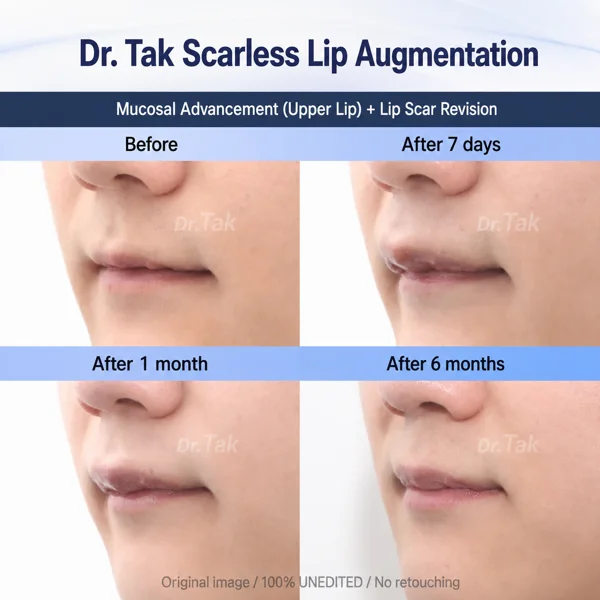
"This Is the Last Time," You've Told Yourself Again — The Question That Arises at the End of Repeated Fillers
Every 3 or 6 months you book another appointment telling yourself "this is the last time." The lips you imagined when you first started filler — full, defined, natural — you can no longer tell whether you're looking at freshly injected lips or lips where it's almost worn off. More and more patients reach this point.
I see people at this exact crossroads in my consultation room regularly. Patients who have been getting fillers for 3, 5, even 7 years, who arrive with the question: "Doctor, I'm not sure this is working anymore. Would surgery be better?" I always give the same answer: "If you understand why filler disappears, the answer becomes clear."
This post contains that answer — with enough medical reasoning behind it. Rather than simply promoting mucosal advancement as a "good procedure," I'll start from the anatomical structure of the lips and explain why filler inevitably needs repeating — and how mucosal advancement solves that problem through a fundamentally different approach.
The Three Layers of the Lip — Where Filler Is Placed vs. Where Mucosa Moves
Understanding the anatomical structure of the lip immediately shows why mucosal advancement is a fundamentally different approach from filler. From outside to inside, the lip has three distinct tissue zones.
① Skin layer — The ordinary skin from below the nose to the vermilion border (lip line). This includes the vertical groove of the philtrum and fine surface wrinkles. It is the most superficial zone where filler can be placed.
② Vermilion — The entire red portion we identify as "the lip." It is a transitional zone between skin and mucosa, divided into a drier outer part (dry vermilion) and a slightly glossier inner part (wet vermilion). Most lip fillers are injected here.
③ Labial mucosa — The moist pink tissue visible inside the lip when the mouth opens. Invisible from outside, it is the key tissue that determines lip volume. Mucosal advancement surgery moves this labial mucosa forward (outward), making ② the vermilion wider and fuller.
Filler adds material to ② the vermilion to create volume. Mucosal advancement permanently enlarges ② by repositioning ③ the labial mucosa. Rather than adding material, it changes where the body's own existing tissue sits. This difference is the decisive factor separating durable results from temporary ones — and natural feel from artificial bulk.
📍 Bottom line: Mucosal advancement is not a procedure that "adds." It is one that "relocates." Because the lip's own mucosal tissue is drawn forward and permanently secured, the concept of fading simply doesn't apply.
Why Filler Keeps Disappearing — The Combined Effect of Orbicularis Muscle and Enzyme
Two simultaneous medical mechanisms explain why lip filler fades faster than filler placed elsewhere on the face.
First: hyaluronidase. Our bodies recognize injected hyaluronic acid as a foreign substance and gradually break it down. This enzyme is distributed throughout the body's tissues, but shows higher activity in the mucosa-rich zone around the lips. This is the biological reason lip filler feels as though it lasts 2–3 months less than cheek filler on average.
Second: the mechanical compression of orbicularis oris. The orbicularis oris — the circular muscle used to open and close the lips — contracts an average of 2,000–3,000 times per day. Every lip movement — speaking, eating, smiling, drinking — compresses the filler material inside. That repeated pressure accelerates breakdown and disperses injected material into surrounding tissue.
Repeated injections create another problem. Among patients who have had lip filler for many years, I sometimes find subtle fibrosis in the lip tissue — the cumulative result of microscopic reactions from repeated needle passes. Paradoxically, lips that have maintained filler for a long time sometimes gradually lose their natural elasticity. These are the patients who say "I think my lips were actually better before I started."
That's why it never ends. Filler fades, more is needed, tissue changes, and more follows. Mucosal advancement breaks that cycle.
The V-Y Suture Principle — How Tissue Is Permanently Repositioned
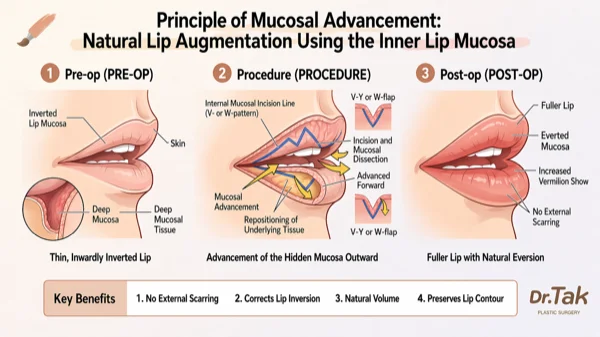
The operating principle of mucosal advancement is exactly what the name describes. A V-shaped incision is made in the labial mucosa, the mucosal tissue is advanced forward, then sutured closed in a Y-shape to secure it. Advance the V, close it as a Y — that is the core of V-Y mucosal advancement.
For this procedure I design the incision within approximately 15–20 mm on each side of the upper lip. The distance the mucosa moves forward after suturing is 3–5 mm. 3 mm of advancement gives a subtly fuller appearance; 5 mm creates noticeable volume. For most patients wanting a natural result, I plan for 3–4 mm and adjust based on desired volume.
All incisions are made entirely inside the lip, so there is no scar on the external skin. This is the most important distinction from vermilion advancement, which incises at the outer edge of the lip border and can leave a fine linear scar. Mucosal advancement leaves the scar entirely inside the mouth.
To be direct: this procedure is not for everyone. If the labial mucosa is not thick enough, or if there is a history of prior lip surgery, there may not be sufficient tissue laxity for the advancement. That is exactly why examining the mucosal condition inside the lip during consultation is essential.
Start a 1:1 Personalized Consultation Now
✅ Mucosal advancement · vermilion advancement · filler — we explain which option suits your lips
✅ We give an honest opinion regardless of whether surgery is the right choice
📲 Dr.Tak Plastic Surgery official site → chat icon at bottom right → connect to live consultation
Mucosal Advancement · Lip Filler · Vermilion Advancement — 9-Point Complete Comparison
Here is a side-by-side comparison of all three approaches. Use this as a framework for deciding which option fits your situation.
| Comparison | Mucosal Advancement | Lip Filler | Vermilion Advancement |
|---|---|---|---|
| Duration | Permanent | 6–12 months | Permanent |
| External scar | None (inside mouth) | None | Possible fine linear scar |
| Volume increase | Moderate | Adjustable | Moderate |
| Procedure time | 30–50 min | 5–10 min | 30–50 min |
| Recovery | 2–3 weeks swelling | 1–3 days | 1–2 weeks |
| Reversibility | Irreversible | Reversible (hyaluronidase) | Irreversible |
| Natural movement | Complete at 3 months | Immediately natural | Complete at 3 months |
| Foreign material | None | Hyaluronic acid | None |
| Best suited for | Repeat filler / want permanent | First experience / non-surgical | Poorly defined lip border |
📍 Bottom line: Mucosal advancement simultaneously meets the conditions: "I don't want to keep getting filler, I don't want a visible scar, and I want permanently fuller lips." Because the result cannot be reversed, thorough consultation and careful judgment are essential.
Post-Surgery Timeline — From Swelling to Final Result
Recovery after mucosal advancement falls into four broad stages. The period most patients find hardest is not the first week — it's weeks 3 to 6, when much of the swelling has subsided but the lips still feel noticeably firm.
| Period | Key Changes | Notes |
|---|---|---|
| Surgery day–Day 3 | Maximum swelling, significant lip enlargement, difficulty speaking and eating | No spicy foods, no alcohol, no smoking |
| Day 4–Week 2 | 70% of swelling resolves, suture removal (~Day 7), eating gradually normalizes | Avoid exaggerated expressions, no forceful pursing |
| Week 3–6 | Residual swelling, lips feel firm (fibrotic response) | Light massage possible (per surgeon's guidance) |
| 3 months onwards | Final result complete, lip movement becomes natural | Periodic follow-up recommended |
The comment I hear most during this phase is: "My lips still feel a bit stiff." This is a normal healing response — a temporary fibrotic reaction as the sutured tissue settles into position. By three months, most patients find the texture has returned to natural softness. There is no need for concern.
About 50% of swelling resolves within one week, and 70% within two weeks. Knowing in advance that the complete final result takes three months makes the recovery far easier to manage.
15+ Years of Experience in Korea — Principles, Not Just Numbers
I have over 15 years of specialized clinical experience in lip and philtrum procedures at a Korean clinic. In that time, I've learned one principle above all others: "In lip surgery, technique is 70% of the result; planning is 30%."
Technique means the precision of the incision, the tension of the sutures, and the bilateral symmetry of mucosal advancement. Planning means presetting the balance between the patient's existing lip thickness, orbicularis muscle tone, the relationship between teeth and lips, and desired volume within a natural range. That is why consultations take time.
Dr.Tak Plastic Surgery holds a Google Review rating of 190+ with a perfect 5-star score. What that number represents isn't simply "many patients were satisfied" — it's that patients returned and left honest reviews.
💬 "To make people smile."
For me, that phrase is not just a slogan. When someone gains confidence through lip surgery — when they feel more at ease in front of a mirror, when having a photo taken feels a little less daunting — that is what keeps me dedicated to this work.
The Dr.Tak 4S Patient Care System — From Pre-Surgery Through Six Months
We focus on people, not procedures.
Solution
From consultation through surgery, we work together to find the right approach for your lips. If mucosal advancement is not the best option, I will say so honestly. My goal is not to recommend surgery but to help you make the right choice.
Support
From the day of surgery through recovery at one week, suture removal, and the one-month follow-up — our dedicated team is with you at each step. A direct communication channel remains open whenever swelling or unexpected reactions arise.
Scar Care
Mucosal advancement leaves no external scar, but care for the suture site inside the lip matters. Between 3 and 6 months post-surgery, we provide a protocol for oral hygiene, tissue massage, and mucosal care.
| Period | Care Items |
|---|---|
| Surgery–2 weeks | Oral rinsing, restrict irritating foods, protect suture site |
| 2 weeks–1 month | Normalize oral hygiene, gentle lip stretching |
| 1–3 months | Tissue-softening massage, managing residual fibrosis |
| 3–6 months | Final result follow-up, micro-correction if needed |
Service
From immediately after surgery through six months later, our team's care continues. You can reach us at any time with questions.
For More Information — Dr.Tak Plastic Surgery Official Channel
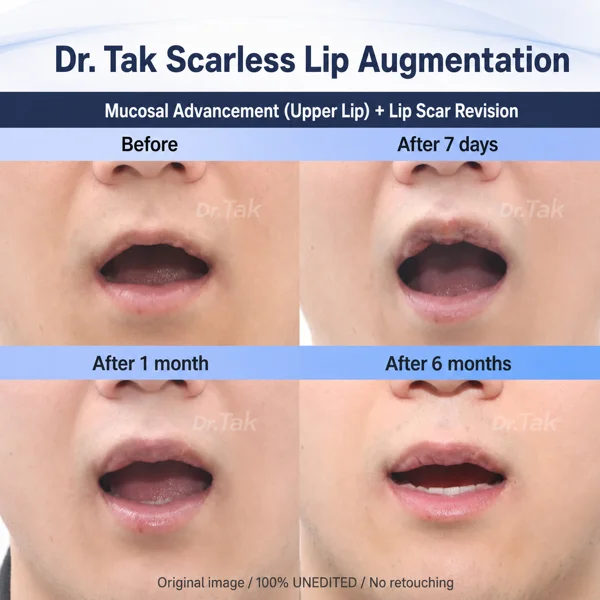
🌐 Official site drtakprs.com — mucosal advancement case photos and detailed information
7 Questions to Ask Yourself Before Deciding on Surgery
✅ I have been getting lip filler repeatedly for more than 6 months
✅ The duration of my filler seems to be getting shorter over time
✅ I want permanent fullness without an external scar
✅ I can accept 2–3 weeks of swelling during recovery
✅ I fully understand this is an irreversible procedure
✅ I understand that natural lip movement takes 3 months to fully develop after surgery
✅ I am aware that surgical eligibility depends on the condition of my labial mucosa (thickness and adhesion status)
Frequently Asked Questions (FAQ) — 5 Questions
These are the questions most frequently received at Dr.Tak Plastic Surgery Korea.
Q1. What type of anesthesia is used for mucosal advancement? Is there pain during surgery?
I perform mucosal advancement under local anesthesia combined with IV sedation. Because sedation is administered before surgery, the majority of patients have no awareness of pain during the procedure — and many wake up asking "is it already over?" Once anesthesia wears off, there may be a pulling or heavy sensation around the lips, which is well managed with prescribed pain medication.
Q2. How long does swelling last? When can I return to work?
In my clinical experience, approximately 70% of swelling resolves within two weeks. If you have important in-person commitments, I recommend setting aside at least two weeks after surgery. Patients who work from home or in light office roles sometimes return after suture removal (around Day 7). For roles with significant face-to-face contact, planning for two weeks or more is more comfortable.
Q3. How much does mucosal advancement cost in Korea, and is health insurance covered?
Mucosal advancement is a cosmetic procedure and is not covered by health insurance. The cost at our clinic for the upper or lower lip is provided during consultation. In general, when compared with the cumulative cost of 3–4 years of filler treatments, mucosal advancement is often more cost-effective overall. That said, I believe proper patient selection matters more than cost.
Q4. Where does the scar appear after mucosal advancement? What side effects are possible?
All scarring is confined to the inner mucosa of the mouth. No incision touches the external skin, so looking in a mirror there is no visible sign of surgery. Possible side effects include temporary altered sensation (most resolve within weeks to months post-surgery), minor inflammation at the suture site, and mild asymmetry. With over 600 surgeries in my experience, serious complications have been rare — but I never claim any surgery is 100% risk-free. Individual risk factors are reviewed together during consultation.
Q5. What if my lips look awkward when I smile after surgery? I'm worried people will notice.
This is the question I receive most often. To be honest: for the first 1–2 months after surgery, lip movement may feel slightly stiffer than usual. Some patients notice an awkwardness when smiling broadly during this period. However, by three months the orbicularis muscle has fully adapted to the new tissue placement, and from that point the smile returns to the same natural feel as before surgery. One of the reasons I have performed this procedure for 15+ years is that I have seen that three-month outcome enough times to be confident in it.
Dr.Tak Plastic Surgery | Korea Lip & Philtrum Specialist Clinic, 15+ Years
"To make people smile."