You thought your lips were thin — but what if they are rolled in?
You may have looked in the mirror a few days after filler and found that, instead of fuller lips, only the area around your mouth looked heavy and pushed forward. The volume clearly went in, yet the red of your lips still looked like a thin line, and when you smiled your upper lip still disappeared.
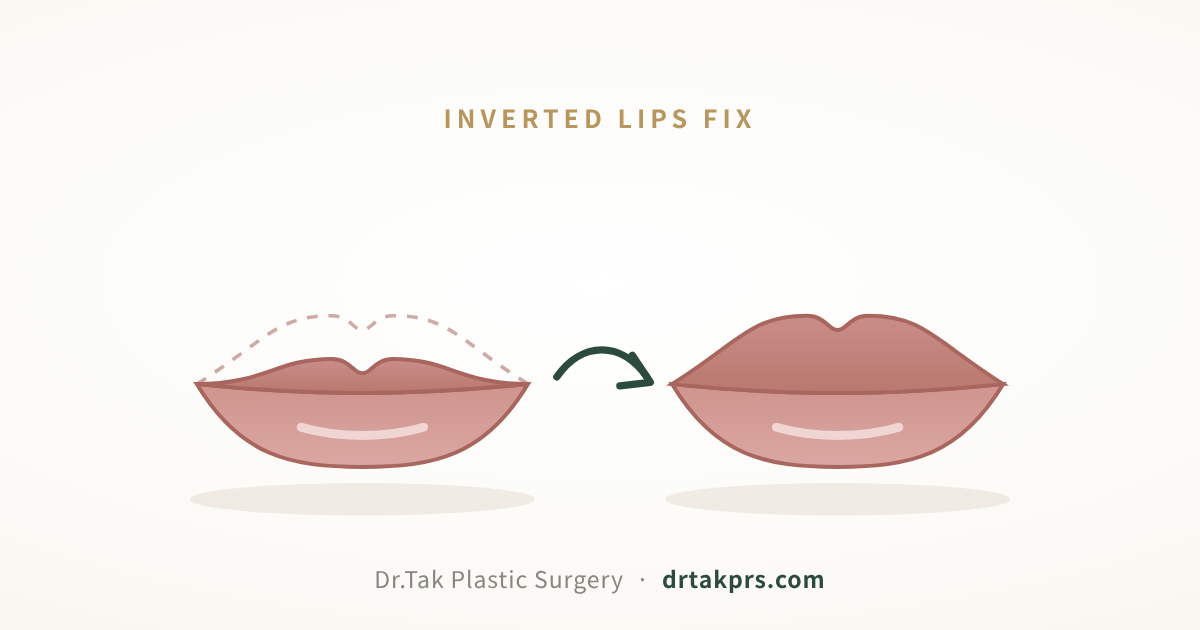
When I meet people with this story in my consultation room, the first thing I do is take a side-profile photo. And quite often I reach the same conclusion. The lips are not thin — they are rolled inward. There is already enough volume, but the red part of the lip curls back toward the teeth, so very little of it shows from the front.
The two look similar, but the fixes run in opposite directions. Filling suits thin lips. Fill an inverted lip, though, and it only pushes forward — it does not unfold outward. That is why each round of filler may have left you more frustrated than the last.
So here is the order of this article. I will briefly define inverted lips in clinical terms, separate the three causes that make lips roll inward, and give you a self-check you can do alone at the mirror. At the end I will put filler, lip flip, mucosal advancement and lip lift side by side by type.
One thing I want to say up front. Of the three causes, one will not resolve no matter how much you work on the lip itself.
What exactly are inverted lips — a question of how much shows, not how much there is
To put the conclusion first: inverted lips are lips whose red portion (the vermilion) does not unfold outward enough and instead curls back toward the teeth, so the height of red lip visible from the front looks smaller than the actual amount of tissue. People also call them inward-rolling lips or hidden lips, and they are far more common in the upper lip.
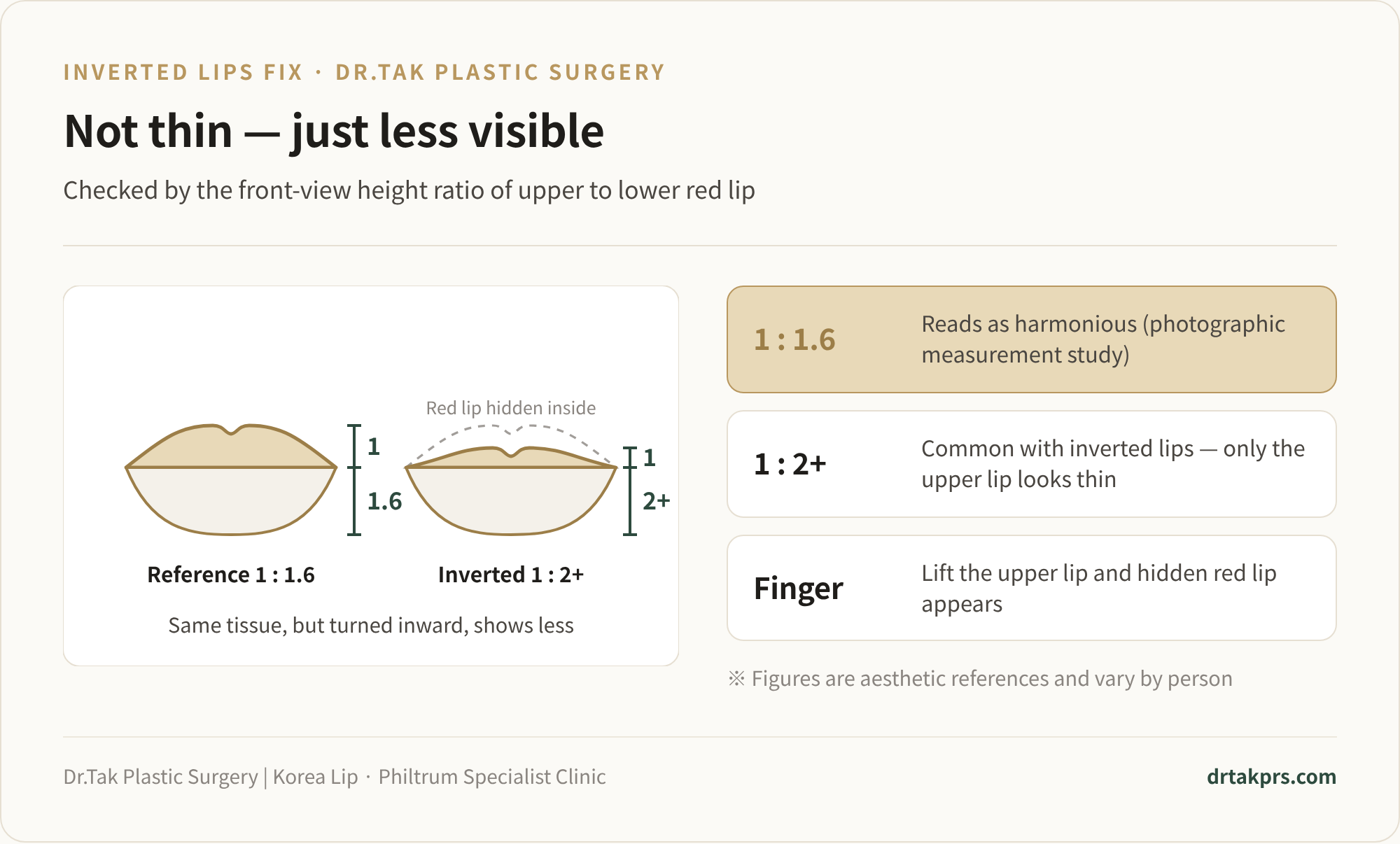
The biggest difference from thin lips is that the issue is angle, not tissue volume. A thin lip has little red-lip thickness. An inverted lip has the thickness, but it faces inward instead of outward. If you part your lips slightly and lift your upper lip with a finger, many people are surprised by how much red lip was hiding inside.
One figure is often cited as an aesthetic reference: a photographic measurement study found that a front-view ratio of upper to lower red-lip height of roughly 1:1.6 reads as harmonious. In people with inverted lips this ratio often goes well past 1:2, because the lower lip stays the same while only the upper lip looks thin.
I always show this ratio as a number during consultation. Quite a few people look at it and say, "So what I wanted wasn't volume — it was this." But the reason the ratio broke down differs from person to person.
Three things that make lips roll inward — each needs a different fix
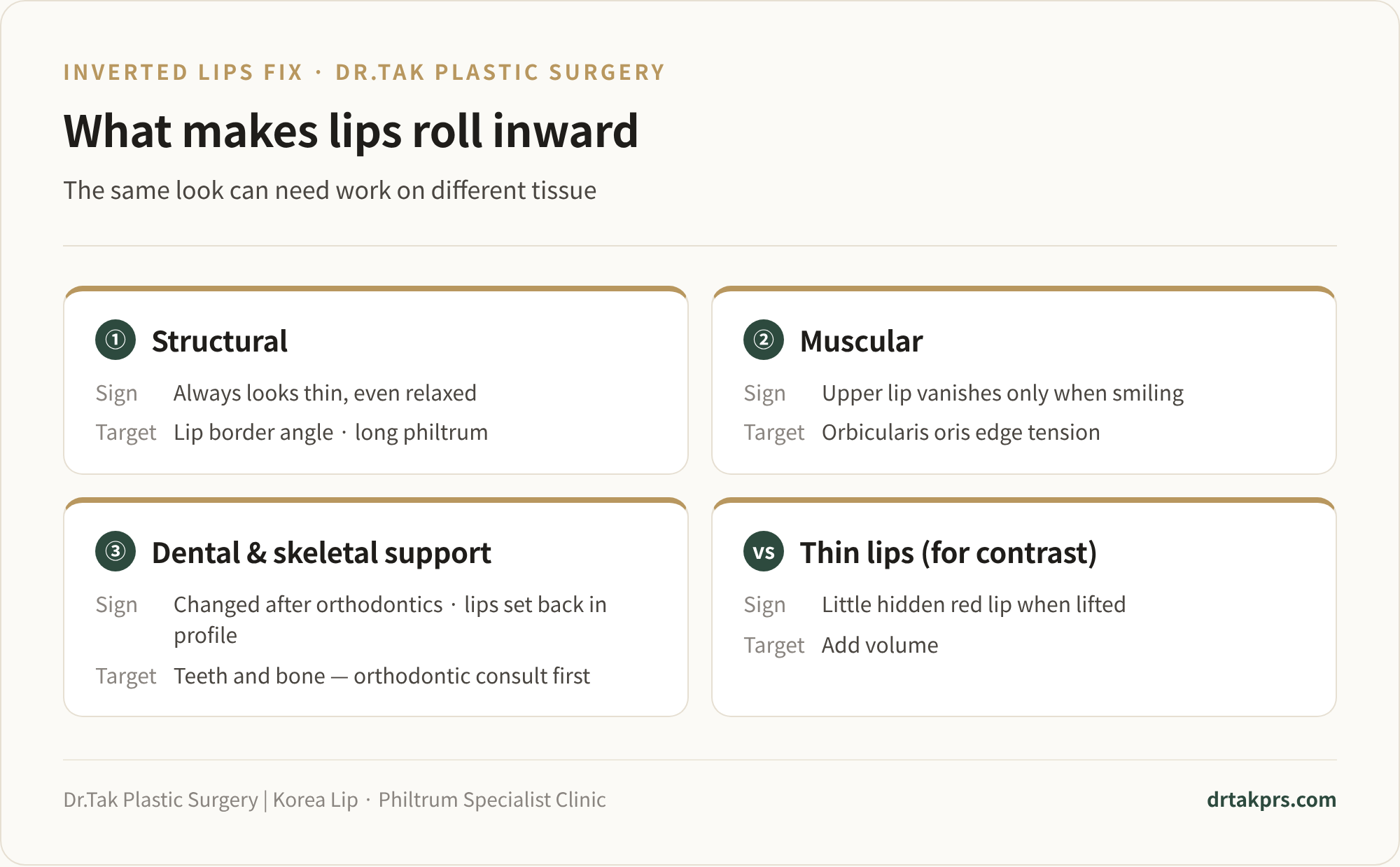
In short, the causes of inverted lips divide into the structure of the lip itself, tension in the muscle around the mouth, and the teeth and bone that support the lip. The same appearance can come from different causes, and each one involves a completely different tissue.
① Structural type — the angle of the lip border or the length of the philtrum
Here the boundary between the red lip and the inner mucosa sits further inward from birth, so the red lip faces inward from the start. If the philtrum is also long, the whole upper lip sags downward and the red lip curls in even more. The longer the distance from the base of the nose to the upper lip, the lower the lip's center of gravity sits, and its edge naturally rolls inward.
The marker of this type is that it shows even when your face is completely relaxed. Smiling or at rest, the upper lip always looks thin, and in profile the upper-lip line drops flat instead of projecting forward.
② Muscular type — the muscle around the mouth pulls the lip inward
The orbicularis oris is the ring-shaped muscle that closes and purses the mouth. In people whose outer edge of this muscle is especially tense, the upper lip rolls over the teeth and almost vanishes when they smile. If plenty of red lip shows at rest but your lips seem to disappear in every smiling photo, this is the type I suspect first.
To identify it, I look at a short video before still photos. While you talk and smile, the exact moment the lip rolls in is much clearer on video.
③ Dental and skeletal support type — the base that holds the lip has moved back
The lip is tissue resting on the teeth and the bone around them. If the front teeth tilt inward, if they moved back considerably after orthodontic treatment with extractions, or if the upper jaw itself is small and set back, there is not enough support in front of the lip, and it collapses inward as it rolls.
The clues for this type are outside the lip. If you feel your lips got thinner after orthodontic treatment, or if in profile your lips sit well behind the line from nose tip to chin, think of this type. This is also the one I mentioned at the start that "will not resolve no matter how much you work on the lip." Pull the lip forward while leaving the base where it is, and the lip ends up sticking out on its own, looking out of place.
Which type are your lips — a three-minute self-check at the mirror
Even before visiting a clinic, you can get a sense of direction on your own. Just follow these steps.
✅ Take two front photos and one profile photo — a front view with your mouth closed and fully relaxed, a front view with your usual big smile, and a relaxed side profile.
✅ Gently lift your upper lip with a finger — if a fair amount of hidden red lip appears, your lips are more likely inverted than thin.
✅ If the upper lip looks thin even in the relaxed photo → the structural type ① is likely. Check the distance from the base of your nose to your upper lip as well.
✅ If the relaxed photo looks fine but the upper lip disappears only when smiling → the muscular type ② is likely.
✅ If in profile your lips sit well behind the nose-tip-to-chin line, or the change began after orthodontic treatment → suspect the dental and skeletal support type ③.
✅ If, after lip filler, only the area around your mouth looked pushed forward → the cause was likely inversion, approached with volume.
✅ If two or more seem to overlap — this is actually the most common case. In my experience, ① and ② together are especially frequent.
A self-check is for finding your direction; it is not a diagnosis. Still, arriving with just this much organized lets a consultation get to the point much faster.
Start with a 1:1 personalised consultation
✅✅ Before an inverted lips fix, we compare all four options — filler, lip flip, mucosal advancement and lip lift — against your cause type
✅✅ An honest opinion, whether or not you choose surgery
📲 Dr.Tak Plastic Surgery official site, chat icon at the bottom right → live consultation
Filler, lip flip, mucosal advancement, lip lift — the right one depends on the type
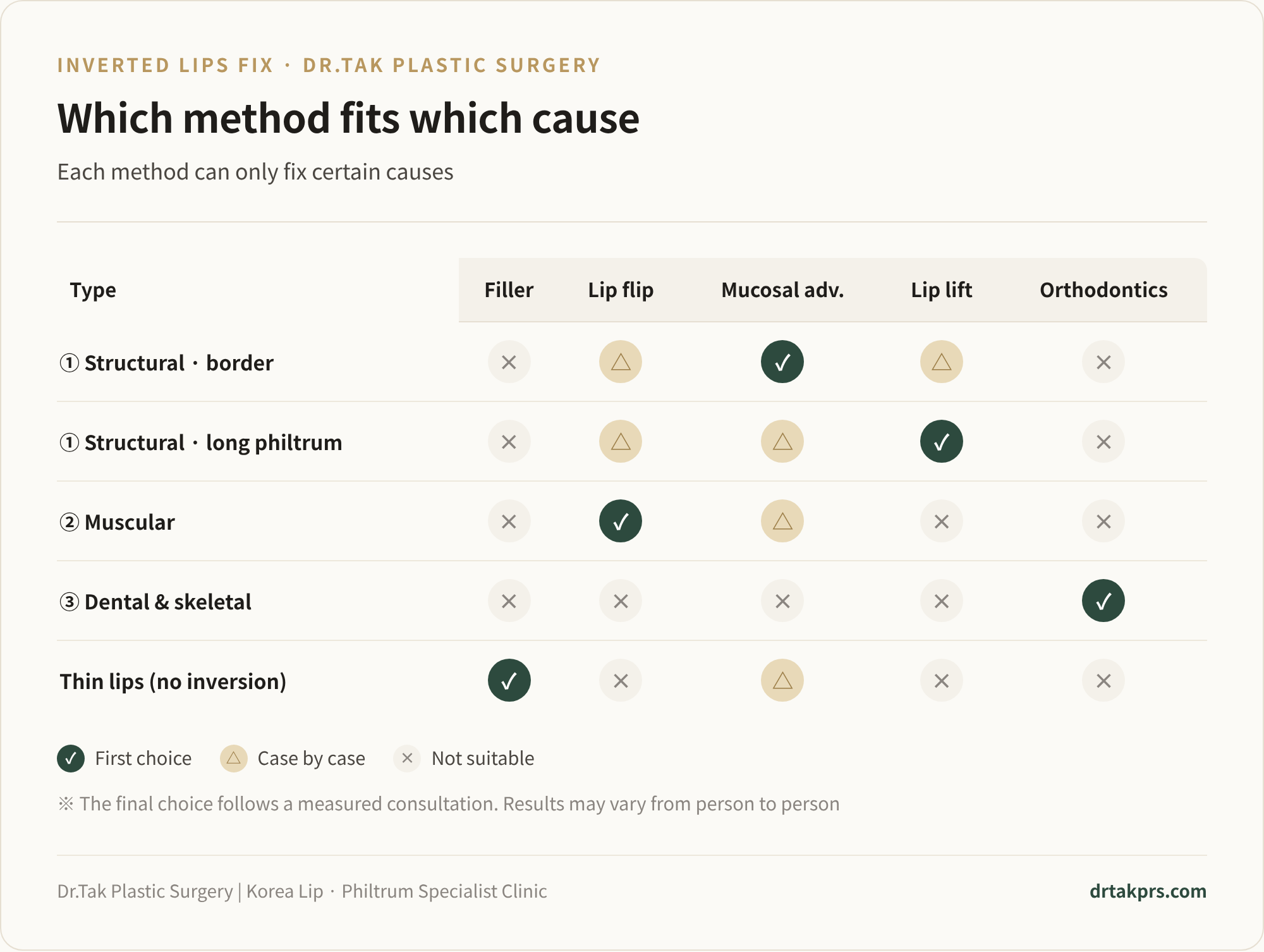
Now to the core. This is the table worth spending the most time on.
| Comparison | Filler | Lip flip (Botox) | Mucosal advancement | Lip lift (philtrum reduction) |
|---|---|---|---|---|
| How it works | Adds volume inside the lip | Relaxes the edge of the orbicularis oris so the lip tips slightly outward | Brings inner mucosa forward to increase red-lip show | Shortens the skin under the nose, lifting the upper lip up and outward |
| Best-fit type | Thin lips without inversion | ② Muscular | ① Structural (border angle) | ① Structural (long philtrum) |
| Poor-fit type | When inversion is the main cause (only projects forward) | ①③ | ③ (support type needs orthodontics first) | ②③, short philtrum |
| Onset | Immediate (1–2 weeks after swelling) | 2–7 days | 2–4 weeks after swelling settles | 2–4 weeks after swelling settles |
| Duration | 6–12 months | 3–4 months | Permanent | Permanent |
| Direction of change | Forward (projection) | Outward (small) | Outward (planned in mm) | Up and outward |
| Reversible? | Dissolvable with hyaluronidase | Fades naturally over time | Hard to reverse | Hard to reverse |
| Scar | None | None | Inside the mouth only | Along the base of the nose |
| Main limitation | Looks heavy on inverted lips, migration risk | Small change, needs repeating | 2–3 weeks recovery, irreversible | Scar care needed, irreversible |
📍 Bottom line: Do not read this table as "which method is better." It shows that each method can only fix certain causes.
Let me say a little more about filler. Why it fails on inverted lips is simple. Filler inflates the place it goes; it cannot change the direction the lip faces. Add volume to a lip pointing inward and it grows in that same direction, pushing forward. The red lip visible from the front barely increases, while from the side only the area around the mouth bulges.
So the more rounds of filler someone has had, the more I recommend clearing it first rather than adding more. Dissolve the remaining filler with hyaluronidase and wait for the tissue to settle, and only then does the true angle of the lip show clearly. Seeing the cause accurately is what keeps the next choice from going wrong.
If you choose mucosal advancement — this is how recovery goes
For the structural type of inverted lips, the most direct method is mucosal advancement. It brings the mucosa from inside the mouth forward so the red lip unfolds outward, and both the incision and the scar sit inside the mouth.
| Period | Condition | Precautions |
|---|---|---|
| Day of surgery – day 3 | Peak swelling, speaking and eating uncomfortable | Cold compresses; no spicy food, alcohol or smoking |
| Day 4 – week 2 | About 70% of swelling gone, stitches out around day 7 | Avoid pursing the lips forcefully |
| Weeks 3–6 | Residual swelling, lips feel firm | Normal healing response — light massage as instructed |
| After 3 months | Final shape, natural movement | Judge the result at this point |
📍 Bottom line: Judge the result of an inverted lips fix after three months. What you see in the mirror at week two is still a shape made by swelling.
The comment I hear most often during recovery comes around week four: "My lips still feel stiff." It is a normal response while the stitched tissue settles, and in most cases it softens within three months. Knowing this in advance makes that period much less worrying.
The principle I keep in correcting inverted lips — advancement planned in millimetres
The most common failure in surgery to unfold inverted lips is bringing too much forward. People who were frustrated by lips they could not see often want a "definite" change, and I understand that completely. But over-advancement makes the lip look flipped outward, and that is far harder to undo.
So I plan the distance the mucosa moves forward mostly within 3–4 mm. At 3 mm the lip looks naturally unfolded; closer to 5 mm it becomes noticeably fuller. Before setting that distance I measure three things: ① the height ratio of upper to lower red lip from the front, ② the angle at which the upper lip projects in profile, and ③ how much of the upper lip disappears when smiling.
If only ③ is far off, I recommend a lip flip before surgery. If ② is off and the philtrum is long, a lip lift may suit better than mucosal advancement. This is where the first choice diverges even for "inverted lips."
🏥 Briefly, the grounds on which we can keep this principle:
- As a Korean lip and philtrum specialist clinic, we have focused on this area alone with more than 15 years of experience
- More than 200 Google reviews, rated 5 out of 5 — covering not only results but the consultation process
- In every consultation we show the measurements and simulation first, and only then discuss whether to operate
- When we judge the cause to lie in the teeth or bone, we recommend an orthodontic consultation before lip surgery
💬 "To make people smile." For someone who used to cover their mouth in photos because their lips vanished when they smiled, this sentence becomes a very concrete goal.
Before & after photographs are on our official page
Dr.Tak Plastic Surgery complies with medical advertising regulations, so we do not place before-and-after photographs inside blog articles. Actual pre- and post-operative changes are collected on the official before & after page.
🔗 View before & after — Dr.Tak Plastic Surgery official page
Results may vary from person to person.
The Dr.Tak 4S Patient Care System — focused on the person, not the procedure
We focus on the person, not the procedure.
Solution — a 1:1 master plan with Dr. Tak Seung-wan
- Genuine empathy and communication: your wishes reflected fully in the surgical plan
- Precise facial golden-ratio analysis, personalised: upper-to-lower red-lip ratio, profile lip angle and lip show when smiling measured on three axes
- Post-operative change simulation provided
Support — a global 1:1 dedicated coordinator
- A dedicated coordinator assigned by country, no language barrier
- Accompanies you through consultation, surgery and aftercare
- 100% appointment-only, for a private clinical environment
Scar Care — six months of intensive scar management
| Item | Period | Content |
|---|---|---|
| Control taping | 3 to 6 months | Prevents scar widening |
| Scar-softening injection | 6 months, monthly | Softens raised scars |
| Laser treatment | 6 months | Reduces redness at the surgical site |
Service — one year of complimentary A/S
- Complimentary A/S within one year of surgery
- We see it through to the end
- Note: basic anaesthesia costs may apply when sedation is used
If you want to know more — official channels
🌐 The Dr.Tak Plastic Surgery official site carries detailed guides for each lip and philtrum procedure
📝 The blog collects articles by procedure — mucosal advancement, lip lift, lip augmentation, mouth corner correction
📹 Video lets you follow the surgical process and recovery course
Five things to settle for yourself before deciding
✅ When you lift your upper lip, does hidden red lip appear? — the first question that separates thin lips from inverted lips
✅ Does it vanish only when you smile, or always look thin? — the clue that separates the muscular and structural types
✅ Have you had orthodontic treatment, and did your lips change afterward? — if so, the dental and skeletal support type must be checked first
✅ Have you had lip filler? — if so, bring the date of your last treatment and your photos from before
✅ Do you want "fuller lips" or "lips that show more"? — the two lead to different procedures
You do not need to bring the right answers. Come with the ones you do not know, and we will work them out together.
Frequently Asked Questions (FAQ)
These are the questions Dr.Tak Plastic Surgery hears most often.
Q1. Can inverted lips be fixed naturally, without surgery?
It depends on the cause. If you have the muscular type, where the lip disappears only when you smile, a lip flip that relaxes a small part of the orbicularis oris edge so the lip tips slightly outward is the first non-surgical option worth trying. The structural and the dental and skeletal support types, however, do not change direction with exercise or massage. Drawing your lip line just outside the natural border with makeup helps as an illusion, but I would not call that a correction.
Q2. Does a lip flip go back to normal when it wears off? Can I reverse it right away if I don't like it?
On average, after 3–4 months the muscle tension returns and the lip naturally goes back to its original shape. However, unlike filler, Botox has no agent that dissolves it immediately, so if you do not like the result you have to wait for it to wear off. If too much is used, drinking through a straw, whistling or certain sounds may feel awkward for a few weeks. That is why I start with a small dose, check the result after two weeks, and add more only if needed.
Q3. I had filler for inverted lips and only the area around my mouth sticks out. Why?
Because filler inflates where it is placed but cannot change the direction the lip faces. Add volume to a lip that points inward and it grows forward in that same direction, while the visible red lip barely increases. In these cases I clear the filler with hyaluronidase first and reassess the true lip angle 2–4 weeks later, once the tissue has settled. Repeated filler also often migrates above the upper lip and thickens the area around the mouth, so my principle is not to go straight to surgery without clearing it.
Q4. Is an inverted lips fix with mucosal advancement permanent? How much should I budget?
Mucosal advancement changes the position of the tissue itself, so the result is permanent. I cannot state an exact price, because the range depends on whether it is the upper lip only or both lips, whether leftover filler needs clearing first, whether it is a revision, and whether sedation is used. Compared with repeating filler and lip flips, though, the order of total cost often reverses over 3–4 years. On the other hand, for people with the dental and skeletal support type, who find it hard to stop smoking, or who have recurring inflammation inside the mouth, I do not recommend surgery at this point.
Q5. What if my lips look flipped out or stick out too much after surgery?
That worry is reasonable. When an inverted lips fix looks unnatural, it almost always comes from one thing: bringing too much forward. That is why we plan the advancement conservatively, mostly within 3–4 mm, and confirm that range together through simulation before surgery. To be honest, this surgery is not right for everyone. If your lips disappear only when you smile, I recommend a lip flip before surgery and tell you there is still time to decide the next step after seeing that result.
Dr.Tak Plastic Surgery | Korea Face Lifting · Lip · Philtrum Specialist Clinic
"To make people smile"