One side sits higher — can exercise fix that?
You have probably stood at the mirror opening and closing your mouth, checking one side against the other. Maybe you took a front-facing photo, noticed that one corner rides higher or one side of the upper lip looks fuller, and ever since you tilt your head slightly whenever a camera comes out.
When I hear this concern in my office, one question follows almost without exception: "Can't I fix it with exercise or massage?" That is a fair thing to ask. Search for it and you will find endless balance exercises, one-sided chewing corrections and lip massage routines.
Let me be honest with you first. Of the four types of lip asymmetry, exercise meaningfully affects exactly one. For the other three, no amount of diligence changes what the mirror shows. That is why this article spends more time on "what is my asymmetry" than on "how do I fix it."
Here is the order. I will define what lip asymmetry means clinically, divide the four causes with their anatomical basis, give you a three-minute self-screening you can do at the mirror, and close with a table matching each type to exercise, Botox, filler or surgery.
By the end you should be able to walk into any clinic and open with "I think mine is the ○○ type — is that right?" That single sentence changes the quality of a consultation more than you would expect.
What lip asymmetry actually is — the 2 mm threshold
To answer directly: lip asymmetry is a state in which the length, thickness, height or range of motion of the lips differs between left and right enough to be visible to the naked eye. Uneven lips, lopsided lips and crooked lips all describe the same thing. In clinical notes we separate static asymmetry, visible at rest, from dynamic asymmetry, which appears only on movement.
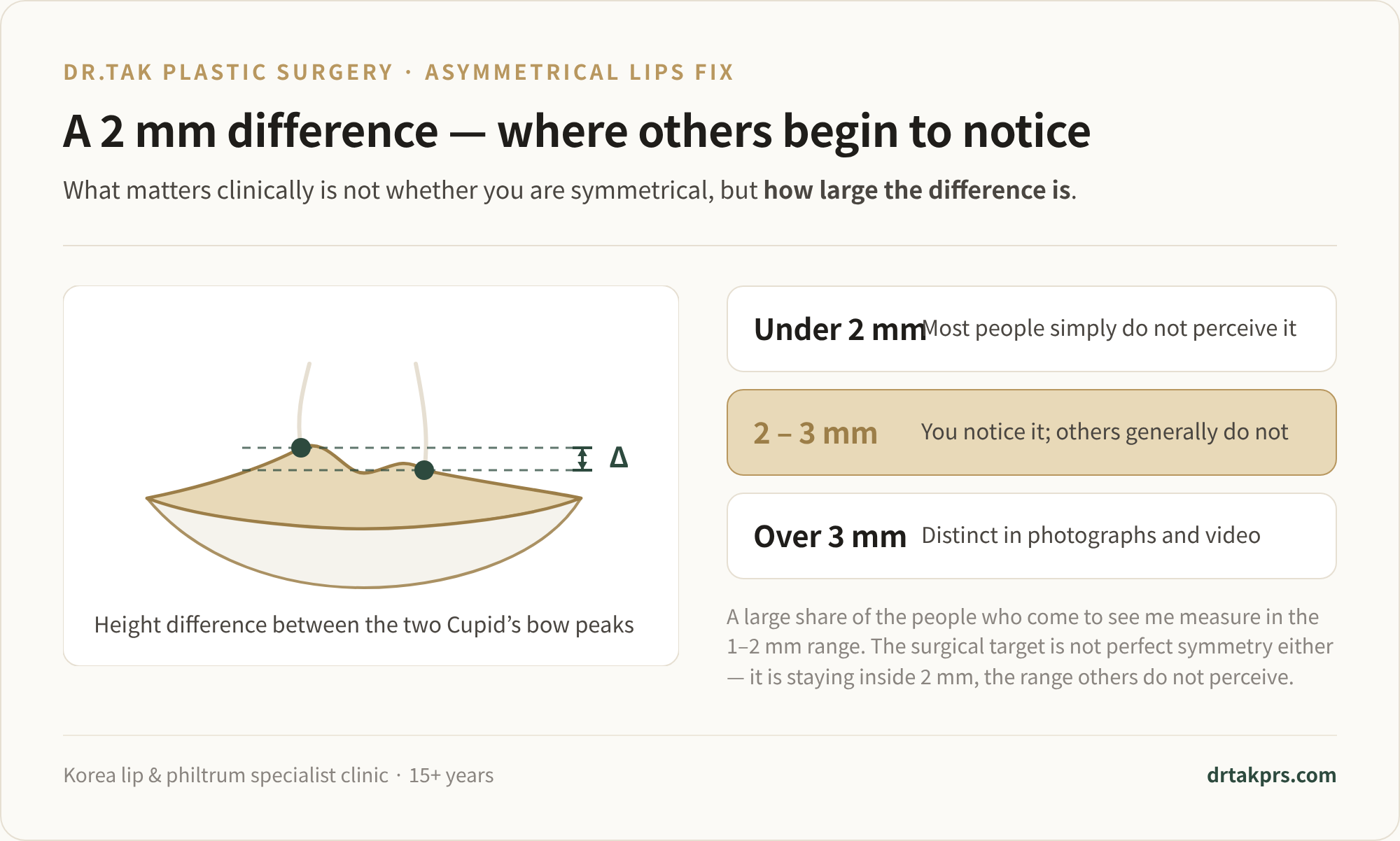
One thing has to be said here. A perfectly symmetrical face essentially does not exist. Facial anthropometry consistently reports this, and in more than 15 years focused on lips and the philtrum I do not recall meeting a perfectly symmetrical pair of lips. So the clinically meaningful question is not symmetrical or not. It is how large the difference is.
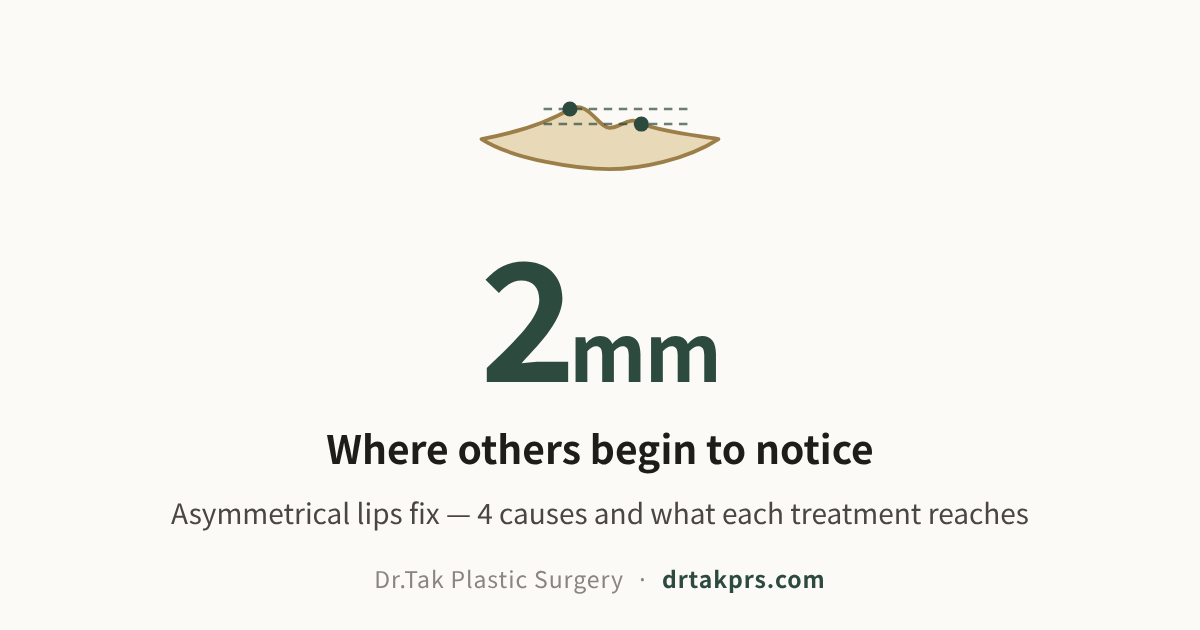
The rough line we use in measurement is this. When the height difference between the two Cupid's bow peaks, or between the two mouth corners, is under 2 mm, most people simply do not perceive it. Between 2 and 3 mm you notice it but others generally do not. Past 3 mm it becomes distinct in photographs and video. A large share of the people who come to see me measure in the 1 to 2 mm range — visible mainly to themselves.
So I show the measurements first. More than a few people have looked at the numbers, said "that's smaller than I thought," and gone home without a surgical plan. But that is exactly where the more interesting question appears. At the same 2 mm, one person is untroubled and another finds it hard to live with. What makes the difference is not the number. It is when that 2 mm shows.
The 4 things that make lips asymmetrical — four anatomically different states
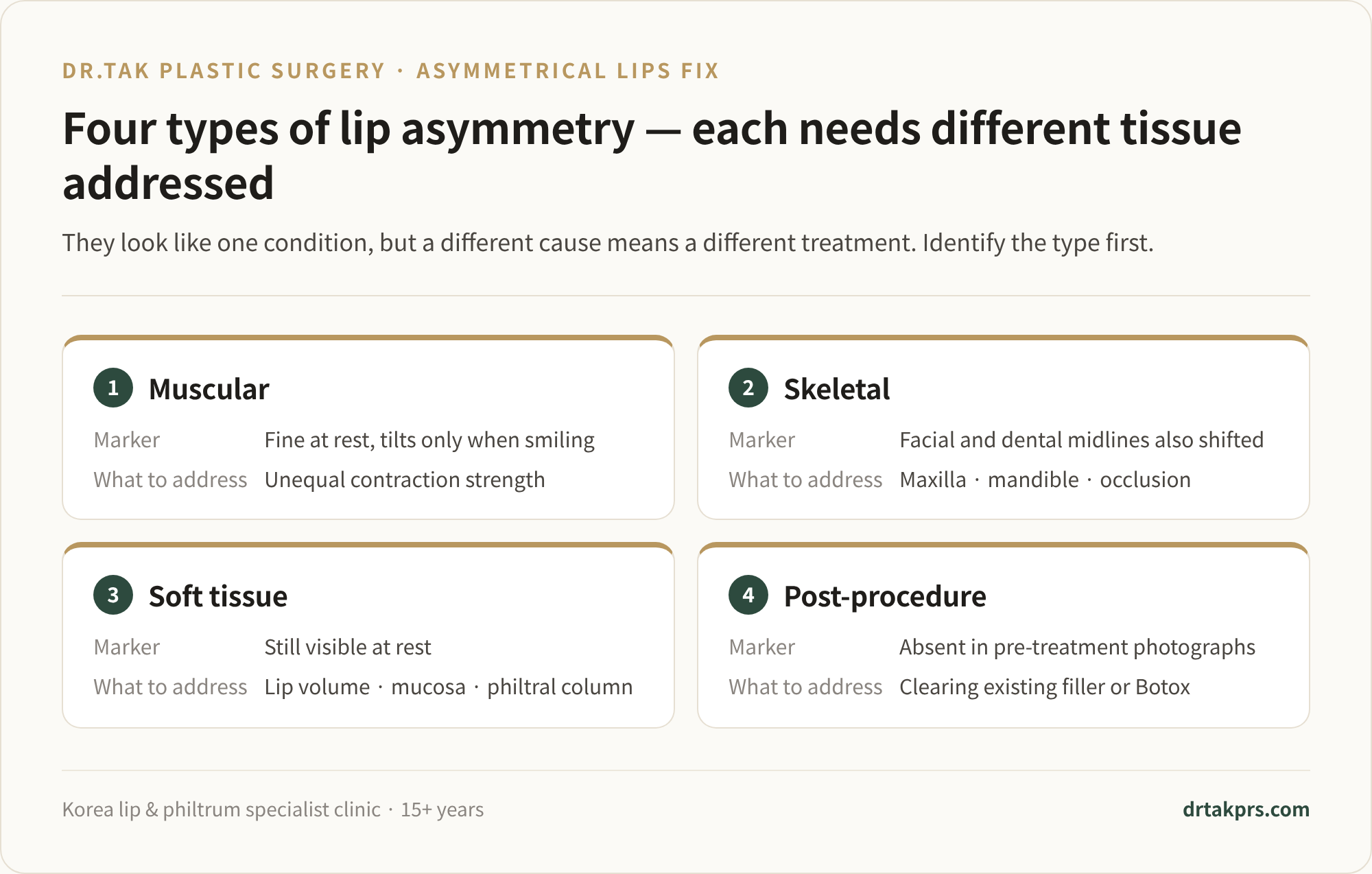
Core point first: lip asymmetry splits into the four causes below, and each one requires working on completely different tissue. Put filler into someone whose problem is muscular and they look better at rest and unchanged when they smile. Operate on the lips of someone whose problem is bone and it drifts back within months.
1. Muscular — the two sides pull with different strength
Around the mouth, the orbicularis oris closes the lips, while the levator labii superioris, the levator anguli oris and the risorius attach in left-right pairs to lift and spread. When these pairs contract with different strength, the lips look fine at rest and tilt only when you talk or smile.
Causes vary: a long habit of chewing on one side, smiling with one side of the face, a history involving the facial nerve, or simply congenital differences in muscle development. The clearest marker of this type is the gap between the resting state and the moving state. That is why I often ask to see a video before a mirror.
2. Skeletal — maxillary, mandibular or dental deviation showing through the lips
Lips are tissue resting on bone and teeth. If the maxilla sits at different heights left and right, if the mandible is shifted to one side, or if the occlusal plane itself is tilted, the lips simply follow that tilt. The lips look asymmetrical, but in truth the lips are fine and the platform beneath them is slanted.
The markers lie outside the lips. If the facial midline through brow, eye, nose and chin is also off, if the upper and lower dental midlines do not meet, or if the bite feels like it lifts on one side, I suspect this type. Here I send people for orthodontic or orthognathic consultation first and postpone any lip surgery. Reverse that order and you end up operating twice.
3. Soft tissue — the lip itself differs in volume, mucosa or philtral column
Here the lip tissue is genuinely asymmetrical. One side of the vermilion is thicker, the two philtral columns differ in length or definition, or one Cupid's bow peak sits higher than the other. Most cases are congenital; some are acquired, where past trauma or scarring has contracted one side.
The marker is that it remains visible at rest. Measure a photograph taken with the mouth closed and the face fully relaxed and the difference is still there. This is also the type where surgical correction produces the most predictable result of the four.
4. Post-procedure — asymmetry created by filler or Botox
This type has grown noticeably in my consultations over the past few years. Filler has settled to one side, filler placed in the upper lip has migrated toward the philtrum so that one side bulges, or Botox has diffused beyond its intended field and over-relaxed one muscle.
It is relatively easy to identify. If the asymmetry was absent in the pre-treatment photographs and appeared afterwards, it is almost always this type. And the approach here is the opposite of the other three. The first move is not adding something. It is clearing out what is already in there.
I do not raise surgery with these patients at the first visit. Filler should be dissolved with hyaluronidase and given time to settle before the underlying shape reappears, and for Botox, waiting for the effect to wear off is the most reliable correction there is. Often the waiting period also reveals whether an original asymmetry was there all along.
Which type is mine — a three-minute self-screen at the mirror
You can sort much of this out on your own before coming in. Follow this order.
✅ Take two front-facing photographs — one with the mouth closed and the facial muscles completely relaxed, one smiling as you normally do. Light from the front, head not tilted.
✅ Visible only in the closed-mouth photo → likely type 3, soft tissue.
✅ Fine at rest but tilted in the smiling photo → likely type 1, muscular.
✅ Visible in both, with the midline through nose and chin also shifted → suspect type 2, skeletal.
✅ Check whether the upper and lower front-tooth midlines meet → if they do not, type 2 becomes more likely.
✅ Any lip filler or Botox in the last one to two years → compare with pre-treatment photographs. A difference that was not there then is type 4.
✅ Several types seem to overlap — which is in fact the most common situation. Do not conclude on your own; get measured.
One caveat. Self-screening sets a direction; it is not a diagnosis. Types 1 and 3 coexist more often than people expect, and photographs alone barely distinguish them.
Start with a 1:1 personalised consultation
✅✅ Before any asymmetrical lips fix, we compare all four options — exercise, Botox, filler and surgery — against your specific type
✅✅ We give you our honest opinion whether or not you proceed with surgery
📲 Dr.Tak Plastic Surgery official site, chat icon at the bottom right — connects you to a live consultation
Exercise, Botox, filler, surgery — what actually works for which type
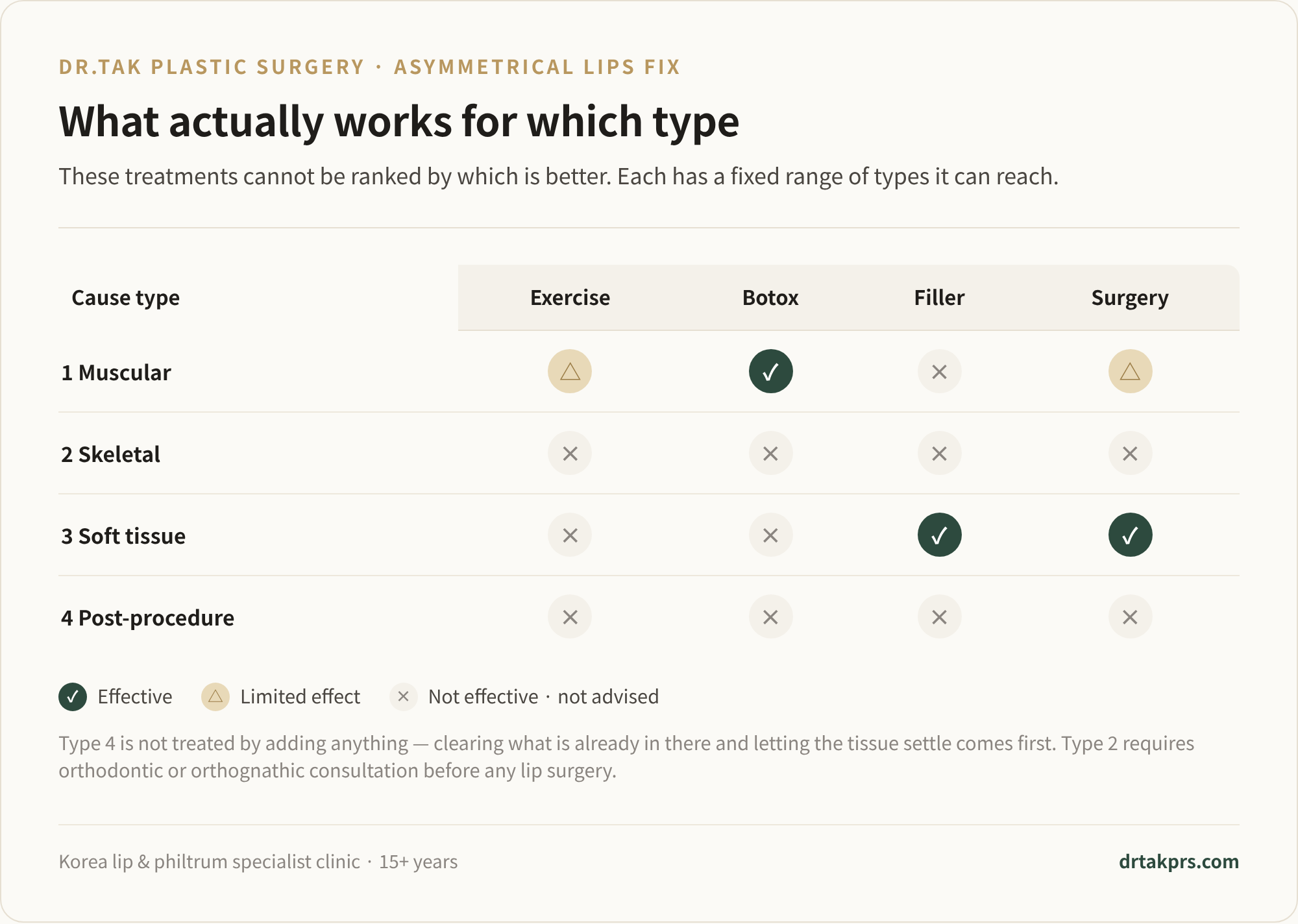
Now the main part. This table is the section worth sitting with longest.
| Criterion | Exercise / massage | Botox | Filler | Surgical correction |
|---|---|---|---|---|
| Mechanism | Repeated contraction shifts muscle use patterns | Selectively reduces an overactive muscle | Adds volume to the deficient side | Excises, repositions and re-sutures tissue |
| Works for | Part of type 1, mild habitual cases | Type 1 | Type 3, volume differences | Type 3; type 1 once fixed |
| Does not work for | Types 2, 3, 4 | Types 2, 3 | Types 1, 2; type 4 (makes it worse) | Type 2 (orthodontics must come first) |
| Onset | Months, minimal change | 3 to 7 days | Immediate, settled in 1 to 2 weeks | 2 to 4 weeks after swelling resolves |
| Duration | Reverts when you stop | 3 to 5 months | 6 to 12 months, product-dependent | Semi-permanent |
| Fine adjustment | Not possible | Adjustable by dose | Adjustable by volume, but migration risk | Millimetre-level at the design stage |
| Reversible | Not applicable | Wears off naturally | Dissolvable with hyaluronidase | Difficult to reverse |
| Return to routine | No restriction | Same day | Same day to 2 days | About a week, to suture removal |
| Main limitation | No effect in most types | Needs repeating; over-correction stiffens expression | Repeat cost, migration and nodule risk | Scar, irreversibility, recovery time |
📍 Bottom line: Read this table down the columns, not across the rows. These treatments cannot be ranked by how good they are. Each is a tool with a fixed range of types it can touch.
A little more on exercise. I do not tell people it is useless. Its range is simply narrow. If a one-sided chewing or smiling habit developed relatively recently and the difference is under 2 mm, habit correction does sometimes produce a small change. Conversely, someone born with different tissue volume can work at it faithfully and the tissue volume will not change. Muscle responds to use. Bone and skin thickness do not.
I also want to issue one warning about filler. People arrive steadily having created a fresh type 4 while trying to balance an asymmetry with filler. Topping up only the deficient side feels like it should even things out, but lips move ceaselessly as you talk, smile and eat, so filler placed on one side only travels over time. That is why, when I use filler on an asymmetry, I re-design both sides rather than filling the thin one. The reason follows in the next section.
Why I never treat only one side — the bilateral design principle
The most intuitive approach to asymmetry is "fix the side that's off." In my experience that is also the one that fails most often.
The reason is simple. Operate on one side only and that side's tissue tension, scar contraction vector and healing speed all differ from the other. It looks symmetrical immediately after surgery, then around the sixth month, as the scar matures, it drifts apart again. Both sides have to start in the same condition if they are to move together over time.
So our measurement works on three axes: the length and angle of each philtral column, the height difference between the two Cupid's bow peaks, and mucosal show in both front and profile view. We measure each, then determine which axis is the one actually visible in photographs. Even when all three are off, usually only one of them shows. My principle is to correct that one and leave the rest largely alone.
Something has to be said plainly here. The goal of an asymmetrical lips fix is not perfect symmetry. As established, no face is perfectly symmetrical, and forcing it produces stiff or artificial expression. The target we design toward is inside 2 mm — the range others do not perceive. Without sharing that line from the outset, surgery can go well and still disappoint.
🏥 Briefly, the basis on which we hold to this principle:
- A lip and philtrum specialist clinic with over 15 years concentrated on this area alone
- 200+ Google reviews, 5 out of 5 — covering the consultation process as well as surgical outcomes
- Every consultation begins with measurements and a simulation before any discussion of surgery
- When surgery is not the answer, we say so
💬 "To make people smile." In asymmetry correction this sentence carries particular weight, because the work is giving someone who became self-conscious about their own smile permission to use it freely again.
If you decide on surgery — why recovery feels uneven side to side
Recovery after asymmetry correction has one feature other lip surgeries do not. Swelling resolves at different rates on each side. Given that the two sides had different amounts removed to begin with, that is only logical — but without being told in advance it is easy to think something went wrong.
| Period | State | What to watch |
|---|---|---|
| Day 0 to 3 | Peak swelling, side difference most pronounced | Cold compress, sleep with head elevated |
| Day 4 to 7 | Swelling begins to recede, sutures removed | Avoid wide mouth opening and big laughs |
| Week 2 | Much of the swelling resolved, side difference still present | Do not judge the result from this point |
| Week 4 to 6 | Scar redness begins, contour emerges | Strict sun protection |
| Month 3 to 6 | Scar matures, final symmetry assessable | Continue control taping and scar care |
📍 Bottom line: Judge the result of an asymmetry correction after the third month. Do not let a week-two photograph rush you.
There is a reason I show this table at every pre-operative consultation. Week two is when most people contact us anxious, and hearing "that's normal" then is far less comfortable than having known it from the start.
Before & after photographs are on our official page
Dr.Tak Plastic Surgery complies with medical advertising regulations, so we do not place before-and-after photographs inside blog articles. Actual pre- and post-operative changes are collected on the official before & after page.
🔗 View before & after — Dr.Tak Plastic Surgery official page
Results may vary from person to person.
The Dr.Tak 4S Patient Care System — focused on the person, not the procedure
We focus on the person, not the procedure.
Solution — a 1:1 master plan with Dr. Tak Seung-wan
- Genuine empathy and communication: your wishes reflected fully in the surgical plan
- Precise facial golden-ratio analysis, personalised: philtral column length, Cupid's bow peak height difference and mucosal show measured on three axes
- Post-operative change simulation provided
Support — a global 1:1 dedicated coordinator
- A dedicated coordinator assigned by country, no language barrier
- Accompanies you through consultation, surgery and aftercare
- 100% appointment-only, for a private clinical environment
Scar Care — six months of intensive scar management
| Item | Period | Content |
|---|---|---|
| Control taping | 3 to 6 months | Prevents scar widening |
| Scar-softening injection | 6 months, monthly | Softens raised scars |
| Laser treatment | 6 months | Reduces redness at the surgical site |
Service — one year of complimentary A/S
- Complimentary A/S within one year of surgery
- We see it through to the end
- Note: basic anaesthesia costs may apply when sedation is used
If you want to know more — official channels
🌐 The Dr.Tak Plastic Surgery official site carries detailed guides and before-and-after cases for each lip and philtrum procedure
📝 The blog collects articles by procedure — lip lift, philtrum reduction, lip augmentation, mouth corner correction
📹 Video lets you follow the surgical process and recovery course
Five things to settle for yourself before deciding
✅ Is my asymmetry present at rest, or only when I smile — this one answer decides half the treatment direction
✅ When did it start bothering me — the clue that separates congenital from acquired
✅ Any filler or Botox in the last two years — if so, bring the pre-treatment photographs
✅ Any orthodontic history or bite discomfort — directly relevant to whether this is skeletal
✅ Do I want perfect symmetry, or a level no one notices — if that expectation is not aligned before surgery, a good result can still disappoint
Simply writing these five down makes a consultation far denser. You do not need to arrive with answers. Leave the ones you do not know blank and we will work them out together.
Frequently Asked Questions (FAQ)
The questions we receive most often at Dr.Tak Plastic Surgery.
Q1. Can asymmetrical lips be fixed naturally? How long should I try exercise or massage before judging?
Only where the type matches, and only within narrow limits. If a one-sided chewing or smiling habit is relatively recent and the difference is under 2 mm — a muscular asymmetry — I suggest trying habit correction for about three months first. If nothing has changed in that window, it is unlikely that continuing will help. Soft-tissue and skeletal asymmetry, by contrast, do not respond to exercise at all. Tissue volume and bone position are not altered by frequency of use.
Q2. My lips look fine at rest but go lopsided when I talk. Is that a surgical case?
That is textbook dynamic asymmetry, and Botox comes before surgery for this type. Selectively reducing the contraction of the over-pulling muscle evens the movement within 3 to 7 days. I avoid surgery here because excising tissue that is itself normal, when only the movement differs, creates a new asymmetry at rest. That said, if there is a history of facial nerve injury, or one corner does not lift at all, this is not a cosmetic matter and neurological assessment comes first. Botox is not suitable for anyone pregnant, breastfeeding, or with a neuromuscular disorder.
Q3. One lip is bigger than the other. Can't you just fill the smaller side?
The most frequent question I get, and the one I most often talk people out of. Lips move constantly as you talk, smile and eat, so volume placed on one side alone relocates over time. I see this steadily with filler placed unilaterally in the upper lip that migrates toward the philtrum and creates a different asymmetry than the one it was meant to solve. Rather than filling the thin side, I re-design both lines together — easing the thick side down slightly and lifting the thin side slightly so they meet in the middle. The total change is smaller, and the result lasts longer.
Q4. Once corrected, is it permanent? And roughly what should I budget?
It depends on the treatment. Botox lasts 3 to 5 months, filler 6 to 12 depending on product and site, and both assume repetition. Surgical correction changes the tissue itself, so it holds semi-permanently. On cost I cannot responsibly quote an exact figure. The range shifts with the type involved, whether bilateral design is needed, whether it is a revision, and whether sedation is used. What I will say is that set against a three to five year horizon, the total often reverses order between the repeat-treatment route and the one-time route. Once the type is confirmed at consultation, we give you a concrete range.
Q5. I am afraid it will end up looking stranger than it does now.
That fear is well founded, and it is the part I spend longest on before surgery. Asymmetry correction generally goes wrong by one of two routes: over-correcting toward perfect symmetry, or treating one side only so that the two heal out of step. So we set the target at inside 2 mm, the range others do not perceive, and design both sides together. And honestly, this surgery is not right for everyone. When someone comes in over a 1 mm difference visible only to themselves, I do not recommend operating. Looking at the measurements together first costs you nothing.
Dr.Tak Plastic Surgery | Korea Face Lifting · Lip · Philtrum Specialist Clinic
"To make people smile"