

Three months in, and the photo looks the same?
Three months. Morning and night, and you have barely skipped a day. Yet the front-facing photo looks exactly like the one from the week you started.
Most people arrive at the same conclusion here. I must be doing it wrong, or I am not doing it often enough. So another video gets watched and another set gets added. The more diligent you have been, the heavier this moment feels. What stings is rarely the lack of result — it is the suspicion that you simply did not try hard enough.
Let me settle one thing before anything else. If a downturned lips fix by exercise has not worked for you, that is almost never a question of effort.
And it is not because "the facial muscles are weak" either. When I measure, I usually find the opposite.
The muscles that lift and the muscles that pull down are not in the same weight class
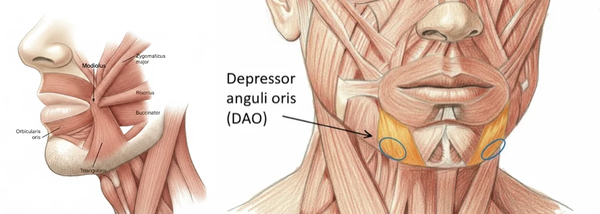
To answer directly: mouth corners do not fall because the lifting force is too small. They fall because the pulling force works for far longer. Training the lifters does not out-work the pullers' shift.
The mouth corner, anatomically the oral commissure, is a junction where several muscles meet at one point and pull in different directions. Two camps face off over that junction.
① The lifting side — zygomaticus major and minor run down diagonally from the cheekbone and pull the corner up and out, with levator anguli oris supporting underneath. These muscles fire when you smile, when you speak, that is, when you deliberately make an expression.
② The pulling side — the depressor anguli oris rises as a triangle from the lower border of the mandible and inserts into the corner. The upper fibres of the platysma, the broad sheet spanning neck to jaw, join it and pull downward together.
③ The decisive difference — the lifters work only while an expression is made, while the pullers hold a resting tone through every waking hour. If you clench, or habitually tense the jaw and neck, those hours grow.
| Comparison | Lifting side (zygomaticus, levator anguli oris) | Pulling side (depressor anguli oris, platysma) |
|---|---|---|
| When it works | While an expression is made | Every waking hour (resting tone) |
| Daily working time | Tens of minutes in total | Effectively all day |
| What training can increase | Contraction strength, recruitment speed | — |
| What training can reduce | — | Almost nothing |
Ten minutes of exercise and fifteen hours of traction are pulling on the same rope. You do not need to calculate which way the rope has moved.
One more thing stacks on top. Unlike limb muscles that run bone to bone, facial muscles are cutaneous muscles with one end anchored directly in the skin. Hypertrophy from training simply does not respond the way it does in an arm, and whatever force is gained is transmitted not into bone but into skin that has already stretched.
In other words, the target the exercise aims at and the real source of the droop are often misaligned from the start. So when someone asks me about exercise results, I ask first whether they have checked which layer the droop is actually happening in.
Three layers exercise never reaches
When a mouth corner settles downward, what has changed is not one thing but three layers. Exercise touches only one of them, and only partly.
First, the muscular layer. The sustained downward traction of the depressor anguli oris and the platysma. Exercise reaches this layer but cannot weaken the opponent. What addresses this layer directly is not training but selective relaxation of that muscle.
Second, the skin and soft tissue layer. Once the skin lateral to the corner has stretched and lost support, no amount of muscular pull holds a lifted position. Pulling harder on an elastic band that has already gone slack does not restore its shape. Exercise does not reach this layer at all.
Third, the support and skeletal layer. Laxity of the ligaments around the corner, dental alignment and the maxillomandibular relationship, the anteroposterior position of the lower jaw. If this layer is the cause, no amount of facial muscle training changes the starting point.
The first thing I measure is how far the corner point sits below the intercommissural line, and then whether pushing the skin lateral to the corner upward with a finger restores the contour naturally. If the line comes back smooth, the muscular layer carries most of the weight; if the skin bunches and folds, the second layer has already progressed. More people split on that single manoeuvre than you would expect.
📍 Bottom line: Exercise reaches half of the first layer out of three. For anyone whose main culprit is the second or third layer, years of it will not change the photograph.
Which always brings one question straight back. Then is everyone who says exercise worked for them lying?
There really are people for whom exercise works
You may be feeling rather deflated by now, which is exactly why this part matters.
Let me be honest: I do not recommend surgery to people for whom exercise is enough. And there are more of them than you might think.
The more of the following apply, the more likely habit correction and exercise alone will change things for you.
✅ You are in your twenties or early thirties, and the contour restores smoothly when the skin is pushed up
✅ The corners drop noticeably while you talk or concentrate, more than at rest
✅ You are aware of clenching, or of tension in the jaw and neck
✅ Mornings look fine and the droop deepens through the afternoon
✅ Photos vary a lot, and some angles look perfectly normal
✅ Your weight has not changed much recently
What these cases share is that the droop is coming from tension and habit rather than from structure. What is needed then is not training that lifts the corner but training that releases the side pulling it down. For these patients I start with letting the jaw and neck go, not with corner lifts. The direction is the exact opposite.
Conversely, if none of the ticks apply and your resting photo looks the same every time, doing more exercise is mostly spending time. That is what I am trying to spare you.
A 1:1 consultation you can start today
✅✅ We measure which layer your mouth corners are dropping from, then compare exercise, non-surgical and surgical options side by side
✅✅ You get an honest opinion, whether or not surgery is involved
📲 Dr.Tak Plastic Surgery official site, chat icon at the bottom right — live consultation
Exercise, taping, botox, filler and corner lift in a single table
| Comparison | Exercise | Taping and massage | Depressor anguli oris botox | Corner filler | Corner lip lift |
|---|---|---|---|---|---|
| Layer targeted | Muscle (lifting side) | Skin surface | Muscle (pulling side) | Skin and soft tissue | Skin and soft tissue |
| When the cause is muscular | Limited | Almost none | Effective | Supportive | Effective |
| When the cause is skin | None | None | Limited | Supportive | Effective |
| When the effect shows | Months, or never | Hours | 3 to 7 days | Immediately | After swelling settles |
| How long it holds | Reverts if stopped | Reverts when removed | 3 to 4 months | 6 to 12 months | Semi-permanent |
| Scar | None | None | None | None | Fine incision lateral to the corner |
| Recovery | None | None | None | Possible bruising, 1 to 3 days | About a week to suture removal |
| Reversible | Not applicable | Not applicable | With time | Can be dissolved | Difficult |
| Repetition needed | Continuous | Continuous | 3 to 4 times a year | 1 to 2 times a year | None |
The table makes the groupings visible: exercise and taping together, botox on its own, filler and surgery together. If hearing that exercise will not work sent your mind straight to surgery and your heart sank, the reason the next step is not surgery is in this table too. If the cause leans muscular, depressor anguli oris botox takes the place exercise was meant to fill — and that is a reversible option.
I rarely open with surgery for someone I am meeting for the first time. I keep the order: try what can be undone, watch the response, then decide what comes next.
A timeline for trying the non-surgical route first
| Period | What to watch | What to mind |
|---|---|---|
| 1 to 3 days | Minor bruising at the injection points | Avoid heavy massage and saunas on the day |
| 3 to 7 days | The downward pull begins to ease | Do not judge yet. It has not fully settled |
| 2 to 3 weeks | The final effect establishes itself | The photo taken here is your reference photo |
| 2 to 3 months | The effect gradually fades | What you see now is close to your baseline |
| 3 to 4 months | Repeat, or decide on the next step | If two or three rounds give only brief satisfaction, the issue may be structural |
What clinics most often skip is the photo at two to three weeks. Without a reference photo there is no basis for deciding what to change next. I ask every patient to keep that one image.
On the time we put into this judgement
Dr.Tak Plastic Surgery has concentrated on the lip and philtrum region in Korea for more than fifteen years. The mouth corner is the endpoint of the lip line and cannot be assessed apart from the balance of the whole mouth, so we never read the corner alone — philtrum length, upper lip show and the dental show line are measured alongside it.
🏥 Why patients trust us
- A lip and philtrum specialist clinic with more than fifteen years of experience
- Over 200 Google reviews, rated 5 out of 5
- A fully appointment-only, private clinical setting
- A consultation principle of reporting the measurements as they are, regardless of whether surgery follows
💬 "To make people smile"

Helping someone smile is not always surgery. Telling a patient that exercise is enough, when it is, is the same work.
The Dr.Tak 4S Patient Care System — focused on the person, not the procedure
Focused on the person, not the procedure
Solution — a 1:1 master plan with Dr. Seungwan Tak
- Genuine empathy and communication: your wishes reflected fully in the plan
- Precise golden-ratio facial analysis, individually tailored: measuring whether the corner droop arises from muscle, skin or support
- A simulation of the expected post-operative change
Support — a global 1:1 dedicated coordinator
- A dedicated coordinator assigned by country, with no language barrier
- Accompanying you through consultation, surgery and aftercare
- 100% appointment-only, for a private clinical environment
Scar Care — six months of intensive scar management
| Item | Period | Detail |
|---|---|---|
| Control taping | 3 to 6 months | Prevents scar widening |
| Scar-softening injections | 6 months, monthly | Softens raised scars |
| Laser treatment | 6 months | Reduces redness at the surgical site |
Service — a one-year complimentary revision guarantee
- Complimentary revision within one year after surgery
- We see it through to the end
- Note: a basic anaesthesia fee may apply if sedation is used
If you would like to know more — official channels
🌐 Official site drtakprs.com — procedure guides and case records
📝 Blog — clinical columns on the lip and philtrum region
📹 Video channel — surgical steps and recovery progress
Five things to settle before deciding whether to keep exercising
✅ Do you have a front-facing photo taken at rest, not smiling
✅ Has that photo changed compared with one or three years ago
✅ Does the contour restore smoothly when the skin is pushed up
✅ Does it differ by time of day
✅ How long have you exercised, and do you have before and after photos
If the fifth is blank, start keeping one photo a month from now. That record alone becomes the most useful material in a consultation.
Frequently Asked Questions (FAQ)
The questions we receive most often about mouth corner exercises.
Q1. How many times a day, and for how many months, before exercise shows an effect
Before the duration, look at the direction. Patients in the tension group usually notice the difference in the late afternoon within two to four weeks, and when nothing has shifted by then I have almost never seen more repetitions change the outcome. So rather than extending the months, I suggest reviewing at the four-week mark. What matters more than the count is whether you are doing a lifting exercise or one that releases the tension pulling down — and a surprising number of patients have those two the wrong way round.
Q2. Are exercise devices or taping better than exercising with bare hands
They target different layers, so the comparison does not really hold. Devices you bite on raise the contraction strength of the lifting side slightly but do not reach the second layer described above, and taping fixes the skin mechanically, so it returns to its original position the moment it comes off. That said, how much the contour survives a night of taping is a useful self-test. When patients tell me that result at consultation, it saves a great deal of measuring time.
Q3. Only one corner is lower. Can exercise even that out
One-sided droop has a very different distribution of causes from a symmetrical one. The order we work through is ① habits such as chewing on one side or sleeping position ② dental alignment and maxillomandibular asymmetry ③ neurological factors, and if even one finding points to the third, that needs checking before any cosmetic treatment. Exercising both sides equally can also make the asymmetry more obvious, so for one-sided droop I recommend establishing the cause before starting at all.
Q4. I am a man and people tell me I look angry. Is the approach the same
The criteria are the same, but the target is not. In men, lifting the corner too much reads as artificial very quickly, so we set a more conservative correction than in women and start depressor anguli oris botox at a lower dose. Cost depends on which layer is addressed, whether asymmetry is involved and which anaesthesia is used, so it cannot be given meaningfully as a figure in advance and is quoted after measurement. What I do often tell male patients is that jaw and neck tension is a proportionally more common cause, so a fair number of cases end at the non-surgical stage.
Q5. I understand exercise will not do it, but there are so many posts about regretting surgery
That fear is reasonable, and I do not recommend surgery to everyone. When I look at the cases where regret appears, it is usually one of two things. An incision was made when the cause was not in the skin layer, or the amount of correction exceeded what that face could carry. So we read the response to reversible botox first, confirm that the lifted version looks natural to you, and only then discuss surgery. Surgery is not for those whose droop is mild, those who have no reference photo and only started noticing it "lately", and those whose asymmetry has not yet been worked up.
Dr.Tak Plastic Surgery | Korea Face Lifting · Lip · Philtrum Specialist Clinic
"To make people smile"