
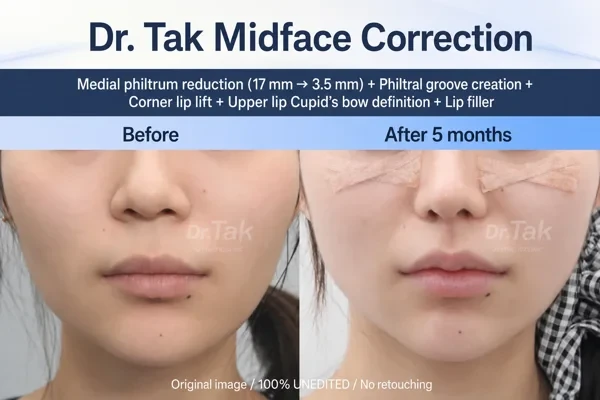
"I've had fillers a few times — why do my lips still feel off?"
If you have had filler more than once and still felt something was missing in the mirror, I believe many of you know that feeling. The volume went in, yet the impression stayed the same — or worse, people said the lips looked puffy.
I hear this often in my consultation room. "I don't want them bigger — I just want them to look natural." What is interesting is that this one sentence has reshaped the entire direction of lip enhancement in recent years.
Lip enhancement in Korea used to be about one thing: how plump can we make them. Not anymore. Balance matters more than size, longevity more than volume, and above all — it should not look done. Yet here is the part many people miss.
Today I want to share, from a surgeon's point of view, where lip enhancement is heading, and why the same procedure can produce such different results.
Modern Lip Enhancement Is About "More Natural," Not "More Volume"
A few years ago, the most common request was "make them plump." Now it is overwhelmingly "I want them to still look like my lips."
This shift is not just taste. As people accumulate filler experience, they learn that a purely volumized lip looks awkward when they smile. It may photograph well while still, but if it looks unnatural in motion — talking, laughing — it eventually "shows."
So the latest direction settles into three points. First, lip line and proportion over volume. Second, lasting structural improvement over temporary filling. Third, natural movement rather than a frozen front-facing photo. Once you understand these, the criteria for choosing a method change completely.
Three Factors That Decide a Natural Lip
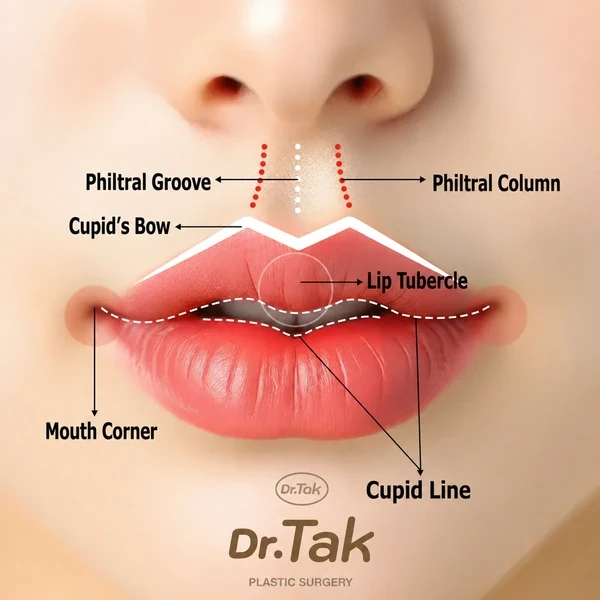
The same lip can give a completely different impression depending on where you treat it. In consultation, I always look at these three first.
① Upper lip show — the vertical height of the visible upper red lip (vermilion) from the front. When this show is insufficient, the face looks older and only the gums stand out when smiling. This is the case where you need to increase show itself, rather than blindly adding filler volume. At Dr.Tak, we improve this show through a lip lift performed as a philtrum reduction — by shortening the philtrum.
② Lip line definition — when the border between lip and skin (the vermilion border) blurs, the lips look undefined even with makeup. Here you restore the border, not the volume.
③ Upper-to-lower volume ratio — the ideal ratio of upper to lower lip is roughly 1:1.6. Enlarging both while this ratio is broken makes lips bigger but not harmonious.
Which of the three is lacking determines the answer. And most disappointing results happen when filler goes in "first," without this diagnosis.
So Why Do the Same Procedures Give Different Results?
This is the part I most want to emphasize. Filler, mucosal advancement, lip lift — the techniques themselves are performed at many clinics. So why do results differ so much?
The difference lies not in "what" you do, but in "where, how much, and in what order." I have specialized in lips and the philtrum for more than 15 years. The most important principle I learned in that time was, paradoxically, "doing less."
To be honest, the most natural results come from the most conservative approach. Instead of maxing out in one session, you adjust only exactly what is needed within the balance of the whole face. That is the core of a lip that does not show. It is not flashy technique but the eye to know when to stop that shapes the result.
And one more thing. The lip is not a static tissue. It moves thousands of times a day. So I always have patients smile and speak, and I design within that movement. Skip this, and you get lips that are pretty only in a photo.
Your 1:1 Personalized Consultation
✅✅ Before any procedure, we compare and explain every option — filler, mucosal advancement, or lip lift — so you know which fits
✅✅ We give an honest opinion, regardless of whether surgery is right for you
📲 Dr.Tak official website, chat icon at the bottom right → connect to a live consultation
Comparing the Methods — by "Natural and Long-Lasting"
Reorganizing the options by longevity and naturalness makes the choice far clearer.
| Comparison | Lip filler | Mucosal advancement (surgery) | Lip lift (philtrum reduction method) |
|---|---|---|---|
| Duration | 6–12 months (repeat needed) | Semi-permanent | Semi-permanent |
| How it works | Volume injection | Advancing the mucosa forward | Shortening the philtrum to increase upper lip show |
| Mainly improves | Volume, hydration | Show, volume | Show, philtrum length impression |
| Naturalness | Depends heavily on dose/placement | Natural, uses your own tissue | Depends on design |
| Recovery | Swelling 3–5 days | Suture removal ~1 week | Suture removal ~1 week |
| Scar | None | Inside the mucosa (not visible) | Along the crease under the nose |
| Swelling | Mild–moderate | Moderate | Moderate |
| Maintenance | Repeat sessions, accumulating cost | Stable after early care | Stable after early care |
| Best for | Light, temporary improvement | Permanent improvement of thin lips | Insufficient upper lip show, long philtrum |
📍 Bottom line: Filler is for "light, right now"; surgical methods are for "the long view, at the root." If you are tired of repeat filler costs and swelling, I encourage you to at least consult about a lasting option once.
Recovery, Organized by Timeline
Recovery is the most common question when considering a surgical method. The rough flow is this.
| Time | Condition | Care point |
|---|---|---|
| Day of | Swelling, numbness | Cold compress, avoid irritating food |
| Day 3 | Swelling peaks, then eases | Soft meals, avoid strong expressions |
| Week 1 | Suture removal | Much of the swelling subsides from here |
| Week 2 | Naturalness returns | About 70% of swelling is gone by now |
| Month 1 | Full return to daily life | The line begins to settle |
| Month 3 | Final shape settles | Tissue softens into place |
The speed at which swelling resolves varies widely between people. That is why I do not declare "two weeks and no one will notice." Still, most reach a state where it is hard for others to tell around the two-week mark.
The Difference 15+ Years Makes — Grounds for Trust
The lips are the most sensitive expression-making area of the face. That is why I have focused on this one area for so long.
🏥 The grounds for trust that Dr.Tak can offer are these: more than 15 years as a lip and philtrum specialist clinic, over 190 Google reviews with a perfect 5-point rating, and multilingual consultation experience with patients from Korea and abroad.
💬 "I focus on people, not procedures. My goal is not a bigger lip, but the lip that looks most like you when you smile."
More important than the numbers, I think, is that this time has given me the eye to tell apart the cases where doing nothing is the better choice.
The Dr.Tak 4S Patient Care System
We focus on people, not procedures.
Solution
We diagnose the lips within the balance of the whole face. We separate show, line, and ratio, and build a custom design that adjusts only as much as needed.
Support
The same doctor sees you consistently from consultation through surgery to recovery. Your case is not handed off midway.
Scar Care
We work through an incision inside the mucosa as a principle, leaving no external scar, and we guide scar care for six months during recovery.
| Time | Scar / tissue care |
|---|---|
| Month 1 | Incision stabilizes, minimize irritation |
| Months 2–3 | Tissue softens, massage guidance |
| Months 4–6 | Final settling, fine adjustment consult if needed |
Service
Beyond Korean, we offer consultation in English, Chinese and more, so your intended direction is matched precisely without misunderstanding.
If You'd Like to Know More — Official Channels
🌐 See procedure information and cases on our official website.
📝 Leave any questions through the chat icon at the bottom right of the website.
📹 You can also see the real consultation atmosphere and the doctor's explanations on our official video channel.
Five Things to Sort Out Before Deciding
✅ Do I want "size," or "natural"?
✅ Can I accept temporary improvement (filler) or lasting improvement (surgery)?
✅ Is my concern about volume, or about show and line?
✅ How much time can I give to recovery?
✅ Am I prepared to hear "you don't need it" at the consultation?
The last point matters most. A good consultation does not push a procedure — it honestly addresses whether you need one at all. That is what I believe.
Frequently Asked Questions (FAQ)
The questions Dr.Tak receives most often, gathered here.
Q1. Won't fillers make my lips look puffy?
One of the most common questions. Puffiness usually comes from adding too much volume at once, or enlarging only the lips while ignoring facial proportion. Because I work in divided, measured amounts and design around the line, the same filler leaves a different impression. In the end it is a matter of "how much and where," not "what."
Q2. How long does the improvement last?
It depends on the method. Filler lasts roughly 6–12 months and needs repeating; surgical methods like mucosal advancement or lip lift are semi-permanent. If repeat filler costs and swelling have been a burden, consulting about a surgical option from a long-term view is worth considering.
Q3. How much does it cost, and what changes the price?
Cost varies greatly by method and the extent of improvement. Filler is priced by volume; surgical methods by scope and difficulty. I do not push a large procedure — I start by explaining the minimum scope that solves only what bothers you. The exact cost is given individually after diagnosis.
Q4. Will there be a scar?
Mucosal advancement is incised inside the lip, so no scar shows externally. Dr.Tak's lip lift is performed as a philtrum reduction, designed along the natural crease under the nose so it does not stand out from the front. Of course, recovery care shapes the result, so we guide scar care with you for six months.
Q5. What if my face doesn't feel like mine after surgery?
This fear is one many patients carry in with them. That is exactly why I always adjust the lips within the impression of the whole face. The goal is not "a different person" but "a more composed you." And honestly, this surgery is not right for everyone — which is why I tell you first, truthfully, whether you need it.
Dr.Tak Plastic Surgery | Korea's lip & philtrum specialist clinic
"To make people smile"