"Are my cheeks hollow, or have they dropped?" — the first question that confuses people in the mirror
At some point your face started looking tired in photos, and the line running from under your eyes into your cheeks began to look broken. If you also noticed that your smile lines deepened first at the top, beside the nostrils, rather than lower down, it makes complete sense that you ended up typing "midface lift" into a search bar.
But when I actually look at the faces of people who bring this same concern into my consultation room, the cause is not always the same. In some, the tissue over the front of the cheekbone has slid down. In others, the tissue is still where it was, but the volume has gone. And in others, the sagging is really concentrated around the mouth and jawline. The symptoms look alike from the outside, yet the right answer for each of the three is completely different.
That is why I talk about telling them apart before I talk about any operation, and this article follows the same order. First I will explain exactly where the midface is and why it descends, then show you a way to sort your type that you can try at home, and finally compare a midface lift with a facelift, a thread lift and filler on the same criteria.
Let me be honest from the start: some of you will finish this article and conclude that you do not need surgery at all. That is a good conclusion too.
What a midface lift is — returning a descended cheek to where it belongs
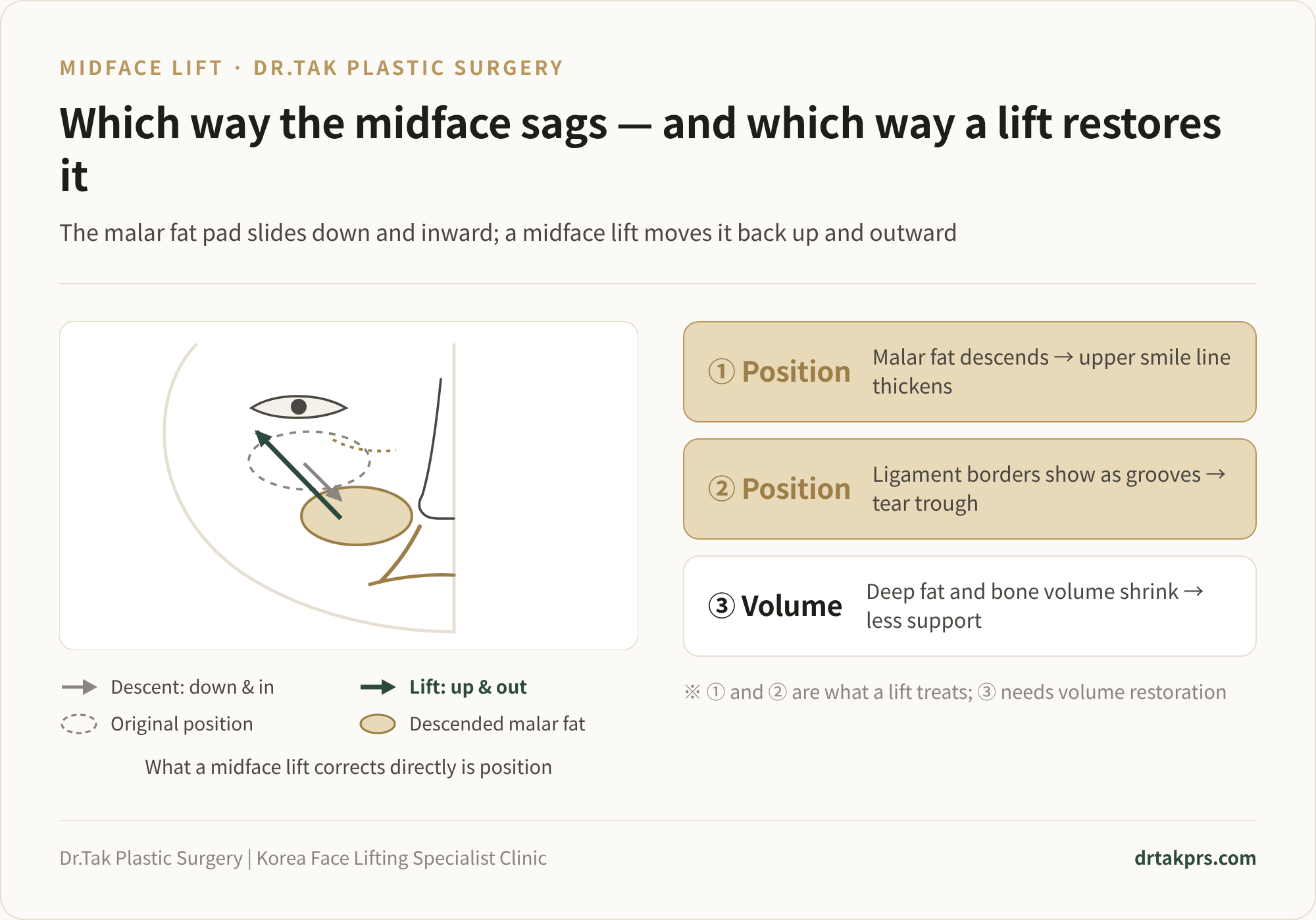
The short answer: a midface lift is an operation that lifts the soft tissue of the front cheek, which has slid downward and inward, back upward and outward and fixes it there. It is not about pulling skin to smooth out wrinkles. The aim is to restore the position of descended tissue, so that the border between the lower eyelid and the cheek and the upper part of the smile line soften together.
The midface here means the central zone of the face around the front of the cheekbone, from just below the lower eyelid down to the side of the nostrils and the top of the smile line. You will also see it called a cheek lift, or an endoscopic midface lift when an endoscope is used. In Korea it is known as 중안면거상 (midface lifting). All of these names refer to surgery on the same zone.
Three things overlap to make this zone descend.
① The malar fat pad slides downward and inward
The pad of fat under the skin that sits over the front of the cheekbone (the malar fat) slips downward and inward with age. As much as it moves down, the area under the eye above it looks hollow, and tissue piles up at the top of the smile line below it, making the fold heavier.
② Grooves appear around the retaining ligaments
Around the eyes and cheekbones there are retaining ligaments that hold the skin to the bone. Where a ligament attaches, tissue descends less, while the tissue around it sags — so that border shows up as a tear trough or as a diagonal groove running from under the eye into the cheek.
③ The deep volume that supports it shrinks
The deep fat layers beneath the skin atrophy, and research shows that the front of the upper jawbone also recedes slightly with age. With less support underneath, the tissue on top descends more easily.
There is one important point here. ① and ② are problems of position; ③ is a problem of quantity. What a midface lift directly corrects is position.
That difference is where the self-check below begins.
Which type is my face — a 3-way check using the lying-down position
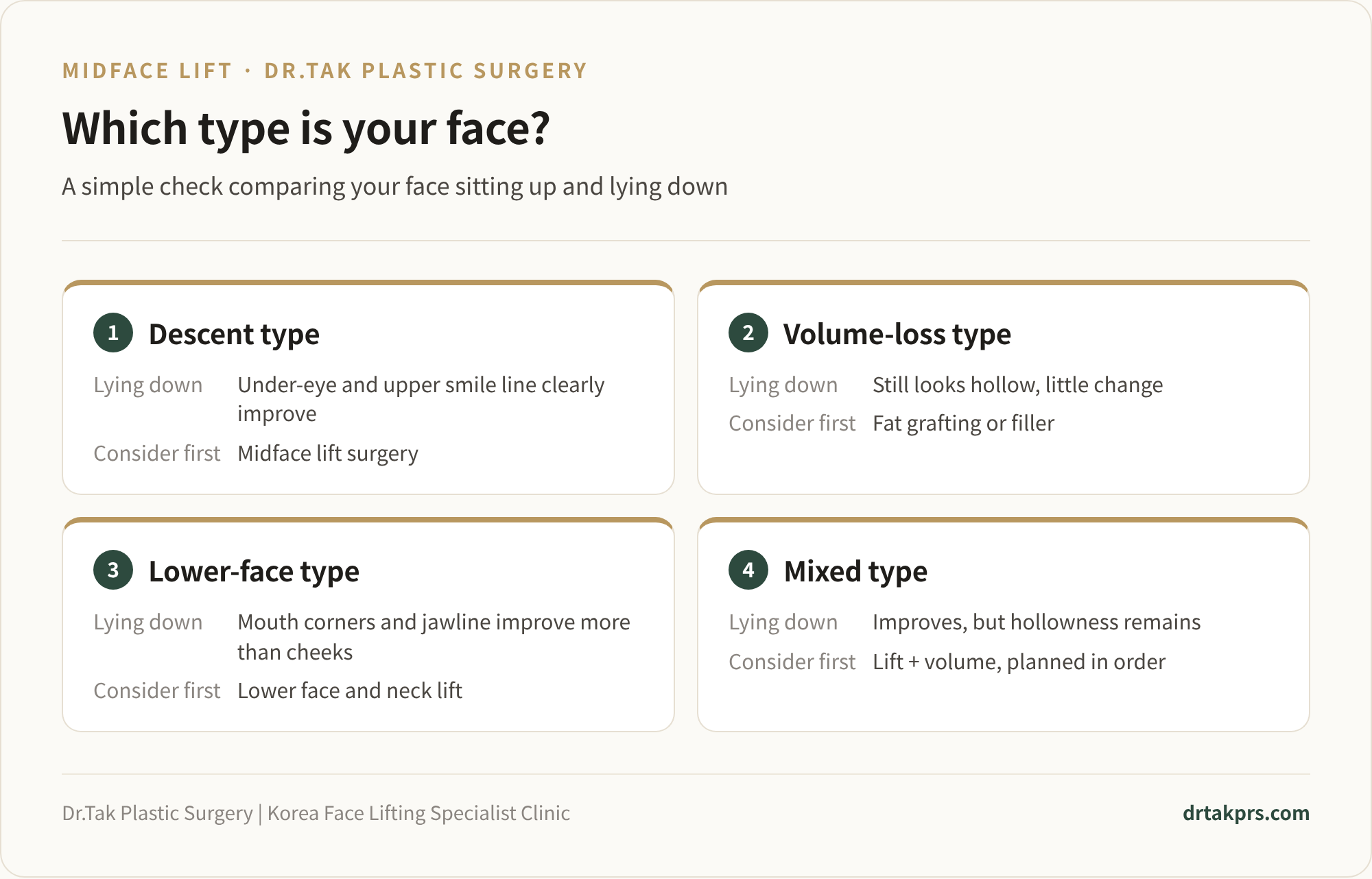
With a mirror and your fingertips, you can get a rough sense of direction at home. Take a straight-on photo while sitting, then lie flat on your back, hold the mirror above your face and take another from the same angle. Then, sitting up again, place your fingertips on the upper outer edge of your cheekbone and lift gently and diagonally toward your ear.
| What to check | Descent type (midface descent) | Volume-loss type | Lower-face type |
|---|---|---|---|
| Change when lying down | Under-eye border and top of the smile line clearly improve | Little change, still looks hollow | Mouth corners and jawline improve more than the cheeks |
| Lifting diagonally with fingertips | Under-eye groove and top of the smile line smooth out together | Smooths a little, but the hollow look remains | Cheeks stay the same; only lifting the jawline helps |
| Shape of the front cheek | Has moved down, lower cheek feels heavy | Front cheek itself is flat and thin | Front cheek is relatively preserved |
| Common background | Gradual progression from your 40s | After weight loss, slim build | Thick skin, a lot of tissue below the jawline |
| Approach to consider first | Midface lift–type surgery | Volume restoration (fat grafting, filler) | Lower-face and neck lift |
📍 Bottom line: The more you improve when lying down, the more likely it is a problem of position; if nothing changes when you lie down, it is more likely a problem of quantity.
In reality, few people have only one type. The face I see most often in consultation is a descent type with some volume loss mixed in. So please treat this table not as a diagnosis but as a starting point for gauging which factor carries more weight. If your concern is mainly the cheeks as a whole, my article on the causes of cheek sagging and how lifting can improve it covers the wider picture.
What happens when that weighting is misread becomes clear in the next section.
The same smile line, a different cause — and a different answer
I quite often meet people who had filler injected several times because the top of their smile lines was deep, only to find their cheeks looking heavier with every session. If the cause was descended tissue, adding more volume on top of it tends to add weight. That is why repeating filler alone on a descent-type face can make it look bigger or puffy.
The opposite happens too. If a face that has gone hollow from volume loss is simply lifted, the position goes up, but the thin tissue is stretched — the cheekbones can stand out more and the cheeks can look even more sunken. That is why, for people who come in after losing a lot of weight through dieting, I raise the subject of volume before surgery.
The lower-face type is different again. When the sagging is concentrated around the mouth, jawline and neck, lifting only the midface improves the cheeks but leaves the jawline as it was. If this is not explained in consultation beforehand, it easily turns into disappointment after surgery — "why is my jowl still there?"
In the end, the order of the questions has to change. The first question is not which operation to have, but what has descended, and by how much.
A 1:1 consultation you can start right now
✅✅ We compare your sitting and lying-down positions to gauge how much is descent, volume loss or lower-face sagging, and explain lifting, volume restoration and non-surgical options side by side
✅✅ We give you an honest opinion whether or not you proceed with surgery
📲 Dr.Tak Plastic Surgery official site, chat icon at the bottom right → live consultation
Midface lift vs facelift, thread lift and filler — compared on the same criteria
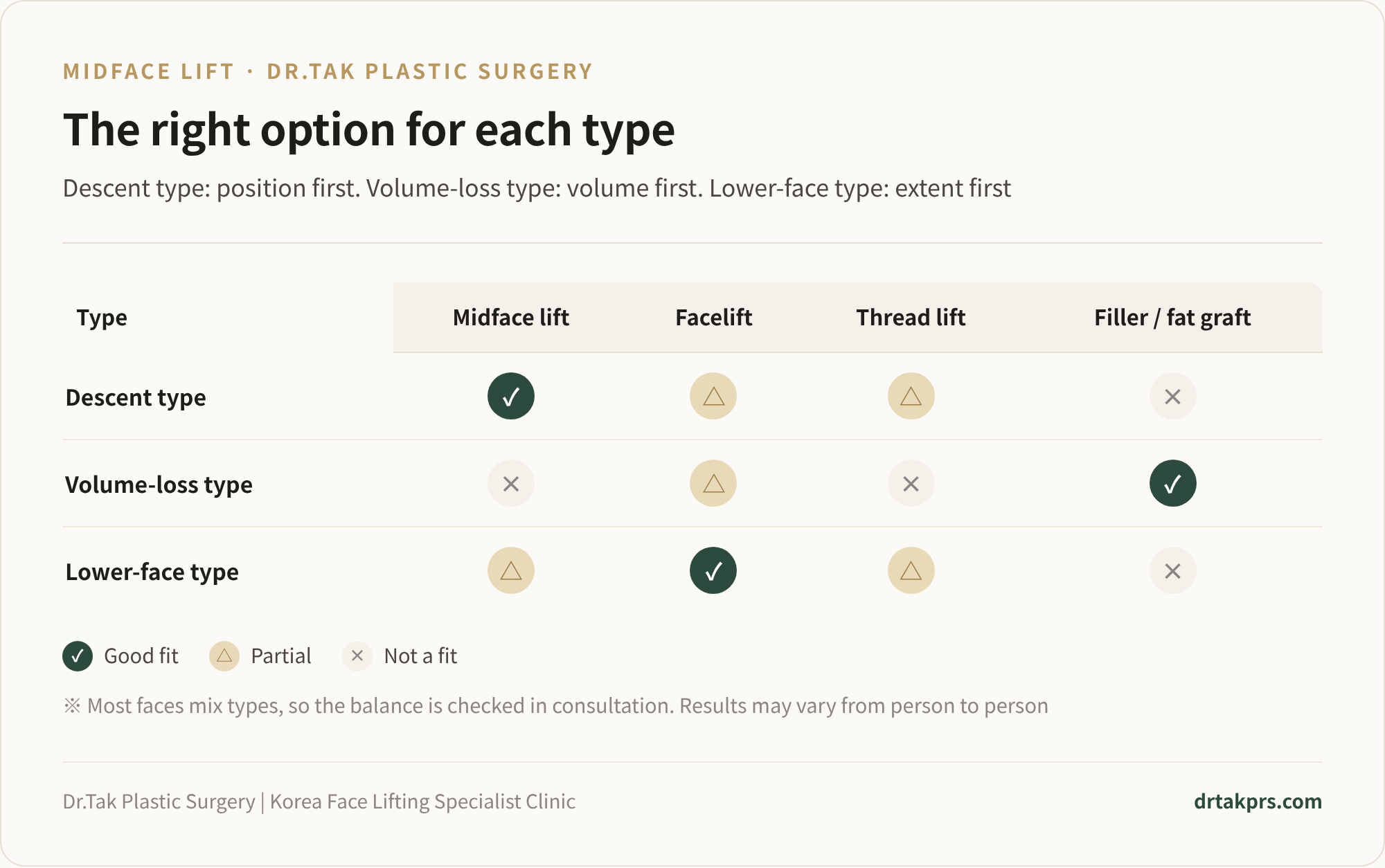
The short answer: a midface lift suits the descent type, where the front cheek has slid down, best; its effect on the jawline and neck is limited, and it does not restore volume itself. The other approaches each have their own clear strengths.
| Comparison | Midface lift–type surgery | Facelift (deep plane, etc.) | Thread lift | Filler / fat grafting |
|---|---|---|---|---|
| Main concern addressed | Front-cheek descent, under-eye border, top of smile line | Broad sagging across cheeks, smile lines, jawline and neck | Mild sagging | Lost volume |
| Area of effect | Centre of the face | Whole face | Localised | Injected area |
| Incision | Short incisions inside the temple hairline, below the lower lid or inside the mouth | In front of and behind the ear, scalp | Needle-point entry | Needle (fat grafting also includes the harvest site) |
| Longevity | Usually several years (varies by person) | Usually several years (varies by person) | Usually around a year | Filler usually 6–18 months / fat lasts as long as it survives |
| Recovery | Return to daily life usually 2–3 weeks | Usually 2–3 weeks or more | A few days | A few days (1–2 weeks of swelling for fat grafting) |
| Jowl improvement | Limited | Can be expected | Limited | Almost none |
| Volume restoration | None (repositioning only) | Partial redistribution | None | Direct restoration |
| Best suited to | Descent type that improves a lot when lying down | Broad sagging with significant skin laxity | Early sagging, or when surgery feels like too much | Volume-loss type, refinement after a lift |
| Points of caution | Lower-lid pull, temporary reduced sensation | Recovery time and scar care | Limited duration, visible threads | Overdoing it worsens sagging; fat survival varies (often reported at 30–70%) |
📍 Bottom line: For the descent type we look at position first, for the volume-loss type at quantity, and for the lower-face type at extent. If two are mixed, we set an order and address them together.
When the sagging runs wider than the midface, the deep layers are usually moved together — I explain how that works in my article on deep plane facelift in Korea.
When I do not recommend a midface lift
To be honest, a midface lift suits a narrower group of people than most expect. If any of the following applies to you, I will either suggest another approach before surgery or redesign the scope.
① When volume loss is the main cause
If the hollowness stays the same when you lie down, the hollow look will remain even if the position is raised. We restore volume first, or plan it alongside.
② When the lower eyelid has very weak support
When the approach is through the lower eyelid, or when tissue is lifted upward, a lower lid with weak support can be pulled downward, showing more of the white of the eye. This is why, in consultation, I always gently pull the lower lid down and release it to see how quickly it snaps back.
③ When the sagging is concentrated in the jawline and neck
Lifting only the midface here falls short of expectations. A lower-face and neck lift should be at the centre of the plan.
④ When there is barely any sagging yet
In your late 20s to early 30s, with good skin elasticity and almost no descent, the burden of recovery outweighs the benefit of surgery.
Beyond these, people who smoke, have uncontrolled blood pressure or diabetes, or have a bleeding tendency need those conditions addressed before surgery. In the end, this is an operation that works efficiently for the right person and leaves regret for the wrong one.
So what does the process actually look like for those it does suit?
Surgery and recovery — from incision to everyday life
A midface lift usually reaches the deep layers through short incisions. There are three main routes: a short incision inside the temple hairline with endoscopic dissection, entry through the lower-eyelid incision together with lower blepharoplasty, and an approach that also uses the inside of the mouth. Which route we take depends on the direction of descent, the condition under the eyes, and whether other areas are being treated at the same time.
| Period | Condition | What to focus on |
|---|---|---|
| ⏱ Day 0 to 1 week | Swelling and bruising at their peak. Tightness around the cheekbones, expression feels stiff | Sleep with your head elevated, cold compresses, take prescribed medication |
| ⏱ 7–10 days | Sutures/staples removed. Bruising fades to yellow | Wash face and hair carefully, as instructed |
| ⏱ 2–3 weeks | Most people return to daily life. Swelling still visible up close | Still avoid strenuous exercise, sauna and alcohol |
| ⏱ 1–3 months | Expression becomes natural, sensation returns around the temples | Do not massage the cheeks hard |
| ⏱ 3–6 months | Swelling fully resolves, final contour emerges | Judge the result only after this point |
You may temporarily notice reduced sensation around the temples or cheeks, or feel as if one side moves less when you smile. In most cases this returns over a few weeks to a few months. But if these changes keep getting worse, or one lower eyelid looks pulled down, please contact us right away rather than waiting for your next appointment.
Recovery tends to feel longer than people expect. So rather than fixing a date first, we look together at whether you can set aside two to three weeks. For a closer look at what each stage feels like, see my facelift recovery day-by-day guide.
Why I don't treat the midface in isolation — a principle kept for more than 15 years
The midface connects to the eyelids above and to the mouth and jawline below. So when I assess midface descent, rather than lifting this zone on its own, I often address it within ponytail lifting — which lifts diagonally from the temples along the direction of descent — or within a deep plane facelift, which moves the deep layers across the whole face together. Whether a result looks natural depends less on the name of the operation than on how precisely it followed the direction of descent.
How much to lift follows the same principle. The more you lift, the more dramatic the first few weeks look — but the risk of a stiff expression or a pulled lower eyelid rises with it. I plan for the face one year from now, and choose to lift a little less than would make the first result look its most dramatic.
🏥 Let me briefly explain why we are able to keep to this principle.
- Dr.Tak Plastic Surgery has more than 15 years of experience in facial lifting and lip and philtrum surgery in Korea
- We hold a 5.0/5 rating across more than 200 Google reviews
- Before designing any operation, we always compare the sitting and lying-down positions to tell the types apart
- For those surgery does not suit, we suggest other approaches first
💬 "To make people smile." No longer being told you look tired, and smiling with ease again — that is the result we want from lifting, too.
Before & after photographs are on our official page
Dr.Tak Plastic Surgery complies with medical advertising regulations, so we do not place before-and-after photographs inside blog articles. Actual pre- and post-operative changes are collected on the official before & after page.
🔗 View before & after — Dr.Tak Plastic Surgery official page
Results may vary from person to person.
The Dr.Tak 4S Patient Care System — focused on people, not procedures
We focus on people, not procedures.
Solution — a 1:1 master plan with Dr. Tak Seung-wan
- Genuine empathy and communication: your wishes reflected fully in the operation
- Precise golden-ratio facial analysis (personalised): comparing sitting and lying-down positions to measure whether midface descent, volume loss or lower-face sagging dominates
- Post-operative change simulation provided
Support — a dedicated 1:1 global coordinator
- A coordinator assigned by country (no language barrier)
- Accompanying you through consultation, surgery and aftercare
- 100% appointment-only (private clinical environment)
Scar Care — six months of focused scar management
| Item | Period | Content |
|---|---|---|
| Control taping | 3–6 months | Prevents scar widening |
| Scar-softening injection | 6 months (monthly) | Softens raised scars |
| Laser treatment | 6 months | Reduces redness at the surgical site |
Service — one-year complimentary revision guarantee
- Complimentary revision within one year of surgery
- We see your care through to the end
- ※ Where sedation is used, a base anaesthesia fee may apply
If you would like to know more — official channels
🌐 Our official site carries technique-by-technique detail
📝 Our blog has related reading on deep plane facelift and the difference between mini and full facelift
📹 Video material shows the surgical process and recovery course
Five things to settle before you decide
✅ How much does your face change when you lie down — bringing two photos to compare makes the consultation far more accurate
✅ Is your main concern under the eyes and cheeks, or around the mouth and jawline — the extent changes the surgical approach
✅ Have you lost a lot of weight in the past one to two years — this is a clue to how much volume loss is involved
✅ If you have had filler or a thread lift, when, where and how much — remaining material affects the surgical design
✅ Can you fit a two-to-three-week recovery into your schedule — if you have important commitments, please let us know
You do not need to bring an answer to every question. Anything you are unsure of, we can work through together in consultation.
Frequently Asked Questions (FAQ)
The questions we receive most often at Dr.Tak Plastic Surgery.
Q1. Does a midface lift also improve jowls?
In many cases, not as much as people hope. A midface lift moves the tissue below the front cheek upward, so it does not directly address sagging that has collected beside the mouth and below the jawline. As the cheek rises, the jawline can look slightly tidier, but if jowls are your main concern, I will first suggest a lower-face lift or an approach that lifts the jawline as well. When I show patients in consultation the difference between lifting only the cheek with my fingertips and lifting the jawline too, most understand straight away.
Q2. Is a midface lift sometimes combined with lower blepharoplasty?
Quite often. If the under-eye fat bulges and the border below it is deeply grooved, the under-eye fat can be repositioned through the lower-eyelid incision while the midface tissue is lifted through the same route, refining the line from under the eye into the cheek in one go. However, this route carries a risk of pulling the lower eyelid down, so I first check that the lower lid has enough support and, if needed, plan a procedure to support the eyelid at the same time. If support is weak, I may switch the route to the temples instead.
Q3. Does it matter whether a fixation device such as Endotine is used?
A fixation device is one of several ways to hold lifted tissue in place. Some clinics use absorbable fixation devices, while another method is to suture the deep layer directly to firm structures to fix it. What I consider more important than the name of the device is which layer was moved, in which direction, by how much, and where it was fixed. Even with the same device, tissue will come back down if the dissection plane and direction are wrong; without any device, it can hold for a long time if the plane and direction are right. If you are curious about how we fix the tissue, I am happy to explain it with a drawing in consultation.
Q4. How long does the effect last, and how is the cost determined?
Lifted tissue keeps ageing from its new position, so however far surgery turns the clock back, ageing continues from there. That is why it is hard to state a fixed number of years; individual variation is large, depending on skin thickness and elasticity, weight changes, smoking and sun exposure. In the same way, it is hard to give an exact figure for cost. The range depends on the extent of sagging, whether it is a standalone operation or combined with lower blepharoplasty or a lower-face lift, whether volume restoration is added, whether it is a revision, and whether sedation is used. We confirm these factors in consultation and then guide you on the range.
Q5. What if my expression looks unnatural or it is obvious I have had surgery?
I know this is the worry that sits deepest with people considering a lift. In the first few weeks after surgery, swelling can make the cheeks move less when you smile and the area under the eyes look pulled, but in most cases this becomes natural within one to three months. When signs of surgery linger, it is usually because the tissue was lifted too much, or pulled in a different direction from the descent. That is why I choose the approach in which your expression comes back first, even if the initial result is a little less dramatic, and we check the changes together throughout recovery.
Dr.Tak Plastic Surgery | Korea Face Lifting Specialist Clinic
"To make people smile"