
"So how many days until I'm fine?" — What matters more than the number
If you stopped at the recovery section while researching a facelift, what you actually want to know is probably not a number. You want to know what those days feel like.
Whenever I get this question in my office, I notice the same thing: most people picture recovery as one single block. You have surgery, you swell a bit, and a few days later it's over. Real recovery does not move in a straight line. It climbs, it dips, it stalls, and then one morning it changes.
That is why I walk patients through the timeline by date before surgery. If I simply say "about two weeks," there is one specific window inside those two weeks where people get badly shaken. If you know it is coming, you are fine. If you don't, your first thought is "something has gone wrong with me."
I will be honest with you: facelift recovery has genuinely uncomfortable stretches. An article that hides them and only tells the pleasant half is no help at all when you are deciding whether to have surgery. So today I am going to lay out, in order, the days I have walked through with my patients — from the morning of surgery to six months out.
And the starting point is not the day most people expect.
The hardest days are day 2 through day 4 — and that is normal
Let me answer first: in facelift recovery day by day terms, the hardest stretch is 48 to 96 hours after surgery, not surgery day itself.
On the day of surgery, anaesthetic effects and the medication given during the procedure are still working. The tension of waiting is also gone. That is why a fair number of patients tell me it's more manageable than they expected. The problem comes next.
Here are the three reasons that window peaks.
① Swelling peaks at 48 to 72 hours, not immediately
When tissue is dissected, fluid collects in that space. The process does not finish at once — it builds over roughly two days. From the mirror's point of view, this reads as "I look worse than yesterday," and that is the single most alarming moment of the whole recovery.
② Bruising travels downward with gravity
The surgical field is around the ear and the side of the face, but by about day 3 bruising spreads down into the jawline and neck. It covers more area, so it feels like deterioration. In fact it is haemoglobin breaking down and migrating — an entirely normal process.
③ Sensation returns, and discomfort returns with it
The numb, muffled feeling of the first day starts to lift around now. Tightness and soreness that you could not feel while numb become noticeable at exactly this point.
All three overlap between day 2 and day 4. I flag this window in every pre-op consultation. More calls reach us during this stretch than any other, and nine times out of ten the patient settles completely once I say the words "this is a normal course." The difference between knowing and not knowing is that large.
So what are the signs that genuinely do warrant a call? I will come back to that shortly.
A facelift is not a skin-tightening operation — the layer that sets your recovery
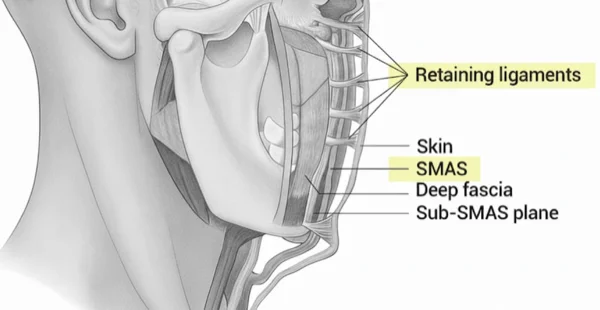
Before going further into recovery, let me define the terms, because what the operation actually addresses is what determines recovery length.
A facelift (rhytidectomy, also called face lifting or a face-lift procedure) is not an operation that cuts away loose skin — it repositions the muscular-fascial layer beneath it, the SMAS. The SMAS is a thin fibrous sheet wrapping the facial muscles. With age, the ligaments anchoring that layer loosen, and the cheek and jawline descend. A facelift lifts that layer, fixes it where it belongs, and lays the skin back over it without tension.
Why this distinction matters for recovery: the deeper the plane of dissection, the longer the swelling lasts and the longer the result holds. Pull only the skin and swelling resolves fast, but it comes back down within a few years. Work the fascial layer properly and recovery is longer, but the contour holds for a different span of time.
📌 A procedure advertised for its short recovery is usually a procedure that did not go very deep. Recovery speed and longevity are, to a degree, traded against each other.
So when someone asks "how many days is recovery," I can only answer "that depends which operation you are having." I will show you that difference in a table shortly.
From surgery day to month six — what you actually look and feel like
Below is the timeline I draw out for patients in consultation. It is based on a standard SMAS facelift, and individual variation exists.
| Stage | How it looks | How it feels | What matters here |
|---|---|---|---|
| Surgery day (Day 0) | Compression dressing on, swelling still mild | Numb and muffled, little pain | Keep upper body elevated 30–45° |
| Day 1 | Swelling begins, bruising around the ear | Tightness and soreness start | First dressing change, drain check |
| Day 2–4 | Swelling peaks, bruising spreads to jaw and neck | The most uncomfortable window | Knowing this is coming |
| Day 5–7 | Swelling visibly subsides | Tightness continues, itching begins | Washing and showering resume |
| Day 7–10 | Bruising turns yellow | Intermittent tingling | Sutures removed |
| 2 weeks | About 70% of swelling gone | Reduced sensation around the ears | Light makeup can cover it |
| 3–4 weeks | Bruising almost gone, contour emerging | Scar line feels firm | Light cardio resumes |
| 2–3 months | Scar redness fades | Sensation largely restored | Focused scar care window |
| 6 months | Final contour settles | Minor sensory differences possible | Time to assess the result |
As the table shows, the point at which you stop looking "done to" and the point at which the surgery is actually finished sit quite far apart. Two weeks usually gets you to makeup-coverable. Tissue fully settling takes close to ten times that.
So for patients with a fixed date ahead, I count backwards. If someone has a wedding in three weeks and wants surgery, I talk them out of it.
📍 Bottom line: Looking fine to others takes 2 weeks. Being happy yourself takes 2–3 months. The final result is 6 months.
A 1:1 consultation you can start right now
✅✅ We compare recovery time and dissection depth across each facelift technique, one by one, before any decision
✅✅ We give you an honest opinion whether or not you proceed with surgery
📲 Dr.Tak Plastic Surgery official site, chat icon at the bottom right → live consultation
Why recovery speed differs between techniques — four procedures compared
If you have searched recovery photos, you have seen the technique name attached: "deep plane recovery," "mini facelift recovery." That is exactly why the same operation gets quoted with different recovery times.
| Comparison | Deep plane facelift | SMAS facelift | Mini facelift | Neck lift alone |
|---|---|---|---|---|
| Plane of dissection | Beneath the SMAS | SMAS layer | Skin to superficial SMAS | Platysma-focused |
| Main area addressed | Midface, folds, jawline | Cheek, jawline | Partial jawline | Neck, submental |
| Operating time | Longest | Moderate | Short | Moderate |
| Swelling peak | Day 3–4 | Day 2–4 | Day 2–3 | Day 2–4 |
| Suture removal | 7–10 days | 7–10 days | 5–7 days | 7–10 days |
| Makeup-coverable | Around 3 weeks | Around 2 weeks | Around 10 days | Around 2 weeks |
| Sensory recovery | 3–6 months | 3–6 months | 1–3 months | 2–4 months |
| Contour settles | 6 months | 6 months | 3 months | 4–6 months |
| Best suited to | Clear midface descent | Typical ageing | Early change | Neck-dominant laxity |
📍 Bottom line: The faster-recovering operation is not the better operation. The better operation is the one that matches the layer your descent came from. A mini facelift on someone whose face fell because of volume loss recovers quickly and changes almost nothing.
That is also why the first thing I do in consultation is not choose a technique. It is measuring whether volume loss or skin laxity is the dominant factor. Get that judgement wrong and no amount of careful recovery management produces a satisfying result.
Who this surgery suits — and who I tell to wait
There is one reason I spend so long explaining recovery: this operation is not right for everyone.
I recommend a facelift when
✅ The jawline has broken down and the face is starting to read as square
✅ Pulling the skin toward the ear by hand makes an obvious difference
✅ Fillers or thread lifts have worked but hold for shorter and shorter periods
✅ Skin is left loose after weight change
✅ You can genuinely set aside at least three weeks for recovery
I tell people to postpone when
- There is an important event within four weeks — it collides with peak bruising and swelling
- Smoking cannot be stopped — skin perfusion drops and flap necrosis risk rises
- Blood pressure is uncontrolled — haematoma risk rises sharply right after surgery
- Volume loss dominates over descent — pulling can make you look gaunt instead
- You would have to get through recovery alone — someone needs to be there for at least the first 48 hours
I am asked about cost often. A facelift does not have one fixed price. The range shifts considerably with the extent of dissection, the technique (deep plane, SMAS, mini), whether a neck lift is included, and the anaesthesia used. Two operations sold under the same name "facelift" can differ substantially in what is actually done. So rather than comparing figures alone, I would ask you to confirm which plane of dissection that figure includes. Exact cost is given after assessment in consultation.
That covers the decisions made before surgery. Afterwards, an entirely different set of variables is waiting.
Five things that ruin a recovery — what I say most often
Some patients get an excellent operation and still lose ground in recovery. Over fifteen-plus years of doing this surgery, the pattern narrows to five things.
🚭 Smoking — the most damaging of all. Nicotine constricts the microvasculature of the skin flap. I ask for four weeks off before and four weeks after, and this is the one point I do not negotiate.
⚠️ Removing the compression dressing early — that first week of compression does more than control swelling; it helps the skin adhere to the tissue beneath. Take it off on day 3 because it feels confining and the swelling settles in place.
💡 Sleeping on your side — for the first two weeks you need to sleep on your back with the upper body at 30–45°. Sleep on one side and only that side swells, and the asymmetry lasts weeks.
🔑 Returning to exercise too early — raised blood pressure raises haematoma risk. I set light cardio at 3–4 weeks and resistance training after 6.
📌 Sun exposure — ultraviolet light on a scar still red at under three months leaves pigment that lingers. Until the scar settles, a hat and sunscreen matter more than any laser.
These five take me longer to explain than the surgery itself. I perform the operation, but a large share of the recovery is in the patient's hands.
Fifteen years and counting — why we treat recovery as part of the surgery
🏥 Four reasons to trust us
- Dr.Tak Plastic Surgery has over fifteen years of experience in facial lifting and lip and philtrum surgery in Korea
- We hold a 5-star rating across more than 200 Google reviews
- We operate strictly by appointment, so follow-up visits during recovery are never pushed back
- Six months of focused scar care is included as standard, at no separate charge
There is a reason I give recovery this much airtime. I have repeatedly seen the six months after surgery change the result more than the few hours inside the operating room. When two patients operated on the same day with the same technique come back six months later with completely different scars, the difference has almost always been in the aftercare.
💬 "To make people smile"
We tell you about the uncomfortable stretches in advance precisely because we want you smiling once you are through them.
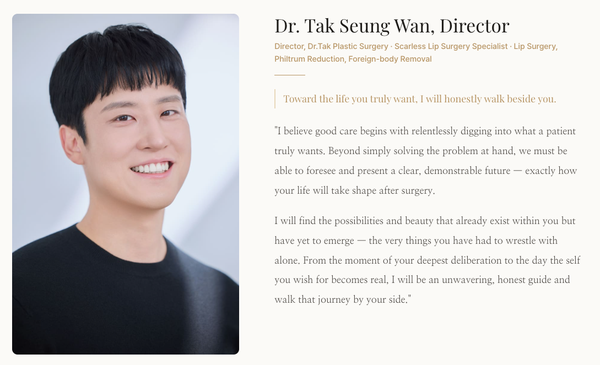
The Dr.Tak 4S Patient Care System — focused on people, not procedures
Solution — a 1:1 master plan with Dr. Tak Seung-wan
- Genuine empathy and communication: your wishes reflected fully in the operation
- Precise golden-ratio facial analysis: measuring whether volume loss or skin laxity dominates
- Post-operative change simulation provided
Support — a dedicated 1:1 global coordinator
- A coordinator assigned by country (no language barrier)
- Accompanying you through consultation, surgery and aftercare
- 100% appointment-only (private clinical environment)
Scar Care — six months of focused scar management
| Item | Period | Content |
|---|---|---|
| Control taping | 3–6 months | Prevents scar widening |
| Scar-softening injection | 6 months (monthly) | Softens raised scars |
| Laser treatment | 6 months | Reduces redness at the surgical site |
Service — one-year complimentary revision guarantee
- Complimentary revision within one year of surgery
- We see your care through to the end
- ※ Where sedation is used, a base anaesthesia fee may apply
If you would like to know more — official channels
🌐 Our official site carries technique-by-technique detail and before-and-after cases
📝 Our blog has related reading on deep plane facelift and the difference between mini and full facelift
📹 Video material shows the surgical process and recovery course
Seven things to settle before you decide
✅ Have you actually marked on a calendar how many days you can give to recovery
✅ Is someone confirmed to be with you for at least the first 48 hours
✅ If you smoke, are you in a position to stop four weeks before surgery
✅ Have you been told whether descent or volume loss is the bigger issue for you
✅ Have you confirmed which plane of dissection the quoted figure includes
✅ Are you ready to disclose your medications and medical history at consultation
✅ Can you accept that day 2 to day 4 will be the hardest part
If any of the seven gives you pause, that is not a signal to cancel surgery. It means you have found a question to bring to your consultation.
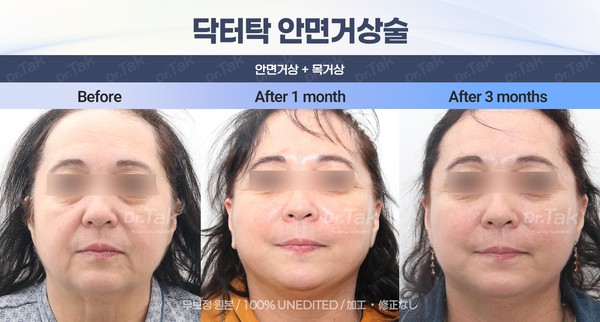
Frequently Asked Questions (FAQ)
The questions we receive most often about facelift recovery at Dr.Tak Plastic Surgery.
Q1. How many days until it doesn't look like I've had surgery
This is the question I get most. I break it into three thresholds: people close to you not noticing usually takes 3–4 weeks, looking natural to strangers takes 6–8 weeks, and being satisfied yourself in the mirror takes 2–3 months. The interesting part is that the third one arrives last. There is always a stretch between weeks 4 and 8 where everyone else has stopped noticing and only you can still see a minor asymmetry. I warn patients about that window in advance, and when it comes I put their photo from that week beside their pre-op photo.
Q2. Does skin age faster after a facelift
This is the fear that sits deepest with people considering surgery, and honestly the question I answer most carefully. The conclusion first: a facelift does not speed up the rate at which skin ages. Ageing continues at the same pace, surgery or not. What is real is that once you have looked roughly ten years younger and then begin to descend again, that change feels larger by comparison. It is closer to an illusion created by the shifted starting point. I always cover this before surgery, and I describe a facelift as an operation that turns the clock back, not one that stops it.
Q3. How long do I have to sleep sitting up
I ask patients to sleep on their back with the upper body raised 30–45° for the first two weeks. From week three you can lower the angle, but avoid sleeping on your side until week four. One practical tip: a wedge pillow is far easier than propping yourself on cushions. Stacked ordinary pillows collapse in the night, and I have seen plenty of patients arrive swollen on one side because of it. That is why I ask people to buy one before surgery.
Q4. Does recovery speed really differ that much between techniques
It differs considerably. In my clinical experience, the makeup-coverable point for a mini facelift and a deep plane facelift is close to twice apart — around 10 days versus around 3 weeks. But I always add one thing. An operation that recovers twice as fast is not twice as good. Perform a mini facelift on someone with clear midface descent and recovery is over in ten days, but six months later there is almost no change and they are back in my office. Recovery time is one criterion among several — it should never be the first.
Q5. My recovery seems slower than everyone else's — when should I call
Many people grow anxious comparing themselves with recovery photos online. First: uneven swelling between sides, bruising travelling downward, and a scar that feels firm at week two are all within normal range. By contrast, sudden severe swelling on one side with rapidly increasing pain, skin turning dark red, or a fever above 38°C warrant a call regardless of what day it is. The first in particular can signal a haematoma, and these occur most often within 24 to 48 hours of surgery. When we receive a call in that window, we bring the patient in the same day.
Dr.Tak Plastic Surgery | Korea Face Lifting Specialist Clinic
"To make people smile"