
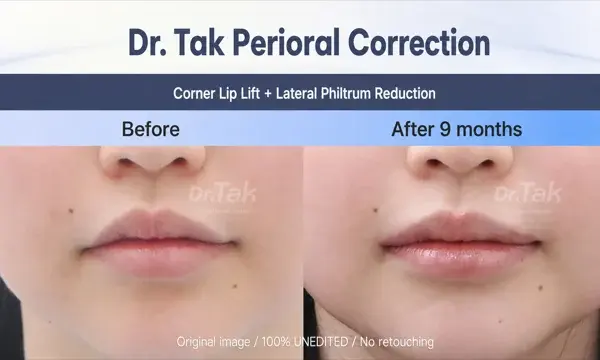
Fine in the mirror, but your smile pulls sideways in photos — why?
You look fine in the mirror, yet in photos someone else takes, your smile seems oddly pulled to one side. When you smile, one corner lifts crisply while the other lags, so even at rest your mouth looks subtly twisted. Many people have quietly carried this exact worry.
It is a strange thing to live with. The change is small, yet it nags at you every time a camera comes out, before an interview, before a presentation. And when you look into it, the answers contradict each other. One place says Botox is enough, another says it is facial asymmetry so you must start with the jaw, a third says fix it with exercises. Who is right?
I have run a clinic focused on lips and the mouth area here in Korea for more than 15 years. The first thing I tell everyone who comes in for mouth corner asymmetry is always the same: before choosing a method, we must pin down the cause. The same-looking asymmetry calls for completely different solutions depending on whether muscle, bone, or habit is behind it. Today I will sort through those branches one by one, and walk with you through the journey — from the first consultation and diagnosis, to tailored correction, and the aftercare that follows.
The muscles that move your mouth corners — asymmetry is usually a broken balance among them
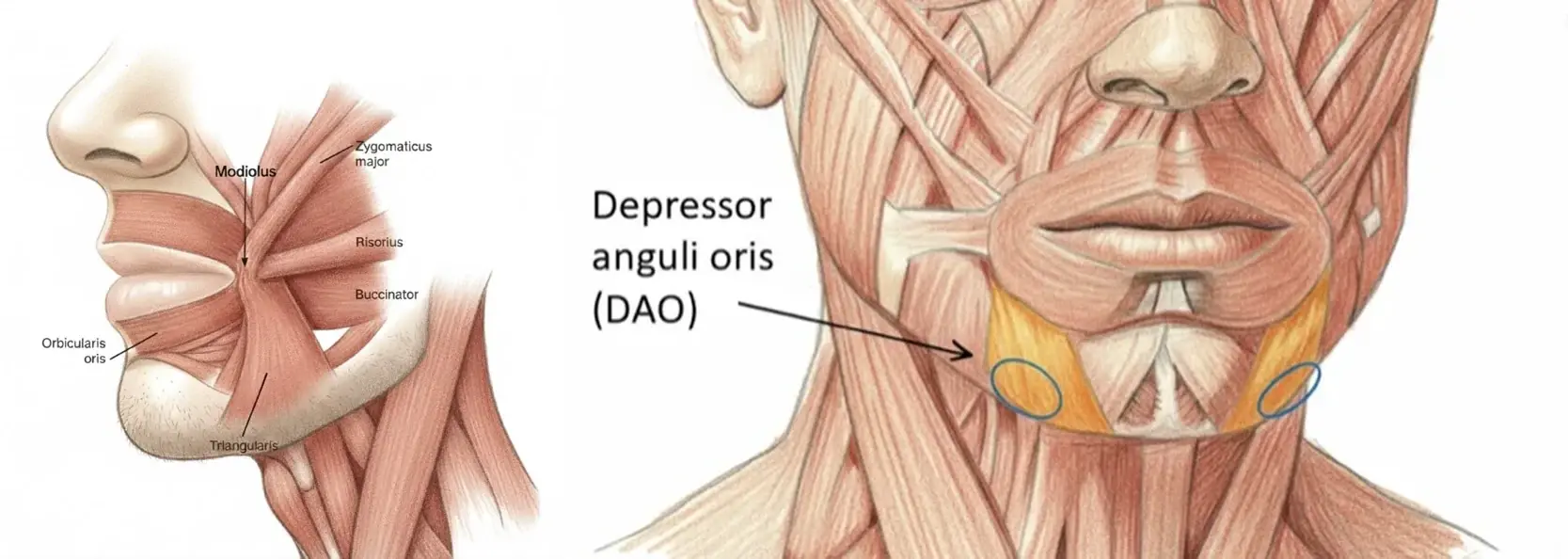
Your mouth corner is not moved by one or two muscles, but by several facial muscles pulling and pressing in balance. When that balance tips to one side, the corner twists. Three are key.
① Zygomaticus major (the corner-lifting group) — runs diagonally from the cheekbone to the corner of the mouth and pulls it up and out. It is the lead actor that lifts the corner toward the cheek when you smile broadly.
② Depressor anguli oris (corner-lowering muscle) — runs from the corner down toward the jaw and pulls the corner downward. If only one side is overly tense, that corner droops even at rest.
③ Risorius and buccinator — pull the corner sideways and drive cheek movement. If the left–right forces differ, the very direction of your smile tilts to one side.
Even with the same muscles on both sides, if the force and frequency of use differ, over time one side thickens while the other weakens. Chewing only on one side, propping your jaw on one hand — small daily habits gradually warp the balance. That is why, in consultations, I always ask which side you usually chew on. The moment I hear the answer, half the cause often comes into view.
But you cannot stop at the muscles. The more important fork in the road comes right after.
At rest vs. while smiling — which one twists is the starting point of diagnosis
The first thing I check in the clinic is simple. Does it twist when your mouth is closed and relaxed, or only when you smile? This single question splits the cause into broad directions.
If one corner is already lowered at rest, we must also consider a difference in baseline muscle tension, a structural asymmetry of bone or teeth, or a nerve issue. If, on the other hand, it looks fine when expressionless but one side lifts less when you smile, the likely culprit is an imbalance in the muscle forces recruited during the smile.
Why does this matter? Dynamic asymmetry that appears only when smiling can largely be addressed by adjusting muscle force, while clear static asymmetry present at rest may have a deeper cause that needs different evaluation. So I always begin by looking at both your relaxed photo and your full-smile photo together. It is the same face, yet the two photos can tell completely different stories about your mouth corners.
Four cause-types of mouth corner asymmetry — which one is yours?
Over years of practice, I have come to sort people who report mouth corner asymmetry into roughly four groups. Different types mean different roads to take.
Muscular type — the most common, and the most manageable
This is when one muscle over-pulls or under-pulls during a smile. It is deeply tied to expression habits and one-sided chewing. Most of the asymmetry I see falls here.
Skeletal/dental type — not a mouth-corner problem at all
Here, an underlying facial asymmetry — a jaw shifted to one side, or a misaligned bite — is the foundation. The mouth corner is not the cause but the result. To be honest, for this type, touching only the mouth area does not solve the root. Dental orthodontics or orthognathic care often comes first, so I clearly tell these patients not to rush into a mouth procedure.
Habit type — more reversible than you would expect
Asymmetry built up by accumulated habits: propping the jaw on one side, chewing on one side, sleeping face-down. If the cause is habit, changing that habit is where correction begins.
Neurogenic type — the one to rule out first
If one side of your face suddenly stopped moving well and the corner dropped, facial nerve palsy (such as Bell's palsy) must be suspected first. This is not a cosmetic matter but one for neurology and rehabilitation. When I see signs like sudden onset or trouble closing the eye, I recommend seeing a neurologist before any cosmetic consultation. Keeping the order right is how we keep the patient safe.
A 1:1 tailored consultation you can start now
✅ We look at your relaxed and smiling photos together and first sort muscular, skeletal, habit, or neurogenic causes
✅ We tell you honestly, from the start, whether a procedure or surgery is truly necessary
📲 Dr.Tak Plastic Surgery official site — tap the chat icon at the bottom right for a real-time consultation
Correction by cause — comparing Botox, mouth corner lift, and muscle re-education
Once the type is sorted, we look at the method that fits each road. Here are the three approaches I explain most often, side by side.
| Comparison | Botox | Mouth corner lift (surgery) | Muscle re-education / habit |
|---|---|---|---|
| Suited to | Dynamic muscular type (overactive) | Drooping / static asymmetry | Habit type / mild muscular |
| Mechanism | Weakens the overpulling muscle | Lifts and fixes the dropped corner | Strengthens weak side / fixes habit |
| Onset | Gradual after 3–7 days | Form changes right after surgery | Over weeks to months |
| Duration | Usually 3–6 months (varies) | Relatively long-lasting | Lasts as long as the habit holds |
| Pain / anesthesia | Fine needle, little anesthesia needed | Local anesthesia involved | No pain |
| Recovery | Daily life immediately | Needs suture & swelling care | No separate recovery |
| Scarring | None | Minor scar along the incision | None |
| Limits | Needs repeating, can't change the habit | Can't fix skeletal causes | Slow, requires consistency |
| Best when | Asymmetry only when smiling | Corner drooped even at rest | Cause is a clear habit |
📍 Bottom line: Even for the same "mouth corner asymmetry," Botox suits a twist that appears only when smiling, a lift suits a corner that droops at rest, and habit correction comes first when habit is the cause. Choosing the method first and forcing the cause to fit almost always fails.
One thing I want to make clear: Botox lets an overactive muscle rest for a while, so the effect is not permanent. As time passes the muscle force returns, so honestly, it is not a one-and-done correction. That is why, when I recommend Botox, I describe it as "a tool that buys time to rebalance and change the habit." Trust the tool alone and leave the habit untouched, and things drift back.
Recovery and aftercare — what to do, by stage
If you have had a correction, the care that follows protects the result. The flow differs by method, but the frame is similar.
| Stage | After Botox | After mouth corner lift | Shared care |
|---|---|---|---|
| Day 0–3 | Gentle care, don't rub the site | Swelling/compression care, avoid forced expressions | Consciously reduce one-sided chewing |
| Week 1 | Effect emerges gradually, check progress | Around suture removal, manage the area | Start left–right balance exercises |
| Week 2–4 | Re-assess left–right balance | Swelling settles, form stabilizes | Review expression habits |
| Beyond | Consult on re-treatment by duration | Scar care, monitor progress | Prevent recurrence with regular checks |
What I stress most in recovery is, surprisingly, not the procedure itself but the habit. If someone who chewed on one side goes right back to it, any correction will lose its balance again. I will keep it short. Habit is half the battle. That is why I always add one line to the recovery sheet: "practice smiling evenly on both sides in front of a mirror."
Why patients trust Dr.Tak Plastic Surgery in Korea
The lips and mouth are an area where a 1mm difference changes the whole impression. I have devoted more than 15 years to this single well of work. I believe the time spent focusing on lips and the mouth is exactly what builds the eye for diagnosis.
🏥 The reasons patients commonly give for choosing Dr.Tak Plastic Surgery in Korea:
- Over 15 years of clinical experience as a lip & mouth specialist clinic
- Around 190 Google reviews, with near-perfect 5-star ratings
- A principle of sorting the cause first and never recommending unnecessary procedures
- Honest opinions in consultation, regardless of whether you have surgery
💬 "To make people smile." The reason we work on the mouth area is, ultimately, to help that smile come out naturally.
The Dr.Tak 4S Patient Care System
We focus on the person, not the procedure.
Solution
We sort the cause-type of asymmetry first — using relaxed and smiling photos and expression analysis — then design a method that fits.
Support
We listen fully to your questions and worries before any correction, and clearly say so when surgery is not the answer.
Scar Care
When an incision is involved, we design the scar to sit in a natural position and guide recovery-phase care together.
Service
From post-correction balance re-assessment to habit checks, we stay with the process that keeps your result lasting.
If you would like to know more — official channels
🌐 Find lip & mouth correction information on our official site.
📝 Real-time consultation connects through the chat icon at the bottom right of the site.
📹 You can also see various cases and explanations from the doctor.
Five things to sort out for yourself before deciding
✅ Does my asymmetry appear at rest, or only when I smile?
✅ Do I have a habit of chewing or propping my jaw on one side?
✅ Did it appear suddenly? (If so, neurology comes first)
✅ Do I want a change in form, or a natural balance?
✅ Do I want to finish in one procedure, or am I ready to commit to aftercare too?
Simply answering these five for yourself makes the consultation far clearer. You don't need to bring all the answers. We can sort them out together.
Frequently Asked Questions (FAQ)
The questions we receive most often about mouth corner asymmetry at Dr.Tak Plastic Surgery in Korea.
Q1. How do I know if my asymmetry is from muscle or from bone (facial asymmetry)?
This is the most common question. A simple self-check is to compare a relaxed photo with a full-smile photo. If only the smile shows one side lifting less, muscle is the likely lead; if one jaw/corner is shifted even at rest, we must also examine the bite and skeleton. Photos alone can't settle it, though, so in consultation we watch your expression move to sort the branch.
Q2. Can Botox alone correct it, or do I need surgery?
For dynamic asymmetry that appears only when smiling, reducing the overactive muscle's force with Botox tends to fit well. If one side droops even at rest, Botox alone is not enough and we consider a lift. In my clinical experience, sorting the type matters more than the method. Misread the type and the result can fall flat or look unnatural.
Q3. How much does correction cost, and is it done in one go?
It varies widely by method and type. Botox is relatively light on cost but usually needs review every 3–6 months, while surgical correction costs more per time but lasts longer. As a principle we quote the exact cost after diagnosis, so we confirm the type in consultation first, then tell you honestly. National health insurance does not apply to cosmetic purposes — we mention that in advance too.
Q4. Is there a risk of becoming more asymmetrical, or of side effects, after correction?
This is the worry I hear most. With Botox, the wrong dose or placement can make the other side stand out more, so precisely calculating the left–right balance is key. For surgical correction, scar and symmetry design decide the result. So from the start I prefer a conservative approach — refining while watching progress — over trying to change a lot at once. The most natural results usually come from the most careful approach.
Q5. Even at rest one corner drops, so I look like I'm smirking. Can it look natural in photos or interviews?
So many people come to us with exactly this worry — that they are smiling, but in photos they look like they are sneering. Bottom line: when we pin down the cause and approach it accordingly, the front-facing impression is often refined to look far more natural. That said, not every asymmetry can be made perfectly symmetrical — a human face is naturally a little different left to right. What we aim for is not "perfect symmetry" but a "natural balance" where the viewer no longer notices the asymmetry.
Dr.Tak Plastic Surgery | A lip & mouth specialist clinic in Korea
"To make people smile"