
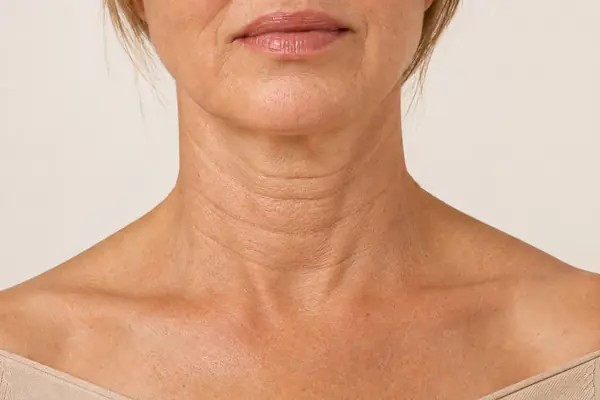
When the third jar of neck cream changed nothing
In the mirror it looked fine. Then someone photographed you from the side, and the line running from under your jaw into your neck was not what it used to be. From that day the turtlenecks came out more often, and on video calls the camera angle crept subtly upward.
So you bought the cream. Then the roller. Then you followed the neck exercise you saw on YouTube. A large share of the patients who come to me in Korea have already worked through that exact sequence, and most of them open with the same sentence: they spent the money and nothing changed.
When I hear that, my first suspicion is not that the treatment was poor. What I check first is something else. Did that treatment target the same layer where the problem actually was? When those two things do not match, no device on the market will produce a result.
And they fail to match more often than you would expect.
Neck wrinkles are not one problem — they are three layers
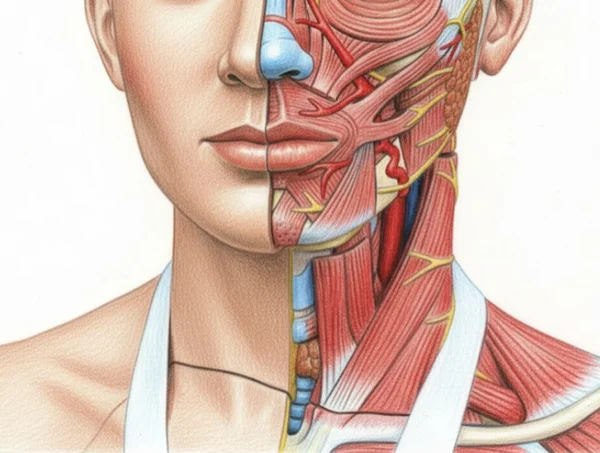
Let me answer directly: the phrase "neck wrinkles" contains three different problems. Fine lines in the surface skin, fat accumulating under the chin, and vertical cords formed when the muscle at the front of the neck separates. Different causes, therefore different answers.
The third is where nearly all of the confusion sits, so let me define it properly.
The platysma is a thin sheet of muscle, roughly 1 to 2 mm thick, that runs from the collarbone and shoulder fascia up to the lower border of the jaw. There is nothing this broad and this thin in the face. With age, the front edges of the left and right platysma pull apart at the midline, and those edges stand out beneath the skin as two vertical cords. This is what people call turkey neck, and what we call a platysmal band. Sagging neck, loose neck skin, crepey neck — the search terms differ, the anatomy does not.
Here is the point. A band is not a wrinkle. It is muscle. A cream acting on the epidermis, a booster stimulating the dermis, a radiofrequency device tightening skin — none of them reverse a separation in muscle. They are aimed at a different depth.
So "what works for neck wrinkles" has no answer as written. The question has to go one layer deeper first.
Thirty seconds in front of a mirror to identify your type
Part of what I actually do in the consultation room can be done at home. It is not a full diagnosis, but it will point you in the right direction.
✅ The clench test — Facing the mirror, clench your teeth and pull the corners of your mouth firmly downward. If two vertical cords rise at the front of your neck, that is the platysma engaging. If those cords remain visible after you relax, the band has already set.
✅ The extension test — Tip your head back as if looking at the ceiling. If the horizontal lines flatten out, the problem sits closer to the surface. If they stay folded, the groove has reached the deeper dermis.
✅ The pinch test — Pinch the tissue under your chin between thumb and index finger. A thick handful means fat. A thin sheet of stretched skin means laxity. Nothing to grasp, yet the silhouette is gone — then we look at muscle or skeletal support.
✅ The profile angle — In a photograph taken from the side, look at the angle formed between the underside of your jaw and your neck. A young, defined neckline sits between 105 and 120 degrees. The blunter that angle becomes, the older the neck reads, regardless of how many lines you can count.
One thing I want to be honest about: most people meet two or more of these criteria at once. Neck ageing does not politely confine itself to a single layer. That is exactly why the choice becomes difficult.
Why horizontal lines and vertical bands need different treatments
The short answer first: horizontal lines are a problem of folding, and vertical bands are a problem of separating. The forces run in opposite directions, so the approaches do too.
Horizontal lines form when repeated neck flexion stacks creases in the same place. The skin of the neck makes this worse. It is thinner than facial skin and carries a low density of sebaceous glands, so it cannot generate its own oil. Dry, and folded constantly — the crease deepens into a groove.
Something new has been added recently. Tilt your head forward just 15 degrees and the load on the cervical spine rises to roughly 12 kg. At 60 degrees it reaches 27 kg. If you spend several hours a day in that posture looking at a screen, your neck is folding in the same place, the same way, every single day.
I bring this up often in consultation, because the number of people arriving in their late twenties about neck lines has risen noticeably, and for most of them the cause is posture and dryness rather than ageing. In those cases there is no reason for me to raise surgery at all.
A vertical band, by contrast, is not built by posture. The muscle edges have physically separated at the midline, so reversing it means either bringing those edges back together with sutures or weakening the muscle's contraction so the cord stops standing out.
Same neck, entirely different answers. So how do the actual options divide?
A 1:1 consultation you can start today
✅✅ We identify which layer is driving your neck lines or sagging first, then compare every option — surgical and non-surgical
✅✅ We give you an honest opinion regardless of whether you proceed with surgery
📲 Dr.Tak Plastic Surgery official site, chat icon at the bottom right → live consultation
Botox, filler, energy devices, neck lift — how far does each one reach
The essentials first: the anatomical depth a method can reach is that method's ceiling. The table below is organised by exactly that.
| Comparison | Botox | Filler / Boosters | RF, Ultrasound, Threads | Neck Lift |
|---|---|---|---|---|
| Primary layer | Muscle contraction | Dermis, subcutaneous | Dermis to SMAS | Skin, fat, platysma |
| Fine horizontal lines | Partial | Good | Partial | Good |
| Vertical bands | Reduces prominence | Little effect | Limited | Corrects at source |
| Submental fat | None | None | Partial | Removed directly |
| Excess loose skin | Not possible | Not possible | Not possible | Removed |
| Onset | 3–7 days | Immediate to 2 weeks | 1–3 months | Gradual after swelling |
| Duration | 3–6 months | 6–9 months | 6–12 months | Long-lasting |
| Repetition | Ongoing | Ongoing | Ongoing | Generally once |
| Downtime | None | 1–3 days | A few days | 2–3 weeks of swelling |
| Scarring | None | None | None | Incision at ear, submental |
📍 Bottom line: Non-surgical treatments are strong at improving skin. Surgery is strong at changing structure. If the problem sits on the surface, treatments are enough. If the structure has collapsed, repeating those treatments will never reach it.
Reading that table, you can probably see why so many people tell me nothing worked. Only one column can remove excess skin.
What to choose for your type — and when surgery is not the answer
This is the order I use in consultation.
① Fine horizontal lines with dry skin — Boosters, moisture and sun protection come first. Discussing surgery at this stage would be excessive.
② Deep horizontal lines with reduced elasticity — Energy-based treatment to stimulate the dermis, combined with filler to soften the groove, is realistic. Just know in advance that repetition is built into this route.
③ Vertical bands that remain when the muscle is relaxed — Botox can reduce how prominently they read, but a set band has clear limits. Bringing the muscle edges together surgically is the definitive answer.
④ Submental fat together with loose skin — Removing only the fat can leave an empty envelope that hangs worse than before. Skin redraping has to accompany it.
⑤ A collapsed neckline alongside facial descent — Lifting the neck alone creates a visible boundary. It has to be designed together with the face.
And to be honest with you, this surgery is not right for everyone. For patients who cannot stop smoking, who have a clear history of hypertrophic scarring, who have uncontrolled diabetes or a bleeding tendency, or who simply cannot free up two to three weeks of recovery, I do not recommend surgery. Managing with treatments and waiting for a better time is far better in those cases.
I also raise cost early. Neck procedures vary widely by scope: whether we remove fat only, whether platysmal suturing is included, whether the face is addressed at the same time, and which form of anaesthesia is used. So rather than quoting a figure first, I confirm how much needs to be addressed and then give you the cost. Reversing that order tends to expand the scope beyond what is necessary.
If you choose surgery — how recovery unfolds
| Period | What is happening | What to do |
|---|---|---|
| Day 0–3 | Peak swelling and bruising | Rest upright, cold compress |
| Week 1 | Sutures removed | Avoid sharp neck flexion or extension |
| Weeks 2–3 | Much of the swelling resolves | Light return to routine, sun protection |
| Months 1–3 | Incision matures, appears red | Taping and scar care together |
| Months 3–6 | Redness settles, line softens | Continue scheduled scar care |
What I emphasise most during recovery is not the swelling but the scar. Time resolves swelling; management changes scars. The neck in particular moves constantly, so early tension widens a line easily. That is why we do not leave patients to get through this stretch alone.
Why results differ for the same operation — what we hold to
Having worked in Korea on face lifting and on the lips and philtrum for more than 15 years, what I have confirmed is that the difference in outcome comes from design and aftercare, not equipment. Where the incision is hidden, how far the platysma is addressed, and how the following six months are managed — those decide what the neckline looks like a year later.
🏥 What we base this on
- More than 15 years of operative experience in face lifting and in lip and philtrum surgery
- Over 200 Google reviews at a 5-star rating from our patients
- A fully appointment-based practice, from consultation through aftercare
- A scar management programme that continues for six months after surgery
💬 "To make people smile"

The Dr.Tak 4S Patient Care System — focused on the person, not the procedure
Solution — Dr. Seungwan Tak's 1:1 Master Plan
- Genuine empathy and communication: your wishes reflected fully in the surgical plan
- Precise facial golden-ratio analysis: measuring, layer by layer, whether your neckline issue comes from skin, fat or the platysma
- Simulation of the expected post-operative change
Support — Global 1:1 Dedicated Coordinator
- A dedicated coordinator assigned by country (no language barrier)
- Accompaniment through the entire process, from consultation to surgery to aftercare
- 100% appointment-only (a private clinical environment)
Scar Care — Six Months of Intensive Scar Management
| Item | Period | Content |
|---|---|---|
| Control taping | 3–6 months | Prevents scar widening |
| Scar-softening injection | 6 months (monthly) | Softens raised scars |
| Laser treatment | 6 months | Reduces redness at the surgical site |
Service — One-Year Complimentary Aftercare Guarantee
- Complimentary aftercare within one year of surgery
- We take responsibility to the end
- ※ Where sedation is used, a basic anaesthesia fee may apply
If you would like to know more — official channels
🌐 Dr.Tak Plastic Surgery official site, drtakprs.com
📝 Detailed guides and records by procedure
📹 Video material on surgical principles and recovery
Six things worth settling before you decide
✅ Is my concern horizontal lines, vertical bands, or submental fat
✅ Do the vertical cords remain visible when my muscles are relaxed
✅ What have I already tried, and what was the result
✅ Can I sustain ongoing maintenance, or do I want this settled once
✅ When can I realistically free up two to three weeks
✅ Is facial descent progressing alongside this
Arriving with that settled means most of the consultation can be spent finding the answer. I hope this article helped with that.
Frequently Asked Questions (FAQ)
These are the questions that come up most often in neck consultations.
Q1. Do neck creams or neck massage actually improve anything
Honestly, the range of what they improve is clearly bounded. Neck skin has a low density of sebaceous glands and cannot produce its own oil, so consistent moisturising and sun protection genuinely do make fine lines read less sharply. But a cream works on the epidermis and the upper dermis, so it cannot reach a groove that has already deepened, nor a vertical cord created by muscle separation. I prefer to draw that distinction first, and then let patients decide whether continuing home care is worth it.
Q2. I am only in my twenties and already see neck lines. Should I be treating them
The number of patients arriving in their late twenties about neck lines has risen sharply in recent years, and on examination the cause is usually posture and dryness rather than ageing. Tilting the head 15 degrees raises the load on the neck to about 12 kg, and repeating that for hours a day stacks creases in one place. At this stage, raising your screen, using a lower pillow, and extending moisturiser and sunscreen down onto the neck are far more efficient than any procedure. I frequently tell these patients not to treat anything and to come back in six months.
Q3. If I have thread lifting, does it achieve something similar to a neck lift
I get this question constantly. The direct answer is that the two reach different layers. Threads engage subcutaneous tissue and pull it upward, which helps refine the contour, but they cannot remove excess skin or bring separated platysmal edges back together. So for someone whose skin excess is modest and whose main issue is lost elasticity, threads are a good choice — while someone whose vertical bands persist at rest is likely to be disappointed. A significant share of the patients who come to me expressing disappointment after thread lifting fall into that second group.
Q4. Are the treatment and the cost different for horizontal lines versus vertical bands
Yes, considerably. Horizontal lines are addressed mainly through treatments acting on the dermis and skin surface, so there is almost no downtime, but repetition is assumed. Vertical bands require the muscle edges to be sutured together, which places them in the surgical category. Cost is not comparable on a single scale either, because the scope shifts depending on whether we remove fat only, whether platysmal suturing is included, whether the face is treated at the same time, and which anaesthesia is used. That is why I confirm how much needs to be addressed before quoting anything.
Q5. If only my neck is tightened, will it look odd against the rest of my face
Many patients raise this, and I think it is a fair concern. If the neckline is corrected while descent in the lower face is left untouched, a visible step can appear at the jaw border. So in consultation I always settle first whether we are looking at the neck alone or the face as well. There are certainly patients for whom neck-only correction reads naturally, and that judgement requires looking at the cervicomental angle and the degree of lower facial descent together. It is not something to decide from a single photograph or a description alone.
Dr.Tak Plastic Surgery | Korea Face Lifting Specialist Clinic
"To make people smile"