
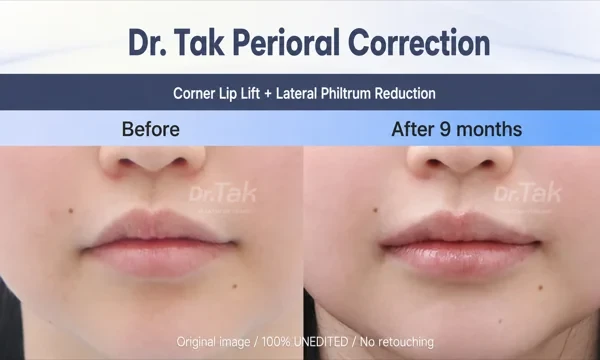
If people say you look angry when you have not said a word
If people keep asking "Are you upset?" or "Is something wrong?" when you are simply resting your face, the reason may not be your mood — it may be your mouth corners. This is what many people call a "sad mouth."
When the corners of the mouth turn downward, a completely neutral face reads as unhappy or annoyed. Your expression looks darker in photos, and even a forced smile feels somehow awkward. I imagine that has been frustrating.
I have spent many years looking at nothing but lips and the mouth area. In my consultation room in Korea I meet this concern constantly, and what is interesting is that almost everyone first asks the same thing: "Do I need surgery, or is filler enough?" But to answer that, there is something we have to look at first.
This article gathers, in order, the questions I hear most often in consultation. What causes it, how filler, botox and surgery differ, what they cost and how long they last, and why some people write that "it did not work." Before you rush a decision, I recommend reading to the end.
Why do mouth corners droop — the answer starts with the cause
The first thing I want to say is this: the same "drooping mouth corners" can have very different answers depending on the cause. Choosing a method before knowing the cause is how people spend money and time and still feel dissatisfied.
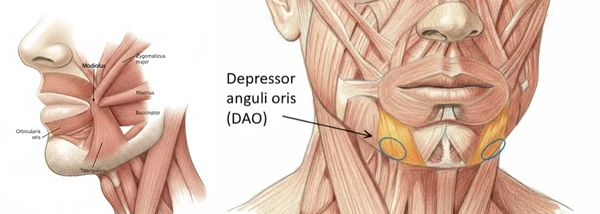
Drooping mouth corners generally come from one of three causes.
① Congenital structure — the muscle that pulls the corners down (the depressor anguli oris, DAO) is naturally strong, or the muscles that lift the corners are relatively weak. If your corners point downward even in childhood photos, this is the likely type.
② Age-related sagging — with age the skin and ligaments around the mouth lose elasticity and cheek fat drifts downward, dragging the corners with it. If it was fine when you were young but has worsened over time, this is your type.
③ Habit and asymmetry — chewing or smiling on one side, or left-right muscle imbalance, often drops one corner more than the other. Korean Q&A boards are full of "only one corner looks crooked" questions.
So in consultation I start with a mirror. I need to see how the corners move at rest, with a slight smile, and with a full smile, because that is where the cause reveals itself. Skip this observation and the choice of method goes off course.
Filler, botox or surgery — this is always the first question
Nine out of ten people open with this. "Is filler better, botox better, or do I need surgery?" The three work on entirely different principles. Let me lay it out in a table.
| Comparison | Mouth corner filler | Mouth corner botox | Corner-lift surgery |
|---|---|---|---|
| Mechanism | Fills the drooped area to support and lift the line | Relaxes the muscle (DAO) that pulls corners down | Removes drooped tissue and fixes the corner upward |
| Effect strength | Subtle improvement | Subtle improvement | Clear improvement |
| Duration | About 6–12 months | About 3–4 months | Semi-permanent |
| Procedure time | 5–10 min | About 5 min | 30 min–1 hr |
| Recovery/swelling | 1–2 days | Almost none | Sutures 5–7 days |
| Scarring | None | None | Yes (hidden at the corner) |
| Best for | Mild droop, volume loss | Muscular droop, early stage | Moderate or more, structural droop |
| Cost (per session) | Relatively low | Lowest | Relatively higher |
📍 Bottom line: Filler and botox are the "light, reversible" way to start; surgery is the "definite, long-lasting" way. Neither is simply better — the degree and cause of the droop decide the choice.
Let me be honest about one thing. If the corners are structurally quite low and you try to fully lift them with filler or botox alone, the result can look unnatural or leave you unsatisfied. In those cases I think it is more honest to recommend surgery from the start.
So which one fits me — sorted by condition
If the table above is a comparison of principles, this is how to gauge "which category am I in." Checking yourself before consultation makes the direction much clearer.
- ✅ Corners droop only at rest but look natural when you smile → you may be able to start with botox or filler.
- ✅ Volume has deflated and the corner line has collapsed → filler to support and lift the line suits you.
- ✅ One side droops because a muscle is unusually strong → botox to balance left and right works well.
- ✅ Corners are clearly and always down in photos, or the skin has loosened → likely structural droop; I recommend a surgical consultation.
Of course this check does not replace a diagnosis. The same symptom can trace back to muscle, to volume, or to skin, and the answer differs for each. That is exactly what a consultation is for.
How long is recovery — it depends on the method
The second most common question is recovery. People especially worry about "when can I go back to daily life, and will it show?" The recovery picture differs by method, so let me separate them.
| Timeline | Filler | Botox | Corner-lift surgery |
|---|---|---|---|
| Day of | Slight swelling/redness | Barely noticeable | Sutures, mild swelling |
| 2–3 days | Mostly settled | Effect begins gradually | Swelling peaks then eases |
| 5–7 days | Fully stable | Effect sets in | Sutures removed |
| 2–4 weeks | — | Final effect confirmed | Most swelling gone |
| 3–6 months | Gradual absorption begins | Effect fades, re-treatment window | Scar matures, looks natural |
In my clinical experience, filler and botox allow washing your face and light outings the same day, while for surgery it is better to be careful until the sutures come out at 5–7 days. Surgery does not mean lying in bed for a long time. But because care during this period shapes how the scar finishes, I emphasize it especially.
Why do some people say "it did not work" — what separates failure
This is a subject I want to address honestly. Some people come to me anxious after reading posts saying "I had corner surgery and it did nothing" or "I wasted my money." That fear is completely understandable.
The failures I have observed clinically usually came down to one of three things: the cause was misdiagnosed, the method was too weak for the degree of droop, or the strength of the muscle was ignored.
One misunderstanding is especially common — the expectation that simply filling with volume will lift a drooped corner. But for someone whose corners are pulled down hard by muscle, no amount of volume will hold; the muscle drags them back down. In that case you have to address the muscle first with botox, or approach it surgically. The cause and the method have to match for a result to appear.
So I believe that "knowing why it drooped first" decides 80% of the result, more than "what you do." Accurate diagnosis comes before any impressive procedure name.
Why you can trust us — let me speak in numbers
Once you understand the methods, the last thing that remains is "who to trust with it." I prefer to answer this part with plain numbers.
🏥 Dr.Tak Plastic Surgery is a Korean clinic focused on lip, philtrum and mouth-area procedures, with a director who has built more than 15 years of experience in the lip and philtrum field. Our Google reviews number over 190, holding an average close to a perfect 5 out of 5. Numbers like these are not built overnight.
💬 "To make people smile." This is why we focus on a person's impression, not just the procedure.
The Dr.Tak 4S patient-care system
We focus on the person, not the procedure.
Solution
We diagnose the cause of the droop first, then design the method — filler, botox or surgery — that fits your current condition.
Support
From consultation to the procedure and follow-up, the same director sees you throughout.
Scar Care
If surgery is performed, we manage the scar so it settles naturally at the corner of the mouth, on the schedule below.
| Timing | Care point |
|---|---|
| 1 week | Suture removal, early cleansing |
| 2–4 weeks | Swelling care, sun protection |
| 2–3 months | Scar softening, pigment care |
| 4–6 months | Final maturation check |
Service
Whether or not surgery is involved, we do not recommend procedures you do not need.
If you would like to know more — official channels
🌐 On our official site drtakprs.com you can see a range of mouth-correction cases and information.
📝 Consultations connect in real time via the chat icon at the bottom right of the site.
📹 We also prepare video content on mouth-corner and lip correction.
Five things to sort out before your consultation
✅ Whether corners droop at rest, or also when you smile
✅ Whether they were down in childhood photos (congenital vs age)
✅ Whether one side droops, or both
✅ Whether you want a reversible method or a long-lasting one
✅ How much recovery time you can spare
Sorting out just these five makes the consultation much faster and more precise. You do not need to prepare perfectly. We can look at it together.
Frequently Asked Questions (FAQ)
These are the questions we receive most often at Dr.Tak Plastic Surgery.
Q1. Will corner-lift surgery leave a visible scar, or make my smile look awkward?
I know this is the deepest fear. Let me answer directly: when the incision is placed at the natural line of the mouth corner and the closure is precise, the scar is almost invisible from the front. Awkwardness usually comes from "lifting too much." That is why I make it a principle to lift conservatively, only to the angle that suits your own face. Naturalness comes from taking less, not more.
Q2. How long is recovery, and when can I return to daily life?
It depends on the method. With filler and botox, light daily activity is possible the same day, and swelling mostly settles within 1–2 days. For corner-lift surgery, it is better to be careful until sutures come out at 5–7 days, and swelling eases over 2–4 weeks. In my experience even surgery allows a faster return than people expect, but I do ask that you keep the early scar-care routine.
Q3. How do the cost and longevity of filler, botox and surgery differ?
Starting with duration: mouth-corner botox lasts about 3–4 months, filler about 6–12 months, and surgery is semi-permanent. On cost, botox is usually the lowest, filler next, and surgery relatively higher. But remember that filler and botox require repeat sessions to maintain, so factor that in. Exact cost depends on your condition and the volume needed, which we explain in consultation.
Q4. Will corrected mouth corners droop again over time?
Filler and botox fade as they are absorbed, so re-treatment is needed. Surgery is semi-permanent, but it does not stop aging itself, so the surrounding tissue keeps changing over the years. That said, clinically, corners lifted by surgery tend to hold for a long time. Rather than assuming "forever unchanged," it is better to understand each method's nature and choose — you will regret it less.
Q5. How do you decide whether filler is enough or surgery is needed?
This truly varies case by case. Mild droop or volume loss is often enough with filler or botox, while structural droop or loosened skin calls for surgery. The key to the decision is the cause — whether muscle, volume or skin is behind it. Honestly, not everyone needs surgery. If a non-surgical option is enough, I recommend the non-surgical route first.
Dr.Tak Plastic Surgery | Korea's lip and philtrum specialist clinic
"To make people smile"