
A long, drooping upper lip — where do you even begin?
Have you ever looked in the mirror and felt your upper lip looked unusually long and heavy, your top teeth barely showing even when you smile, leaving you with a tired expression? In photos the gap between your nose and lips looks wide, and someone's offhand comment that you look older than your age stays with you.
The moment you start researching, it gets more confusing. Upper lip lift, lip lift, philtrum reduction, mucosal advancement, lip filler — similar-sounding terms pile up and nothing fits together. One clinic recommends surgery, another says filler is enough. Who is right?
I have run a clinic in Korea focused specifically on the lips and philtrum for more than 15 years. The question I hear most is, "Am I a surgery case or a procedure case?" Today I'll answer it by placing the upper lip lift side by side with the lip lift, mucosal advancement and filler, and laying out how to choose what fits your face. The honest answer up front: it differs from person to person.
Why an upper lip looks long — length, volume and droop are different things
First, one thing to clear up. "I don't like my upper lip" is one sentence, but the cause falls into three groups. Miss this distinction and you end up with the wrong surgery.
① A long philtrum (columella to lip) — the distance from under the nose to the red part of the upper lip is long. The average for Korean women is roughly 12–15 mm; longer than that and the mid-face looks stretched. This is a length problem.
② A thin red upper lip (low show) — the visible thickness of the lip is lacking. This is a volume problem, not length.
③ An aging, inward-rolling droop — the upper lip rolls under and sags, hiding the top teeth and weighing down the mouth. This is a position problem caused by aging.
Because the causes differ, so do the solutions. If length is the issue, a lift-type surgery; if volume, filler or mucosal advancement; if droop is mixed in, a combination may be needed. That's why I look at photos first in consultation and ask, "What bothers you right now — the length, or the thickness?" The path forks right here.
Lift, lip lift, mucosal advancement, filler — how they really differ
Here I'll be candid about the part people find most confusing. The "upper lip lift" is not one fixed surgery but an umbrella term for several ways of raising the upper lip. Broadly there is the approach that shortens the philtrum through an incision under the nose (commonly called the lip lift or philtrum reduction), and the approach that incises along the red border of the upper lip.
Let me be clear about one thing. At Dr.Tak we do not recommend the upper lip lift that incises along the lip border. The scar lands right above the red lip — the most visible spot on the face. No matter how precisely it is sutured, the border between red lip and skin catches the light and tends to show. I have kept one principle: I don't create a scar I can't be confident will stay hidden.
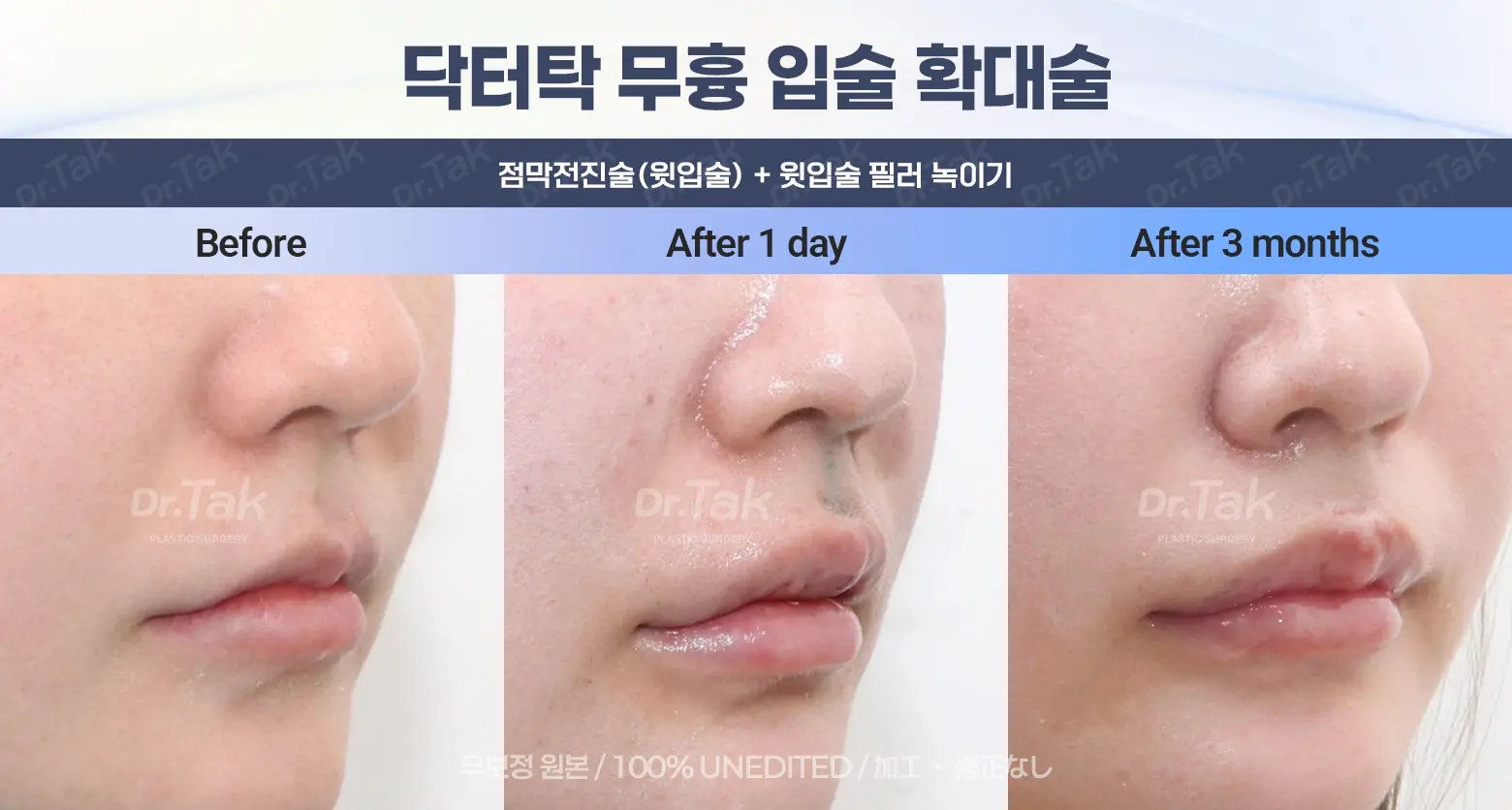
So if you want to realistically enlarge the upper lip — the visible lip itself — what should you do? I recommend mucosal advancement. It advances the inner mucosa of the upper lip outward to widen the red lip naturally, and because the incision hides inside the mouth, no scar shows on the outside. Filler, by contrast, requires no incision but is a temporary volume procedure you must repeat every 6–12 months. Here is the core in one table.
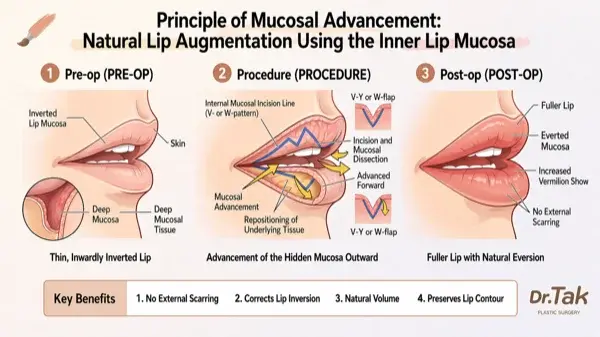
| Comparison | Lip lift / philtrum reduction (subnasal incision) | Mucosal advancement (intraoral incision) | Lip filler (non-surgical) |
|---|---|---|---|
| Incision site | Base of the columella | Inner mucosa of upper lip | None (injection) |
| Main effect | Shorter philtrum + more tooth show | Enlarges the red upper lip | Adds lip volume |
| Philtrum length | Visibly shortened | Almost unchanged | Almost unchanged |
| Upper lip size (show) | Slightly increased | Clearly increased | Increased but temporary |
| Longevity | Semi-permanent | Semi-permanent | 6–12 months |
| Recovery | Sutures 5–7 days, swelling 2 weeks | Swelling 1–2 weeks | Almost none (same day) |
| Scar | Hidden in subnasal crease | Inside the mouth (not visible) | None |
| Pain / anesthesia | Local | Local | Topical |
| Naturalness | Depends on incision placement | Natural fullness | Unnatural if overdone |
| Best for | Long, stretched mid-face | Wanting a larger upper lip | Normal length, temporary volume |
| Cost profile | One-time surgery | One-time surgery | Repeated, cumulative |
📍 Bottom line: If a long philtrum makes your whole face look stretched, the subnasal approach (lip lift / philtrum reduction) fits; if you want to permanently enlarge the visible upper lip, mucosal advancement is the answer. The lip-border-incision lift we don't recommend, because the scar burden is too high. The same "upper lip concern" can start from very different places.
A 1:1 personalized consultation you can start now
✅ We compare the lip lift, mucosal advancement and filler and explain which fits your face
✅ We give an honest opinion regardless of whether you choose surgery
📲 Dr.Tak Plastic Surgery official site → chat icon at the bottom right → live consultation
When surgery fits vs when non-surgical is better
Honestly, surgery is not right for everyone. In consultation I quite often say, "For now, try filler before surgery." I believe trust is built by naming the limits first.
This checklist helps set a direction.
When surgery is worth considering
- ✅ A long philtrum making the mid-face look stretched is your core concern → lip lift / philtrum reduction
- ✅ You want to permanently enlarge the visible upper lip → mucosal advancement
- ✅ Top teeth barely show when you smile, giving a heavy look
- ✅ You dislike the cost and bother of repeating filler and want it settled at once
When I recommend starting with filler
- ⭐ You want subtle adjustment rather than a big change
- ⭐ The burden of scarring or downtime feels heavy
- ⭐ You want to gauge the direction of change before deciding on surgery
- ⭐ You'd like to experience the effect temporarily first, then decide
One thing to add. Filler does recover fast and feels light, but you must redo it every 6–12 months and the cost adds up over time. Surgery like mucosal advancement or the lip lift is done once, but comes with downtime. It's less about which is better and more about what you can tolerate. This is the real fork in the decision.
How recovery unfolds — a timeline
The most practical worry when considering surgery is "how many days will it show?" Here is the general recovery flow for lip lift and mucosal advancement type surgery.
| Stage | State | Care |
|---|---|---|
| Surgery day | Local anesthesia, mild swelling begins | Cold compress, avoid strong expressions |
| Days 2–3 | Swelling peaks | Sleep with head elevated, avoid irritating food |
| Days 5–7 | Suture removal | Keep the incision dry and clean |
| 2 weeks | About 70% of swelling subsides | Light makeup can cover it |
| 1 month | Natural contour settles | Strict sun protection |
| 3–6 months | Scar matures and softens | Continue scar care |
The most important points in recovery are suture removal at days 5–7 and the 3–6 month mark when the scar begins to soften. Swelling fades faster than you'd expect. What truly decides the result is where and how the scar sits — and that is settled on the day of surgery, in the design. Which is why the next part matters.
Why the same surgery gives different results — the basis for trust
The reason results vary so widely under the same surgery name comes down to design and incision placement. A lip lift scar sitting in the subnasal crease, and a mucosal advancement incision hidden in the inner mouth, barely show from the front. The reason we don't recommend the lip-border incision is exactly the same logic. Placement is everything.
What we offer patients is not flashy advertising but accumulated clinical work and reviews. Dr.Tak Plastic Surgery is a clinic specialized in lips and philtrum with more than 15 years of experience, and has earned 5-star ratings across over 190 Google reviews. Numbers don't say everything, but hands that have worked the same area for a long time, and the voices of those who left their results, are a clear basis for trust.
💬 We focus on people, not procedures. Our goal is not a shorter philtrum, but your ease in front of the mirror.
The Dr.Tak 4S patient care system — focused on people, not procedures
Solution
We diagnose first whether length, volume or droop is the core concern through photo analysis, then choose your direction among lip lift, mucosal advancement and filler.
Support
From pre-op design to post-op progress, we make it easy to ask your questions as they come up.
Scar Care
Scars matter as much as the surgery. We guide a staged six-month plan.
| Stage | Scar care focus |
|---|---|
| 0–2 weeks | Keep incision dry/clean, don't pick scabs |
| 2 weeks–1 month | Begin scar ointment, sun protection |
| 1–3 months | Continue hydration/regeneration, monitor redness |
| 3–6 months | Scar maturation, extra care consult if needed |
Service
Our principle is to give an honest opinion whether or not you have surgery.
If you'd like to know more — official channels
🌐 You can find procedure information at the Dr.Tak Plastic Surgery official site (drtakprs.com).
📝 The chat icon at the bottom right of the site connects you to a live consultation.
📹 Materials on surgical principles and recovery are also available.
Five things to sort out before deciding on surgery
- ✅ Is my concern length, volume or droop?
- ✅ Do I want a semi-permanent change, or to try something light first?
- ✅ Can my schedule handle downtime (sutures 5–7 days, swelling 2 weeks)?
- ✅ Can I accept that a faint scar may remain?
- ✅ Have I decided how much change I want (natural vs noticeable)?
Answer these five for yourself and the conversation in the consultation room becomes far faster and clearer. There's no rush to sort it out.
Frequently Asked Questions (FAQ)
The questions we most often receive about the upper lip lift at Dr.Tak Plastic Surgery.
Q1. Does it hurt a lot? How is anesthesia done?
The lip lift and mucosal advancement are mostly done under local anesthesia. There's a sting as the anesthetic goes in, but pain during surgery tends to be minor. What I often tell patients is that the swelling and tightness over the first few days will bother you more than pain — and it's well controlled with painkillers.
Q2. How long is recovery, and when can I return to daily life?
Sutures usually come out at 5–7 days, and about 70% of swelling subsides within 2 weeks. Many return to light outings around suture removal, with a mask. Since the incision fully softens over 3–6 months, if you have an important event I recommend leaving at least two weeks' margin.
Q3. Will a scar remain? Will it show from the front?
The very reason we don't recommend the lip-border-incision upper lip lift is this scar — right above the red lip is the most visible spot. Instead, the lip lift places the incision in the subnasal crease and mucosal advancement inside the mouth, so neither shows from the outside. That said, I won't claim "no scar at all." A faint scar can remain, which is why we guide six months of staged care.
Q4. Won't an upper lip lift make a protruding mouth look worse?
This worry comes up often in consultation. If someone with a forward-protruding mouth raises the upper lip too aggressively, the protrusion can stand out more. So I assess the degree of protrusion first and, if needed, take a conservative amount or recommend a different approach. It is not a surgery that lifts the same amount for everyone.
Q5. What if my face doesn't feel like mine after surgery?
I think this is the deepest fear. That's why I don't get greedy with the amount of change from the start. In an area where 1–2 mm shifts the whole impression, I design conservatively with naturalness first. Ironically, the most satisfying results come from the reaction, "I can't tell you had anything done."
Dr.Tak Plastic Surgery | Korea's lip & philtrum specialist clinic
"To make people smile."