
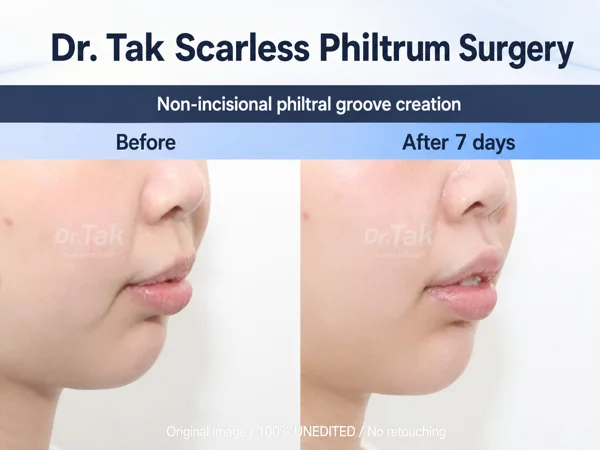
Scar-Free Philtrum Reduction Guide — The Difference Between "Not Visible" and "Not There"
If You Searched "Scar-Free" Because You're Afraid of Scarring, Please Read This to the End
If fear of scarring is making you hesitate, you're not alone — this is one of the most common consultations I receive at Dr. Tak Korea. "They call it scar-free, but will there really be no scar?" More than half the patients who visit our clinic ask this exact question. I completely understand this concern. The fear that a permanent mark could remain below the philtrum is not a small thing.
Today I'd like to answer this question from a different angle. If you searched "scar-free philtrum reduction," what you actually want may not be incisional surgery at all. Let's clarify together what's really at the heart of that concern — and along the way, I'll explain why non-incision philtrum groove surgery is the most practical alternative.
What "Scar-Free" Doesn't Tell You — The Truth About Incisions and Marks
I've spent over 15 years specializing exclusively in lips and the philtrum in Korea, and I know how much confusion the term "scar-free philtrum reduction" creates. Let me be direct.
① "Scar-free" means "scars that are hard to see," not "no incision at all"
What is commonly called "scar-free philtrum reduction" typically involves a small incision along the inner border of the nostril (intranasal approach). Because access is through the inside of the nose rather than the visible skin below the nose, marks are not easily visible from the front — but the incision itself still exists. I explain this in every consultation. The gap between what "scar-free" implies and what the procedure actually involves is larger than most people expect. There is a real difference between "looks clean" and "doesn't exist."
② In Asian skin, even a "clean scar" requires more care
Asian skin — especially Korean skin — tends to have a thicker dermis and more reactive pigmentation than Caucasian skin. Philtrum skin is approximately 1.5–2.5mm thick, one of the thicker areas of the face. Even with an intranasal incision, temporary hyperpigmentation or, rarely, hypertrophic scarring can occur at the closure site. Among cases I've seen clinically, some patients returned for a second consultation saying, "You said it would be clean — why is there this mark?" The difference in information creates the difference in outcomes.
③ Suture tension and incision depth determine the result
Even with an intranasal incision, excessive suture tension can leave a more visible mark. This comes down to the surgeon's experience and suture design. The physical reality of this is not hidden by the word "scar-free." So the real question is here.
Is There a Way to Make the Philtrum Look Shorter Without Scarring? — The Shift to Non-Incision Philtrum Groove
There's a question I often ask during consultations: "Do you want to actually shorten the philtrum, or do you want it to look shorter?" These are two very different things.
What most patients want when they look in the mirror is not a measured reduction of a few millimeters, but a change in impression — a philtrum that looks shorter than it does now. If the facial proportion looks different and the lips appear fuller, isn't that close to what you're looking for? This is where non-incision philtrum groove surgery emerges as an entirely different option.
Non-incision philtrum groove surgery involves no incision on the skin below the nose or above the lip. It accesses through the inner oral mucosa, using dissolvable sutures to create a concave groove in the philtrum area. Since there's no surface incision, the nature of any scar concern changes fundamentally. However, this method is not the perfect answer for everyone. I'll explain — from the mechanism to the limitations — honestly.
How Non-Incision Philtrum Groove Works — The Visual Mechanism
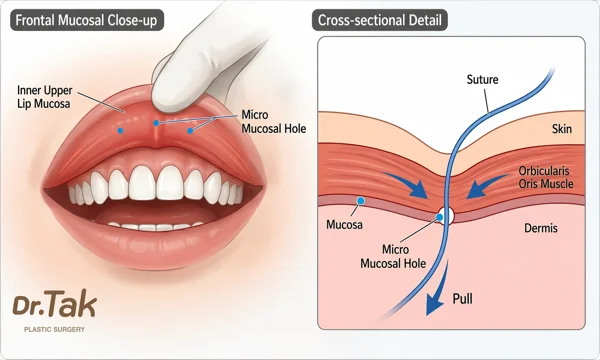
When I first introduced this procedure at our Korean clinic, what fascinated me most was this exact principle: not simply reducing length, but changing the philtrum structure itself to create the visual appearance of shortening.
The philtrum has two vertical ridges (philtrum columns) with a concave groove between them. The more defined this groove, the shorter the philtrum appears, and the more the lips project forward — creating the C-curl effect. Conversely, if the groove is flat and the ridges are indistinct, the philtrum looks longer and gives a flatter impression even at the same length.
Non-incision philtrum groove surgery focuses on making this groove deeper and more defined. Fine sutures are inserted through the inner oral mucosa, and anchor points in the lower philtrum tissue draw it inward, forming the groove.
① Procedure time: Approximately 30 minutes
② Recovery: Most patients return to daily life within 3 days (minimal swelling with no surface incision)
③ C-curl effect: As the philtrum line becomes more defined, lip volume appears enhanced as well
When patients come back a week later and say, "I had no idea it could look this natural," I'm reminded again of the practical value this approach holds. But that's not the whole story.
Start Your 1:1 Personalized Consultation Today
✅ Comparison of scar-free philtrum reduction vs. non-incision philtrum groove — which suits you
✅ Honest opinion regardless of whether you proceed with surgery
Visit drtakprs.com → bottom right chat icon → real-time consultation
Scar-Free Philtrum Reduction vs. Non-Incision Philtrum Groove — 9 Key Comparisons
| Comparison | Scar-Free Philtrum Reduction | Non-Incision Philtrum Groove |
|---|---|---|
| Skin incision | ⭕ Micro-incision inside nostril | None, or up to 2~3mm if needed |
| Surface mark risk | Low (varies by location & suture design) | Extremely low |
| Actual philtrum shortening | ⭕ Possible (2~5mm) | ❌ No actual shortening |
| Shorter-looking effect | ⭕ Yes | ⭕ Yes (visual) |
| C-curl lip line | Secondary effect | ⭕ Primary effect |
| Recovery period | 5–7 days (swelling, suture removal) | 1–3 days |
| Duration of results | Semi-permanent (tissue removed) | Relatively limited |
| Pain level | Moderate after local anesthesia | Low after local anesthesia |
| Best candidates | Philtrum ≥20mm, physical shortening needed | Philtrum ≤18mm, wanting impression change & C-curl |
Bottom line: If your philtrum is truly 20mm or longer and physical shortening is necessary, incisional surgery is the right choice. For everyone else wanting impression change and C-curl effect without scarring, non-incision philtrum groove is the realistic first option.
Non-Incision Philtrum Groove — An Honest Word About Duration of Results
There is one thing I always emphasize first when recommending this procedure. Like the buried suture double eyelid method, the duration of results from non-incision philtrum groove surgery varies depending on how well the sutures adhere to the surrounding tissue. When adhesion is strong, the effect can last for a long time. However, depending on individual tissue elasticity, frequency of oral muscle movement, and suture type, the groove may relax earlier for some patients.
To be honest: the duration of results from non-incision philtrum groove surgery is relatively limited.
I do not tell patients at the initial consultation that "it lasts X years" — that would be inaccurate guidance. While strong adhesion can lead to long-lasting results, individual variation is significant. Choosing this procedure while expecting permanent results may lead to disappointment. You need to understand this clearly before deciding. This is the most honest guidance I can offer — and I've learned through clinical experience in Korea that honest guidance ultimately leads to better outcomes.
Who Is Non-Incision Philtrum Groove Better Suited For?
The more of the following that apply to you, the more likely this procedure is a good fit.
Fear of scarring is preventing you from deciding on surgery
Philtrum is 18mm or less, and you want an impression change rather than extreme shortening
You need a quick return to daily life (recovery within ~3 days)
You have significant psychological resistance to incisional procedures
You want to experience results through a minimally invasive approach first
You want a C-curl lip line or a more defined philtrum ridge
On the other hand, incisional surgery is more realistic if:
Philtrum is 20mm or longer and physical shortening is absolutely necessary
You have already tried a non-incision procedure but were unsatisfied with the results
You want permanent and definitive results
Not every procedure suits every person. I make this distinction at the very start of every consultation.
The Foundation of Trust at Dr. Tak Korea
4 Reasons to Trust
① 15+ years of specialized experience in lips and philtrum in Korea — clinical depth built on this field alone
② 190+ Google reviews, perfect 5-star rating — the most common feedback: "I received an honest explanation during the consultation"
③ A clinic that handles both scar-free philtrum reduction and non-incision philtrum groove comprehensively
④ Consultations grounded in accurate information, not inflated expectations
"To make people smile — helping people smile"
We don't treat this mission as a mere slogan. That better results lead to more natural smiles, and that those results come from sufficient information — these are truths I've learned through years of clinical practice in Korea. Delivering accurate information from the start builds trust that lasts far longer.
Dr. Tak 4S Patient Care System — What Happens After the Procedure Matters More
Focused on people, not procedures
Solution
From non-incision philtrum groove to minimal-incision philtrum reduction — we design the optimal approach step by step, based on your philtrum length, skin thickness, and expectations. Not one fixed answer, but the right choice for you.
Support
Post-procedure swelling, groove maintenance, further management direction — our role doesn't end when the procedure does. Reach out anytime with questions.
Scar Care
No surface incision means no external mark to manage. But we provide detailed guidance on care during the tissue stabilization period.
| Period | Care Instructions |
|---|---|
| Day 1–3 | Avoid excessive oral movement, soft diet |
| Day 4–7 | Swelling stabilizes, normal diet resumes |
| Week 2 | Tissue adhesion stabilizing, avoid intense exercise |
| Month 1 | Confirm result, follow-up consultation available |
Service
Our role spans the entire journey — from the first consultation to the one-month check-in.
Learn More — Official Channels
Official website: drtakprs.com — non-incision philtrum groove procedure details
Naver Blog: Dr. Tak Plastic Surgery Korea — clinical cases and recovery documentation
YouTube: Dr. Tak — procedure principles explained directly by the surgeon
7 Things to Check Before Deciding on Non-Incision Philtrum Groove
Have I measured whether my philtrum is actually 18mm or longer?
Have I clarified whether I want "actual shortening" or "a shorter-looking impression"?
Do I fully understand that the duration of results is relatively limited?
Have I consulted a specialist about whether non-incision or incisional surgery suits my case?
Can I manage oral care for 2 weeks post-procedure?
Am I prepared to accept the gap between expectations and realistic limits?
Do I have a clear expectation about the result itself, beyond just fear of scarring?
Frequently Asked Questions (FAQ)
The most common questions received at Dr. Tak Korea.
Q1. Is non-incision philtrum groove really painful? I'm scared of the needle itself
The procedure is performed under local anesthesia, so there is virtually no pain during the process. I tell patients who say "I'm too scared to go through with it" during consultation: the momentary sting of the anesthetic injection is essentially all you feel. There may be mild tenderness when pressing the area for 1–2 days after, but nothing that disrupts daily life. It's entirely different from the post-procedure tightness of incisional philtrum reduction.
Q2. When can I return to work after non-incision philtrum groove?
Most patients return to work the next day or the day after. Since there's no surface incision, washing your face and applying makeup is often possible from the same day. We recommend avoiding straws and excessive mouth opening for the first week. Compared to incisional philtrum reduction or corner lift surgery, the recovery burden is significantly lower.
Q3. Is non-incision philtrum groove less expensive than scar-free philtrum reduction?
Generally, non-incision philtrum groove tends to cost less than incisional scar-free philtrum reduction. However, the exact difference depends on scope, suture type, and combination procedures, so please confirm during your consultation. What I always say first: cost matters less than whether the method is right for you. Cheaper isn't always better-suited, and more expensive doesn't guarantee better results.
Q4. What if someone notices I had something done? I'm worried people might be able to tell
Since there's no surface incision, no external mark is visible. There may be a very minor mark on the inner oral mucosa immediately after, but it heals naturally within a few days. No trace of the procedure is visible from the front or side. One of the most common pieces of feedback we receive is: "People couldn't tell I had anything done at all" — and that natural outcome is exactly what we aim for.
Q5. Is this not right for everyone? What if I regret it later?
This is not a procedure for everyone — I say this clearly at every first consultation. If your philtrum is genuinely 20mm or longer and needs physical shortening, or if you've already tried a non-incision procedure and weren't satisfied, incisional surgery is more realistic. On the other hand, if you have significant scar concerns, your philtrum is borderline in length, and you want impression change with C-curl effect, non-incision philtrum groove can be a meaningful first step. To avoid regret, the most important thing is a consultation that sets accurate expectations.
Dr. Tak Plastic Surgery | Korea Specialized Lip & Philtrum Clinic, 15+ Years of Experience
"To make people smile — helping people smile"