
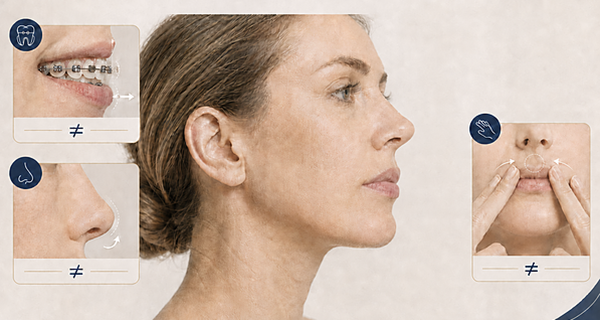
You probably tried the 10-second exercise three times before running this search
There was a day when a friend took a photo of you and the space between your nose and your mouth looked unusually wide. From that day your selfie angle changed. Chin slightly up, camera slightly higher, and a conscious effort to lift the upper lip when you smile.
Then you searched. I ran that same search myself today. One video titled "10-second exercise for a shorter philtrum" has passed 320,000 views, and massage, facial rolling, braces and rhinoplasty follow one after another. In one answer forum, a top-rated reply claimed that pressing the philtrum with your fingers will cut its length in half.
Having worked on this one area for more than 15 years, I find those results genuinely unfortunate.
Not because those methods are false, but because they are doing something else. Making a philtrum look shorter and making it become shorter are two entirely different things, and the search results blend them together. I keep meeting patients in Korea who spent six months or a year without knowing where that line falls.
This article is not here to push a procedure. It is here to draw the line precisely. And to understand that line, we have to start with what actually determines philtrum length.
Philtrum length is set by three structures, not by your skin
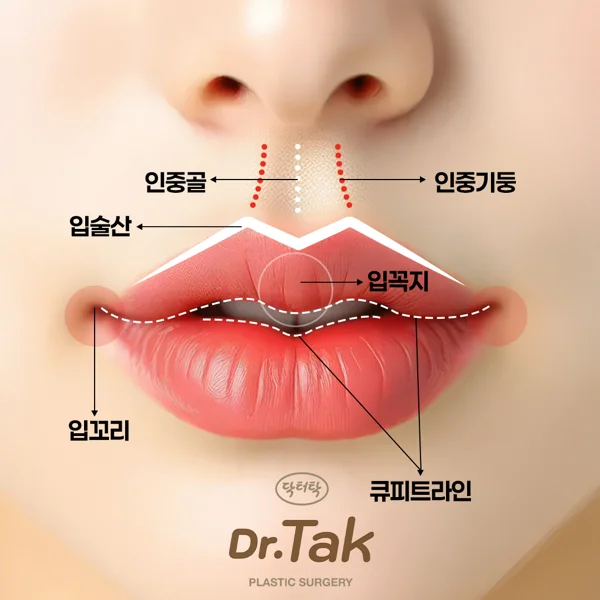
Let me answer directly: philtrum length is determined by the absolute distance across bone, muscle and skin — not by skin tone, elasticity or swelling. That is why pressing or moving it from the outside changes nothing.
The philtrum is the area of skin from the base of the nose to the top edge of the upper lip. Clinically it is measured as upper lip length, and in everyday search it goes by many names: how to shorten the philtrum, philtrum reduction, lip lift, upper lip lift. The names vary; the measurement does not. It is the vertical distance from the midpoint beneath the nose to the highest point of the upper lip.
Three things set that distance.
① The vertical height of the maxilla. If you were born with a vertically long upper jaw, the skin covering it is long as well. That is bone, and bone is not something we reach from the outside.
② The strength and position of the muscles that lift the upper lip. The levator labii superioris and its neighbours pull the upper lip upward. When their tone drops, the lip descends and the philtrum reads as longer. This is why most people feel their philtrum grew as they aged.
③ The absolute length of the skin itself. How many millimetres of skin sit between nose and lip. This value can stretch. It does not shrink on its own.
In measurement terms, adult women commonly fall between 13 and 17mm and men between 17 and 21mm. Past 20mm, the number of people who describe their own philtrum as long rises sharply. That is exactly why "philtrum 2cm" keeps appearing as a search phrase. Twenty millimetres is close to a real psychological threshold.
None of those three can be altered by a finger or an expression. So why do the exercise videos perform so well?
The anatomical reason massage and exercise cannot shorten a philtrum
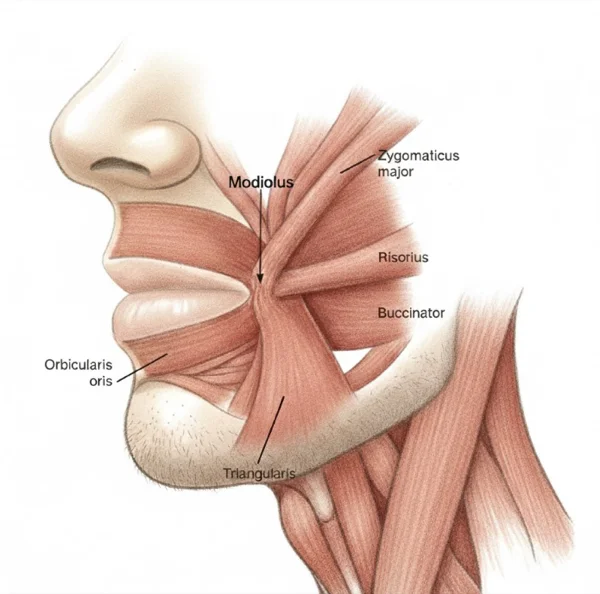
The short answer: philtrum exercises temporarily raise muscle tone so the upper lip sits slightly higher. They do not reduce the absolute length of skin. That is why you see a change while you are doing it, and why it is gone a few days later.
Repeatedly using the muscles that elevate the upper lip does raise their tone. That is not a bad thing. For someone whose descent is progressing, it may slow that progression. I will grant that much.
The problem is expectation.
To hold the upper lip 1mm higher through muscle tone, that muscle has to stay contracted. But the resting state is the default state for facial muscles. Train your arm and it stays thicker at rest; relax a facial muscle and it returns to where it was. So the change you earn from exercise exists only in the moment you take the photo.
Massage is even clearer. There is no anatomical pathway by which pressing and rubbing skin shortens the distance from nose base to lip. The claim that finger pressure halves the length has, with respect, no basis.
Still, those minutes were not wasted. At least nothing in them pushed your philtrum in the other direction. Because the habits that genuinely lengthen a philtrum are a separate matter.
Philtrums really do get longer — three pathways
Search phrases like "habits that lengthen the philtrum" and "why philtrums get longer" keep surfacing. That is not a misconception. It is a fair question, because philtrums do lengthen.
We track three pathways by measurement.
First, skin laxity with age. Upper lip skin stretches and the gap between nose and mouth widens. The literature likewise reports upper lip length increasing with age.
Second, loss of upper lip volume and eversion. As the lip thins and rolls inward, the philtrum reads as wider even when the measured length is unchanged. Comparing photographs, this single factor accounts for more than half of the perceived difference.
Third, changes in tooth and gum height. When upper incisors wear down or descend, the scaffold supporting the lip drops with them.
An important consequence follows. The first two pathways can be slowed and the third belongs partly to dentistry — meaning it is possible to prevent a philtrum from lengthening, but reversing length that already exists is a different problem.
So how far can orthodontics actually reach? I am asked this constantly.
Do braces shorten the philtrum? Separate length from projection
Let me answer directly: orthodontics can reduce forward projection and in some cases influence vertical position, but as a solution for a philtrum that is long, it has clear limits.
This confusion shows up in consultations more than almost any other. Many people who say their philtrum is long in fact have a philtrum that is thick and pushed forward. That is why "how to slim the philtrum" appears alongside the length searches. In those cases the problem is not length. It is projection.
For projection, orthodontics is close to the correct answer. Retracting the incisors changes the angle of the skin draped over them, and the profile shifts substantially. Some treatment plans also adjust vertical tooth position for an added effect.
But the vertical distance from nose base to upper lip does not shorten with braces. The length of skin covering the bone is a value independent of where the teeth sit.
So in consultation I always ask first: is it the width between nose and mouth in a frontal photo that bothers you, or the way your mouth projects in profile? The two answers lead down completely different roads.
Begin without making that distinction and you can finish years of orthodontic treatment with the frontal photo unchanged.
What "rhinoplasty makes the philtrum look shorter" really means
Half of that statement is true. You need to know where the half ends.
When the nasal tip rotates upward, the base of the nose shifts relative position and the visual reference point moves. Midfacial proportions are redistributed, so the philtrum can read as less long. Some patients genuinely leave with a far more composed midface.
The measurement, however, is unchanged.
Hold a ruler from the midpoint under the nose to the lip in a frontal photo and the number is the same as before surgery. What changed is the context surrounding that number. Choosing rhinoplasty knowing this, versus choosing it expecting a shorter philtrum, produces two very different levels of satisfaction.
That is the boundary of the "looks shorter" territory. Before we cross into the rest, if the judgement is difficult, you do not have to make it alone.
A 1:1 consultation you can start today
- ✅✅ We measure first and separate whether the issue is philtrum length, thickness or projection
- ✅✅ We give you an honest opinion, whether or not surgery is involved
- 📲 Chat icon at the lower right of the Dr.Tak Plastic Surgery official site → connects you to a live consultant
What actually shortens it versus what only looks shorter — 9 points
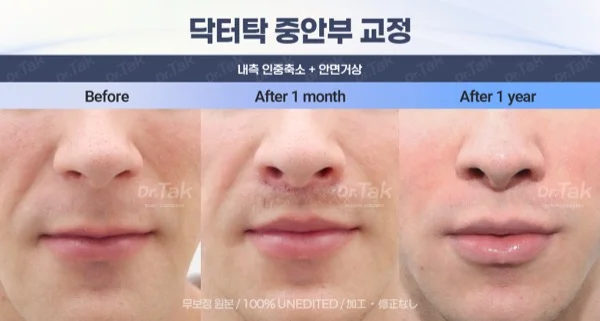
Putting that boundary in a table makes the choice far easier. The first three columns are visual improvement. Only the last one is actual shortening.
| Comparison | Exercise / massage | Makeup / semi-permanent | Filler, botox, lip flip | Philtrum reduction (lip lift) |
|---|---|---|---|---|
| Change in measured length | None | None | None | 3–7mm of real shortening |
| Mechanism | Temporary muscle tone | Shading and lip line redesign | Volume and eversion illusion | Skin excision and closure |
| When you see it | Only while doing it | Immediately | 3 days to 2 weeks | 2–4 weeks, after swelling |
| How long it holds | Does not hold | Gone when removed | Months | Semi-permanent |
| Scar | None | None | None | Hidden in the crease at the nasal base |
| Recovery | None | None | Minimal | About a week to suture removal |
| Change in incisor show | None | None | Slight | Clearly increased |
| Helps a thick, projecting philtrum | No | Limited | Limited | Limited — orthodontic review needed |
| Best suited to | Preventing descent | Mild concerns | Thin lips alongside | Measurably long philtrum |
📍 Bottom line: Only one of those four columns changes the measurement. The other three are not worthless — they simply solve a different problem.
What decides the result in philtrum reduction — the 1.2cm you must leave
If you have decided on surgery, this is the part that matters most.
Philtrum reduction excises skin at the base of the nose and closes it, genuinely reducing length. Remove more and you shorten more. The problem is that removing more does not make it a better operation.
One widely used clinical benchmark is a minimum remaining philtrum length of 1.2cm. Go below that and you risk difficulty closing the mouth comfortably, excessive gum show when smiling, or expressions that read as unnatural. So I work backwards from the measurement. I do not excise as much as someone wants; I first secure the length that has to remain, then design within whatever range is left.
Once the excision amount is set, the incision line is next.
There is a natural crease boundary at the base of the nose. Place the incision exactly along it and the scar tends toward being barely perceptible from the front. Stray from it by even 1 or 2mm and you have created a new line where none existed.
Honestly, this is not the right operation for everyone. When the measurement falls in the normal range and the length is felt rather than measured, I recommend improving lip volume or eversion first. The same concern resolves there more often than you would expect.
Six months after surgery — what we manage
The day surgery ends is not the day the result is decided. The scar is built over the six months that follow.
| Period | Condition | Management |
|---|---|---|
| Immediately to 1 week | Marked swelling, visible suture line | Suture removal, no friction, cold compress |
| 2 weeks to 1 month | Swelling largely resolved, redness begins | Control taping begins, strict sun protection |
| 1 to 3 months | Scar maturation, redness at its peak | Taping maintained, scar-softening injection if needed |
| 3 to 6 months | Redness fading, line softening | Laser treatment, final assessment |
The most common regret in this window is not the scar itself. It is stopping care at the one-month mark. Once the swelling settles it feels finished. But redness reaches its strongest point after that. This is precisely why we commit to six months together.
What 15 years on one area teaches you
I have worked on lips and philtrums for more than 15 years. Look at a single area long enough and you learn that tiny differences decide results — 1mm of excision, 2mm of incision placement, the order of the closure layers.
🏥 What we stand on
- More than 15 years as a lip and philtrum specialist clinic, concentrated on this one area
- Over 200 Google reviews, rated 5 out of 5
- A private clinical environment run entirely by advance appointment
- Every plan built around six months of scar care and a one-year complimentary revision guarantee
💬 "To make people smile"
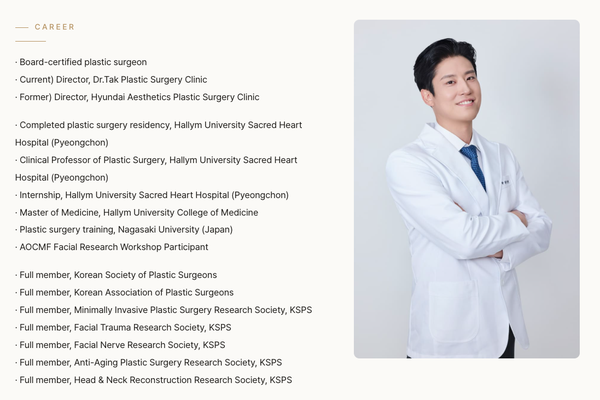
The Dr.Tak 4S Patient Care System — focused on the person, not the procedure
Solution — a 1:1 master plan with Dr. Tak Seung-wan
- Genuine empathy and communication: your wishes reflected fully in the surgical plan
- Precise facial golden-ratio analysis, personalised: measuring whether length, thickness or projection dominates
- Simulation of your expected post-surgical change
Support — a global 1:1 dedicated coordinator
- A dedicated coordinator assigned by country, so there is no language barrier
- Accompanying you through consultation, surgery and aftercare
- 100% advance appointment system, in a private clinical setting
Scar Care — six months of intensive scar management
| Item | Duration | Purpose |
|---|---|---|
| Control taping | 3–6 months | Prevents scar widening |
| Scar-softening injection | 6 months (monthly) | Softens raised scarring |
| Laser treatment | 6 months | Reduces redness at the surgical site |
Service — one-year complimentary revision guarantee
- Complimentary revision within one year of surgery
- We take responsibility to the end
- ※ Where sedation is used, a base anaesthesia fee may apply
If you want to know more — official channels
- 🌐 Procedure information and real progress records are available on the official site
- 📝 Consultation enquiries connect through the chat icon at the lower right of the site
- 📹 Surgical process and recovery progress are documented on the official video channel
Five things to settle for yourself before deciding
- ✅ Is my concern length, thickness or projection — have you checked a frontal and a profile photo separately?
- ✅ Do you know the actual millimetre measurement from beneath your nose to your upper lip?
- ✅ Is a thin or inward-rolled upper lip part of the picture?
- ✅ Is this a period in your life when you can sustain six months of scar care?
- ✅ Do you want real shortening, or do you want it to look shorter?
Once the fifth answer is clear, the rest becomes much easier.
Frequently Asked Questions (FAQ)
These are the questions we receive most often at Dr.Tak Plastic Surgery.
Q1. That 10-second philtrum exercise with 320,000 views — does it work?
I will not say it does nothing. But you should know exactly what it does. It temporarily raises tone in the muscles that lift the upper lip, and it may have value in slowing descent. The distance of skin from nose base to lip, however, is unchanged. I regularly meet patients who only discovered, once we measured, that several months of exercise had moved the number not at all.
Q2. Are there habits that lengthen the philtrum? Did I cause this?
There is no evidence that one particular habit lengthens a philtrum, so please do not blame yourself. That said, real pathways exist: laxity of upper lip skin, loss of lip volume and eversion, and wear or shifting of the upper incisors. Frequently rolling the lips inward and heavy sun exposure can accelerate the second pathway slightly, so that is the part I do ask patients to watch.
Q3. Mine measures 2cm. Is that long, and what does treatment cost?
Twenty millimetres sits above average for women. Even so, someone at 20mm with a long face and full lips may not read as long, while someone at 17mm can. That is why I never define a surgical candidate by the number alone. Cost varies with the extent of the excision design, whether it is a revision, and the anaesthesia method; where sedation is used, a base anaesthesia fee may apply separately. Quoting a figure before measuring is not something we do.
Q4. I have seen people say "don't get philtrum reduction." Why does that come up?
I am aware that phrase keeps appearing in search, and I can guess where the regret comes from. Usually one of two things. Either the measurement was within the normal range and surgery was chosen for psychological reasons, so the change fell short of expectation — or the excision was too aggressive and the remaining philtrum dropped below 1.2cm, leaving expressions unnatural. So we do not recommend surgery to patients whose measurement is normal, or whose concern looks resolvable through lip volume and eversion. If a condition impairs scar healing, or six months of care is not possible right now, I suggest postponing.
Q5. Mine is thick and projecting rather than long. Is the approach the same?
No, and this distinction is the most important part of this article. A thick, forward-sitting philtrum usually involves projection of the incisors and alveolar bone, so excising skin will not deliver the change you want. In those cases I ask patients to obtain an orthodontic assessment first. Looking wide from the front and looking projected from the side are different measurements entirely.
Dr.Tak Plastic Surgery | Korea Face Lifting · Lip · Philtrum Specialist Clinic
"To make people smile"