
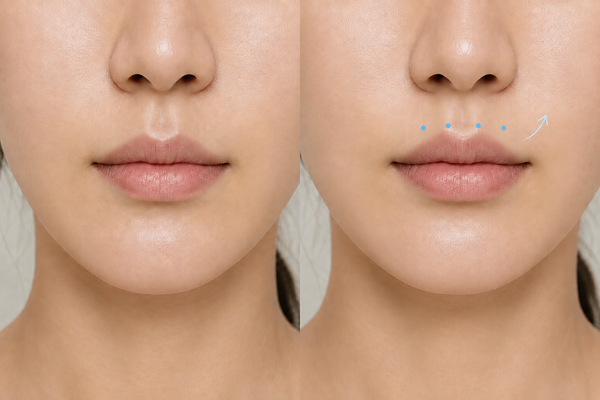
Why do the reviews split so violently
It is unusual for one procedure to divide opinion this sharply. One group says their philtrum looks shorter. The other says they wasted their money. If you have been searching for a while, you have probably already noticed the real problem — there is no standard by which to judge which group is right.
I am asked this almost every week in clinic. And when I answer, I always follow the same order. I do not start by declaring who is correct. I start by checking what that person means when they say "my philtrum got shorter." Skip that step and the conversation stays misaligned to the end.
In practice, two people often describe completely different events using the same words. One means the distance between the nose and the upper lip has decreased. The other means the upper lip shows a little more, so the philtrum area reads as cleaner. Both look like a shorter philtrum in the mirror. What happened inside the face was entirely different.
So this article goes to anatomy instead of collecting reviews. Once you draw the line showing which layers toxin reaches and which it never touches, the reason the reviews diverge sorts itself out. And when you draw that line, something interesting appears. "It doesn't work" and "it works" are each about half right.
The philtrum is not one block. It is five layers
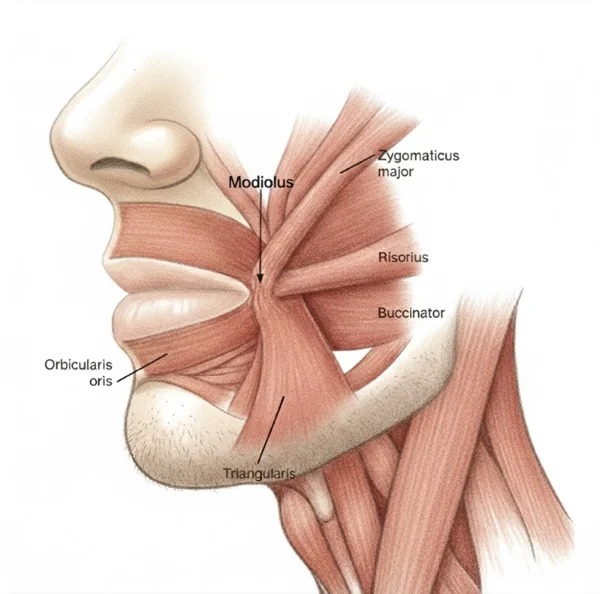
To answer directly: the layer that creates philtrum length and the layer that botulinum toxin acts upon are different layers. That single sentence is the skeleton of this entire article.
First, the terms. The philtrum is the area from the base of the nose to the upper border of the upper lip, and the surgery that reduces its vertical distance is philtrum reduction, also called a lip lift, upper lip lift, or subnasal lip lift. Most people search for it as "how to shorten a long philtrum." Philtrum reduction botox, by contrast, temporarily lowers the contractile force of muscles around that area. It removes no tissue and relocates nothing. The names sit side by side, but they belong to different categories.
Cut the philtrum in cross-section and roughly five layers stack up in order.
1. Skin and epidermis — the visible surface, and the very area we perceive as "long."
2. Subcutaneous fat and connective tissue — the layer anchoring skin to the muscle beneath. As this layer lengthens with age, the philtrum begins to look longer.
3. Orbicularis oris — the sphincter muscle encircling the mouth, whose upper portion reaches the lower philtrum.
4. Levator labii superioris alaeque nasi and depressor septi nasi — the muscles that pull the upper lip, the alar base and the nasal tip. This is the layer toxin actually targets.
5. Maxilla and anterior dentition — the skeletal support behind the philtrum. Whether the mouth protrudes is decided here.
What matters is that layers 1 and 2 create vertical philtrum length. How many millimetres of skin cover the gap from nose base to lip is philtrum length. Toxin acts on layers 3 and 4. It is a drug that blocks nerve signalling to muscle, so it has no route into a layer that is not muscle.
Philtrum length in Korean adults falls roughly between 13 and 15mm in women and 17 to 19mm in men. Beyond 20mm we consider it long. Changing that number requires physically reducing layers 1 and 2. Toxin does not arrive there.
So were all those reports of a fresher-looking philtrum imagined? No, they were not.
What botox actually changes — not the length, but the way it reads
To summarise the core first: philtrum botox does not shorten the length. It changes the proportion and exposure of the philtrum area. And that change reads quite clearly in the mirror. There are three mechanisms.
1. Release the depressor septi nasi and the downward pull on the nasal tip eases
This muscle pulls the nasal tip down and the upper lip up at the same time. Patients whose nasal tip drops when they smile, making the philtrum look unusually long, are heavily influenced by it. Reduce its contraction and the tip lifts minutely while the nasolabial angle opens slightly. Rohrich and colleagues published an anatomic study on this muscle's importance in rhinoplasty; the point was that this one muscle alone alters the impression under the nose.
2. Release the levator labii superioris alaeque nasi and gingival display decreases
Showing a lot of gum when smiling is called a gummy smile, and it is often caused by this muscle overelevating the upper lip. In Polo's 2005 report, a small dose of toxin applied to this muscle reduced gingival display from around 5mm to under 1mm. Five millimetres is not a small number. On a face, 5mm changes the impression.
3. Release the upper orbicularis oris and the upper lip rolls out slightly
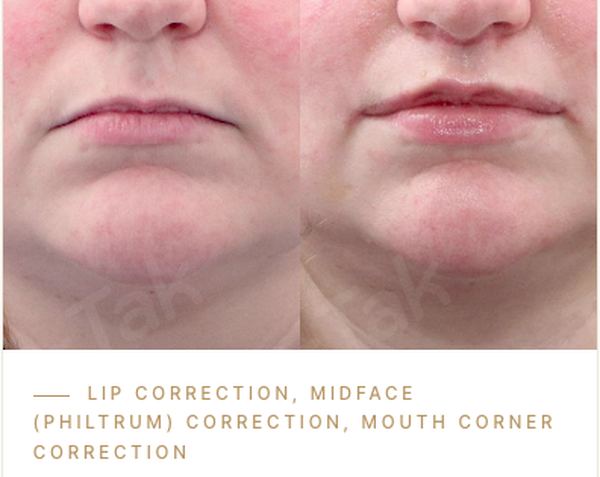
As the inward-tightening force weakens, 1 to 2mm more of the red lip becomes visible. The absolute philtrum length is unchanged, but because the lip below appears fuller, the proportion the philtrum occupies decreases. Most of what gets described in reviews as "my philtrum got shorter" is this.
📍 Bottom line: Toxin does not make the philtrum short. It makes the philtrum less noticeable. Take those two as the same statement and disappointment is inevitable. Take them as different statements and satisfaction is possible.
And what it cannot change — vertical skin length is not a muscle problem
Let me be honest. When someone comes to me with a philtrum over 20mm wanting that length itself reduced, I do not recommend botox. I have no grounds to.
The reason is the line drawn above. The vertical distance of skin covering the gap from nose base to lip does not shrink because a muscle got shorter. A lip lift typically removes 5 to 8mm of skin, and there is no pathway by which toxin makes that much skin disappear. If it did, something other than toxin was at work.
Some of you will have seen flat online statements that philtrum reduction botox "does absolutely nothing." I think that phrasing goes too far, but the target it aims at is accurate. As a claim about reducing length, that statement is correct. Saying the effect is zero across gingival display and the nasolabial angle as well, however, is not true. Neither side is entirely wrong, which is exactly why the argument never ends.
One more thing worth knowing: duration. Toxin usually begins to show at 3 to 7 days, peaks around two weeks, and by 3 to 4 months muscle function has returned to baseline. In other words, returning to baseline is the normal course. Knowing this in advance means you will not look in the mirror after four months and conclude it failed.
A 1:1 consultation you can start now
✅✅ We compare botox, filler, non-incision and incisional approaches layer by layer against your own philtrum structure
✅✅ We give you our honest opinion regardless of whether you proceed with surgery
📲 Chat icon at the bottom right of the official Dr.Tak Plastic Surgery site → live consultation
Who it helps, who it does nothing for, and who loses out
Sorting into three groups makes the decision much faster. I follow this same order in consultation.
Those it may help
✅ Your philtrum looks unusually long only when you smile, and barely registers at rest
✅ Gingival display of 3mm or more when smiling is the bigger concern
✅ Photographs confirm your nasal tip is dragged downward when you smile
✅ Philtrum length is within the average range but a thin upper lip makes the area look wide
✅ You have not decided on surgery and want to test the direction gently
Those unlikely to see an effect
Cases where the philtrum already measures long at rest. If it is long while the muscles are resting, that length was not created by muscle. In these cases I say so plainly before any procedure: the change is unlikely to match the money and time invested.
Those I do not recommend it for
⚠️ Pregnant or breastfeeding, or with a neuromuscular junction disorder such as myasthenia gravis
⚠️ Previous hypersensitivity to botulinum toxin products
⚠️ Active infection or inflammation at the injection site
⚠️ Existing difficulty with speech or eating, where further reducing orbicularis oris function is unsafe
⚠️ Immediately after rhinoplasty, while tissue has not yet settled
These belong to a category where suitability itself has to be confirmed in a face-to-face consultation. They are not decisions to make from online information.
The four options, rebuilt around the layer they act on
Most people read a comparison table looking only at "how many millimetres" and "how much." I suggest looking first at which layer it acts on. If the layer does not match, the remaining columns are meaningless.
| Comparison | Botox | Filler | Non-incision philtrum groove | Philtrum reduction (lip lift) |
|---|---|---|---|---|
| Layer of action | Muscle (3, 4) | Subcutaneous (2) | Subcutaneous–muscle adhesion | Excision of skin and subcutis (1, 2) |
| Vertical philtrum length | No change | No change | No substantive change | Typically shortened 5–8mm |
| What actually changes | Gingival display, nasolabial angle, lip exposure | Philtral column shadow, lip volume | Definition of the philtral groove | The nose-to-lip distance itself |
| Onset | 3–7 days, peak at 2 weeks | Immediate | 2–4 weeks | 4–8 weeks after swelling |
| Duration | 3–4 months | 6–12 months | Where adhesion forms well it may hold for a long period, but it can carry a relatively limited duration | Permanent |
| Scarring | None | None | Virtually none | Remains at the subnasal border |
| Return to routine | Same day | Same day | 1–3 days | About a week until suture removal |
| Reversibility | Recovers naturally over time | Partly adjustable with hyaluronidase | Partially possible | Not reversible |
| Best suited to | Looks long only in expression | Flat philtral columns | Wanting philtral groove definition | Measures long even at rest |
| Cost range | Varies widely — determined by units, product, combined areas and retreatment interval | Determined by material type and volume | Determined by the extent of the technique and any combined procedure | Determined by incision extent, revision status and anaesthesia method |
I cannot state exact figures on cost. Procedures with the same name vary considerably by units, product and combined areas. But there is one calculation worth doing. Botox is a procedure that has to be repeated every 3 to 4 months. Maintain it for three years and that is 8 to 12 sessions. Placing that total on the same scale as a single surgical fee is more accurate than looking at the per-session price alone.
📍 Bottom line: If it measures long at rest, botox is not a shortcut — it is a different road. If it looks long only in expression, botox may be the least burdensome first step.
The two weeks after philtrum botox
| Timing | What commonly happens | What to watch |
|---|---|---|
| Same day | Slight redness at injection points, occasionally bruising | Stay upright for 4+ hours, do not rub the area |
| 2–4 days | Upper lip strength begins to feel slightly reduced | Straws and whistling may feel awkward |
| 1–2 weeks | Effect reaches its peak | Judge from photos at this point; ideal time for adjustment |
| 3–8 weeks | Stable maintenance | Report any speech discomfort without delay |
| 3–4 months | Muscle function gradually recovers | Returning to baseline is normal; reassess retreatment |
What I adjust most often in practice is not dose but placement and symmetry. The muscles around the philtrum are expressive muscles, so a small deviation makes one side lift differently in a smile. That is why I deliberately begin conservatively with first-time patients. Adding at two weeks is easy. There is no method for removing excess other than time.
Where I do use philtrum botox
I do not present philtrum botox as a substitute for philtrum reduction surgery. I do use it actively in three places.
1. As a tool for previewing surgical suitability
You can experience how your own face reads when the upper lip shows slightly more, through a method that is reversible. The property of returning to baseline in 3 to 4 months is an advantage here, not a drawback.
2. To lower the tension acting on a scar after surgery
What determines the result of philtrum reduction is incision placement and scar management. Repeated pulling force on the suture line can widen or thicken a scar. Within the six-month scar management we run, toxin takes on the role of lowering that tension.
3. When gingival display has to be addressed alongside
Philtrum length is resolved surgically, but gingival display sometimes remains. Running the two approaches in parallel gives the better result here.
To summarise: I do not cast philtrum botox as the lead. I cast it in a supporting role. In a supporting role, this procedure is rather capable.
The grounds on which we speak about trust
🏥 Four grounds for trust
✅ Over 15 years of experience as a lip and philtrum specialist clinic — time spent concentrating on the philtrum and lip region alone
✅ Over 200 Google reviews, rated 5 out of 5
✅ 100% appointment-only private care — unhurried consultation time without waiting
✅ A consultation principle of telling you first when you are not a suitable candidate, regardless of surgery
Working in this one region for a long time has given me one conviction. The philtrum is a millimetre-scale region. Five millimetres changes an impression; a 2mm asymmetry reads in photographs. So I try not to use the word "approximately" in this area.
💬 "To make people smile"

The Dr.Tak 4S Patient Care System — focused on the person, not the procedure
Solution — a 1:1 master plan with Dr. Seungwan Tak
- Genuine empathy and communication: your wishes reflected fully in the surgical plan
- Precise facial golden-ratio analysis, personalised: measuring absolute philtrum length and the change during expression separately, to distinguish a muscular cause from a tissue cause
- Simulation of expected post-surgical change
Support — a global 1:1 dedicated coordinator
- A dedicated coordinator assigned by country, so there is no language barrier
- Accompaniment through the entire process, from consultation to surgery to aftercare
- 100% appointment-only, for a private clinical environment
Scar Care — six months of intensive scar management
| Item | Period | Content |
|---|---|---|
| Control taping | 3–6 months | Prevents scar widening |
| Scar-softening injection | 6 months (monthly) | Softens raised scars |
| Laser treatment | 6 months | Reduces redness at the surgical site |
Service — a one-year complimentary aftercare guarantee
- Complimentary aftercare within one year of surgery
- Care that takes responsibility to the end
- ※ A basic anaesthesia fee may apply where sedation is used
If you would like to know more — official channels
🌐 The official website carries full information on every procedure in the philtrum and lip region
📝 The surgeon's blog collects questions raised in real consultations, with answers
📹 Video material lets you see philtrum anatomy and the differences between techniques
Six things to settle for yourself before deciding
✅ Place a resting photo and a smiling photo side by side and check which one makes the philtrum look longer
✅ Measure the actual millimetres from nose base to upper lip border with a ruler, judging against 20mm
✅ Check from a frontal photo how many millimetres of gum show when you smile
✅ Write in one sentence whether what you want changed is "length" or "proportion and exposure"
✅ Decide whether you are willing to repeat every 3 to 4 months, calculated as a three-year total
✅ Note your current medications, underlying conditions, and pregnancy or breastfeeding status before the consultation
Arrive with all six filled in and the consultation becomes far shorter and far more accurate. I much prefer it that way too.
Frequently Asked Questions (FAQ)
These are the questions we receive most often at Dr.Tak Plastic Surgery.
Q1. How many millimetres does philtrum reduction botox actually take off
To answer in millimetres: the distance from the nose base to the upper lip border reduces by 0mm. That distance is the vertical length of skin and subcutaneous tissue, and toxin does not act on that layer. What happens instead is that 1 to 2mm more of the red lip shows and gingival display decreases, so the proportion occupied by the philtrum becomes smaller. In consultation I always separate this into two numbers. Explained as one figure, expectation and outcome come apart later.
Q2. Where is philtrum botox injected, and what happens if the placement is off
The primary targets are the depressor septi nasi at the midline under the nose and the levator labii superioris alaeque nasi beside the alar base, with small divided doses into the upper orbicularis oris where needed. If placement drifts laterally, asymmetry appears in a smile; if too much enters the orbicularis oris, straws and speech can feel awkward for a few days. In my clinical experience the cause of problems is usually not dose but symmetry and depth. So I set the first session conservatively and adjust at two weeks.
Q3. I have had rhinoplasty. When can I have philtrum botox
This question comes into our consultation channels frequently. Generally it is safer to wait until swelling and tissue response have settled to a reasonable degree, and I use a minimum of one month as my benchmark. Rhinoplasty works directly on the depressor septi nasi and the tip support structures, so adding toxin there can blur judgement of where healing tissue actually sits. That said, technique and healing speed differ between individuals, so this timing should follow the opinion of the surgeon who operated.
Q4. Can a student who is still growing have this
There is something to address before whether it is possible. Facial skeleton and upper lip proportions shift considerably as growth completes, and an impression of a long philtrum sometimes resolves on its own. So until growth has finished I recommend observation rather than treatment. And cosmetic procedures for minors require guardian consent and an in-person consultation as a precondition. I would like to say clearly that this is not a decision that has to be rushed.
Q5. What if my gums show more, or my smile ends up looking strange
More people worry about this than you might expect, and I think the worry is reasonable. This is a procedure on the muscles that make expressions, so it is natural for the result to appear in expression. There is one reassuring property, however. The effect of toxin returns. Muscle function recovers within 3 to 4 months, so a result you dislike does not remain permanently. That is why I tend to present philtrum botox as a stage for experiencing something before making an irreversible decision. If awkwardness is your concern, raising that concern in consultation first is the best prevention there is.
Dr.Tak Plastic Surgery | Korea Face Lifting · Lip · Philtrum Specialist Clinic
"To make people smile"