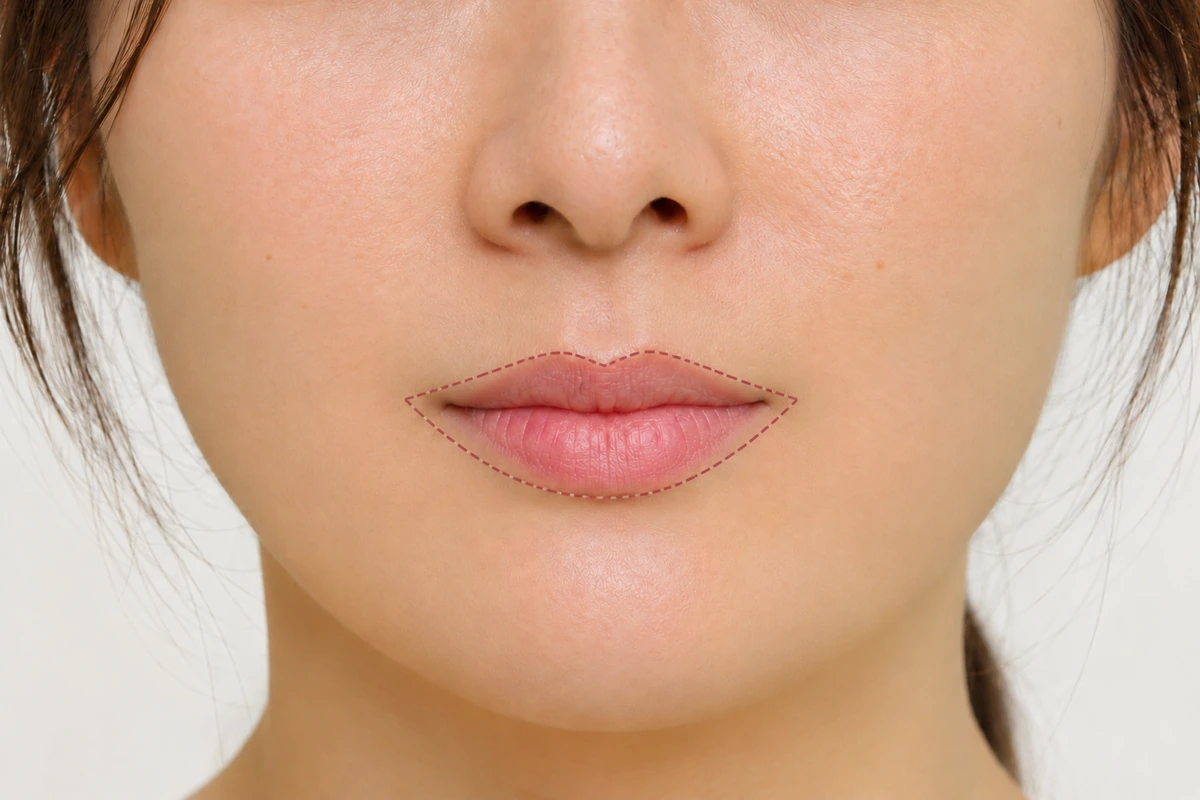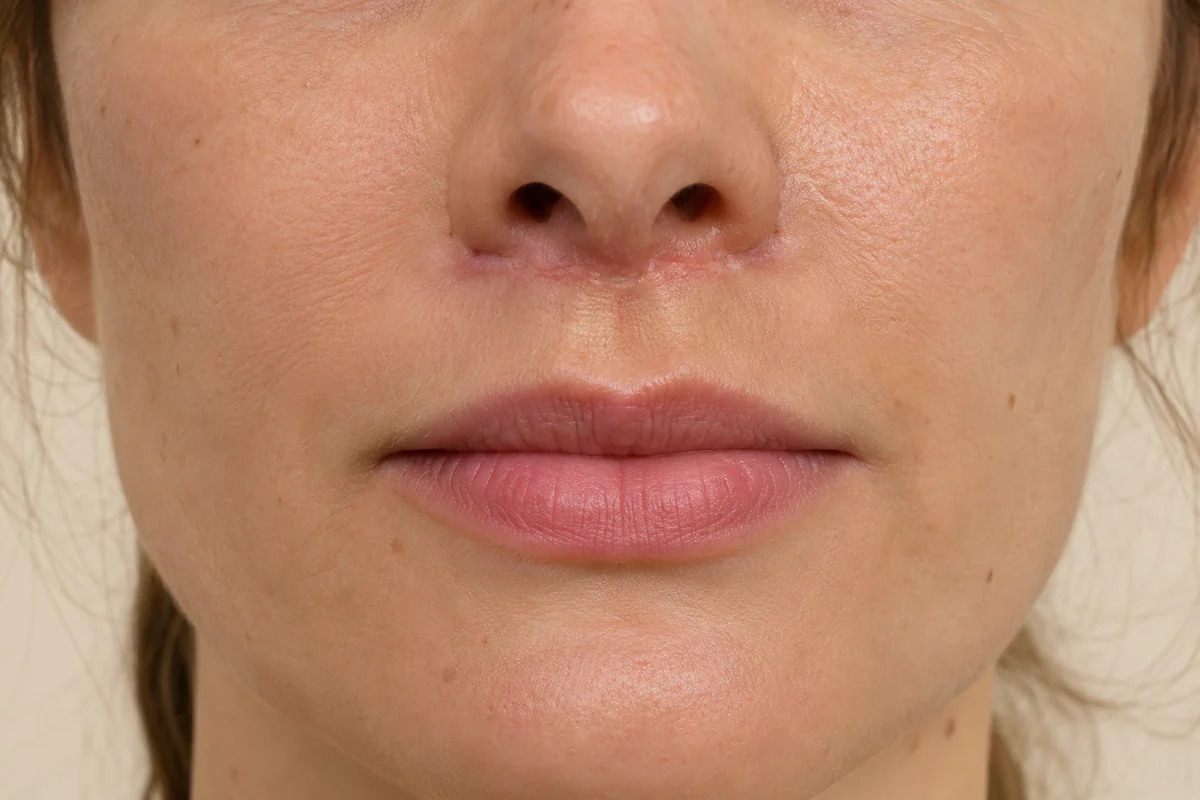
"I don't know which clinic to see for a lip lift consultation"
Search for a lip lift and you will see "don't do it" and "I regret it" posts right next to reviews saying it changed someone's life. You have probably felt stuck about which side to believe and which clinic to contact first. Many of you may have counted reviews and compared advertised prices, only to end up more confused.
Over more than 15 years of lip and philtrum surgery, I have come to see one thing clearly. The point where results split apart comes in the consultation room before the operating room. What is measured, what is asked and what is discouraged becomes the surgical plan itself.
So today I would like to give you questions instead of clinic names. I have taken the 7 things I actually check first in my own consultation room and rewritten them as questions you can ask at any clinic. I will also share the signs that should make you think twice.
What a lip lift consultation is — not booking a date, but deciding whether to shorten
To put it simply, a good lip lift consultation is not where you book a surgery date. It is where the numbers decide whether this face should have its philtrum shortened, and if so, by how much.
A lip lift is also called philtrum reduction, philtrum shortening or a subnasal lip lift; in Korea it is known as injung-chukso. Skin is removed in a narrow strip just below the nose and closed, which shortens the distance between the nose and the upper lip. The operation itself is short, about 30 minutes to an hour. But how many millimetres to remove, along which line and in what shape are mostly settled in the consultation.
That is why I put the standard for choosing a lip lift clinic in one sentence. Look for a place that measures your face in numbers and explains it to you with those numbers.
What those numbers are, I have set out in the 7 points below.
The 7 things I check first in my consultation room — feel free to ask them as they are
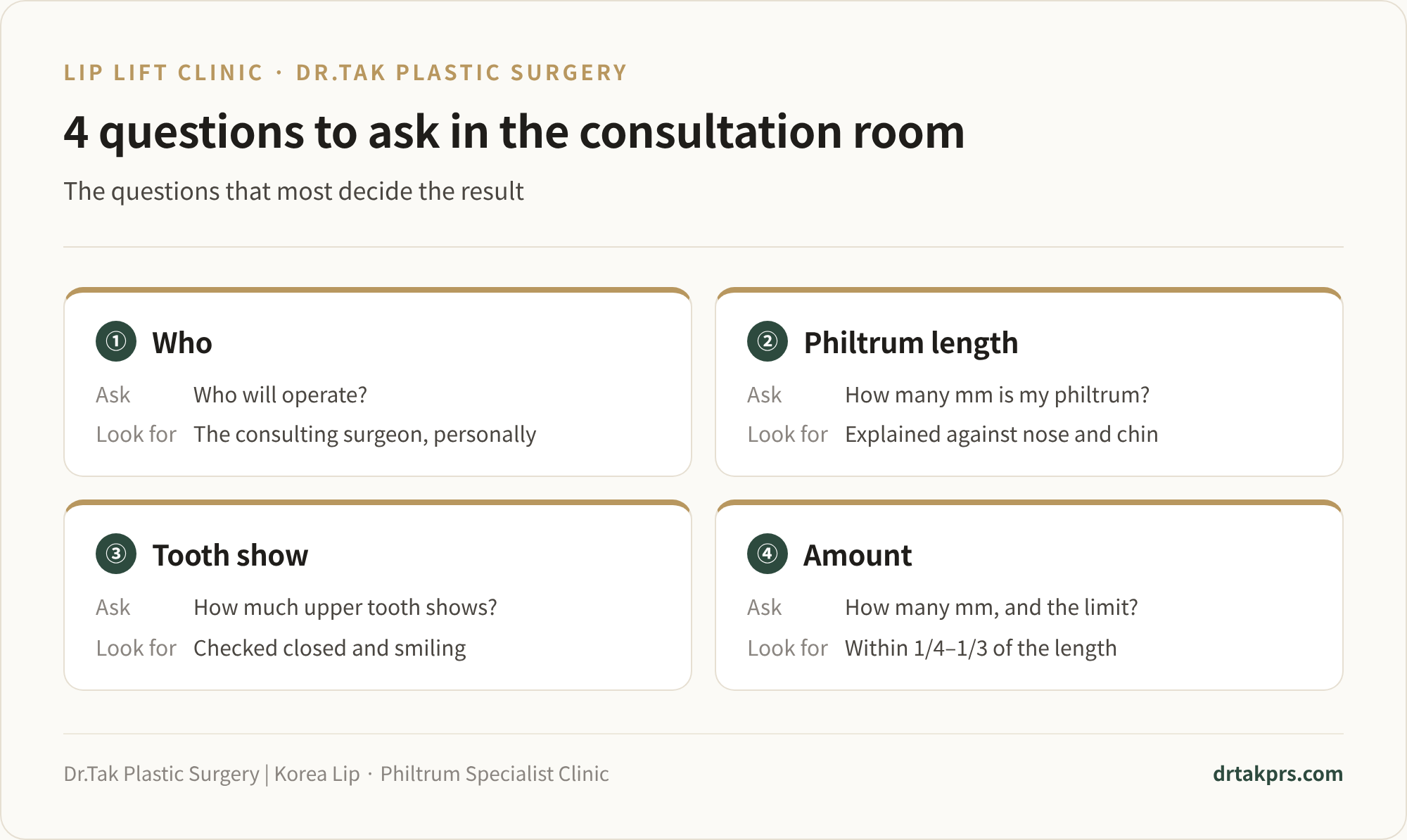
① Who consults, and who operates
The first thing to check is the person. It is not rude to ask whether the doctor who consults you is the same doctor who operates, and whether that doctor is a board-certified plastic surgeon. I redraw the design from the consultation myself on the day of surgery. When the person who designs and the person who holds the scalpel are different, a 1mm conversation in the consultation has a hard time reaching the operating room intact.
② Is philtrum length measured in numbers
Anyone can say "your philtrum is long." What matters is how many millimetres it is, and how that length compares with the length of your nose and chin. I put a ruler to the face in the consultation because the same 20mm can be a long philtrum on one face and a balanced one on another. If a consultation ends with "it will look better shorter" without any measurement, it is worth asking again what that judgement is based on.
③ Is upper tooth show checked, and the gums when you smile
When the philtrum is shortened, the upper lip rises and more upper teeth show with the lips relaxed. About 3–4mm is considered natural for women and 1–2mm for men. If you already show a lot of upper teeth, or your gums show when you smile, removing the same amount gives a completely different result. I often show patients this number before I show them their philtrum length.
④ Are the nasal angle and nose tip looked at together
Seen from the side, the angle where the columella meets the upper lip, and the height of the nose tip, also make a philtrum look long. A drooping nose tip makes the philtrum look longer than it is. In that case the nose may need to be decided before the philtrum. A consultation that looks at the nose and mouth as one picture makes fewer mistakes than one that looks at the philtrum alone.
⑤ Is it explained why the incision goes where it does
Most lip lift scars are placed in the shadow of the line where the nose meets the lip. Some methods hide the line inside the nostrils, which shows less scar but can change the shape of the nostrils. I have explained this difference separately in how lip lift incision placement can change the shape of your nostrils. The standard is not that one method is right, but whether you can hear why that method is chosen for your face.
⑥ Is the amount given in mm, along with its limit
I do not remove more than a quarter to a third of the philtrum length. That means there are times I will not remove as much as you would like. If you leave a consultation having heard only "a moderate amount" or "naturally," ask again for the number in millimetres. Removing less can be added to later, but removing too much is very hard to undo.
⑦ Are scar care and revision criteria explained before surgery
A scar passes through a red, firm phase and softens over 3–6 months. Before surgery you should hear what will be done during that period, and when and by what standard the result will be reviewed if you are not happy with it. You can see how a scar changes over time in our month-by-month guide to the lip lift scar.
You might worry that asking all seven will make the consultation long. In fact, a consultation that answers these questions without hesitation tends to be short and clear.
A 1:1 consultation you can start today
✅✅ We measure your philtrum length, upper tooth show and nasal angle in person, and decide with you first whether to shorten at all
✅✅ We give you an honest opinion, whether or not you choose surgery
📲 Dr.Tak Plastic Surgery official site, chat icon at the bottom right → live consultation
Think twice if you hear this — 3 warning signs
To be honest, when I listen to people who regret their lip lift, it has often gone wrong in the consultation rather than in surgical technique. The three signs below are worth noticing at any clinic. If you hear them in a consultation room, put off the decision and think it over once more.
⚠️ A consultation that starts with "how many millimetres do you want?" and ends without measuring — the amount should be set by what your face allows, not by the number you want
⚠️ A consultation that pushes a same-day decision, such as "this price if you decide today" — there is no reason to save a day when deciding a line that stays on your face for life
⚠️ A consultation that ends with "there are hardly any side effects" or "it suits everyone" — this is a surgery that clearly does not suit some people
On the other hand, if you heard an answer that discouraged surgery, that consultation may be worth trusting. The reason is in the table below.
A consultation worth trusting and one to think twice about, side by side
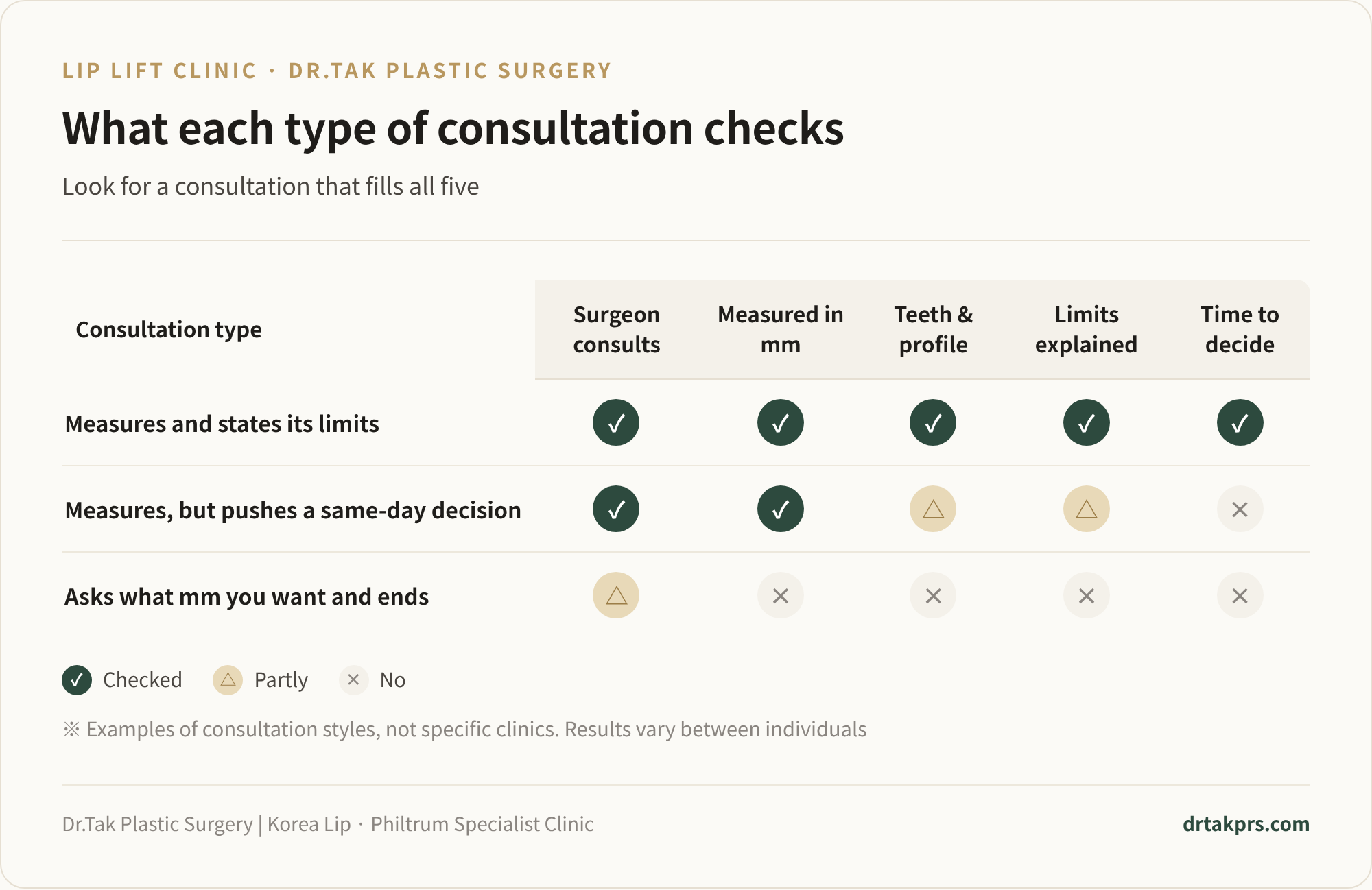
| Item | A consultation worth trusting | A consultation to think twice about |
|---|---|---|
| Who consults | The surgeon who will operate | Mostly a coordinator, with a short doctor visit |
| Philtrum length | Measured in mm and explained against nose and chin | Mostly impressions like "it looks long" |
| Upper tooth show | Checked with lips closed and smiling | Not checked |
| Nasal angle and nose tip | Profile looked at too | Front photo only |
| Incision method | Explains why it suits your face | Offers only one method |
| Amount removed | Gives a number in mm and a limit not to exceed | "As much as you like" |
| Side effects and scar | Explains the scar course and who it does not suit first | "Hardly any" |
| When to decide | Suggests you go home and think it over | Discount for deciding the same day |
| Cases where surgery is discouraged | Yes — suggests another approach or waiting | None — anyone can have it |
📍 Bottom line: A lip lift clinic is chosen more accurately by the numbers that come out of the consultation than by the number of reviews. The standard is whether it measures in mm, states its limits and discourages surgery when it should.
From first enquiry to decision, this is how we proceed
| Stage | What we do | What to check at this point |
|---|---|---|
| 📝 First enquiry and photos | Give only a rough direction from front and side photos | That surgery is not confirmed from photos alone |
| 🏥 In-person consultation (about 30 minutes) | Measure philtrum length, upper tooth show and nasal angle; explain the design | Whether the 7 questions are answered with numbers |
| ⏱ Time to decide | Recommend you go home and think it over | Whether you are given time without pressure |
| 💉 Day of surgery | The consulting doctor redraws the design and operates personally | Whether the design matches the consultation |
| 🩹 5–7 days after | Stitches removed, scar care begins | Whether the care schedule is given in writing |
At the end of a consultation I almost always say, "Please don't decide today. Go home and look in the mirror." When you look in the mirror a day or two after hearing the numbers, you are the one who knows best whether the change you wanted was really the philtrum.
The principle I have kept in the consultation room for over 15 years
Over more than 15 years of lip and philtrum surgery, the thing I say most often is, surprisingly, "I don't think we should shorten this." Some people who come in because their philtrum is long are mainly troubled by drooping mouth corners, or by a drooping nose tip that makes the philtrum look long. If I shorten their philtrum, the surgery goes well but the worry stays.
Dr.Tak Plastic Surgery has more than 200 Google reviews with a perfect 5-star rating. One thing that comes up often in those reviews is that we were honest enough to say when not to have surgery. It is the review we value most.
💬 "To make people smile." I believe a good consultation is not time spent selling surgery, but time spent finding, together, the change a person truly wants.
Before & after photographs are on our official page
Dr.Tak Plastic Surgery complies with medical advertising regulations, so we do not place before-and-after photographs inside blog articles. Actual pre- and post-operative changes are collected on the official before & after page.
🔗 View before & after — Dr.Tak Plastic Surgery official page
Results may vary from person to person.
Dr.Tak 4S Patient Care System — focused on people, not procedures
We focus on people, not procedures.
Solution — 1:1 master plan with Chief Director Dr. Tak Seung-wan
- Sincere empathy and communication: your wishes fully reflected in the surgery
- Precise golden-ratio facial analysis (personalised): philtrum length, upper tooth show and nasal angle measured in person at the consultation
- Simulation of the expected post-operative change
Support — Global 1:1 dedicated coordinator
- A dedicated coordinator assigned for each country (no language barrier)
- With you through the whole process, from consultation to surgery to aftercare
- 100% advance reservation (private clinic environment)
Scar Care — 6-month intensive scar management
| Care item | Period | Details |
|---|---|---|
| Control taping | 3–6 months | Prevents the scar from widening |
| Scar-softening injection | 6 months (once a month) | Softens raised scars |
| Laser treatment | 6 months | Reduces redness at the surgical site |
Service — 1-year free A/S guarantee
- Free A/S within 1 year after surgery
- Care that takes responsibility to the end
- ※ A basic anesthesia fee may apply if sedation is used
Want to know more? — Official channels
🌐 The Dr.Tak Plastic Surgery official website has detailed guides for each lip and philtrum procedure
📝 The blog collects articles by procedure, including lip lift types, scars, swelling and mouth corner correction
📹 Videos show the surgical process and the recovery course
5 things to sort out before your consultation in Korea
✅ In the mirror, what bothers you most — philtrum length, mouth corners or lip thickness? — a different main worry leads to a different surgery
✅ Have you taken front and side photos in the same lighting? — they are useful to compare with the numbers measured in the consultation
✅ Do your upper teeth show when your lips are relaxed and closed? — if so, the amount removed may be set more conservatively
✅ Have your scars ever healed red and thick? — if you tend toward keloids, please tell us first
✅ Have you written down the 7 questions? — after the consultation, ticking the ones that were answered makes the decision easier
You do not need to have every answer ready. Anything you are unsure of, we can measure together in the consultation.
Frequently Asked Questions (FAQ)
We have gathered the questions Dr.Tak Plastic Surgery hears most often.
Q1. There are so many "don't get a lip lift" posts. Why do people regret it?
What I hear most often in revision consultations is not about the scar but "this isn't the face I imagined." In most cases the philtrum was shortened as much as the person wanted, and then too many upper teeth showed, or the upper lip rolled up so the mouth looked as if it pushed forward. Measuring upper tooth show and the nasal angle before surgery, and keeping the amount within a quarter to a third of the philtrum length, prevents a good share of this regret. That is why I think regret more often comes from the plan than from the surgery itself.
Q2. I had a lip lift elsewhere and I'm not happy with it. Can I get a revision consultation?
Yes, you can. But a revision has less spare skin to work with than a first surgery, so shortening further may be possible while restoring length is far more difficult. In revision consultations I first check whether the scar has softened enough, and I usually plan only after at least 6 months have passed since the first surgery. Rushing back in while swelling remains can simply leave one more scar.
Q3. Can the philtrum be shortened through an incision inside the mouth?
An incision inside the mouth (in the mucosa) is mainly used to bring the red part of the upper lip outward and make the lip fuller. A wider red lip does make the philtrum look relatively shorter, but it does not shorten the skin between the nose and the lip itself. So in the consultation I first separate people whose philtrum skin is truly long from people whose thin upper lip makes the philtrum look long. For the latter, enlarging the lip with mucosal advancement, done through an incision inside the mouth, may suit better.
Q4. I was told in a consultation that I'd be better off without surgery. What happens then?
Not having a lip lift does not cause any health problem. The philtrum tends to lengthen a little with age, but the pace differs from person to person. The people I do not recommend surgery for usually already show a lot of upper teeth, or their main concern is the mouth corners or the nose tip. In those cases I suggest looking at mouth-corner correction or nose-tip surgery first, or doing nothing and measuring again in one to two years.
Q5. Why is the price in an advert different from what I heard in the consultation? Is there anyone the surgery doesn't suit?
An advertised price usually shows only the most basic method and the surgery fee. The real cost varies within a range depending on the extent of the incision, whether mouth-corner correction is done at the same time, whether sedation is used and how much scar care is included, so an exact figure is hard to state in advance. There are certainly people it does not suit. For those who already show a lot of upper teeth, whose mouth tends to push forward, or who tend to form keloids, I either do not recommend surgery or plan very conservatively.
Dr.Tak Plastic Surgery | Korea Face Lifting · Lip · Philtrum Specialist Clinic
"To make people smile"