"My eyes look droopy" — the first thing we hear in consultation
Every time you look in the mirror, the area above your eyes looks heavier, and people have started telling you that you look tired or sleepy. Eyeliner smudges into the lid, and by the afternoon you catch yourself holding your forehead up without meaning to.
Patients who come to us with this concern almost always open with the same sentence: "My eyes are drooping." And most of them have already decided on an answer before they sit down. They think they need an upper blepharoplasty.
But when I actually examine them, the starting point of that "droop" is more often not the eyelid at all. The brow itself has come down and is pushing the eyelid skin from above. In that case, trimming only the eyelid can make the eyes look even more crowded a few months later.
That is why I don't start a consultation with the name of an operation. I start by looking at where the droop actually is. This article follows that same order: what each operation changes, the three things we check first, a quick mirror check you can do yourself, and a side-by-side comparison.
By the end, instead of saying "I want a blepharoplasty" at your consultation, you will be able to ask, "Is my droop coming from the brow or the eyelid?" That one question changes the whole consultation.
What exactly is the difference — one operation lifts, the other removes
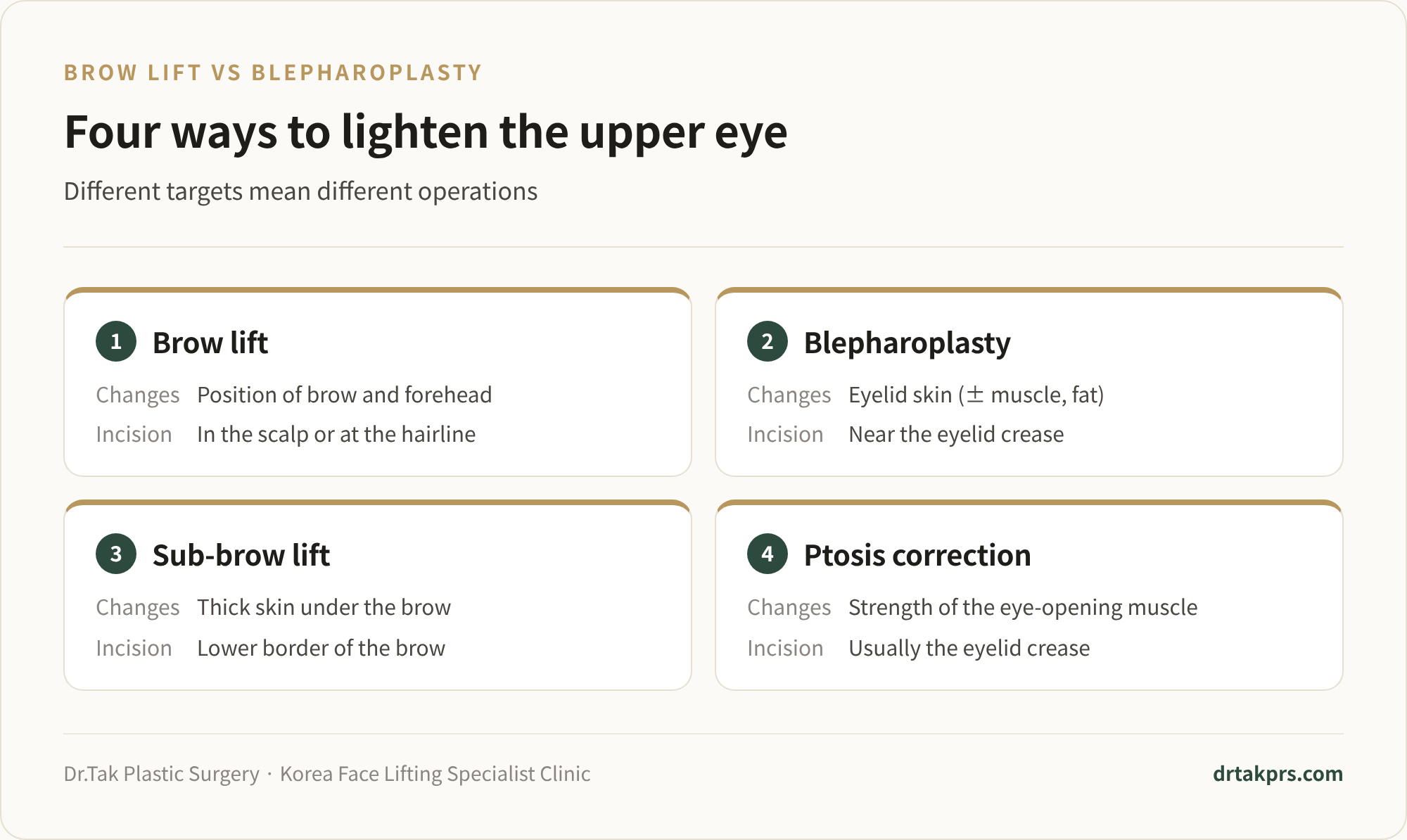
To put it simply, a brow lift raises a brow that has dropped, and an upper blepharoplasty removes eyelid skin that has stretched. Both make the area above the eyes feel lighter, but they work on different layers and change different things.
Let's settle the terms first. A brow lift is also called a forehead lift. The two most common approaches are the endoscopic brow lift, done through small incisions hidden in the scalp, and the hairline brow lift, done through an incision along the front hairline. An upper blepharoplasty — often called eyelid surgery or an upper eyelid lift — is done through an incision near the eyelid crease, removing excess skin and, when needed, some muscle or fat.
In Korea there is a third option that comes up often: the sub-brow lift (infrabrow excision). Skin is removed along the lower edge of the eyebrow, so in terms of location it sits roughly between the other two. Knowing these three will make whatever you hear in a consultation much easier to follow.
📌 In one line: if the brow has dropped, lift it; if there is extra skin, remove it. The problem is that most people have a mix of both.
The three things we check first in consultation
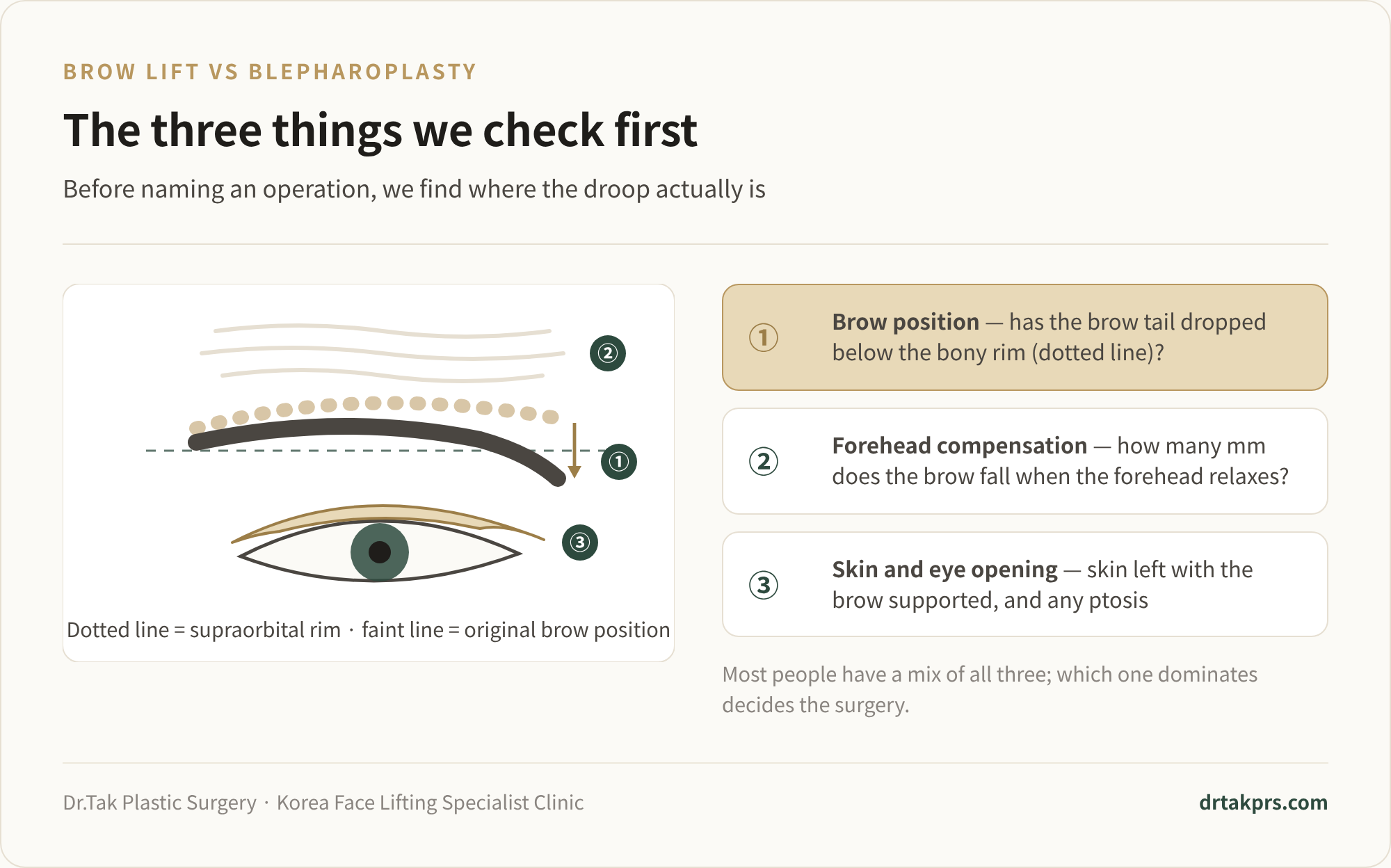
Now to the core. Before I talk about any operation, I check these three things in order. They are what decides brow lift vs blepharoplasty on a real patient's face.
① Where is the brow — above the bony rim, or below it?
Just under the eyebrow you can feel a firm bony edge, the supraorbital rim. In younger women the brow usually arches above this rim; in men it tends to sit flatter, around the level of the rim. With age, the support of the forehead weakens and the brow, especially its outer tail, slides below the rim. When the tail drops, the outer eyelid skin folds over in a small triangle — which is what many people describe as "my eye corners are drooping."
② Are you holding your forehead up — what horizontal lines tell us
The second thing I look at is the horizontal lines on the forehead. When the lids feel heavy, the body unconsciously contracts the forehead muscle (frontalis) to pull the brows up and clear the field of vision. It is a compensation. People with heavy lids therefore often have unusually deep forehead lines, and many tell me about afternoon headaches or forehead fatigue. That is why, during a consultation, I ask patients to close their eyes gently, relax their forehead, and then open them. In many people the brow drops a few millimetres the moment the forehead relaxes.
But why does this compensation matter so much? After a blepharoplasty, the lids become lighter, and the forehead muscle no longer needs to work. A brow that loses that support comes down. I will come back to this shortly.
③ How much skin is really left — and is the eye-opening muscle working normally?
Finally, I hold the brow up at its normal position with a finger and look at how much eyelid skin remains. If the skin still hangs over the lashes, there is true eyelid laxity. At the same time I check the strength of the eye-opening muscle. If the upper part of the iris is still heavily covered even after the skin is lifted, the problem may not be skin at all but ptosis. In that case, neither a brow lift nor a simple blepharoplasty is the answer; the muscle that opens the eye needs its own correction.
To be honest, few people fall neatly into one category. The most common picture is a brow that has dropped a little plus some skin laxity. That is why working out "which part is larger" becomes so important.
A 30-second check at the mirror — what you see when you lift the brow
You can get a rough sense of direction at home before your consultation.
- Stand facing the mirror, relax your forehead completely and open your eyes naturally.
- With both index fingers, gently lift the outer tail of each brow up to the level of the bony rim. You are not pulling the forehead up — just returning the brow to where it used to be.
- Now look at your eyelids.
If most of the covering skin disappears when the brow is lifted, the centre of your droop is likely the brow. If the skin still hangs over the lashes even with the brow lifted, the eyelid skin plays the larger role. If it is a bit of both, you have a mix.
⚠️ Please keep in mind: this is only a rough guide, not a diagnosis. Skin thickness, fat volume and eye-opening strength cannot be judged in a mirror. Quite a few patients who arrived convinced it was "the eyelid" changed direction after measurement.
Start with a 1:1 personalised consultation
✅✅ We compare three options — brow lift, blepharoplasty and sub-brow lift — according to the cause of your droop
✅✅ We give you an honest opinion, whether or not you choose surgery
📲 Chat icon at the bottom right of the Dr.Tak Plastic Surgery website → live consultation
Brow lift vs blepharoplasty — nine points side by side
The short version: a brow lift hides its scars in the hair but takes longer to recover; a blepharoplasty recovers faster but changes the shape of the eye itself.
| Point | Brow lift (endoscopic · hairline) | Upper blepharoplasty |
|---|---|---|
| 🎯 What it changes | Position of the brow and forehead | Amount of eyelid skin (± muscle, fat) |
| ✂️ Incision | Small incisions in the scalp, or at the hairline | Eyelid, near the crease |
| 🩹 Scar visibility | Hidden by hair | Hidden in the crease when the eye is closed |
| 👁 Eye shape | Shape kept, only position raised | Crease and overall eye impression change |
| 📏 Forehead lines | Often softened too | Little change |
| ⏱ Stitch / staple removal | About 7–10 days | About 5–7 days |
| 💧 Major swelling | 1–2 weeks (may settle around the eyes) | 1–2 weeks |
| 🌿 Sensation | Scalp numbness or itching for weeks to months | Tightness of the lid for a few weeks |
| ⚠️ Take extra care if | Forehead already long or hairline high | Brow already significantly lowered |
📍 Bottom line: neither is "the better operation." There is only the operation that matches where your droop starts.
One more point for Asian patients in particular: Asian eyelid skin and the tissue beneath it tend to be relatively thick. Removing a lot of skin near the crease can leave thick skin sitting above the line and make the eye look heavy. That is why a sub-brow lift, which removes the thicker skin just under the brow, is often considered alongside. Which of the three is right is ultimately decided by measurement.
What can happen if you only do the eyelid first — why the brow comes down
Earlier I mentioned the forehead muscle's compensation. Here is how it turns into a real problem.
While the lids are heavy, the forehead muscle keeps pulling the brows up. Once a blepharoplasty removes skin and the eyes feel lighter, the forehead muscle has no reason to work. The brow that had been held up returns to its true position, which is lower. As the distance between brow and eye shortens, the eyes can look more crowded than before surgery, or the expression can become sharper.
This is the concern I hear most often from people who had a blepharoplasty elsewhere: "I definitely had skin removed, but a few months later it looks covered again." When we examine them, the skin usually has not stretched again; the brow has come down.
This does not mean blepharoplasty is a bad operation. It is a question of order. If brow descent makes up a large part of the droop, the brow position should be set first, and then the remaining skin removed. Reverse the order and you end up removing more skin than necessary — and eyelid skin, once removed, cannot be put back.
That is why, when I take pre-operative photos, I always record a separate shot with the forehead fully relaxed. That one photo changes the surgical plan surprisingly often.
Who each operation suits — and who I don't recommend it for
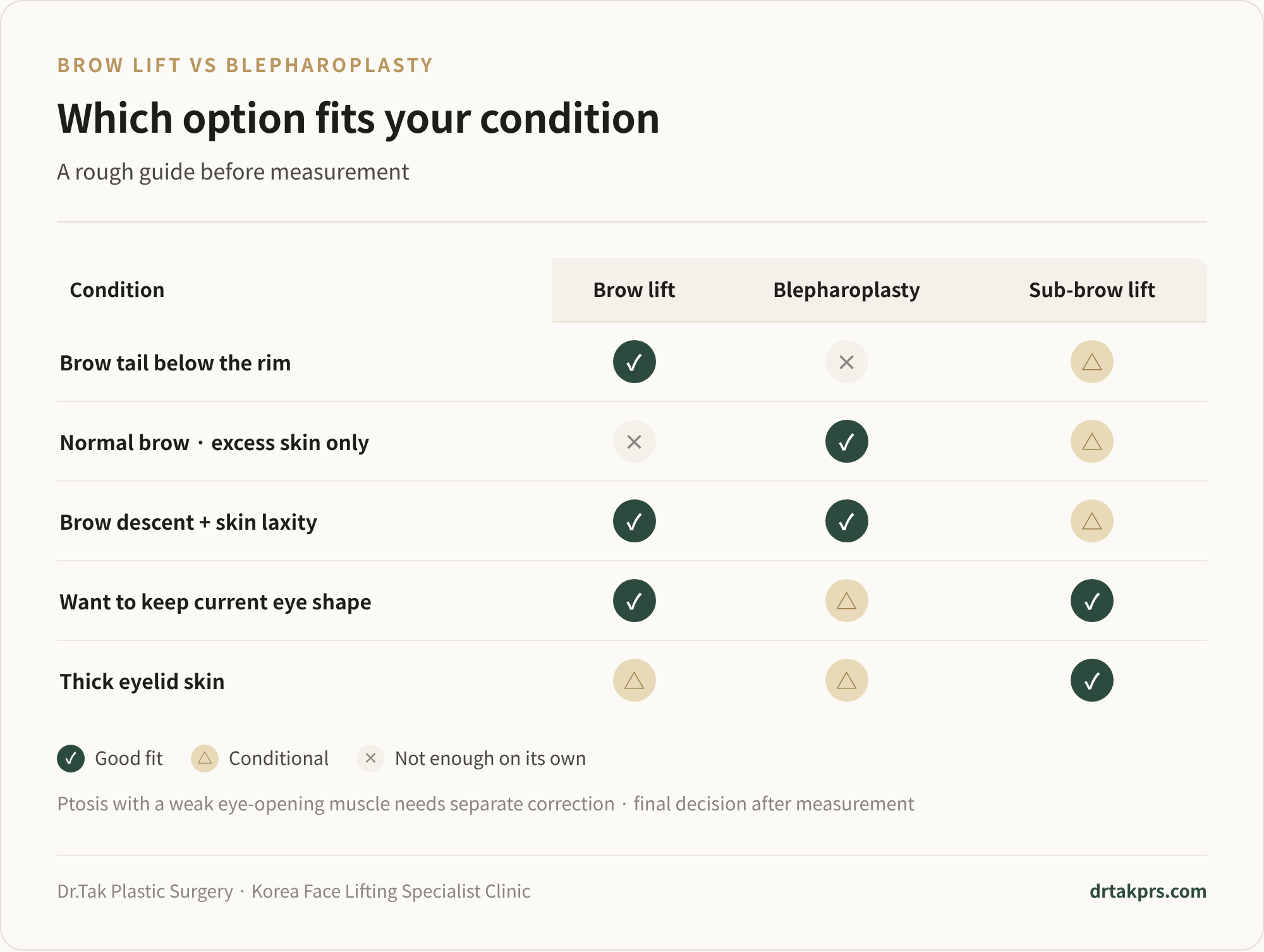
| Brow lift suits better | Blepharoplasty suits better | |
|---|---|---|
| ✅ Good fit | Brow tail below the bony rim · deep forehead lines · wants to keep the current eye shape | Brow in a normal position but skin covering the lashes · wants the crease refined at the same time |
| ⛔ Use caution | Forehead already long, hairline high (consider hairline approach) · strong reluctance about scalp surgery | Brow significantly lowered · severe dry eye · coexisting ptosis |
There are situations where I don't recommend going straight to surgery: active thyroid eye disease or other conditions causing swelling around the eyes, severe dry-eye symptoms that need ophthalmology treatment first, and a difference of only 1–2 mm that feels large only to you. In that last case, the burden of recovery may outweigh the change surgery can give.
Surgery is not right for everyone. Saying so up front is part of a consultation too.
Recovery looks different — a timeline for each operation
| Time | Brow lift | Upper blepharoplasty |
|---|---|---|
| Day 0–3 | Swelling of forehead and around the eyes, scalp tightness | Peak eyelid swelling and bruising |
| Day 5–10 | Swelling may drift down around the eyes; stitches/staples out at 7–10 days | Stitches out at 5–7 days; coverable with makeup |
| 2 weeks | Back to daily life; scalp numbness continues | Major swelling settled; crease still looks high and thick |
| 1–3 months | Brow position gradually settles | Crease softens and looks more natural |
| 3–6 months | Final position assessed; most sensation returns | Scar matures; final result assessed |
📍 Bottom line: for both operations, do not judge the result before three months. A two-week photo is still mid-process.
When planning recovery, it helps to tell us first the date you need to be back, rather than the surgery date. If you are travelling from abroad, whether you can stay in Korea until stitch removal can also influence which method we choose.
More than 15 years in the same place — why we identify the cause first
🏥 Four reasons to trust us
- Dr.Tak Plastic Surgery has more than 15 years of experience in face lifting and lip & philtrum surgery
- We are rated 5 out of 5 across more than 200 Google reviews
- Fully appointment-based, so every consultation has enough time
- Six months of intensive scar care is part of the standard post-operative course
I see the face as one connected structure from top to bottom. When the brow drops, the lid gets covered; when the lid is heavy, the forehead works harder. Plan surgery by looking at only one spot, and a problem appears somewhere else. That is why much of our consultation time goes not into describing operations but into measuring and checking.
💬 "To make people smile"
When the area above the eyes becomes lighter, the whole expression changes. We want that change to look as natural as your own face.
Before & after photographs are on our official page
Dr.Tak Plastic Surgery complies with medical advertising regulations, so we do not place before-and-after photographs inside blog articles. Actual pre- and post-operative changes are collected on the official before & after page.
🔗 View before & after — Dr.Tak Plastic Surgery official page
Results may vary from person to person.
The Dr.Tak 4S Patient Care System — focused on the person, not the procedure
We focus on the person, not the procedure.
Solution — 1:1 master plan with Lead Surgeon Dr. Tak Seung-wan
- Genuine empathy and communication: your wishes fully reflected in the surgery
- Precise facial golden-ratio analysis (personalised): three-axis measurement of brow position, forehead-muscle compensation and eyelid skin excess
- Simulation of the expected post-operative change
Support — Global 1:1 dedicated coordinator
- A dedicated coordinator assigned for each country (no language barrier)
- Accompanies you from consultation through surgery to aftercare
- 100% appointment-based (private clinical environment)
Scar Care — Six months of intensive scar management
| Care item | Period | What it does |
|---|---|---|
| Control taping | 3–6 months | Prevents scar widening |
| Scar-softening injections | 6 months (monthly) | Flattens raised scars |
| Laser treatment | 6 months | Reduces redness at the surgical site |
Service — 1-year free A/S guarantee
- Free A/S within 1 year after surgery
- We take responsibility and care for you to the end
- ※ A basic anaesthesia fee may apply when sedation is used
If you want to know more — official channels
🌐 The Dr.Tak Plastic Surgery website has detailed guides to each face lifting and lip & philtrum procedure
📝 Our blog covers facelift recovery, mini vs full facelift and other lifting topics
📹 Watch videos of procedures and recovery progress
Five things to settle for yourself before deciding
✅ Does your brow drop when you relax your forehead? — Try the 30-second mirror check before you come
✅ Which feels heavier, the outer or inner part of the brow? — Outer heaviness is a clue pointing to brow descent
✅ Have you had eyelid or double-eyelid surgery before? — If so, please bring the surgical records or earlier photos
✅ Do you have dry eye or a thyroid condition? — This can change the timing and method of surgery
✅ Do you want to change the shape of your eyes, or keep your current eyes and just make them lighter? — This answer decides half of the choice
You don't need to arrive with the answers. If you don't know, come as you are. We will check together.
Frequently Asked Questions (FAQ)
The questions Dr.Tak Plastic Surgery hears most often.
Q1. How is a Botox brow lift different from a surgical brow lift?
A Botox brow lift relaxes the muscles that pull the brow down, raising the tail by roughly 1–2 mm. The effect usually lasts 3–4 months and needs repeating. I suggest it for people whose brow descent is mild, or who want to see whether a lifted brow suits their face before considering surgery. If the brow has clearly dropped below the bony rim, though, Botox cannot give enough change. And Botox placed across the forehead to smooth lines can actually lower the brow and make heavy lids feel heavier, so if your lids are heavy, please discuss injection sites carefully.
Q2. Can both operations be done together? Does recovery take longer?
Yes. And for people with clear brow descent plus clear skin laxity, I actually prefer to plan them together. Setting the brow position first and then removing only the remaining skin on the same day lowers the risk of removing too much. Recovery does not simply add up; it generally follows the brow-lift timeline. Because swelling gathers around the eyes, though, the first one to two weeks can feel more uncomfortable than a single operation.
Q3. How is a sub-brow lift different from these two?
It removes skin along the lower edge of the brow. It does not raise the brow much, but it trims the thicker skin in the upper part of the lid. Because it does not touch the crease, it suits people who want to keep their current eye shape and those with thick eyelid skin. The scar sits at the lower border of the brow, fades over 3–6 months and is further hidden by brow makeup or tattooing. If the brow has dropped a lot, this alone is not enough and a brow lift is considered alongside.
Q4. What are the disadvantages of blepharoplasty, and what should I expect to pay?
The biggest drawback is its relationship with brow descent described above, and the risk that removing too much skin can make it hard to close the eyes fully or cause dryness. Eyelid skin is among the thinnest skin on the body, so once removed it is difficult to restore. My principle is to remove less and refine later if needed. I can't state an exact price, because the range depends on whether it is blepharoplasty alone, combined with a brow lift or sub-brow lift, a revision, and whether sedation is used. Once measurement defines the scope of surgery, we will give you a specific range.
Q5. What if I end up looking harsh, or not like myself?
Many people worry about this, and the worry is completely reasonable. Lift the brow too high and you look permanently surprised; remove too much eyelid skin and the brow and eye sit too close, giving a sharp expression. Both come from trying to change too much. That is why we aim to return the brow only to where it used to be. If you bring a photo from a few years ago, we can plan around that position. When the goal is not a new face but your own face from a few years back, the result looks like you.
Dr.Tak Plastic Surgery | Korea Face Lifting Specialist Clinic
"To make people smile"