
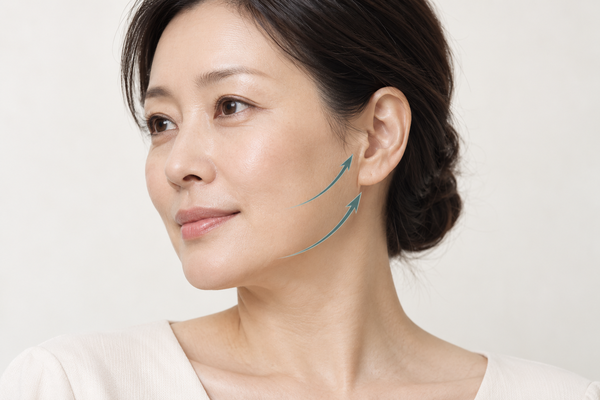
To everyone who arrives holding two quotes
One clinic tells you a mini facelift is enough. The other says you should go straight to the full procedure. The price differs threefold, and nobody explains to the end why the answers diverge so sharply. Several people a week walk into my clinic in Korea in exactly that state.
I do not sit there and rule on which clinic was right. Instead I take out a sheet of paper and draw the face divided into three zones. Then I ask one question. Of these three zones, which one catches your eye first in the mirror?
Once that question has an answer, which of the two quotes fits you usually settles on the spot. The frustration you have been feeling was not caused by a lack of information. It is because the criterion that separates these two operations has been explained wrongly from the start.
Let me begin with what that criterion actually is.
What actually separates a mini facelift from a full facelift
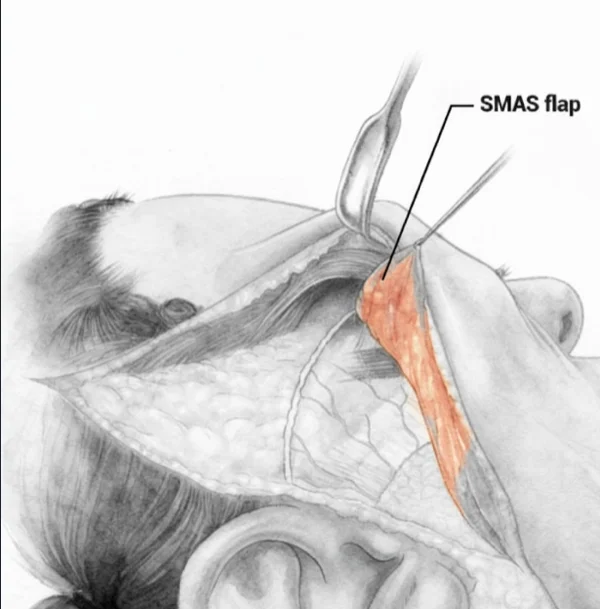
To put the conclusion first: what separates the two is not incision length but dissection extent.
Let me define the terms. A mini facelift is formally a short scar rhytidectomy, and it is also searched for as mini face lift, short scar facelift, partial lift and minimal incision lift. A full facelift refers to SMAS rhytidectomy, sometimes called a traditional or full lift. Both operations belong to the same family in that neither simply pulls skin — both address the SMAS, a fibromuscular layer. What differs is how far into that layer the surgeon goes to release it.
Looking only at the incision, the difference seems obvious.
① The mini facelift incision — roughly 4 to 6cm along the pre-tragal line in front of the ear, rarely extending behind it.
② The full facelift incision — from the temple, around the front of the ear, then behind the ear into the occipital hairline; together 12 to 15cm or more.
③ Yet comparing only these numbers leads you astray — the incision is merely the entrance that provides exposure. The actual correction is determined by how widely the tissue was released and repositioned through that entrance.
I explain this part using the back of my hand. If you pinch the skin on the back of your hand with two fingers and lift, only the pinched area rises; the area near the wrist stays exactly where it was. When the dissection extent is narrow, precisely this happens across the face. What was pulled becomes taut, what could not be reached stays behind, and a border forms between them.
That is why I ask patients not to read "mini" as a small full facelift. More accurately, it is an operation in which the correction zone has been deliberately limited to one zone.
Where the dissection stops — splitting the face into three zones
The essential point first: which line the dissection stops at determines exactly which zone improves. And that border is already fixed anatomically.
Facial skin and the SMAS are anchored to bone and deep tissue by several retaining ligaments. The zygomatic ligament over the cheekbone, the masseteric cutaneous ligaments in front of the masseter, and the mandibular ligament along the jawline are the principal ones. With age these ligaments lengthen and the tissue beneath them slides downward. To return that tissue to its original position, the dissection has to reach the point where it meets the lengthened ligament.
So what happens when the dissection stops short of that ligament?
Zone 1 — in front of the tragus (lower midface and mouth corner)
The dissection ends within 2 to 3cm in front of the tragus. Because it reaches part of the zygomatic ligament and the upper masseteric cutaneous ligaments, laxity of the lower cheek and around the nasolabial area does improve. This is the zone a mini facelift is built to handle.
Zone 2 — past the mandibular angle (jawline and jowls)
Here the dissection crosses behind the jawline at the mandibular angle and reaches the mandibular ligament. Tissue that has folded down over the jawline — what people call jowls — belongs to this zone. Reaching it usually requires a post-auricular incision. This is the first point at which mini and full genuinely part ways.
Zone 3 — the upper neck (platysma)
The dissection continues to the platysma at the front of the neck. Vertical neck bands and submental laxity barely move with facial dissection alone. A separate neck approach is required.
📌 The important point here: these three zones do not age in order. Zone 1 usually begins first, but in someone whose weight has fluctuated significantly, or whose lower facial skeleton is steep, zone 2 can be the first thing that catches the eye. That is why setting the range by age alone goes wrong. Age is the starting point; the actual judgement is zone measurement.
And yet in real consultations, age carries more predictive power than you would expect. There is a reason for that.
Why age becomes the first indicator
To put the conclusion first, age tells us the probability that laxity has progressed in a given zone. It is a prior probability, not a diagnosis.
Over the past fifteen years, working across both face lifting and lip and philtrum surgery, I have repeatedly seen that the location of the complaint people bring to a first consultation shifts quite regularly by decade. The table below summarises that clinical experience alongside measurement findings.
| Age band | Zone where laxity has begun | Dissection extent usually required | What I often say in this band |
|---|---|---|---|
| Early 40s | Early zone 1 — mostly volume shift, minimal true descent | Before the surgical stage | Honestly, for most it is still too early. I look at volume and skin quality first |
| Late 40s | Zone 1 established, approaching zone 2 | Pre-tragal plus the mandibular angle border | The clearest indication for a mini facelift. Still, I judge it together with the jawline |
| 50s | Zones 1 and 2 together, early neck change | Crossing the mandibular angle is essential | With mini, the jawline is left behind. The proportion for whom I recommend the full range rises steeply here |
| 60s and beyond | All three zones plus excess skin | Full range including a neck approach | Even when a mini is requested, I explain my view and we discuss again. Narrowing the range leaves more behind |
The late-40s row is where the majority of readers of this article are standing. It is also the hardest position to judge. If you have been postponing the decision for years, let me say first that this is not a failure of resolve — it is because the information itself has been split.
Why it is hard is this: in this band, looking at zone 1 alone makes a mini look sufficient, while looking at the jawline makes it look inadequate, and both states overlap. So I ask patients in this band to check one thing in front of a mirror. Photograph the jawline twice — once with the chin lifted slightly, once looking straight ahead. If the difference between the two photographs is large, zone 2 has already begun.
That single difference is often what decides which of the two quotes was right.
A 1:1 consultation you can start now
✅✅ We compare every option with you — mini facelift, full facelift, and non-surgical lifting
✅✅ We give you our honest opinion regardless of whether you have surgery
📲 Dr.Tak Plastic Surgery official site — chat icon at the bottom right for a live consultation

Mini facelift and full facelift across 11 points
| Comparison point | Mini facelift (short scar) | Full facelift (SMAS) |
|---|---|---|
| Incision length | About 4–6cm along the pre-tragal line | 12–15cm or more: temple, pre-auricular, post-auricular |
| SMAS dissection extent | Centred on the 2–3cm pre-tragal zone | Extends past the mandibular angle into the upper neck |
| Correctable zones | Zone 1 (lower cheek, mouth corner) | Zones 1, 2 and 3 (jawline and neck included) |
| Ligament access | Zygomatic and upper masseteric cutaneous | Includes the mandibular ligament |
| Operating time | Around 2 hours | Around 4 hours or more |
| Anaesthesia | Sedation, or sedation with local | General anaesthesia in a higher proportion |
| Main swelling resolution | Substantially within 2–3 weeks | 3–4 weeks, residual swelling longer |
| Return to daily life | Relatively early | Requires a generous schedule |
| Scar location | Concentrated on the pre-auricular line | Pre-auricular, post-auricular and hairline |
| Revision difficulty | Lower — can be extended to the next stage | Higher — the dissection plane already exists |
| Cost structure | Time, anaesthesia and dissection all smaller | Time, anaesthesia and dissection all larger |
📍 Bottom line: in this table, the rows that decide your actual result are not the first one but the second and the third. Incision length decides where the scar sits. Dissection extent decides the result.
How different is the recovery, really
The essential point first: the difference in recovery speed is largely decided by whether there is a post-auricular incision, not by incision length. A case that stayed in front of the ear and one that curved behind it into the hairline differ markedly in how long the tightness lingers.
| Period | Mini facelift | Full facelift | Common precautions |
|---|---|---|---|
| First 3 days | Compression dressing, swelling at peak | Same, greater in degree | 🚭 No smoking, keep the head elevated |
| 1 week | Suture removal begins | Removed in stages by area | Follow washing and hair-care instructions |
| 2–3 weeks | Swelling substantially reduced | Reduces from the front of the face first | Daily life manageable with a mask |
| 1–2 months | Tightness eases, contour settles | Post-auricular tightness lingers longer | Scar care begins |
| 3–6 months | Final contour confirmed | Final contour confirmed | Control taping and scar care continue |
There are genuinely uncomfortable parts during recovery. Where a post-auricular incision has been made in particular, tightness and reduced sensation continue for several weeks or more. I do not understate this in consultations. Patients who begin knowing it are far more comfortable through the recovery period.
Three misunderstandings that keep recurring
Almost everyone who searches this topic arrives with the same misunderstandings. They are listed in the order they come up most often in enquiries.
Misunderstanding 1 — mini and full differ only in incision size
The most common one. There are techniques with a small incision but a wide dissection, and cases with a large incision where the dissection ends superficially. That is why I suggest asking not about incision length but "how far do you dissect?"
Misunderstanding 2 — a mini recovers much faster, so the burden is lower
It is true that recovery tends to be earlier. But you should look at why: because the dissection extent is smaller. The burden is lower, and so is the correction zone. Choose on recovery speed alone and the remaining zone comes into view a few months later.
Misunderstanding 3 — two or three minis add up to a full
This is not true. Repeatedly pulling the same zone and repositioning a wide zone once from the start give different results. If anything, repeated surgery creates adhesion in the dissection plane and can narrow your later options.
💬 "This operation is not right for everyone. I believe saying that first is part of a surgeon's job."
How we built this judgement
🏥 Four grounds for trust
- Judgements built on more than fifteen years of clinical experience across face lifting and lip and philtrum surgery
- Over 200 Google reviews, rated 5 out of 5 — covering the consultation process as much as the surgical outcome
- Dr. Seungwan Tak personally handles consultation, surgery and follow-up
- 100% appointment-only practice, so each patient has sufficient consultation time
💬 "To make people smile"
The most rewarding moment for me is not showing a patient their result. It is watching someone leave after a consultation with a relieved expression, saying they do not have to decide today.
The Dr.Tak 4S Patient Care System — focused on the person, not the procedure
We focus on the person, not the procedure.
Solution — a 1:1 master plan with Dr. Seungwan Tak
- Sincere empathy and communication: your wishes reflected fully in the surgery
- Precise facial golden-ratio analysis, individually tailored: measuring zone by zone whether laxity stopped in zone 1, crossed the mandibular angle, or continued into the neck
- Simulation of the expected post-operative change
Support — a global 1:1 dedicated coordinator
- A dedicated coordinator assigned by country (no language barrier)
- Accompanies you through consultation, surgery and aftercare
- 100% appointment-only (a private clinical environment)
Scar Care — six months of intensive scar management
| Care item | Period | Content |
|---|---|---|
| Control taping | 3–6 months | Prevents scar widening |
| Scar-softening injection | 6 months (monthly) | Softens raised scars |
| Laser treatment | 6 months | Reduces redness at the surgical site |
Service — a one-year complimentary revision guarantee
- Complimentary revision within one year after surgery
- We take responsibility through to the end
- ※ Where sedation is used, a basic anaesthesia fee may apply
If you would like to know more — official channels
🌐 Our official site holds face lifting resources and consultation information
📝 The surgeon's own clinical column covers zone-by-zone criteria in more depth
📹 Video material on the surgical process and recovery course is also available
Seven things to settle for yourself before deciding
✅ In the mirror, what catches your eye first — below the cheek, the jawline, or the neck
✅ Is the jawline difference large between a chin-lifted photograph and a straight-on one
✅ Has your weight changed by 5kg or more in recent years
✅ Your history of thread lifts or laser lifting, and how satisfied you were
✅ How many days of recovery you can genuinely set aside
✅ Whether you can accept a scar that extends behind the ear
✅ Whether what you want now is "natural tidying" or "a clear change"
Write down your answers to these seven and half the consultation time is saved. And that half can go to a far more important conversation.
Frequently Asked Questions (FAQ)
These are the questions we receive most often at Dr.Tak Plastic Surgery.
Q1. If I have a mini facelift first, does that put me at a disadvantage for a full facelift later
I understand the feeling behind this question well. The decision stalls because it feels irreversible. To put the conclusion first: it does not become impossible, but the conditions change. Adhesion forms where tissue has once been dissected, so a second operation adds the work of finding the dissection plane again, and difficulty and operating time rise accordingly. The pre-auricular line is also traversed once more. That is why, with patients between their late forties and early fifties, I suggest we calculate together whether the present range will still satisfy them in five years.
Q2. How much does mini facelift longevity differ from a full facelift
Let me say first that I do not use expressions that pin the longevity of these two operations to a fixed number of years against another. Ageing continues after surgery and its pace varies greatly between individuals. What clinical practice does show is a difference less in duration than in where dissatisfaction reappears. Patients who had a mini facelift often notice change first in the uncorrected zone 2, along the jawline. Those who had the full range progress gently across the whole face together. That is why the same passage of time feels different.
Q3. Why does the same mini facelift differ several-fold in cost between clinics
The exact figure depends on your condition and the range, so I cannot state it here. What I can explain is why, under the same name of mini facelift, the Korean market spreads from the low millions of won to well over ten million. Three variables create the cost: dissection extent, operating time, and anaesthesia method. Even when it is called mini, extending the dissection to the mandibular angle brings the time and difficulty close to a full procedure; conversely, tidying only the skin superficially shortens it. So rather than comparing figures first, I suggest confirming what range that figure includes. Where sedation is used, it is also worth confirming in advance that a basic anaesthesia fee may apply separately.
Q4. I have heard some faces cannot have a mini facelift. Which cases are those
They exist. Many people ask this, and the accurate answer is not well known. A mini facelift suits those whose laxity remains within zone 1, whose skin excess is not marked, and whose jawline contour is still maintained. Conversely, where tissue has folded down below the mandibular angle, where platysmal bands are already visible in the neck, or where substantial skin excess remains after weight loss, the mini range leaves what remains more conspicuous. Beyond that, uncontrolled hypertension or diabetes, blood-clotting disorders, and an inability to stop smoking are conditions that require careful judgement about surgery itself, regardless of range. In those cases I do not recommend the operation and discuss other approaches first.
Q5. I am in my late forties and was told a mini is too early but a full is too much. What then
This is the question I receive most in this band, and there are genuinely cases where both statements are correct. Here I divide not by time but by zone. If only zone 1 has progressed, the mini range is sufficient; if change has begun at the mandibular angle border, I design an intermediate range that extends the dissection to that border alone. There really are several stages between mini and full. If a clinic has presented you with only two names, I would encourage you to ask once more whether the range in between is possible.
Dr.Tak Plastic Surgery | Korea Face Lifting Specialist Clinic
"To make people smile"