
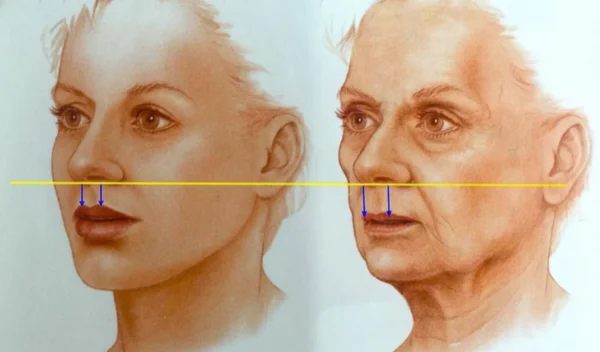
Understanding Philtrum Reduction: Definition, Anatomy & Safety from Korea
"My Philtrum Looks Too Long…" — The First Question I Hear Every Day, Answered from 30 Years in Korea
In 30 years of running a Korean clinic focused exclusively on lips and philtrum, the most common concern patients raise in the first consultation is "my philtrum looks too long, and it just bothers me." Yet when I ask in return what philtrum reduction actually is, very few can describe its definition, anatomy, or safety zones precisely. If that vague unease sounds familiar to you, I believe today's article is the best starting point.
Dr. Tak Plastic Surgery has spent 30 years in Gangnam focused on a single field — lips and philtrum. Today I want to walk you through what you should know before any decision: the definition of philtrum reduction, the muscles and vessels involved, the golden ratio, the safe zones, and the recovery timeline — all at 1 mm precision. This is not a decision-stage article. It is the explainer you need the first time you hear the term.
By the end you should be able to describe what philtrum reduction is, why 1 mm precision matters, and what to bring to your first consultation. That alone makes the first appointment far easier on you.
📞 For deeper questions, take a free online consultation → drtakprs.com (orange widget bottom-right)
1. What Philtrum Reduction Really Is — The 1 mm Between Nose Tip and Upper Lip
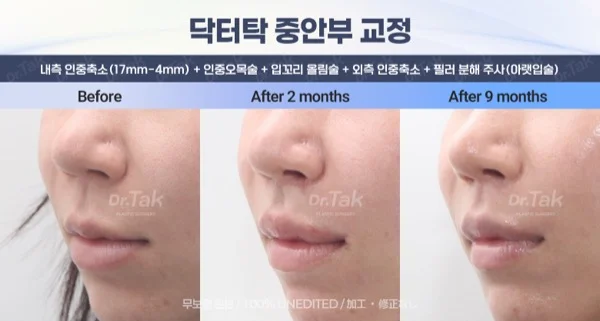
When I describe philtrum reduction to a patient in one sentence, I say it precisely shortens the white skin band between the columella base and the upper-lip vermilion border. That short definition contains everything that matters. The feeling that "my philtrum is long" usually comes from this band being long relative to the patient's own face proportions. Two patients with the same philtrum length can present very differently — one with a drooping cupid bow, another with a thin-looking upper lip — and the difference always traces back to 1 mm-level excision depth and design.
The first piece of data we show in the clinic is the measured distance between the nose tip and the upper lip. The mirror only tells you "it looks long," but a caliper records three distinct values: frontal, lateral, and dynamic smile. Philtrum reduction is not "cutting length." It is a precision design that balances those three measurements at once.
📌 Core definition: Philtrum reduction precisely shortens the white skin band between the columella and the upper lip — at 1 mm increments — while designing for frontal, lateral, and smile dynamics simultaneously.
2. The 5 Muscles That Move the Philtrum — Where the Incision Must Not Cross
To grasp the definition, you first need to know why 1 mm precision is mandatory. The answer lies in the muscle network around the philtrum. I tell patients that philtrum reduction is not a "skin cut" operation but a search for the scar-free incision line that avoids five specific muscles. Recognizing all five is the prerequisite for a safe procedure.
Here are the five muscles, in order ① ~ ⑤, as I introduce them in the clinic.
① Orbicularis Oris — The Core of Lip Movement
This muscle encircles the lips and creates every expression. If the incision crosses it, the smile line itself can become unnatural. A 1 mm offset in design is required to spare it.
② Levator Labii Superioris — Lifts the Upper Lip
Originating beside the nostril and extending into the upper lip, this muscle anchors what we call the smile line. Touching its origin during philtrum reduction can alter the natural smile.
③ Nasalis — Directly Tied to Nose Tip Shape
Running from beside the nose tip into the upper philtrum, this muscle can be affected if the incision rises too high, subtly changing the nose tip shape.
④ Zygomaticus Major — Pulls the Mouth Corner Upward
Located deep along the philtrum's lateral side, this expression muscle can be subtly disrupted if the incision extends too laterally. Lateral design precision matters as much as the frontal view.
⑤ Levator Anguli Oris — Defines the Mouth Corner Shape
This muscle directly shapes the corner of the mouth and has the greatest impact on left-right smile symmetry after philtrum reduction.
🔑 Quick checklist
Philtrum reduction is never simply a skin cut.
All 5 muscles (orbicularis oris, levator labii superioris, nasalis, zygomaticus major, levator anguli oris) must be avoided at 1 mm precision.
Lateral and dynamic design matter as much as the frontal view.
3. The Vessels Crossing the Philtrum — Why Incision Depth Has a Safe Zone
Just as important as muscles is the vascular distribution of the philtrum. The single concept I emphasize most in the clinic is the "safe zone." Patients are often unaware that two arteries run very superficially through the philtrum's center line. Knowing this safe zone at the definition stage gives you the criteria to evaluate which surgeon to trust at the decision stage.
① Superior Labial Artery
A bilateral pair crosses just above the vermilion border. An incision deeper than 4–5 mm here risks direct injury, making 1 mm depth control essential.
② Philtral Branch of the Facial Artery
This branch enters the upper philtrum from beside the nose tip. Its position varies considerably between patients, so I map each patient's vessels with Doppler ultrasound before finalizing the design.
✅ Safe-zone checklist
Central ± 3 mm: artery-dense zone → cautious depth control
4 mm lateral on each side: relatively safe zone
Directly below the nose tip: facial artery branch variability is high → patient-specific mapping required
📍 Bottom line: The safety of philtrum reduction is decided by how deep you can cut while avoiding arteries — and that is the second reason 1 mm precision matters.
4. Philtrum Length by the Golden Ratio — Korean Averages vs 1 mm Precision
Every time I pull out the golden-ratio chart, patients look surprised. It is often the first time they see whether their philtrum truly exceeds average — backed by numbers, not just a mirror. That said, the golden ratio is not an absolute standard applied identically to everyone. It must be read inside the balance of one's own face — forehead, nose, and chin proportions.
Here is the Korean adult philtrum-length data I share in the clinic. Comparing your own measurements helps you ask "how many millimeters of shortening is natural inside my proportions," not just "long or short."
Measurement | Location | Korean Adult Average | Youthful Range
Frontal philtrum length | Nose tip → upper lip border | 13–15 mm (F) / 15–17 mm (M) | 11–13 mm (F)
Lateral philtrum length | Lateral nose tip → lateral upper lip | 14–16 mm | 12–14 mm
Smile-dynamic length | Smile, frontal | Average −1 to −2 mm | Same
Across 30 years of Korean practice, shortening 1–2 mm below average tends to create an "awkwardly short" impression, while staying 2+ mm above average reads as "heavy and dull." So after showing the chart, I always invite patients to design "the 1 mm inside your own face."
📍 Bottom line: Golden ratio is only the starting line. Philtrum reduction means finding the natural 1 mm inside your own face proportions.
5. Who Benefits from Philtrum Reduction — 5 Indications from the Definition
In the first consultation I encourage patients to evaluate whether they actually need surgery. Not everyone does. At the definition stage, count how many of the five indications below apply to you.
① Frontal length 2 mm or more above Korean average
17 mm+ on frontal measurement places you in the group with the highest visual gain from philtrum reduction.
② Upper lip appears thin
A long philtrum visually thins the upper lip. Philtrum reduction alone creates the visual effect of a thicker upper lip.
③ Drooping cupid bow
Philtrum reduction simultaneously lifts the cupid bow 1–2 mm, sharpening the smile line.
④ Almost no upper teeth show on smile
Often described as "drooping mouth corners." Philtrum reduction can restore natural upper-teeth exposure on a smile.
⑤ Youthful or refined image as a design goal
Among 30s–50s Korean patients, philtrum reduction paired with lip design is the most popular combination for a youthful image.
Indication | Visual Change | Average Effect per 1 mm
① | Frontal length reduction | −2 mm excision = visual −3 to −4 mm
② | Upper lip thickness perception | +0.5 to +1 mm thicker
③ | Cupid bow lift | 1–2 mm upward
④ | Upper teeth exposure on smile | +1 to +2 mm
⑤ | Composite youthful effect | Appears 3–5 years younger
A Real Consultation, Tailored to You — Start Now
Dr. Tak Plastic Surgery offers more than a generic intake. We provide "1:1 personalized consultation with real case review."
✅ Before/after analysis tailored to your features ✅ Realistic diagnosis and predictable outcomes ✅ Free consultation — no pressure to start ✅ Video consultation available (before any visit)
If a real consultation is what you want, click the orange widget on the right right now!
6. Scars — Why You Should Know This at the Definition Stage
I tell patients that you cannot discuss the definition of philtrum reduction without mentioning scars. The incision sits right under the nose tip — the most visible frontal zone — so knowing scar management at the definition stage is what makes the difference six months later.
Here are the three reasons that decide scar outcomes, as I explain them in the clinic.
Reason ① Incision design precision
An incision aligned with the nose-tip contour heals to nearly invisible at six months. A 1 mm difference decides visibility.
Reason ② Number of suture layers
I use 5-layer closure as standard. Skin-only closure can leave a visible scar at six months.
Reason ③ The 6-month scar protocol
Care at the 30-, 90-, and 180-day checkpoints is decisive. We run a 6-month complimentary scar program.
📍 Bottom line: Philtrum reduction scars are decided at the definition stage by design + closure + 6-month care. Knowing all three from the start determines satisfaction at six months.
7. The 30-Day Recovery — What You Should Know at the Definition Stage
Walking patients through the 30-day recovery in advance is one of the most important parts of our practice. Patients who decide without understanding recovery often feel surprised by swelling and stitch-removal stages. Reviewing the timeline at the definition stage makes the decision much easier.
Stage | Timeframe | Main Changes | Daily Life Return
🩹 1 | Surgery – Day 3 | Peak swelling, gauze in place | Home rest recommended
⏱ 2 | Day 4–7 | Swelling down 50%, sutures removed | Mask-on outings OK
📝 3 | Day 8–14 | Scar reddish, expression natural | General daily life
💉 4 | Day 15–30 | Swelling down 80%, scar fading | Makeup allowed
🏥 5 | Day 30 – Month 6 | Scar disappears, final shape settles | 100% daily life
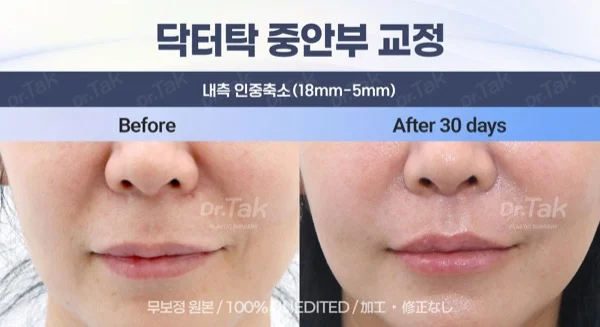
We check in with patients at each stage during recovery. Across 30 years, we have confirmed that patients who knew the recovery timeline at the definition stage stay calm through small fluctuations — and satisfaction is consistently higher.
📍 Bottom line: Philtrum reduction recovery hinges on the first 30 days. Knowing the 5 stages at the definition stage makes the decision noticeably more comfortable.
8. Philtrum Reduction vs Non-Surgical Options — A 9-Point Comparison at the Definition Stage
I always invite patients to compare surgical and non-surgical options at the definition stage. Seeing the differences side by side makes the path that fits you clearer.
Comparison | Philtrum Reduction (Surgery) | Non-Surgical (Filler / Thread Lift)
① Duration | Permanent (10+ years) | 6–12 months
② Procedure time | 40–60 min | 15–30 min
③ Recovery | 30 days (back to life in 7) | 1–3 days
④ Scar | Sub-nose-tip line (nearly invisible at 6 months) | None
⑤ 1 mm precision control | Possible | Limited
⑥ 5-muscle preservation | Possible by design | Minor impact
⑦ Cupid bow lift | Yes (1–2 mm) | Minimal
⑧ Smile-line change | Natural improvement | Almost none
⑨ Average cost (Korea) | KRW 3–5 M | KRW 0.5–1 M per session
💡 Selection guide: Philtrum reduction wins on permanence, 1 mm precision, and smile-line improvement. Non-surgical wins on minimal recovery and shorter procedure time. Pick the trade-off that matters more to you at the definition stage.
📍 Bottom line: Philtrum reduction's core value is permanence + 1 mm precision + smile-line change. A non-surgical comparison at the definition stage gives you a clear decision standard.
9. Dr. Tak Plastic Surgery's 30 Years of Authority — Trust Spoken by 190+ Google Reviews
Once you grasp the definition, I tell patients the next step is choosing who to trust. Many Korean clinics offer philtrum reduction, but few have standardized 1 mm precision + 5-muscle preservation + 6-month scar management together.
🏥 Four trust factors at Dr. Tak Plastic Surgery
30 years of clinical experience in lips and philtrum, in Gangnam, Korea
190+ Google Reviews, 5-star ratings accumulated
5-layer closure + 6-month complimentary scar management program
1:1 personalized consultation + free video consultation
💬 "To make people smile — we focus on people, not procedures."
The Dr. Tak 4S Patient Care System — Focused on People, Not Procedures
We run our 4-stage system on the belief that surgery is the beginning, not the end.
Solution — 1:1 Custom Design
We measure your face proportions and map all 5 muscles and vessels, then design the 1 mm inside your own face — together with you.
Support — 24-Hour Consultation Channel
Kakao and phone channels stay open so you can ask questions anytime after surgery.
Scar Care — 6-Month Complimentary Scar Management
We run this 6-month scar program as our standard.
Checkpoint | Care
Day 7 | Suture removal + initial scar assessment
Day 30 | Scar compression tape + moisturizing care
Day 90 | Pigmentation evaluation + optional adjunct laser
Day 180 | Final scar evaluation + 6-month program closes
Service — 24-Month Post-Surgery Care
After the 6-month scar program ends, regular check-ups continue for another 24 months.
Want to Learn More — Official Channels
🌐 Website: drtakprs.com — full procedure information + medical team profile 📝 Blog: Five-language precision guide series on lips and philtrum 📹 YouTube: 1:1 consultation footage + definition and anatomy series
7 Things to Prepare Before the Decision
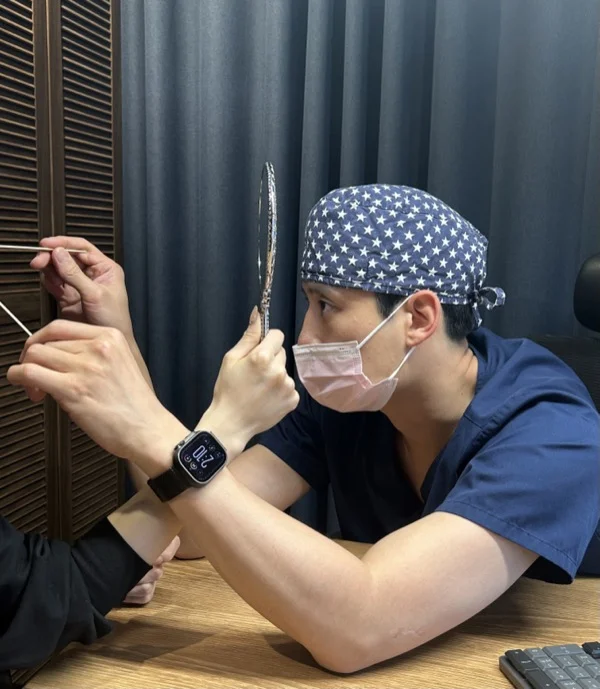
These are the seven items we ask patients to bring to the first consultation.
✅ Frontal and lateral philtrum length measurements (mm) ✅ Three mirror photos — frontal, lateral, smile (natural light) ✅ One line describing the change you want ✅ Preference between youthful vs sharper image ✅ Whether 7–14 days of recovery fits your schedule ✅ Willingness to commit to 6 months of scar care ✅ Prior procedure or filler history (within 3 years)
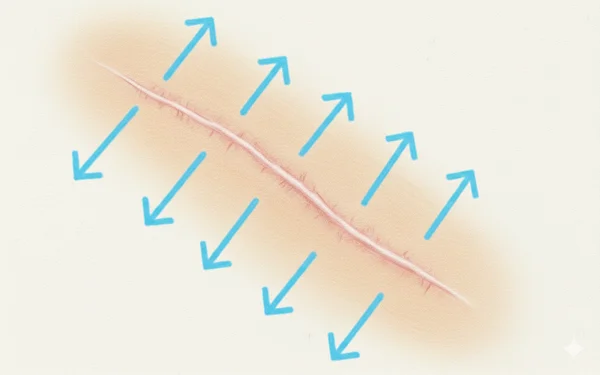
Bringing these seven items deepens the first consultation noticeably — a pattern I have confirmed across 30 years of practice. That closes the definition-stage explainer. The next step is a 1:1 consultation, where we draw the 1 mm inside your own face together.
Dr. Tak Plastic Surgery | Korea's Lip & Philtrum Specialist Clinic "To make people smile."
References
Talei B. Lip Lift: Functional and Aesthetic Analyses of Aging Lip. Facial Plast Surg Clin North Am. 2021;29(2):187-198.
Penna V, Stark GB, Iblher N. Aging in the perioral region. Plast Reconstr Surg. 2015;136(1):144-150.
Lee TS, Park YW. Anatomical study of philtral muscles for surgical safety. J Craniofac Surg. 2018;29(3):725-728.
Dr. Tak Plastic Surgery clinical data (cumulative through 2026).