
If you've ever wondered why your smile looks different in every photo
Once you notice that one corner of your mouth lifts less than the other, that is all you see in photographs from then on. You start taking selfies from one fixed angle. In group photos, you zoom in on your own face first. I hear this in my clinic constantly. And the question that follows is almost always the same — botox, or surgery?
I often can't answer that question straight away. I know that can sound evasive. But there is a reason.
Asymmetric mouth corners are a symptom, not a diagnosis.
Two people can look equally tilted, and yet in one the cause is muscle tone while in the other it is the angle of the jawbone. Give both the same treatment and one improves while the other barely changes. Some end up looking stranger than before. In more than 15 years of working on lips and the perioral area here in Korea, this is the single failure pattern I have run into most.
So I won't start with procedures today. Instead I want to open up the four anatomical layers in which asymmetric mouth corners are created. Once you understand this structure, it becomes obvious what to ask in a consultation.
What exactly are asymmetric mouth corners
To answer directly: asymmetric mouth corners refers to a left-right difference in the height, angle or movement of the oral commissures. The medical literature calls it commissural asymmetry or smile asymmetry. Patients search for it as uneven mouth corners, a lopsided smile, a crooked smile, or one drooping mouth corner. Different names, same target.
There is one distinction that must be made first.
Static asymmetry is the difference already present when your face is fully relaxed. Skeleton, soft tissue volume and resting muscle tone are the main contributors.
Dynamic asymmetry only appears when you smile or speak. Muscle contraction strength and nerve supply dominate here.
These two have different causes and different solutions. Yet a striking number of people who went straight to treatment made their decision without ever separating the two.
📍 Bottom line: Put a relaxed photo and a full-smile photo side by side. That is where every differential diagnosis begins.
The muscle map of the mouth corner — the crossroads called the modiolus
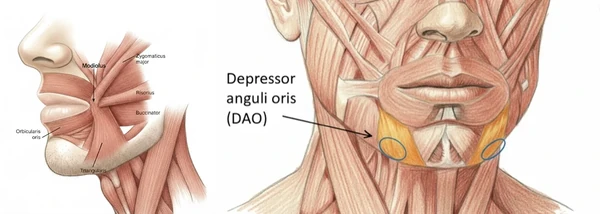
The mouth corner is not held by a single muscle. Roughly 1cm lateral to the commissure sits a fibromuscular knot called the modiolus, where the tendons of several muscles converge and interlace. In consultations I describe it as the interchange station of the perioral muscles.
Three main lines run into that station.
① The elevators — zygomaticus major and levator anguli oris
Zygomaticus major runs from the cheekbone to the modiolus and pulls the corner up and outward when you smile. Think of it as the prime mover of the smile. Levator anguli oris sits deeper beneath it and lifts the corner vertically.
② The depressor — depressor anguli oris
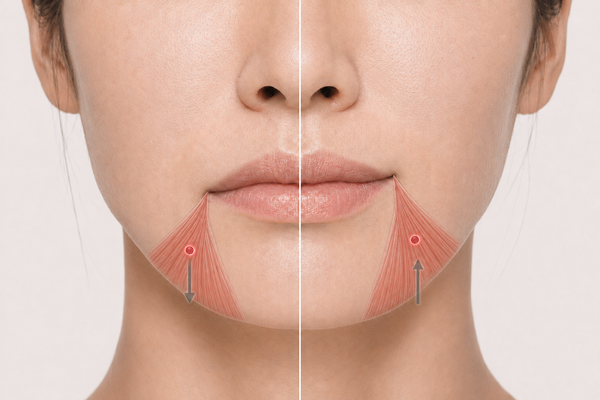
Depressor anguli oris (DAO) rises from the lower jaw border to the modiolus and pulls the corner downward. It is the muscle that builds a sad expression. A left-right difference in the tone of this muscle is one of the most common causes of asymmetry I see clinically.
③ The constrictors — orbicularis oris and buccinator
Orbicularis oris encircles the lips, and buccinator converges from the cheek into the modiolus. These two govern tension balance rather than direction.
What matters here is not the sum of forces but the balance between them. Your mouth corner does not sit high because the elevators are strong; it sits wherever the vector sum of elevators and depressors points. That is why even a slightly stronger DAO on one side produces a visible difference.
And yet nearly half of the asymmetries I see cannot be explained by muscle alone.
The cause is built in four layers
When I consult, I always run down the same order in my head. Four layers.
① The muscle layer — differences in tone and contraction strength
The most common. Habitually chewing on one side, or smiling with only one corner raised, will over years lock in an activation pattern on that side. The signature is that dynamic asymmetry exceeds static asymmetry. If you look fairly even at rest and clearly uneven when you smile, you belong here.
② The skeletal layer — mandibular canting and occlusal tilt
If the lower jaw is tilted left or right (mandibular canting), or if the occlusal plane where the teeth meet is itself tilted, the entire soft tissue envelope resting on it tilts with it. In these cases it is rarely only the mouth corner — the midline of the nasal tip, philtrum and chin are usually off as well. Muscle treatment alone produces poor satisfaction in this type. To be honest with you, this is a case where I sometimes recommend orthodontic or orthognathic consultation before any aesthetic procedure.
③ The nerve layer — differences in facial nerve supply
The buccal branches of the facial nerve (cranial nerve VII) supply zygomaticus major and levator anguli oris, while the marginal mandibular branch supplies depressor anguli oris and the lower lip muscles. That marginal mandibular branch is anatomically vulnerable. In the classic dissection study by Dingman and Grabb, posterior to the facial artery about 19% of marginal mandibular branches were found running below the inferior border of the mandible, by up to 1cm. That is the anatomical background to lower lip asymmetry appearing after jaw surgery or trauma. Subtle residual differences after recovery from Bell's palsy also belong to this layer.
④ The soft tissue layer — differences in volume and descent
When subcutaneous and buccal fat volume, skin elasticity or ligament laxity differ between sides, the same muscular force produces a different result. If the asymmetry is something that appeared only in recent years, this is the layer I suspect first.
And in real practice, the most common situation is not one layer alone but two or three layers overlapping.
Differential markers you can check in front of a mirror
Organising this before your consultation makes far better use of the appointment. Please go through the following in order.
✅ Take one relaxed front-facing photo and one full-smile front-facing photo, in the same lighting and at the same angle
✅ Almost even at rest, clearly uneven when smiling → muscle or nerve layer likely
✅ Already lower on one side at rest → skeletal or soft tissue layer likely
✅ Nasal tip, philtrum midline and chin are all shifted to one side → skeletal layer likely involved
✅ Only the lower lip pulls to one side, and lower teeth show more on one side → suspect the nerve layer, marginal mandibular branch
✅ It appeared only within the last few years → check for soft tissue descent or a history of nerve injury
✅ The same pattern is visible in childhood photographs → developmental or skeletal origin possible
✅ You clench, chew on one side, or rest your chin on one hand → muscle layer contribution to confirm
How many of the eight you ticked is not the point. Which rows the ticks clustered in is.
How far can mouth corner exercises actually take you
I get asked this a great deal. The training where you press down the side that lifts easily and pull only the weaker corner toward the cheekbone and hold — you have probably seen it in a video.
To answer directly: the layer it works on is fixed.
Corner exercises are meaningful when ① the problem sits in the muscle layer and ② a habitual expression pattern is the driver. Repeated training does gradually shift the recruitment pattern of the weaker side. But it takes time. Think in months, not weeks.
Conversely, if the cause lies in the skeletal or nerve layer, you can train as hard as you like and the left-right difference will stay essentially unchanged. I make a point of saying this plainly, because I have met a number of people who trained daily for months, saw nothing, and arrived disheartened. The exercise wasn't wrong. The layer simply didn't match.
📍 Bottom line: Doing the differential before you start the exercises will save you time.
A 1:1 consultation you can start now
✅✅ We compare every available option — botox, filler, corner lip lift surgery — against your specific type
✅✅ We give you an honest opinion whether or not you go ahead with surgery
📲 Dr.Tak Plastic Surgery official site, chat icon at the bottom right → connect to a live consultation
How the approach changes by type
Core points first: the muscle layer takes botox as first line, the soft tissue layer calls for volume or lifting, the skeletal layer is not solved by aesthetic surgery alone, and in the nerve layer identifying the cause comes before any treatment.
The comparison below is what I actually sketch out for patients in the consultation room.
| Comparison | Botox (DAO etc.) | Filler / fat grafting | Corner lip lift (surgery) |
|---|---|---|---|
| Main indicated type | Muscle layer (dynamic) | Soft tissue layer (volume loss) | Soft tissue descent + fixed muscle pattern |
| Mechanism | Suppresses overactive muscle | Corrects hollowing and volume difference | Excises and re-anchors skin and soft tissue |
| Onset | Begins after 3–7 days | Immediate | Staged, after swelling settles |
| Duration | Months; repeat needed | Varies by material and site | Relatively long term |
| Recovery | Immediate return to daily life | 1–3 days of swelling | About 1 week to suture removal |
| Scarring | None | None | Fine incision lateral to the commissure |
| Improves static asymmetry | Limited | Yes | Yes |
| Improves dynamic asymmetry | Excellent | Limited | Partial |
| Improves skeletal asymmetry | No | Camouflage only | No |
| Reversibility | Resolves on its own over time | Partly dissolvable or adjustable | Difficult |
📍 Bottom line: The rows worth staring at are the last three. No procedure corrects skeletal asymmetry.
Nor is this surgery right for everyone. Please use the criteria below as a reference.
Where corner lip lift surgery helps
- One corner sits lower even at rest, and the cause is soft tissue descent
- Botox has been repeated but static asymmetry remains
- There is confirmed skin laxity around the commissure
Where I don't recommend it, or where something else comes first
- Skeletal causes such as mandibular canting or occlusal tilt dominate → orthodontic or maxillofacial consultation first
- Facial nerve palsy is still progressing or its recovery course needs observation
- Clear scarring risk factors such as a keloid tendency
- The difference is so subtle it barely shows in photographs, yet the preoccupation with it is intense
There is a reason I bothered to list that last item. Among the cases where I declined to operate, the ones I remember were mostly of this type.
Recovery and durability — a different timeline for each approach
| Stage | Botox | Corner lip lift |
|---|---|---|
| Day 0 | Immediate return to daily life; stay upright 4 hours | Compression and cold packs, soft diet |
| 3–7 days | Effect begins to appear | Sutures out, swelling down by more than half |
| 2 weeks | Peak effect confirmed, fine adjustment if needed | Scar redness begins, makeup possible |
| 1 month | Maintenance phase | Swelling largely gone, expression settles |
| 3 months | Effect begins to fade, discuss repeat timing | Scar maturation under way |
| 6 months | — | Final phase of scar management |
The point I stress most in practice is the two-week mark. Re-photographing both sides then and comparing against the baseline images is what lets us judge whether the residual difference reflects undercorrection or a different layer altogether. Skip that comparison and the next decision gets made on instinct.
Why we run the differential first
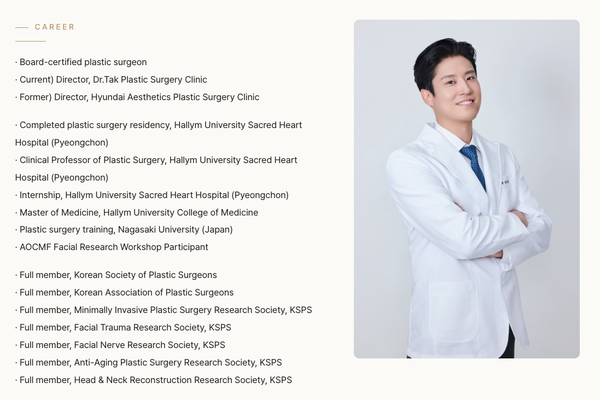
I have run a clinic focused solely on the lips, philtrum and perioral region for more than 15 years. This area is small enough that a 1–2mm difference changes the whole impression of a face. Which is why correction applied to the wrong layer is not an improvement but a new asymmetry — something I have confirmed over and over in that time.
Dr.Tak Plastic Surgery holds over 190 Google reviews with a 5 out of 5 rating. I don't believe that number comes from dramatic before-and-after photographs. I believe it comes from being trusted to say so when the cause isn't in the aesthetic domain, and to say it isn't needed when it isn't needed.
💬 "To make people smile" — holding to that, I put more weight on the time spent identifying the cause than on the time spent producing the result.
The Dr.Tak 4S patient care system
We focus on the person, not the procedure.
Solution
We first identify which layer is producing the asymmetry. Only then do we judge whether botox, filler or surgery is needed — or whether nothing is.
Support
We don't rush the decision. We help you choose for yourself, once you fully understand what each layer can and cannot deliver.
Scar Care
If you choose surgery, we hide the incision within the natural shadow around the mouth corner and manage the scar in stages over six months.
| Stage | Scar care focus |
|---|---|
| 1–2 weeks | Suture line stability, infection prevention |
| 3–4 weeks | Redness management, sun protection |
| 2–3 months | Observing and softening scar maturation |
| 4–6 months | Final concealment check |
Service
Giving you an honest opinion regardless of whether you have surgery is the baseline of our service.
If you'd like to know more — official channels
🌐 Official site drtakprs.com
📝 Procedure-specific information and case material
📹 Video content presented directly by the surgeon
Six things to settle for yourself before deciding
✅ Have you prepared one relaxed and one smiling photo under identical conditions
✅ Can you pinpoint when you first became aware of the asymmetry
✅ Do you have a history of orthodontic or dental treatment, or TMJ symptoms
✅ Do you have any facial nerve history — Bell's palsy, trauma, surgery
✅ Do you remember the site and timing of any previous botox or filler
✅ Have you decided whether what you want improved is your resting face or your smile
Come with those six lines filled in and more than half of the consultation can go to building the actual plan.
Frequently Asked Questions (FAQ)
These are the questions that come into Dr.Tak Plastic Surgery most often.
Q1. What exactly does mouth corner botox do, and is it painful?
Mouth corner botox is not a procedure that lifts the corner; it is a procedure that releases the muscle pulling the corner down. Once the overactivity of depressor anguli oris eases, the elevators become relatively dominant and the corner appears to rise. Understanding that distinction explains why the effect is striking in some people and barely visible in others. Pain is handled by topical anaesthetic in most cases, and in my observation the anxiety about having an injection into a facial expression muscle is greater than the pain itself.
Q2. How long does botox last, and how long is recovery from surgery?
Botox appears over 3–7 days, peaks around two weeks, then declines gradually over a period of months. So if you have an important event, I suggest having it at least two weeks beforehand. For a corner lip lift, sutures come out at about one week, makeup can cover the site at around two weeks, and expression settles at roughly one month. That said, when someone asks me about recovery time I always ask back — the timing I recommend changes depending on when and where you need to be.
Q3. How much does corner lip surgery cost, and is it covered by insurance?
Asymmetry correction for aesthetic purposes is not covered by health insurance. Cost varies widely by approach, and even within the same operation it depends on whether it is unilateral or bilateral and whether correction of another layer is needed alongside. If you search you will find a wide spread of figures between clinics, and a substantial part of that spread comes down to differing surgical scope and anaesthesia. I think it is more accurate to give you a range after explaining the differential findings. And for any approach that needs repeating, compare annual total cost rather than the price of a single session.
Q4. Will there be a scar, and how is it managed if there is?
Botox involves no incision, so there is no scar. However, if dose or placement is off, speech can feel awkward or the smile can look unnatural — and this resolves with time. A corner lip lift does create a fine incision lateral to the commissure. That site overlaps the natural shadow around the mouth corner so it is hard to see from the front, but I will not tell you there is no scar at all. Management differs by stage: sun protection and suture line care early on, scar ointment from weeks 3–4, and a laser discussion if redness persists. That is why we set the management window at six months.
Q5. Why do people regret corner lip surgery?
This genuinely comes up in searches, and I think it is the most reasonable worry of all. Looking back over cases of regret, far more of them involved treating the wrong layer than overcorrection. Treat a skeletal asymmetry with a muscle procedure and the left-right balance stays exactly where it was while the expression turns awkward. That is why I prefer to start with an approach that can be undone. Confirming the response with something that fades over time and then deciding the next step has, in my experience, produced the least regret.
Dr.Tak Plastic Surgery | Korea Face Lifting · Lip · Philtrum Specialist Clinic
"To make people smile"