
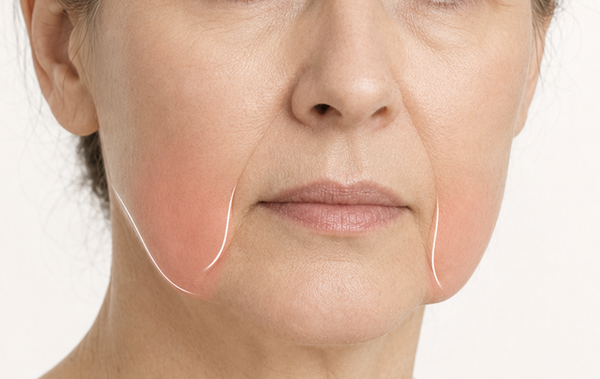
When people keep saying you "look tired," it may be your sagging jawline
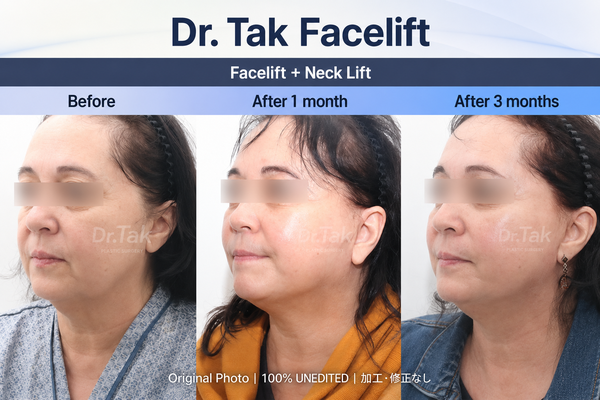
If people around you have started asking "Is something wrong?" or telling you that you look tired — even when you're not angry or exhausted — it may not be your expression at all. It may be the line of your face. When the flesh beside the corners of the mouth droops, a person looks older and grumpier regardless of how they actually feel. That drooping flesh is what we commonly call jowls.
I see this concern very often in my clinic here in Korea. And when the consultation begins, most people say the same thing: "I've tried lifting, I've tried filler, and it's still the same." So I gently ask them one question. Before you had those treatments, did anyone actually diagnose why your jowls formed in the first place?
At this point, many people pause. Most had a "trendy" procedure first, without ever hearing a clear cause. Yet jowls often require the exact opposite solution depending on the cause. That is precisely why so many people spend money and time and see no change.
Today I want to explain, honestly and from a surgeon's perspective, how jowls actually form inside the face — and how the cause type should decide whether you choose a non-surgical or a surgical route. The bottom line first: the answer is not in the name of a procedure, but inside the cause.
Jowls aren't from "gaining weight" — they come from a collapsing structure
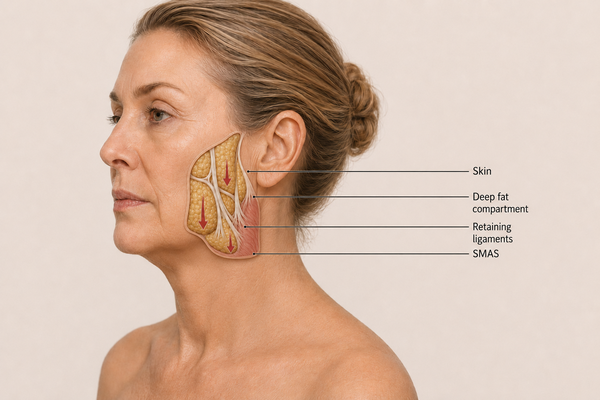
The first misconception I want to correct is this. Many people assume jowls are simply fat and that dieting or removing fat will fix it. That's exactly why even slim people can have prominent jowls. Jowls are a structural change that appears when three supporting layers of the face give way together.
① The skin layer — as collagen and elastin decline, the skin loses its own elasticity. With the same degree of sagging, thin, low-elasticity skin makes jowls look far more obvious.
② The fat layer (deep cheek fat) — facial fat is divided into compartments, and when the borders holding those compartments weaken, the fat slides downward. The upper cheek hollows while the area beside the mouth bulges — the exact shape that resembles a bulldog.
③ The ligaments and SMAS layer — deep in the face, retaining ligaments and the fibromuscular layer (SMAS) anchor tissue to the bone. When this support loosens, the tissue above sinks as a whole. The deepest root of jowls actually lies in this layer.
These three layers don't act independently. They collapse in an interlocked way, which is why a procedure that touches only one layer rarely shows results. And which of the three has collapsed most varies from person to person. That difference is what decides the solution.
Why jowls differ so much at the same age — three cause types
Same age, similar build — yet one person has almost no jowls and another has pronounced ones. The variation is too wide to lump under the single word "aging." In consultations, I sort jowls into three broad types, because a different type demands a completely different approach.
Fat-dominant type — abundant, downward-shifted deep cheek fat
The deep fat inside the cheek is naturally abundant and has migrated downward, bulging beside the mouth. People who show jowls even in their 20s usually fall here. Ironically, this type owes more to inherited fat distribution than to age.
Sag-dominant type — ligaments and fascia have loosened and tissue has descended
Here the main driver is the loosening of the support structure rather than fat. Many people who feel their jawline "suddenly collapsed" after their 40s belong to this group. For them, procedures that only tighten the surface bounce back within months. The stories of thread lifts relapsing quickly almost always trace back to this type.
Skin-dominant type — reduced elasticity combined with thin skin
The skin is thin and has lost much of its elasticity, so fine lines and sagging stand out together. It sometimes follows rapid weight change. For this type, tightening the support structure alone isn't enough; skin elasticity has to be lifted as well for the result to last.
In reality, most jowls are a blend of these three. But which one dominates completely changes the starting point. That is why, before deciding based on a single photo or a trending procedure, I identify the dominant cause of your jowls through palpation and by checking your expressions in motion. Skip this diagnosis and everything that follows becomes unstable.
A one-on-one consultation you can start now
✅✅ Before any procedure, we first diagnose the dominant cause of your jowls (fat, sagging, or skin)
✅✅ We give you an honest opinion, regardless of whether you choose surgery
📲 On the official Dr.Tak Plastic Surgery website, tap the chat icon at the bottom right for a live consultation
The solution splits by cause — non-surgical vs surgical at a glance
Once the cause type is confirmed, it comes down to choice. The key here is not "which procedure is better" but "which one fits my cause." The table below sums up the character of the non-surgical and surgical routes.
| Comparison | Non-surgical (thread lift, RF, filler) | Surgical (facelift, deep plane) |
|---|---|---|
| Main target layer | Skin, superficial fat | SMAS, retaining ligaments (deep) |
| Suited cause type | Skin-dominant, early sagging | Sag-dominant, moderate or more |
| Strength of effect | Subtle and limited | Clear and fundamental |
| Duration | Relatively short (months to ~1 year) | Relatively long-lasting |
| Recovery | Short, quick return to daily life | Relatively long (swelling, bruising) |
| Scarring | Virtually none | Incision near the ear (hidden in natural creases) |
| Relapse tendency | Frequent if the cause is deep | Low, since it corrects the root |
| Cost range | Relatively lower | Relatively higher |
| In one line | Delaying and refining | Restoring and re-anchoring |
📍 Bottom line: If the cause is skin or early sagging, non-surgical may be enough. But if the support structure has collapsed — the sag-dominant type — no amount of repeated surface work will fix the root. Honestly, this surgery isn't right for everyone, and conversely, not every case of jowls can be solved without it.
Recovery and longevity by procedure — setting realistic expectations first
To help your decision, here is the recovery flow and duration for each route. The fear of "what if I don't like the result" usually arises when expectations don't match reality. So I state the numbers honestly from the start.
| Type | Swelling/bruising | Return to daily life | Final result settles | Duration |
|---|---|---|---|---|
| RF/ultrasound lifting | Almost none | Same day | 1–3 months | Relatively short |
| Thread lift | A few days | 2–3 days | 2–4 weeks | Varies widely by cause |
| Facelift/deep plane | 1–2 weeks intense | 1–2 weeks | 2–3 months | Relatively long |
A large share of the swelling subsides within the first two weeks. But the final line takes longer to settle. So that you don't mistake that in-between awkwardness for the result, I make it a rule to explain in advance what is normal at each stage of recovery.
Why patients trust Dr.Tak Plastic Surgery in Korea
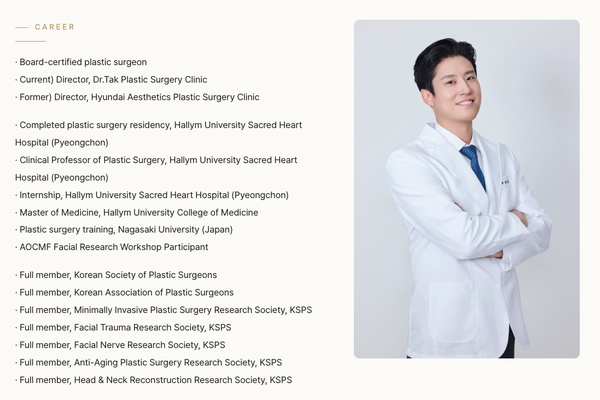
We are a Korean clinic with over 15 years of experience in the fine facial areas, including the lips and philtrum. Over that time, I have seen countless times why the "just pull it tight" approach so often fails. That is why I put cause diagnosis ahead of the name of any procedure.
More than 190 Google reviews with a perfect 5-star rating, I believe, are not because of flashy result photos. I believe they reflect trust in an attitude that never pushes unnecessary surgery and says so plainly when a procedure isn't needed.
💬 "To make people smile — our goal is not the number of procedures, but a face you can smile with, at ease."
The Dr.Tak 4S Patient Care System
We focus on the person, not the procedure.
Solution
We first diagnose the dominant cause of your jowls (fat, sagging, or skin) and then propose the fitting non-surgical or surgical direction. Diagnosis, not trends, is the standard.
Support
Ample consultation before the decision, and after it, we check together what is normal at each stage of recovery.
Scar Care
If you choose surgery, the incision is hidden within the natural creases around the ear, and we manage the scar in stages over six months.
| Period | Scar care focus |
|---|---|
| 1–2 weeks | Suture stability, infection prevention |
| 3–4 weeks | Redness care, sun protection |
| 2–3 months | Observing scar maturation, softening |
| 4–6 months | Checking the final concealment |
Service
Regardless of whether you have surgery, giving an honest opinion is the baseline of our service.
If you'd like to know more — official channels
🌐 On our website you'll find procedure information and the surgeon's columns.
📝 For consultations, feel free to use the chat icon at the bottom right of the official website.
📹 We've also prepared videos of the actual care process and the surgeon's explanations.
Five things to sort out for yourself before deciding
✅ Do your jowls stand out more from below or in profile than from the front?
✅ Have you had a recent rapid weight change (a skin-type clue)?
✅ Have they been there since your 20s, or did they appear suddenly after your 40s (fat-type vs sag-type clue)?
✅ Did a previous procedure bounce back within a few months (a deep-layer cause clue)?
✅ Do you want "subtle refinement" or "fundamental restoration of the line"?
Please remember one thing. The answers to these five questions are far more important information than the name of any procedure.
Frequently Asked Questions (FAQ)
Here are the questions we receive most often at Dr.Tak Plastic Surgery.
Q1. I've had several thread lifts — why do the jowls keep coming back?
This is the complaint I hear most often. In most cases the cause is loosening of the deep support structure (SMAS, ligaments), yet only the surface layer was repeatedly tightened. If the root is sag-dominant, surface work tends to relapse within months. If relapse keeps happening, before switching to yet another procedure, I'd advise having the cause layer re-diagnosed first.
Q2. How long is recovery? Can I go straight back to work?
It differs greatly by route. RF/ultrasound lifting allows same-day return, and a thread lift is usually fine after 2–3 days. For surgery like a facelift or deep plane, I recommend allowing the 1–2 weeks when swelling and bruising peak. In consultation I ask about your actual work and appointment schedule first, then adjust the method and timing accordingly.
Q3. Is there a big cost difference between non-surgical and surgical?
Yes — they are different in nature. Non-surgical can start at a relatively lower cost, but the short duration means repeat costs add up. Surgery has a higher upfront cost, but as a fundamental correction it can actually be more economical over the long run. That said, the exact cost depends on the cause type and extent, so I never quote a figure before diagnosis.
Q4. I'm worried about scarring.
Non-surgical methods leave virtually no scar. Facelift-type surgery does require an incision, but I design the incision line within the natural creases around the ear so it isn't visible from the front. Position is half the result. Add six months of staged scar care, and it becomes even less noticeable over time.
Q5. What if my face looks unnatural or overly tight after surgery?
This is the most common fear, and I think it's completely understandable. Unnaturalness usually comes from pulling only the skin hard. Because I prioritize re-anchoring the SMAS layer beneath the skin rather than the skin itself, I aim for a "returned to its original place" look rather than a "pulled" one. And honestly, if a result would look excessively tight, I wouldn't recommend that surgery in the first place.
Dr.Tak Plastic Surgery | Korea's lip & philtrum specialist clinic
"To make people smile"