
Non-Incision Philtrum Groove vs. Incision Lip Lift in Korea — How to Create a Shorter-Looking Philtrum Without Cutting
If You've Ever Tilted Your Head Up Slightly to Make Your Philtrum Look Shorter in Photos — This Explains Why
If that experience sounds familiar, you already understand intuitively why the non-incision philtrum groove procedure works. When a philtrum groove forms, the philtral columns become defined and the way light reflects off your philtrum changes. That's why the philtrum appears shorter even without removing any skin.
In my clinic, I frequently hear patients say: "I'm terrified of surgery, but I can't keep living with this." Some have been repeating consultations for years, too afraid of incisions to commit. I understand that feeling completely — which is why I want to be honest today about when this procedure is enough, and when it isn't.
Because frankly, this procedure is not right for everyone.
How Non-Incision Philtrum Groove Works — The Pinhole Tent-Fabric Principle
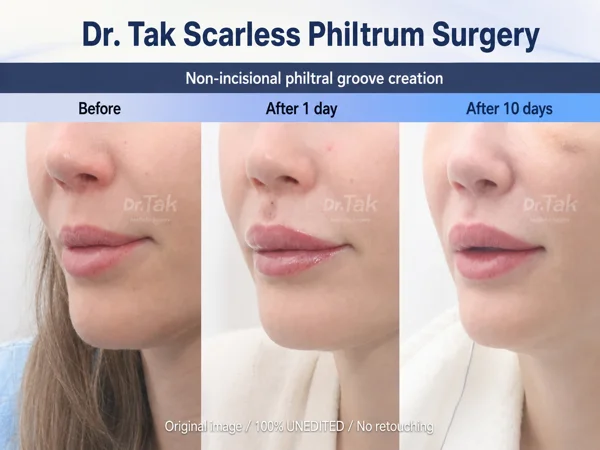
I always explain this surgery with the analogy of a tent fabric. When someone pulls the fabric inward from inside a tent, a concave groove forms on the outer surface. That is exactly the principle behind the non-incision philtrum groove.
A pinhole — no larger than a needle tip — is made in the inner mucosal lining of the upper lip (the surface visible when you flip your lip). Through this pinhole, a specialized surgical thread is introduced, which interlaces the orbicularis oris muscle with the dermal layer of the outer skin. The thread is then pulled firmly toward the inner mucosa and knotted securely.
Philtral groove (central concave line) — The pinhole is placed precisely behind the intended philtral groove location. Depending on the patient's upper lip thickness and desired C-curl depth, I adjust the position in 0.5mm increments between the vestibule and mucosal center. This is where my full attention goes.
Philtral columns (elevated ridges on either side) — Thread is placed symmetrically on both sides of the groove to create a three-dimensional Cupid's bow line. The balance between both columns is what determines whether the result looks natural. Even a subtle asymmetry shows.
C-curl line — As the thread is drawn inward, the upper lip mucosa converges. This force lifts the outer skin upward, naturally forming a C-shaped curl. Once the C-curl appears, the upper lip projects slightly forward and upward, visually altering the philtrum-to-lip boundary.
The pinholes are closed with three to four absorbable sutures. Even if the suture material dissolves and is swallowed, it breaks down safely inside the body. There is no visible external scarring whatsoever.
Start Your Personalized 1:1 Consultation Now
Side-by-side comparison of non-incision vs. incision options tailored to your philtrum length, lip thickness, and desired result
Honest opinion regardless of whether surgery is needed
Visit drtakprs.com → chat icon at the bottom right → real-time consultation
Non-Incision vs. Incision Philtrum Groove vs. Lip Lift — 9-Point Comparison
Honestly, I never start a consultation with a predetermined preference for non-incision or incision. The right choice depends entirely on the patient's philtrum length, skin thickness, and the degree of change desired. Review the table first, then check the selection criteria below.
| Comparison | Non-Incision Philtrum Groove | Incision Philtrum Groove | Incision Lip Lift |
|---|---|---|---|
| External scarring | None (pinhole only) | None (intraoral) | Possible fine scar below nose |
| Actual philtrum length reduction | None (visual effect only) | None (visual effect only) | Skin removal = real shortening |
| Philtrum depth & dimension | Created | Created (stronger) | Created (secondary effect) |
| Duration | 12–18 months (varies widely) | Semi-permanent (3–5+ years) | Semi-permanent (3–5+ years) |
| Recovery | Same-day return to routine | 5–7 days | 7–14 days |
| Anesthesia | Local | Local / IV sedation | Local / IV sedation |
| Ideal philtrum length | 16–19mm | 16–19mm | 19mm or more recommended |
| Re-treatment | Easy | Possible | Limited |
| Cost | Lowest of the three | Moderate | Highest |
If your philtrum measures 20mm or more, the non-incision groove procedure alone is often insufficient. In that case, I honestly recommend considering an incision lip lift first.
When Is It Enough — and When Is It Not? Honest Criteria
I always explain these criteria at the start of a consultation — not to steer patients toward surgery, but to prevent regret later.
Non-incision philtrum groove is sufficient when:*
Philtrum length is between 16–19mm
Lack of dimension (flatness) is the main concern — the visual issue is greater than the actual length
Surgery and incisions feel too daunting, or recovery time is limited
You want to test the result before committing to an incision procedure
Non-incision alone is likely insufficient when:*
Philtrum length is 20mm or more — visual correction alone may not meet expectations
The upper lip is thick — lip tissue absorbs the tension of the suture thread
Philtrum has been lengthened after orthodontics or protrusion surgery — actual skin volume has increased
A previous non-incision attempt lasted less than 6 months
Looking back at my own consultation data at Dr. Tak Plastic Surgery in Korea, approximately 30% of patients were better served by first discussing an incision lip lift. The majority do well with non-incision, but I cannot honestly call this procedure universally appropriate.
Why You Can Trust Dr. Tak Plastic Surgery in Korea
From the day I opened this clinic in Korea, I have held to one principle: a technically performed surgery that produces an unnatural result is not a good surgery. After more than 1,000 lip and philtrum cases, what I value most is not the technique — it is each patient's expectations and concerns.
Total lip & philtrum procedures: 1,000+ cases
Non-incision philtrum groove alone: 400+ cases
Google Reviews 190+ at 5.0 stars — top-rated Korean lip & philtrum clinic
15+ years of specialized Korean lip & philtrum practice
"To make people smile."
Living this mission in the consultation room means not recommending surgery to everyone — it means guiding each person to the option that is honestly right for them.
Dr. Tak 4S Patient Care System — With You Before and After
People, not procedures
Solution
From non-incision groove to incision lip lift — I propose the most efficient approach based on your philtrum length, lip thickness, and dimensional concerns. Even for the same procedure, thread material, insertion angle, and knotting method are customized per patient.
Support
After you go home on procedure day, you can reach me on KakaoTalk at any time. You do not have to manage swelling, discomfort, or asymmetry concerns alone. We follow up together.
Scar Care
There is no external scarring with non-incision, but internal pinhole care matters.
| Timeline | Care Instructions |
|---|---|
| Days 1–3 | Intraoral antiseptic rinse, avoid spicy/hot foods |
| Days 4–7 | Suture removal visit, continue rinsing |
| Weeks 2–4 | No intraoral massage, avoid strenuous exercise |
| Week 6+ | Confirm final result, discuss re-treatment if desired |
Service
3D preview imaging at consultation, follow-up observation for 6 months post-procedure. You are always welcome to return with questions at any time.
Official Channels — Learn More
Website: drtakprs.com — before/after photos, pricing information
Dr. Tak Blog — in-depth articles on philtrum and lip procedures
YouTube & Instagram — real procedure footage, patient case curation
6 Things to Check Before Deciding
Do you know your philtrum length in mm? (Golden ratio: 12–15mm from nose tip to upper lip border)
Is your philtrum long because of actual length, or because of flat dimensionality?
How many days can you set aside for recovery?
If you've had a non-incision groove before, how long did it last?
Any history of orthodontic treatment or protrusion surgery? (These can affect philtrum length)
Are you looking for "more dimension" or "actual length reduction"?
Frequently Asked Questions (FAQ)
The questions most commonly received at Dr. Tak Plastic Surgery in Korea.
Q1. Does it hurt during the procedure? I'm actually more scared because it's local anesthesia
This concern comes up all the time. The most common thing I hear after the procedure is: "It was nowhere near as uncomfortable as I expected." The local anesthesia injection itself has a brief sting, but the oral mucosa absorbs anesthesia quickly. During the procedure, patients typically feel pressure and mild foreign-body sensation rather than pain. The procedure takes 30–40 minutes. For those with strong anxiety about local anesthesia, I offer the option of IV sedation.
Q2. How long does the swelling last? When can I go back to normal activities?
Seventy percent of swelling resolves within two weeks. You can return home the same day, and routine activities are generally possible the next morning. If you have presentations, client meetings, or events where wearing a mask isn't an option, I recommend allowing 3–5 days of buffer. The most uncomfortable period is days 1–2, during which you may feel stiffness and mild soreness inside the upper lip. Compared to an incision lip lift, the recovery is significantly faster — which is one of the main reasons patients choose the non-incision approach.
Q3. How much does it cost? Is it covered by insurance?
The non-incision philtrum groove is a cosmetic procedure and is not covered by health insurance in Korea. Pricing varies by clinic, thread material, and treatment scope. Detailed pricing at Dr. Tak Plastic Surgery is provided during consultation. A package rate applies when combined with an incision lip lift. My consistent advice: the experience of the practitioner and the quality of the thread material matter more than the price. With this procedure, the precision of suture placement directly determines how natural the result looks.
Q4. I've heard surgery can widen the nose — what if it ends up looking worse?
Nasal widening is primarily a risk associated with incision lip lifts, not with non-incision philtrum groove procedures. Since the non-incision technique does not directly engage the nasal base structures, the risk of nasal widening is low. That said, during the 4–6 week settling period, the groove may appear deeper than intended or slightly asymmetric — this is a normal part of stabilization. In the rare case where mild asymmetry persists, a corrective touch-up is available. I fully understand the fear of ending up with a result that looks worse. That is exactly why I show 3D preview imaging during consultation, so expectations are aligned before the procedure begins.
Q5. I'm afraid non-incision alone won't be enough. Will it actually work for my philtrum?
I'll give you the honest answer: if your philtrum is 20mm or longer, non-incision alone may not be sufficient. In my clinical experience in Korea, patients with a 20mm+ philtrum do see a 2–4mm visual reduction, but if expectations are higher, an incision lip lift typically enters the discussion. For those in the 16–19mm range, the majority achieve a result they are satisfied with from non-incision alone. The most important starting point is knowing your exact philtrum measurement. That single number is the most decisive factor in choosing between non-incision and incision.
Dr. Tak Plastic Surgery | Korea's Lip & Philtrum Specialist Clinic*
"To make people smile."*