
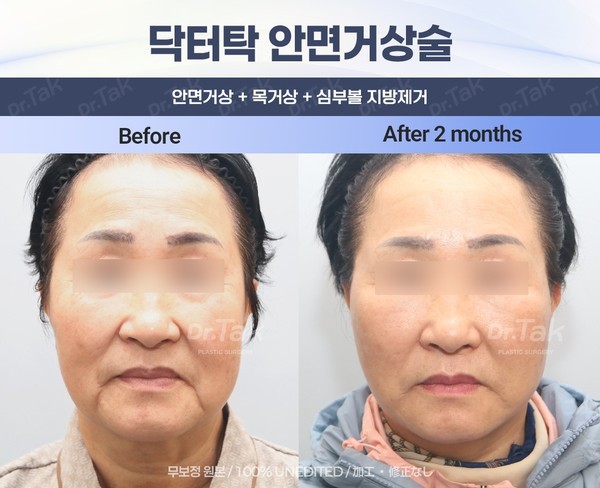
When one day your jawline suddenly looks like it has collapsed
I believe many of you have looked in the mirror and gently lifted your cheeks with your fingers, wondering, "was my face always this saggy?" When the jawline in a side photo looks blurred, or the corners of your mouth seem to droop even when you are not frowning, that frustration is bigger than people expect.
In my clinic here in Korea, I hear this constantly: "I haven't really gained weight, yet my whole expression looks like it's sinking." And then, without fail, comes the question — "Is this just because of age?" Blaming age is comforting, but it is not the whole story.
Sagging skin is not a phenomenon caused by a single factor. It is the result of several layers at different depths collapsing at different speeds and overlapping. That is why, at the same age, one person sags only in the cheeks while another loses the jawline first.
Today I want to break down, anatomically, why and from which layer the face drops — into five causes. Why knowing the exact cause matters so much will become clear by the end.
Your face is not a single layer — the 5 layers behind sagging
To truly understand sagging, you first have to know that the face is built from several stacked layers. It is not simply a matter of skin stretching.
From the outside inward, it is roughly composed like this.
① Epidermis and dermis — the layer holding the collagen and elastin that create elasticity
② Subcutaneous fat — the layer where the fat pads that build facial volume and curves sit
③ SMAS and retaining ligaments — the fascia and ligament structure that suspends the face from the bone
④ Facial bone — the framework that supports all of the above
⑤ And the external factors acting on all of these
Sagging happens simultaneously across these five layers. This is exactly why addressing only one layer rarely brings fundamental improvement. So let us go down one layer at a time, starting from the first.
Cause 1 — Loss of dermal collagen and elastin
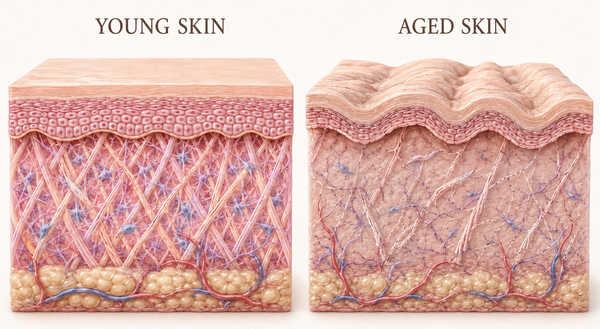
The first place to start breaking down is the skin itself, and within it, the dermis.
The dermis contains collagen, which holds the skin taut, and elastin, which lets it stretch and spring back — woven together like a net. The problem is that this collagen begins to decline by roughly 1% every year from your mid-twenties. The number sounds small, but stacked over ten years, the density of that net thins noticeably.
Elastin is even less forgiving. Once damaged, our body can barely produce it anew. So skin that used to snap right back when you pressed your cheek starts, with age, to leave a lingering mark. That lag in elasticity is the first sign of sagging.
Here I want to be honest about one thing. If you are only in an early stage with dermal elasticity decline, regenerative or tightening procedures and lifestyle management come first, not surgery. Not all sagging is a candidate for the operating table. The real difficulty is that it rarely ends as a dermis-only problem.
Cause 2 — Descent and atrophy of the fat pads
Go down to the second layer and the story changes.
A young face looks smooth and full because subcutaneous fat sits in the forehead, under-eye, cheeks and around the mouth as several independent "compartments," balanced in place. Each fat pad is separated by thin partitions that keep it where it belongs.
With age, two things happen at once. The upper fat pads shrink and hollow out, while the lower fat slides down with gravity. As a result the area beneath the cheekbone becomes gaunt, and jowls form around the mouth along with deepening nasolabial folds. The volume has not vanished — it has relocated.
In consultations I often meet people who say, "I thought losing weight would improve the sagging, but it looks even more droopy now." When only the fat leaves the skin it was supporting, the remaining skin stands out more. That is why aggressive dieting or fat removal must be approached with caution when sagging is present.
Cause 3 — Laxity of the SMAS and retaining ligaments
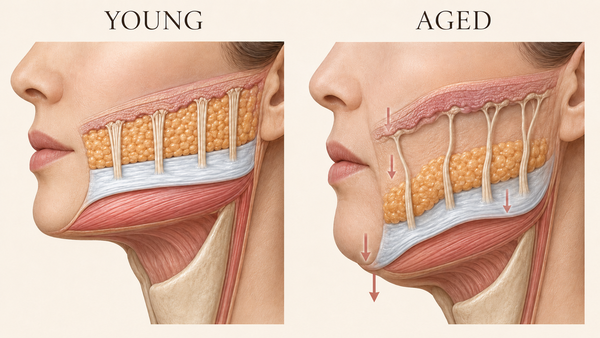
The third layer — this is the true center of sagging.
The SMAS (superficial musculoaponeurotic system) is a tough membrane between skin and muscle, a kind of "internal corset" that suspends the face from the bone. On top of it, several retaining ligaments anchor specific points of the face to the bone like fixed straps.
Over time this SMAS membrane loosens and the tension of the retaining ligaments falls. It is like the strings of a corset going slack. Then the fat and skin resting on top slide down as a whole. This is why no matter how good a product you apply to the surface, jawline sagging does not improve.
It is precisely this SMAS layer that divides how lifting works. High-intensity ultrasound or radiofrequency devices try to contract this layer with heat, while a surgical facelift pulls and fixes this layer directly. Which one is right depends on how deep the sagging has progressed. This is the core thing that must be diagnosed before you even consider surgery.
Cause 4 — Resorption and structural change of the facial bone
The fourth cause is a part many people never consider. It is the bone.
The facial bone that supports your face seems permanent, but in reality certain areas are gradually resorbed and lose volume with age. In particular, the orbit around the eyes, the upper jaw and the angle of the lower jaw change, and the skeleton itself gently shrinks.
Imagine the pillars holding up a house becoming a little shorter. If the roof on top (skin and fat) stays the same while the pillars shrink, the remaining structure loosens and drops. When bony support weakens, the same amount of soft tissue looks more slack.
Why this cause matters is that bone change cannot be reversed by skin procedures. So sagging in midlife and beyond has limits if you only address the surface; an approach that also restores volume or repositions the structure is often needed alongside.
Cause 5 — External factors that accelerate aging
If the first four are structural changes made by time, the fifth is a domain we can control to some degree. And much of the reason sagging speed differs from person to person lies here.
The single most powerful factor is UV light. Often called photoaging, it is known that roughly 80% of the external causes of skin aging are due to UV. UVA penetrates deep into the dermis and directly severs collagen and elastin.
There are also habits that bring sagging forward.
① Rapid weight change — repeated gain and loss means the skin cannot spring back as much as it stretched
② Smoking and excess alcohol — constrict micro-vessels and impair collagen synthesis
③ Sleep deprivation and chronic stress — break down the very recovery cycle that produces collagen
④ Excess sugar intake — glycation hardens collagen and it loses elasticity
Among these, rapid weight change deserves a special note these days: rapid weight loss from GLP-1 class obesity medications (Ozempic, Wegovy and the like). The term "Ozempic face" has emerged overseas precisely because losing a large amount of body fat in a short period so often leaves the face looking unusually aged.
The mechanism connects directly to Cause 2 above. These drugs rapidly reduce body fat everywhere — and the facial fat pads are no exception. When cheek and temple volume collapses quickly, the skin that had covered it loses its support and droops, making nasolabial folds and jawline sagging look more pronounced than one's actual age. The paradox arises: the weight came off, but the face looks more sagged.
I feel that consultations from people taking or considering these drugs have risen sharply lately. So I always say this: weight loss itself may be good for your health, but facial volume loss is a separate issue you should prepare for in advance. It is wise to coordinate the pace of loss with your medical team and, if needed, plan volume restoration or elasticity care alongside.
Honestly, before talking about procedures or surgery, I advise checking this fifth cause first. No matter how good a lift you receive, if the cause keeps working, the result will not last.
The 1:1 tailored consultation you can start now
✅✅ We diagnose which layer your sagging started in, and explain both non-surgical and surgical options in comparison
✅✅ We give you our honest opinion, regardless of whether surgery is involved
📲 Official Dr.Tak site, chat icon at the lower right → connect to a live consultation
Different causes need different solutions — a layer-by-layer comparison of non-surgical vs surgical
If you have read this far, you now see why "this device is the best" is a dangerous claim. When the layer being treated differs, so does the result.
| Comparison | Non-surgical lifting (ultrasound, RF, threads) | Surgical facelift |
|---|---|---|
| Main layer treated | Dermis–subcutaneous, some SMAS heating | SMAS and ligaments dissected and fixed directly |
| Suitable sagging degree | Early to moderate | Moderate to advanced |
| When effect appears | Gradually (weeks to months) | Immediately after surgery |
| Duration | Roughly repeated every 6 months–1 year | Long-lasting over years |
| Recovery time | Almost none to a few days | 1–2 weeks of swelling/bruising |
| Anesthesia | Mostly topical/local | Local or sedation |
| Scarring | None | Incision around the ear (hidden in hairline/creases) |
| With volume loss | Combined with filler/fat graft | Combined with repositioning/volume restoration |
| Best candidate | Care and prevention focused | Those needing structural improvement |
📍 Bottom line: If sagging is at the dermal stage, non-surgical is reasonable; once it has slid to the SMAS, surface procedures alone clearly have limits. So it is the "depth" of your sagging that comes first, not the device name.
Sagging progresses in steps — signs by stage
What makes sagging frightening is that it feels as if it arrived one day out of nowhere. In reality it builds up slowly, then becomes glaringly visible at a certain point.
| Stage | Common signs | Approach for this stage |
|---|---|---|
| Early signs | Reduced cheek elasticity, fine lines, enlarged pores | UV protection, lifestyle management, tightening care |
| Mid signs | Deepening nasolabial folds, jowls at the mouth | Volume restoration, non-surgical lifting |
| Advanced signs | Blurred jawline, neck sagging accompanying | Consider surgical approach addressing the SMAS |
In my experience, the most regrettable cases are people who brush off early signs thinking "it's probably fine for now," and only come in once advanced signs appear. Knowing the cause early gives you far more options.
Why cause diagnosis comes first — the Dr.Tak approach
There is a reason I keep saying "look at the cause first" throughout this article. Sagging starts in a different layer for each person, and if you misjudge that layer, you can spend time and money and still get an unsatisfying result.
Dr.Tak Plastic Surgery is a clinic in Korea that has walked one path for over 15 years in lips, philtrum and facial aesthetics. I believe the 190-plus Google reviews with an average of a perfect 5 stars come from focusing on accurately diagnosing each person's cause, rather than expanding the menu of procedures.
💬 "To make people smile." That is why, when we look at sagging, we look at the whole structure of a person's face first — not at a device.
The Dr.Tak 4S patient care system
We focus on the person, not the procedure.
Solution
We diagnose the layer where sagging originates and propose only as much as needed, from non-surgical to surgical. We do not push overtreatment.
Support
From consultation to procedure to recovery, the same surgeon looks after you consistently. You are always welcome to ask again about any concern.
Scar Care
When a surgical approach is needed, we hide the incision line within the creases around the ear and inside the hairline, and manage recovery step by step.
| Stage | Care focus |
|---|---|
| Right after–1 week | Swelling/bruise care, keeping the incision clean |
| 2–4 weeks | Early scar care begins after suture removal |
| 2–3 months | Intensive care during scar maturation |
| 6 months | Final review and finishing |
Service
We hold to honest consultation about results. If we judge that surgery is not the answer, we say so.
If you want to know more — official channels
🌐 Official homepage: drtakprs.com
📝 Live consultation: chat icon at the lower right of the site
📹 A range of cases and the surgeon's explanations are available on the official channels.
5 things worth organizing yourself before a consultation
✅ Since when, and in which area of the face, you feel the sagging began
✅ Whether there was any rapid weight change recently
✅ What your lifestyle habits are like — UV exposure, smoking, sleep
✅ Whether you have any prior procedure or surgery history
✅ Whether you are considering surgery, or prefer a care-focused approach
Just organizing these five makes the direction of your consultation much clearer. There is no need to overthink it.
Frequently Asked Questions (FAQ)
These are the questions we receive most often about sagging at Dr.Tak.
Q1. Is sagging skin really only because of aging?
No. Aging is only one of several causes. In my clinic I see that even among people in their forties, the degree of sagging varies greatly, and much of that difference comes down to UV exposure, rapid weight change and sleep habits. When these external factors layer onto structural aging (collagen, SMAS, bone), they determine the speed.
Q2. What is recovery and return to daily life like after a lifting procedure?
It depends on the approach. Non-surgical lifting usually allows normal daily life the same day, with swelling settling within a few days. A surgical facelift addressing the SMAS, on the other hand, means allowing for roughly 1–2 weeks of swelling and bruising. In consultation I first ask when you need to return to work, and tailor the method to that.
Q3. What kind of cost should I expect?
It varies widely depending on the layer causing the sagging and the method you choose. I should say up front that cosmetic procedures are not covered by insurance. What matters is that repeating cheaper single procedures often makes the total cost larger in the end. So an accurate cause diagnosis at the start is ultimately more economical.
Q4. Will a facelift leave a noticeable scar?
Since it is a surgery that requires an incision, a scar does form. However, because we design the incision line within the creases in front of and behind the ear and inside the hairline, the principle is to hide it so it is not visible from the front after recovery. The accurate expression is not that there is "no scar," but that we "manage it to be invisible." I explain this honestly in advance during consultation.
Q5. It feels too early for surgery — if I do something now, won't it just look unnatural?
This is what many people are most cautious about. To answer directly: the earlier the stage, the more often the answer is "slowing the cause" through management rather than a big change. Forcing a pull or a fill looks unnatural, but approaches that respect the grain — UV care and early tightening procedures — do not show. For those who are early, I recommend prevention over surgery. If you are worried about looking unnatural, that worry is actually a healthy sign.
Dr.Tak Plastic Surgery | Korea's lip & philtrum specialist clinic
"To make people smile"