
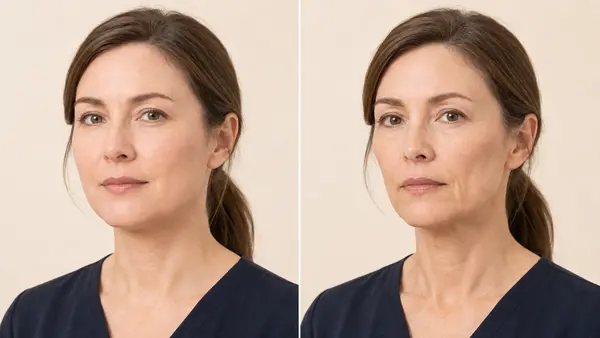
The morning after you hit your goal weight, did you go looking for old photos instead of celebrating?
The number on the scale went down. And yet in front of the mirror you find yourself pulling up a photo from a year ago. The face in it is fuller, and somehow it looks younger. You take a few more shots from different angles just to check whether you are imagining it.
You are not imagining it. And you did not fail at anything.
Over the past year or two I have seen a clear rise in patients coming to my clinic in Korea for exactly this. Most lost the weight with Wegovy or Mounjaro, are happy with their bodies, and change expression only when the conversation turns to their face. That feeling — having earned a result you cannot fully enjoy — is something I understand well.
This article is not written to sell you a procedure. When I gathered the questions people actually search on this topic, a clear order emerged, and answering them in that order seemed most useful. The trouble is that the first question usually rests on a false premise.
What Ozempic face actually is — not a drug side effect, but a matter of speed
Let me answer directly: the drug did not age your face. The speed did.
Ozempic face is the popular term for what happens when GLP-1 medications such as Ozempic, Wegovy or Mounjaro produce large weight loss in a short period: facial fat drops quickly, skin elasticity cannot keep pace, and the cheeks, temples and under-eyes hollow while the jawline blurs. It is also called Wegovy face or Mounjaro face, and in my consultation room people describe it simply as looking older after dieting. It is the name of a phenomenon, not a diagnosis.
The same thing happens without GLP-1 drugs. I have seen identical facial changes in patients who lost more than 20kg through fasting and exercise alone. These medications are simply so fast and so reliable that a change which used to be uncommon has become common.
Three things are happening at once.
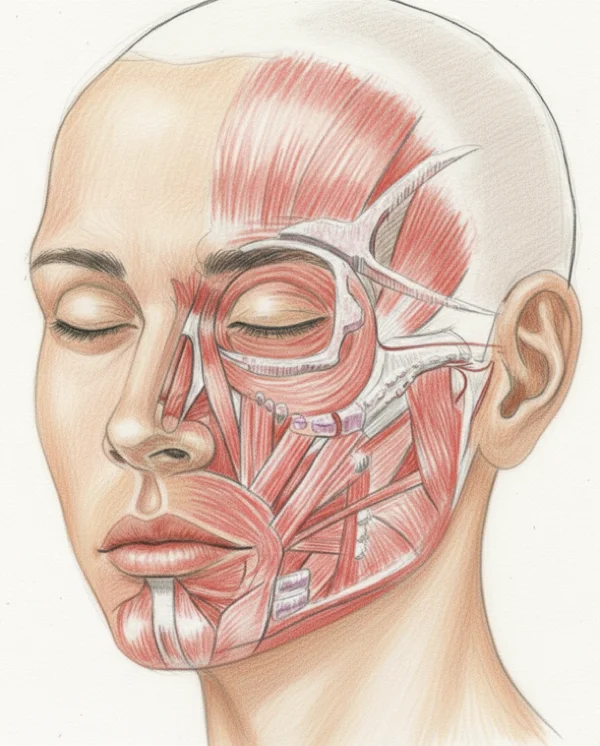
① Uneven loss across facial fat compartments. Facial fat is not one mass but a set of compartments, and they do not shrink evenly. The midface compartments — anterior cheek and under-eye — tend to go first and go furthest. Research cited in Korean media reports midface volume change with weight loss of around 10kg.
② Skin left in surplus. When volume leaves from the inside, the envelope stays. In your twenties and thirties skin retracts to a degree; past forty that retraction slows noticeably.
③ Laxity of the retaining ligaments. When the ligaments anchoring skin and deep tissue to bone loosen, whatever remains settles downward. This is the stage at which nasolabial folds deepen and the jawline develops a contour break.
One Korean survey reported that roughly 60% of users experienced facial volume loss. That means it is common — not that it is irreversible. But when choosing how to address it, most people miss one thing.
It is not only hollow cheeks — two opposite things are happening
This is the most important part of the article.
Ozempic face is not one problem but two overlapping ones. Volume has disappeared (a minus) and skin and ligaments have stretched (a plus). The directions are opposite.
Lost volume is solved by adding. Stretched tissue is solved by lifting or removing. Yet most people decide by looking at only one of the two.
What happens if you go straight to filler because the cheeks look hollow? The volume returns, but the stretched skin is unchanged, so the weight you added settles downward. This is the patient who tells me their face looks wider and their nasolabial folds deeper than before. Conversely, if you only lift without addressing volume, a tightened surface over an empty structure looks more gaunt, not less.
The ratio between these two axes differs completely from person to person. Someone who lost 8kg in their thirties and someone who lost 25kg in their fifties both use the phrase "Ozempic face", yet what their faces need is close to opposite. So before asking which procedure you want, I look at that ratio.
Why lips look thinner and the philtrum looks longer after weight loss
This rarely comes up online, yet it comes up often in my clinic.
Some patients feel their lips have thinned. The red portion of the lip does hold volume, and when it decreases the lip rolls inward. And when the tissue above settles, the distance from the base of the nose to the lip — the philtrum — looks longer even though it has not actually lengthened. If less of your upper lip shows in photos than before, this is likely what changed.
I have worked on face lifting and on lips and the philtrum for more than 15 years, so these subtle complaints do not sound trivial to me. It is a small area in the context of the whole face, but its weight in overall impression is not proportional to its size. It is also an area that broad lifting does not improve well.
"Can I have something done now?" — the question I most often answer with "not yet"
This question comes up constantly in searches. And my answer is often the disappointing one.
If your weight is still moving, I ask you to wait. Add volume while loss is ongoing and it empties again months later; lift while laxity is still progressing and it loosens again by whatever remains to be lost. I understand the impatience, but I have seen several patients pay twice for skipping this order.
| Stage | State of the face | What I recommend |
|---|---|---|
| Loss ongoing | Changing monthly, cannot be assessed | Protein and strength maintenance, control the pace (0.5–1kg per week) |
| Just after finishing | Swelling and fluid shifts make it look worse than it is | Hold off. Patients who decide here regret it most |
| 3–6 months stable | You can see how far skin has retracted on its own | The right time for a first consultation. Assess the two axes |
| Beyond 6 months | What remains will not resolve on its own | Plan volume restoration and lifting |
Honestly, by the third row of that table many people are in better shape than they first feared. Skin retraction is quite good into the early thirties in particular. So I genuinely do tell many patients who come to me before that point to do nothing. I know that is a loss for the clinic. I say it because it is correct.
Start with a 1:1 personalised consultation
✅✅ We compare and explain every option, including whether volume or lifting should come first
✅✅ You get an honest opinion whether or not you go ahead with surgery
📲 Chat icon at the bottom right of the official Dr.Tak Plastic Surgery website → connect to a live consultation
Filler, thread lifting and facelift — side by side across 7 criteria
Rather than asking which procedure is best, ask which state suits which procedure. Seven criteria decide it.
① How much weight was lost (under 10kg, or over 20kg)
② Age — can natural skin retraction still be expected
③ Which axis dominates — volume loss or skin and ligament laxity
④ How long you expect the result to hold
⑤ How many days of recovery you can spare
⑥ Whether you will absorb repeat costs or settle it in one go
⑦ Whether your weight is likely to change again
| Criterion | Filler / fat graft (volume) | Thread lift (non-surgical) | Facelift (surgical) |
|---|---|---|---|
| Axis addressed | Volume loss | Mild laxity | Laxity + surplus skin |
| Suited weight loss | Around 10kg | Around 10kg | 15–20kg or more |
| Suited age | All ages | 30s–40s | 40s and above |
| Anaesthesia | Topical / local | Local | Sedation or general |
| Recovery | A few days | 1–2 weeks | 2–4 weeks |
| Duration | Repetition needed | Limited | Longest |
| Scarring | None | Minimal | Incision, placed to conceal |
| Removes surplus skin | No | No | Yes |
| Corrects ligaments / deep layer | No | Limited | Yes |
| Cost structure | Recurring | Recurring | One-time |
📍 Bottom line: the larger the weight loss and the higher the age, the more the balance shifts from filling to reorganising. Conversely, if the loss was modest and your skin still retracts well, I will not recommend surgery.
Why does it sag again months after a lift?
Patients arriving with this question have increased noticeably, usually after one or two non-surgical lifts.
The reason is simple. The surface was lifted.
What pulls skin downward is not the skin itself but the deep tissue beneath it and the loosened ligaments. Lift only the surface and it looks tight in that moment, while the causal layer stays untouched and returns to the same place. The larger the original weight loss, the faster that return.
That does not mean non-surgical work is pointless. At an early stage of laxity it is the better choice, not the worse one. The problem is starting without confirming which stage you are at.
Recovery — the timeline changes with the path you take
| Timeframe | Volume-based | Surgical |
|---|---|---|
| 1–3 days | Possible swelling or bruising, normal activity | Compression and rest |
| 1–2 weeks | Mostly settled | Sutures out, concealable with makeup |
| 1 month | Final shape | Swelling largely gone, expression natural |
| 3 months | Reassess by absorption | Contour stabilised |
| 6 months | Decide on maintenance | Final scar concealment check |
Reading the numbers alone, the surgical column looks daunting. I know it reads that way. I would only add that over three or five years the picture often looks different.
What patients say most often after coming to us
Dr.Tak Plastic Surgery maintains over 200 Google reviews at a perfect 5 stars. To me the recurring phrase in those reviews matters more than the number itself. Most of them turn on being told they did not need to do it.
Working on face lifting and on lips and the philtrum for more than 15 years has taught me that the decision not to operate is often harder, and more important, than the decision to operate.
💬 "To make people smile"

The Dr.Tak 4S patient care system
We focus on the person, not the procedure.
Solution — Dr. Seung-wan Tak's 1:1 master plan
- Genuine empathy and communication: what you want reflected fully in the surgical plan
- Precise facial golden-ratio analysis: measuring which dominates, volume loss or skin laxity
- Simulation of expected post-operative change
Support — global 1:1 dedicated coordinator
- A dedicated coordinator by country (no language barrier)
- Accompaniment through consultation, surgery and aftercare
- 100% appointment-only (private clinical environment)
Scar Care — six months of focused scar management
| Item | Period | Detail |
|---|---|---|
| Control taping | 3–6 months | Prevents scar widening |
| Scar-softening injection | 6 months (monthly) | Softens raised scars |
| Laser treatment | 6 months | Reduces redness at the surgical site |
Service — one year of complimentary aftercare
- Complimentary aftercare within one year of surgery
- We see it through to the end
- ※ A base anaesthesia fee may apply where sedation is used
If you would like to know more — official channels
🌐 Official website drtakprs.com
📝 Detailed procedure information and case material
📹 Video content presented by the surgeon
Six things to settle before your consultation
✅ Front-facing photos before and after weight loss, same lighting and angle
✅ Total weight lost and the period it took, as numbers
✅ How many months your current weight has held
✅ Whether further loss is planned
✅ The type and timing of any procedures you have had
✅ Whether what bothers you most is the cheeks, the jawline or the perioral area
Fill in those six lines and most of the consultation can go to building an actual plan.
Frequently Asked Questions (FAQ)
The questions we receive most often at Dr.Tak Plastic Surgery.
Q1. Is it true that once Ozempic face sets in, it cannot be reversed?
Half true. Fat that has gone rarely refills on its own, but methods to improve the state clearly exist in stages. The cost structures differ, though: volume procedures cost less per session but require repetition and accumulate over three to five years, while surgical correction is a one-time concentration. The four factors that create the price range are extent of correction, anaesthesia type, whether volume restoration is combined, and any prior procedures — and I give a range only after checking those four.
Q2. If I stop the medication, will my face come back on its own?
Partly. When weight returns some facial fat returns with it, and some patients do consider stopping for that reason. But what returns is fat, not the skin that stretched. I do not recommend reversing weight loss for the sake of the face, because the health gain you would give up is too large and the face can be approached another way.
Q3. Are Wegovy face, Mounjaro face and Ozempic face different things?
Only the names differ. Ozempic and Wegovy are semaglutide, Mounjaro is tirzepatide, but what happens in the face is determined by the extent and speed of loss, not the drug. So I ask how many kilograms over how many months before I ask which medication. Those two numbers predict half of the picture.
Q4. I am still on the medication — can I have a procedure or surgery now?
I would not advise it. Being on treatment means your weight is still moving, and the face in the mirror is not the final state. The right moment is after treatment ends, once weight has held for three to six months and laxity remains after natural skin retraction has stopped. Conversely I do not recommend surgical correction where further loss is planned, where weight fluctuates widely, where an uncontrolled underlying condition exists or where stopping smoking is not feasible — and I would stress that this standard exists to protect the result, not the clinic's convenience.
Q5. Can I prevent it during weight loss? And if it has already happened, is it too late?
While you are still losing, there is something you can do. Pace and nutrition are the only levers in that window, and deliberately slowing down in the final stretch toward your goal makes the biggest difference to the face. If your loss is already complete, it is not too late — the order of approach has simply changed. I try not to use the word "late" in consultations, because I have seen far more results go wrong from hurrying than from waiting.
Dr.Tak Plastic Surgery | Korea Face Lifting Specialist Clinic
"To make people smile"