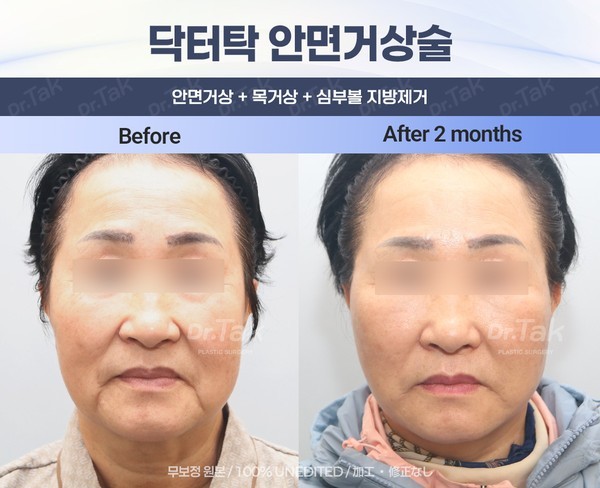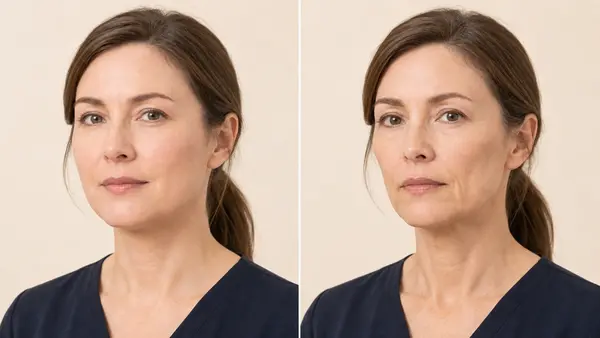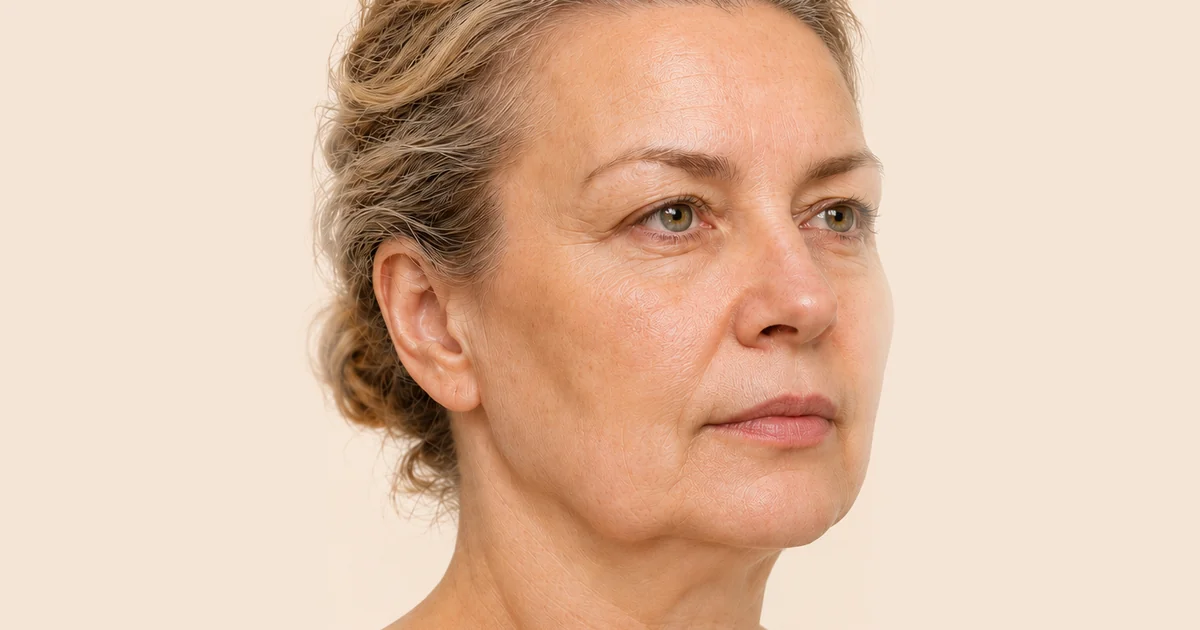
"My face looks like it is sliding down" — what to sort out before you look into a lift
At some point your face in photos started to look as if it had slipped downwards, and you found this article while looking into lifts. The jawline is softening and shadows are gathering around the mouth, and it is hard to know what to do about it.
The thing I hear most often in consultation is "I've sagged a lot, haven't I?" But when I feel the face and change the angle, a fair number of people are closer to hollowed than sagged. The volume in the cheeks and temples has gone, and the skin left behind only looks as if it has dropped.
This difference matters more than you might think. If the main cause of your "sagging" is stretched skin and tissue, it needs to be lifted; if it is lost volume, it needs to be filled. Do the opposite and you spend money and time and still end up looking unnatural.
So this article starts with the four layers where sagging happens, then shows how to tell laxity from hollowing, and finally how to find your own grade. By the end, you will know exactly what to ask in a consultation.
What facial laxity and sagging are — three changes that look alike but are not
The short answer: facial laxity is the cause, and sagging is how it looks. A third change gets mixed in very often — volume loss, or hollowing.
Facial laxity (skin laxity) means the skin and the tissue beneath it have stretched and lost their firmness. Sagging (facial ptosis, in medical terms) is what you see when that stretched tissue moves down with gravity and folds along the jawline and around the mouth. Volume loss is the shrinking of fat and bone that leaves the face hollow; it arrives together with sagging but is treated differently. If you come across "cutis laxa" while searching, that is a separate inherited or disease-related diagnosis, not the age-related laxity this article covers.
These three almost always come mixed. The real question is which one is bigger.
Sagging happens in four layers — skin, fat, ligaments and fascia, and bone
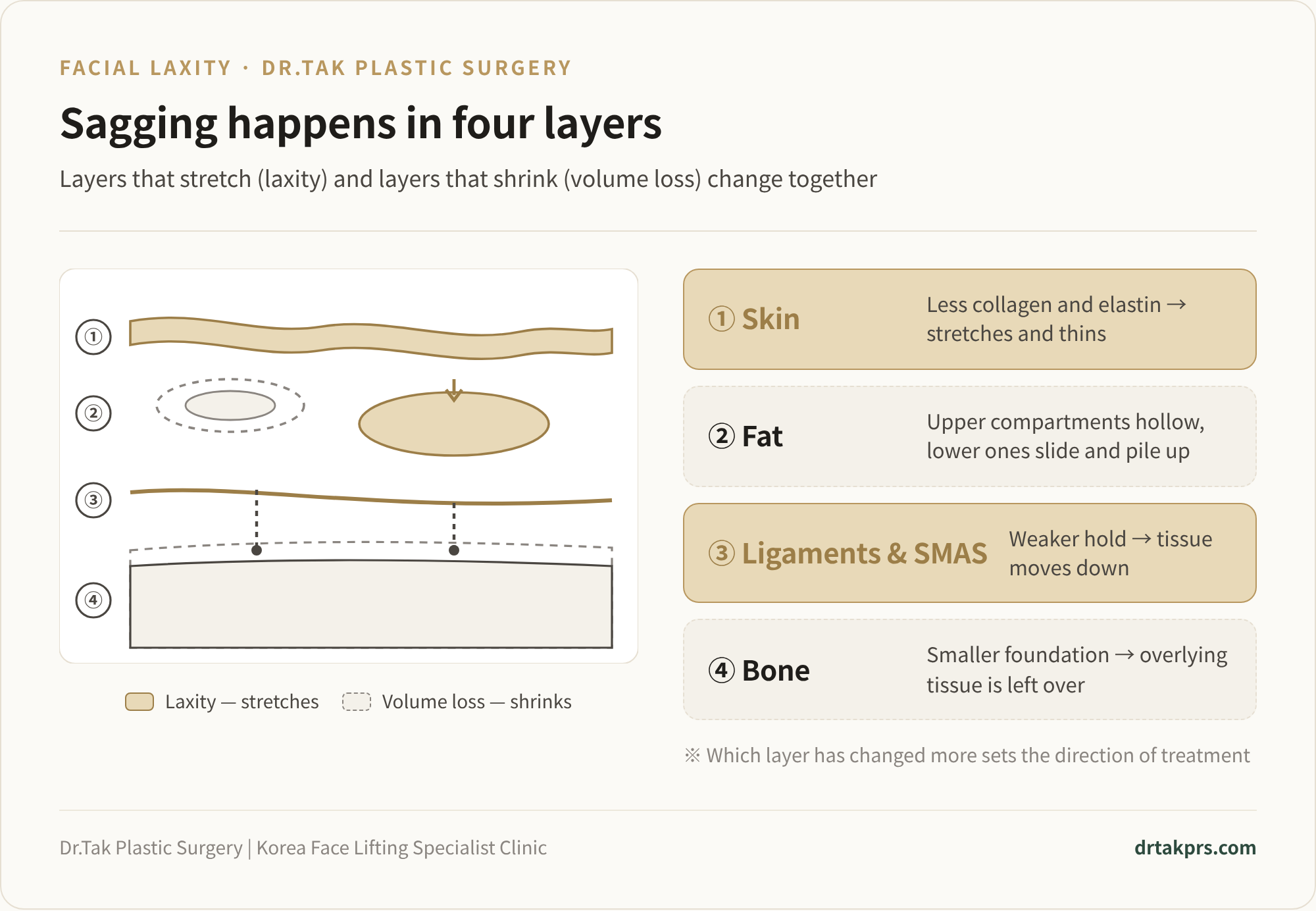
The face is built from four layers — skin, fat, fascia and ligaments, and bone — and with age each layer changes at its own pace. This is the first thing I draw for people in consultation.
① Skin — the layer that loses collagen and elastic fibres
After adulthood, skin collagen is known to decline a little every year. Once the elastic fibres weaken as well, skin stretches and loses the force that pulls it back. Fine lines and thinning skin are the signs of this layer.
② Fat — the compartments that shrink and slide
Facial fat is not one block; it is divided into several compartments. With age, the upper compartments shrink and hollow while the lower ones slide down and pile up. This is why the under-eye area and front of the cheek hollow while the smile lines and the area beside the jaw grow heavier.
③ Fascia and retaining ligaments — the layer that anchors the face to bone
Under the skin lies the fascia that covers the facial muscles (the SMAS), and retaining ligaments under the cheekbone and at the front of the jaw tie it to the bone. When those ligaments loosen, the tissue between them comes down as sagging. Jowls are the classic example: tissue pooling just behind the ligament at the front of the jaw.
④ Bone — the shrinking foundation
This is the part many people do not know. With age, the bony rim of the eye socket widens and the upper and lower jaw bones slowly shrink. When the foundation gets smaller, the tissue draped over it is left over, and left-over tissue looks like sagging.
📍 Bottom line: Stretched skin and ligaments are "laxity"; shrunken fat and bone are "volume loss". They happen together in the same face, but which one dominates sets the direction of treatment.
So can you tell the two apart just by looking in the mirror?
Sagged or hollowed? — laxity and volume loss compared on 9 points
To put it simply: with laxity you see something "left over", and with volume loss you see something "missing". In consultation I go through the points in this table one by one.
| Point | When laxity is the main cause | When volume loss is the main cause |
|---|---|---|
| Where it shows | Jawline, around the mouth, neck | Temples, under the eyes, front of the cheek |
| Facial outline | Jawline breaks and the lower face looks heavy | Outline stays, but hollows appear |
| Lifting with your fingers | Looks markedly younger | Hollows stay where they are |
| Looking in a mirror lying down | Looks considerably better | Little change, or looks more hollow |
| Gently pinching and pulling the skin | Stretches a lot and returns slowly | Stretches less |
| Typical age and trigger | Late 40s onwards, after childbirth or weight gain | After weight loss, slim builds, from the 30s |
| Impression | Heavy, looks displeased | Tired, looks older |
| Direction that fits | Return tissue to place and remove the excess | Replace the lost volume |
| If the wrong choice is made | Filling alone makes it heavier | Pulling alone looks tight and unnatural |
Most faces fall across both columns. Of all the faces I have seen, very few have had only one.
📍 Bottom line: "Which is bigger?" is a more accurate question than "Which one is it?" Once the ratio is clear, the next step is the grade.
Three checks in front of the mirror — finding the main cause of your sagging
There are three checks I suggest people try at home before a consultation. They cannot replace a proper diagnosis, but they are more than enough to understand your own face.
✅ Look lying down — lie flat on your back and hold a hand mirror above your face. If the jawline returns and the shadows around the mouth fade compared with sitting up, gravity — that is, laxity — is the larger share. If the temples and under-eyes stay hollow even lying down, volume loss is the larger share.
✅ Lift with your fingers — place your fingertips beside the cheekbones in front of the ears and draw them diagonally upwards by 1–2 cm. If the smile lines and jowls tidy up together, a lifting approach is likely to work.
✅ Pull the cheek skin — gently pinch the skin in the middle of the cheek between thumb and index finger, pull it forwards and let go. If it stretches a lot and returns slowly, the skin itself has lost elasticity.
It is not unusual for the three results to disagree. Real faces are almost always mixed.
A 1:1 consultation you can start right now
✅✅ We look at the four layers directly and explain whether sagging or hollowing is the bigger factor
✅✅ An honest opinion, whether or not you go ahead with surgery
📲 Chat icon at the bottom right of the Dr.Tak Plastic Surgery official site → live consultation
Facial laxity in 4 grades — the changes you see at each stage and the options that fit
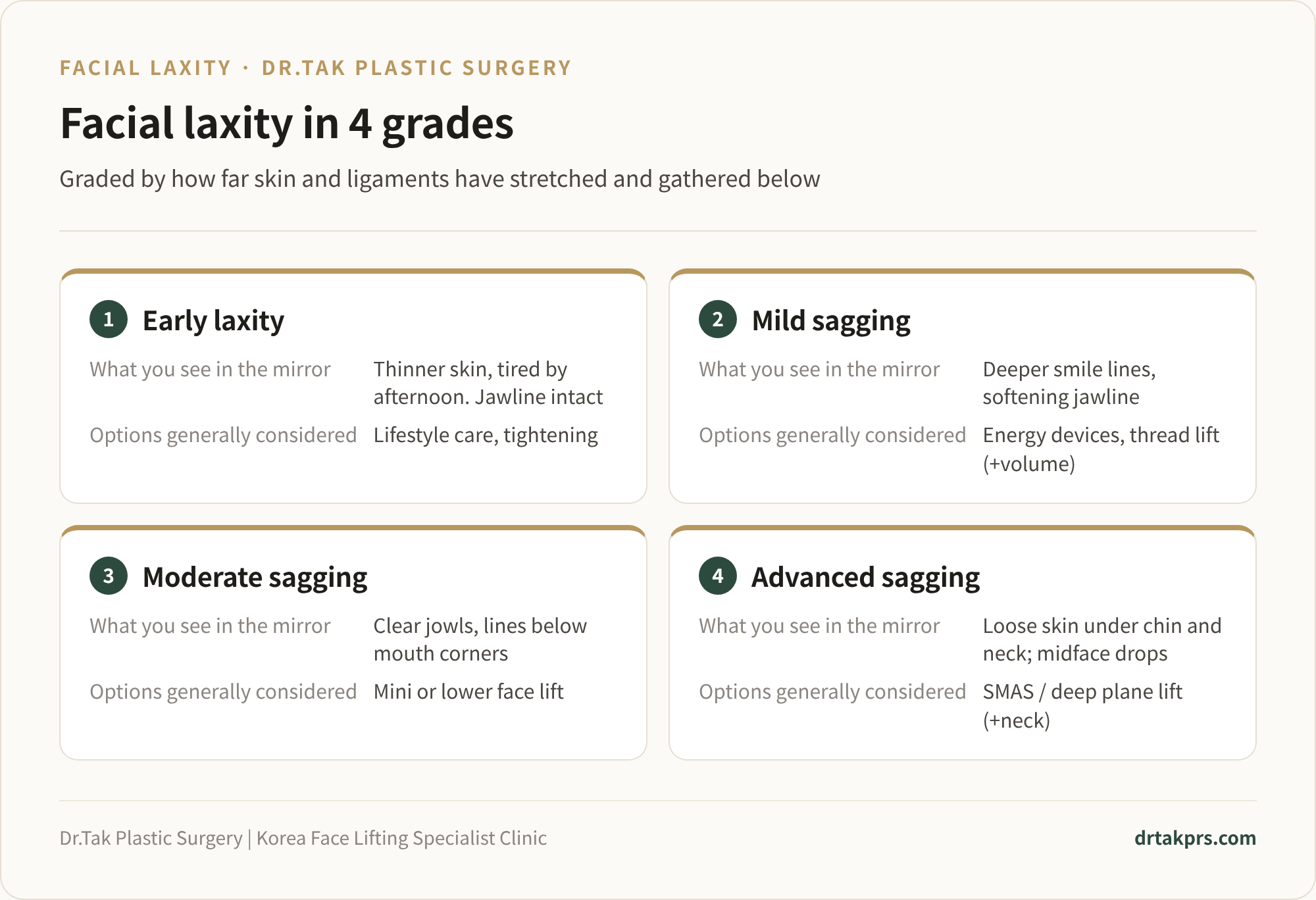
There is one criterion for the grades: how far the skin and ligaments have stretched, and how much tissue has gathered below. The table below simplifies the laxity grading used in the medical literature into four stages that are easy to use in consultation.
| Grade | What you see in the mirror | Lying down | Options generally considered |
|---|---|---|---|
| Grade 1 — early laxity | Skin texture thins and the face looks tired by afternoon. Jawline intact | Almost no difference | Lifestyle care, skin-tightening treatments. Volume replacement if hollowing is significant |
| Grade 2 — mild sagging | Smile lines deepen and the jawline starts to blur. Slight jowls | Slightly better | Energy-based tightening, thread lift. Add volume replacement if hollowing is present |
| Grade 3 — moderate sagging | Clear jowls and lines below the mouth corners. Jawline looks broken | Clearly better | Surgical lifting such as a mini facelift or lower face lift |
| Grade 4 — advanced sagging | Skin hangs under the chin and down the neck; the whole midface has dropped | Much better | SMAS or deep plane facelift, with a neck lift if needed |
At grades 1 and 2 there is not much excess skin yet. So I put support for firmness and replacing what is missing ahead of surgery that removes tissue. From grade 3, the stretched ligaments and fascia need to be returned to place and fixed for the result to last.
The area around the mouth follows the same rule. When the skin above the lip stretches, the philtrum looks longer and the upper lip thinner — I have explained this in why a long philtrum makes the face look older. If you want to go deeper into the causes themselves, see the five causes of sagging skin, from collagen to the SMAS.
Once you have your grade, it is time to lay it over the "main cause" from earlier. Two faces at grade 3 need different plans if one is mostly hollowed and the other mostly stretched.
When the cause and the fix do not match — lifting only, or filling only
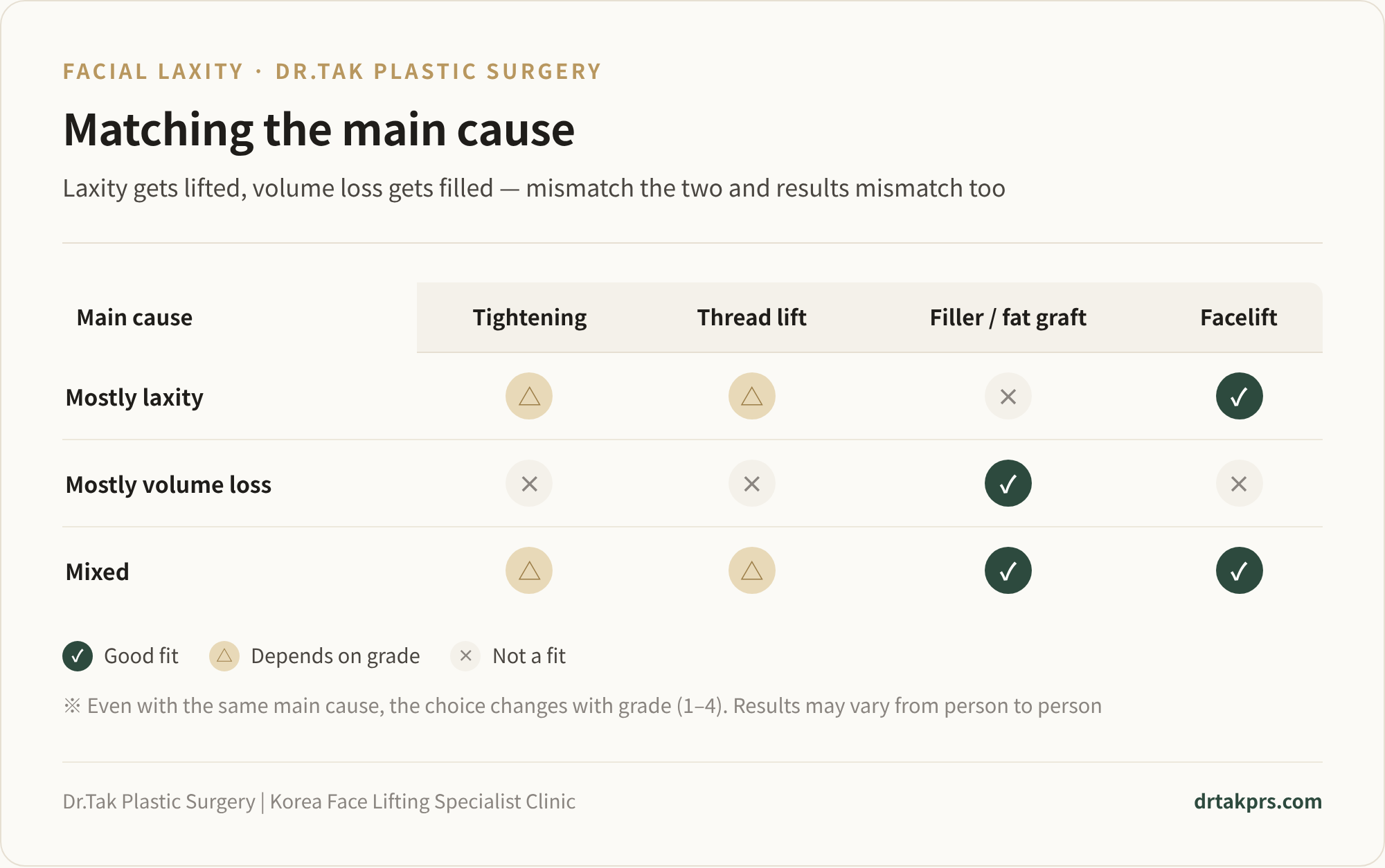
The short answer: most failures in treating sagging come from direction, not technique. Lift a hollowed face without filling it and you get a face that is tight but somehow pulled; fill a stretched face without lifting it and it grows heavier and looks even more sagged.
People keep coming to us saying their face has grown bigger and droopier after repeated filler elsewhere. When I look, most had grade 3 laxity or more, and the weight had been propped up with volume alone. On the other side, some have told me that after a lift their cheeks looked gaunt and they seemed older. That is what happens when hollowing is pulled but never filled.
💬 Sagging goes up; hollowing gets filled. The face only looks natural when the order and the ratio are right.
That is why, when I plan surgery, I decide on the extent of the lift and on the need for volume replacement such as fat grafting together. It is not a choice of one or the other.
There are grades where I do not recommend surgery — who it suits and who it does not
To be honest, surgery is not right for everyone who worries about a sagging face. In consultation I quite often say, "You don't need surgery yet."
✅ Surgical lifting suits you well — grade 3–4, with clearly stretched tissue along the jawline and around the mouth, and a big improvement when lifted with your fingers
✅ Non-surgical care or volume first — grades 1–2, or little difference lying down and hollowing as the main cause
⚠️ Postpone or be cautious — uncontrolled blood pressure or diabetes, difficulty stopping smoking, blood-thinning medication that cannot be paused, or a face still changing during major weight loss
⚠️ Adjust expectations — fine lines and skin texture are not fully solved by a lift alone; the skin surface needs separate care
If you are in the middle of losing weight, I especially recommend waiting. A plan made while the face is still changing may need to be redone a few months later.
We read the layers before we set the grade — a diagnostic order kept for more than 15 years
When I meet someone worried about sagging, I look first at the state of each of the four layers rather than at which operation they want. Only after checking skin thickness, where the fat has moved, how far the ligaments have loosened and how much support the bone gives do I talk about grade and direction.
The reason for this order is simple. Very different faces sit under the single word "sagging".
🏥 Let me briefly explain why we are able to keep to this principle.
- Dr.Tak Plastic Surgery has more than 15 years of experience in facial lifting and lip and philtrum surgery in Korea
- We hold a 5.0/5 rating across more than 200 Google reviews
- In consultation we first explain the ratio of laxity to hollowing, and only then the options
- If we judge surgery to be too early, we will honestly suggest waiting
💬 "To make people smile." Not a face that has simply been pulled up, but a face you can smile at comfortably in the mirror — that is what we consider the result.
Before & after photographs are on our official page
Dr.Tak Plastic Surgery complies with medical advertising regulations, so we do not place before-and-after photographs inside blog articles. Actual pre- and post-operative changes are collected on the official before & after page.
🔗 View before & after — Dr.Tak Plastic Surgery official page
Results may vary from person to person.
The Dr.Tak 4S Patient Care System — focused on people, not procedures
We focus on people, not procedures.
Solution — a 1:1 master plan with Dr. Tak Seung-wan
- Genuine empathy and communication: your wishes reflected fully in the operation
- Precise golden-ratio facial analysis (personalised): checking the four layers — skin, fat, ligaments and bone — to judge the ratio of laxity to volume loss and your grade of sagging
- Post-operative change simulation provided
Support — a dedicated 1:1 global coordinator
- A coordinator assigned by country (no language barrier)
- Accompanying you through consultation, surgery and aftercare
- 100% appointment-only (private clinical environment)
Scar Care — six months of focused scar management
| Item | Period | Content |
|---|---|---|
| Control taping | 3–6 months | Prevents scar widening |
| Scar-softening injection | 6 months (monthly) | Softens raised scars |
| Laser treatment | 6 months | Reduces redness at the surgical site |
Service — one-year complimentary revision guarantee
- Complimentary revision within one year of surgery
- We see your care through to the end
- ※ Where sedation is used, a base anaesthesia fee may apply
If you would like to know more — official channels
🌐 Our official site carries technique-by-technique detail
📝 Our blog has related reading on deep plane facelift and the difference between mini and full facelift
📹 Video material shows the surgical process and recovery course
Five things to settle before a lifting consultation
✅ The difference between your face lying down and sitting up — bring two photos taken on your phone and the consultation goes much faster
✅ The one area that bothers you most — choose just one: jawline, around the mouth, or under the eyes
✅ Any weight change in the last one to two years — please tell us if you have lost 5 kg or more
✅ Previous treatments — the type and timing of filler, thread lifts and energy-based treatments
✅ How long you can take off — recovery for each option differs a great deal by grade
It is fine if you cannot settle everything. We will go through the rest together in consultation.
Frequently Asked Questions (FAQ)
These are the questions we hear most often at Dr.Tak Plastic Surgery.
Q1. Can I self-assess facial laxity at home?
To a degree, yes. The three checks above — the lying-down check in particular — tell you quite a lot about whether laxity or hollowing is bigger. What is hard to judge at home is how far the ligaments have loosened. When I press along the front of the jaw in consultation, I quite often find people who look like grade 2 from the outside but have tissue pooling behind the ligament, so grade 3 is the fairer call.
Q2. Can skin laxity be reversed?
Early laxity at grades 1–2 has some room to improve with skin care and tightening treatments. But tissue that has gathered below because the ligaments and fascia have stretched does not move back up with creams or devices. Cost follows the same divide. We cannot quote an exact figure before a consultation, but it generally depends on the grade and extent of sagging, whether the neck is included, whether volume replacement is added, and the type of anaesthesia.
Q3. Can facial exercises or massage improve sagging?
Exercise can improve colour and make the face feel fresher for a while. But the main cause of sagging — laxity of the ligaments and fascia — does not reverse with muscle exercise, and firm massage can drag stretched tissue further down. I have explained why this happens around the mouth in why exercises rarely fix downturned mouth corners. I do not discourage exercise, but at grade 3 and above I do not recommend relying on it alone.
Q4. My face sagged after losing weight — is that laxity or hollowing?
Usually both. As fat is lost, volume drops, and the skin that had been stretched by that fat is left over and looks saggy. Pull this kind of face only and it looks gaunt; fill it only and the loose skin stays. So I recommend planning a lift and volume replacement together once your weight has been stable for at least a few months.
Q5. What if I look even more unnatural after a lift?
This is the worry people confide most. An unnatural result usually comes from pulling too hard, pulling without filling the hollows, or pulling only the skin so the expression looks frozen. If the fascia and ligaments — not just the skin — are returned to place and only as much as needed is filled, the change is the kind that makes people ask whether you have been on holiday. In consultation I first agree with you, using a simulation, how far to lift.
Dr.Tak Plastic Surgery | Korea Face Lifting Specialist Clinic
"To make people smile"