Your face looks fine from the front — but in profile photos, your upper lip seems to vanish
You may have seen a profile photo someone took of you and thought, "Was my upper lip always this flat?" In the mirror from the front you never noticed, but from the side the area from under the nose to the lip runs in an almost straight line and the lip barely shows.
When I hear this concern in a lip consultation, the first thing I do is not talk about surgery. We put one profile photo in front of us and look at what is making it flat. The same flatness can come from a lip that is thin, from a philtrum that is long, or from an upper jaw and teeth that sit too far back to support the lip — and each of those needs work in a completely different place.
In this article I will first explain three measurements I use to judge the upper lip in profile, then rule out the three causes of a flat look one by one, and finally set out the options that suit each cause in one table.
The order matters. Skip the cause, and you can spend the same money and time and still end up with the same profile.
What a flat upper lip is — a problem of projection, not volume
To put the answer first: a flat upper lip is a state in which, viewed from the side, the upper lip does not come forward enough, so the line from under the nose to the lip looks flat and continuous. In English it is called a flat upper lip, a flat upper lip side profile, or a lack of upper lip projection; in Korea it is often described as 납작한 입술 or a lack of upper lip protrusion.
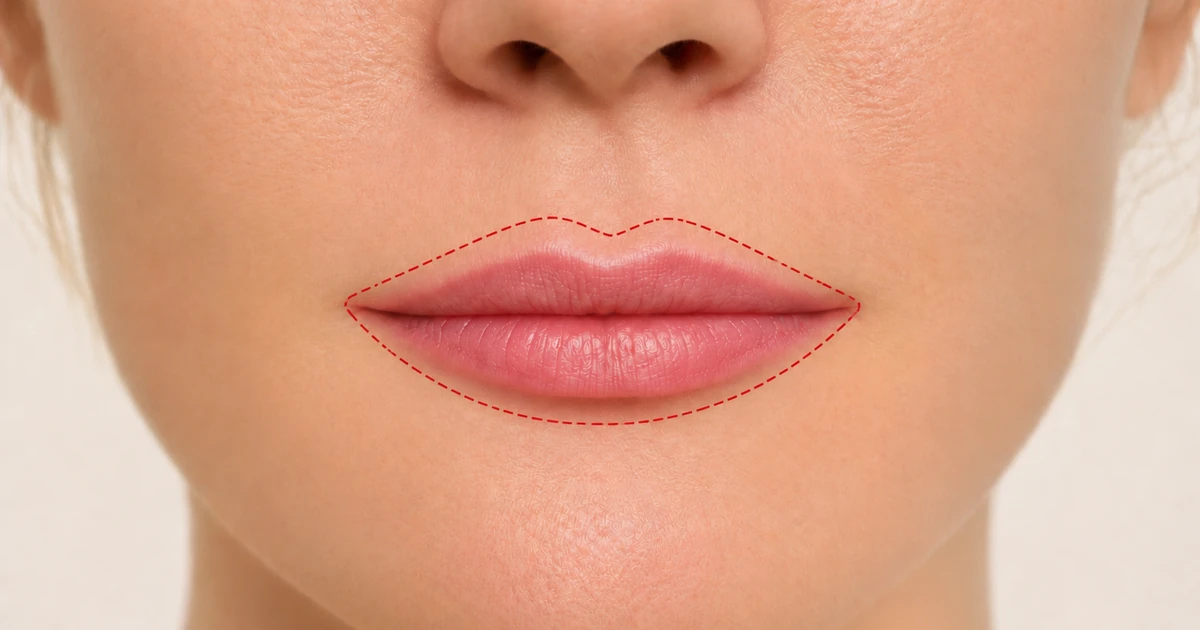
The key point is that thickness from the front and projection from the side are different measures. Some people have plenty of red lip from the front yet look flat from the side; others look thin from the front but have a perfectly good profile line. I have covered front-view volume and dimension separately in how to choose a fix for thin, flat-looking lips; this article deals only with the profile line.
In my consultations, when a profile concern is approached with front-view standards, the result often misses. So what should we look at from the side?
Three measurements for judging the upper lip in profile
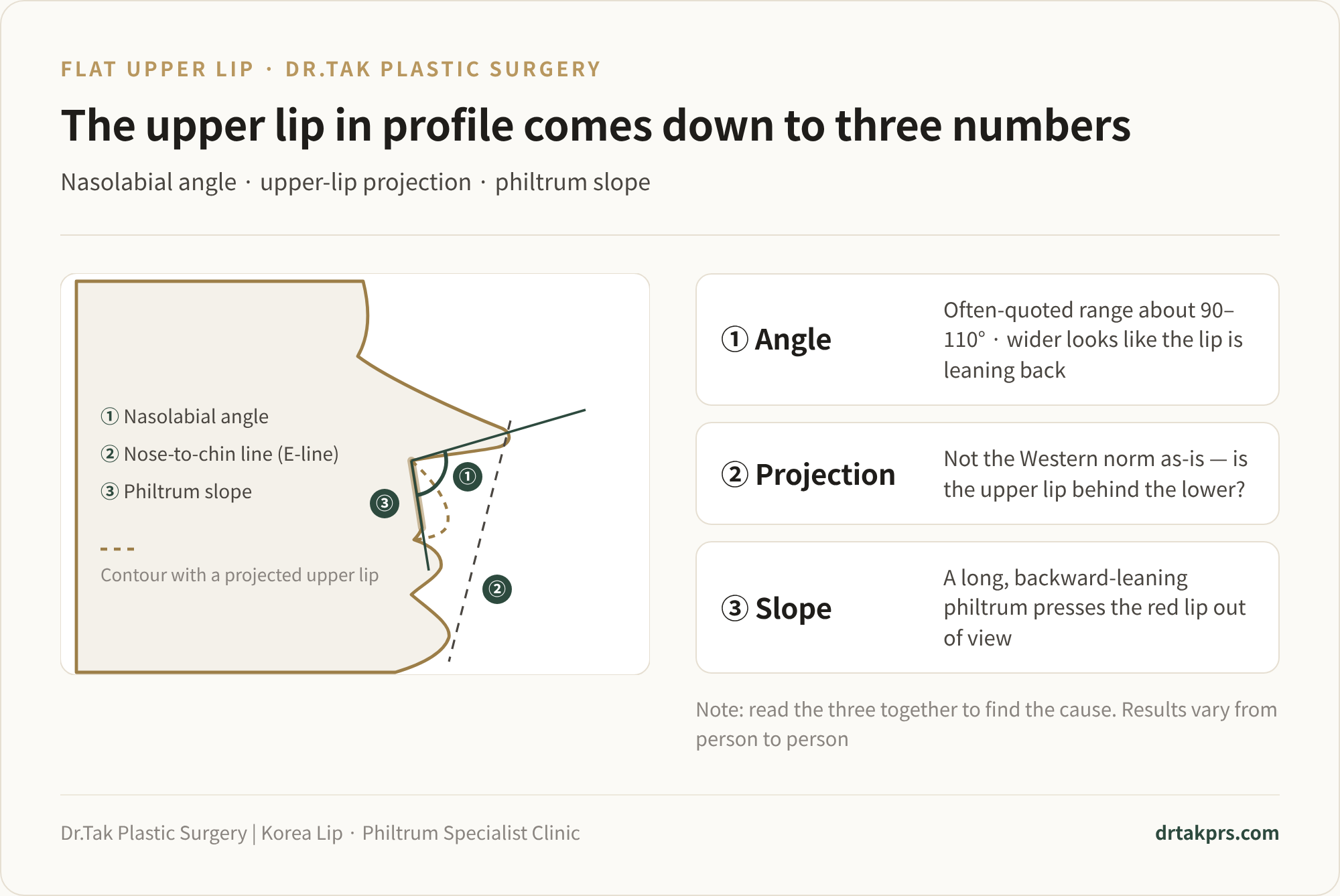
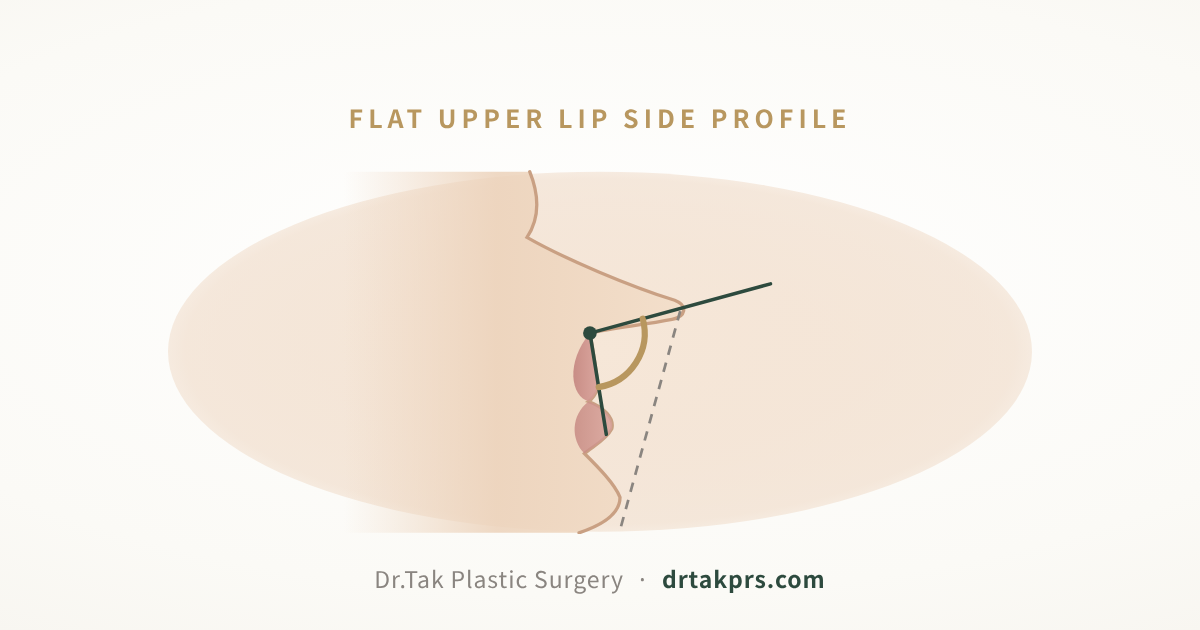
To put the answer first: on a profile photo I measure the nasolabial angle, the position of the upper lip's projection, and the slope of the philtrum. The direction in which these three numbers are off is the direction of the cause.
① Nasolabial angle — where the nose meets the upper lip
Draw one line along the underside of the columella, and another from that point along the front of the upper lip; the angle between them is the nasolabial angle. The range most often cited is roughly 90–110°, and when it opens wider than this the upper lip looks as though it is lying back. People who complain of a flat upper lip often have a wide-open angle. But if the nasal tip is upturned the angle widens regardless of the lip, so I never draw a conclusion from this number alone.
② Upper lip projection — distance from the line joining nose tip and chin
Draw a line from the nose tip to the chin (the E-line) and you can see how far the upper lip sits from it. Western standards place the upper lip a few millimetres behind this line, but Korean lips naturally sit further forward, so I do not apply the Western standard as it is. Instead I look at whether the upper lip lags behind the lower lip. In profile, balance looks best when the upper lip sits very slightly ahead of the lower lip.
③ Philtrum slope — the incline from under the nose down to the lip
I check whether the philtrum stands close to vertical or lies at an inward slant. When the philtrum is long and slants inward, the red lip is pressed by that slope and hides backward. For Korean adult women I regard a philtrum length of roughly 12–15 mm as typical; the longer it is beyond this, the stronger the effect of the slope.
📌 In short: the nasolabial angle tells you the result, projection tells you the degree, and philtrum slope tells you one of the reasons. The cause only shows when you read all three together.
When I sort real causes using these measurements, they gather into three branches.
Three causes that flatten the upper lip — lip, philtrum and support
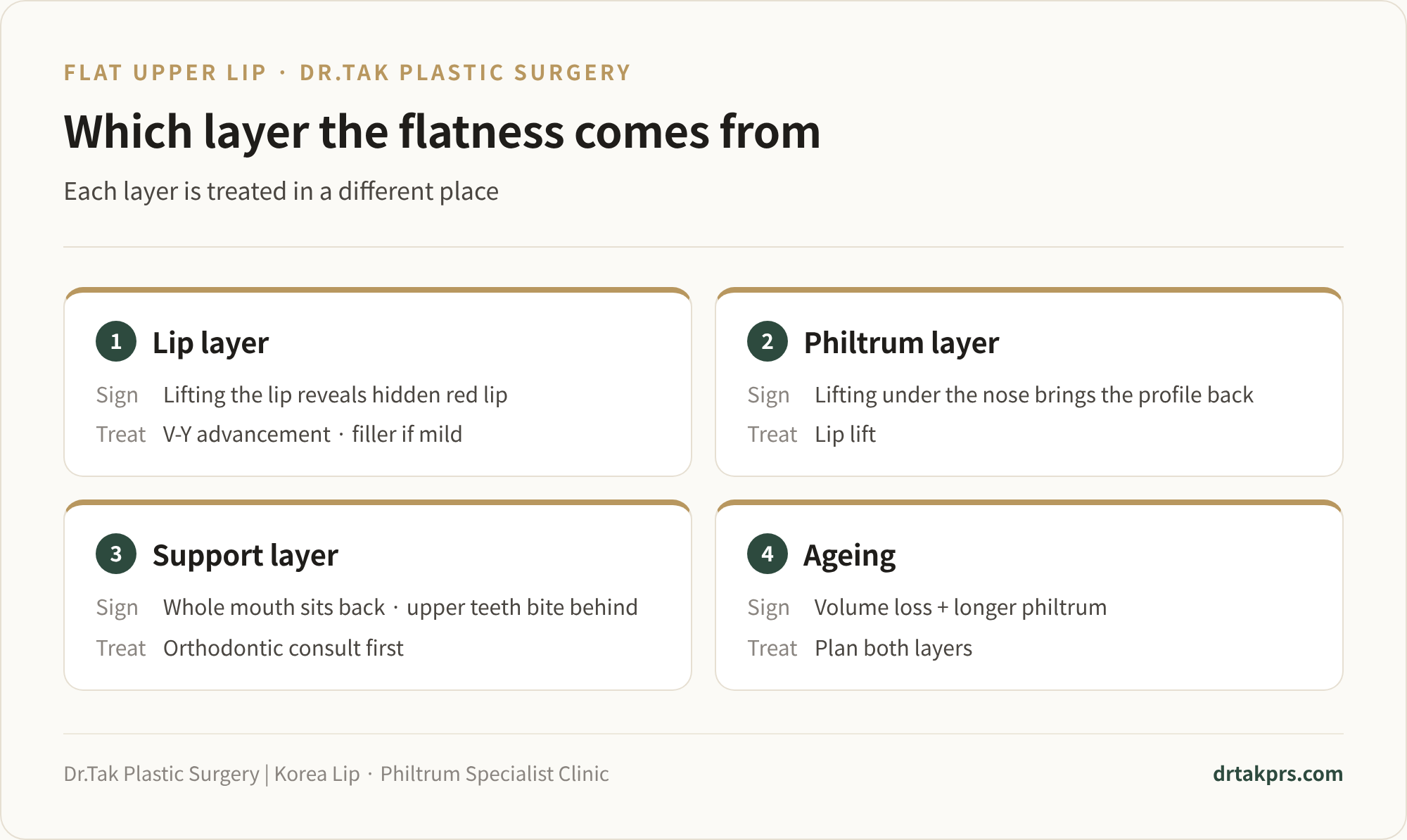
To put the answer first: the cause of a flat upper lip lies in the lip itself (the lip layer), in the philtrum above it (the philtrum layer), or in the upper jaw and teeth behind it (the support layer). Which of the three layers is the problem decides where the work should be done.
① Lip layer — the red lip is thin or rolled inward
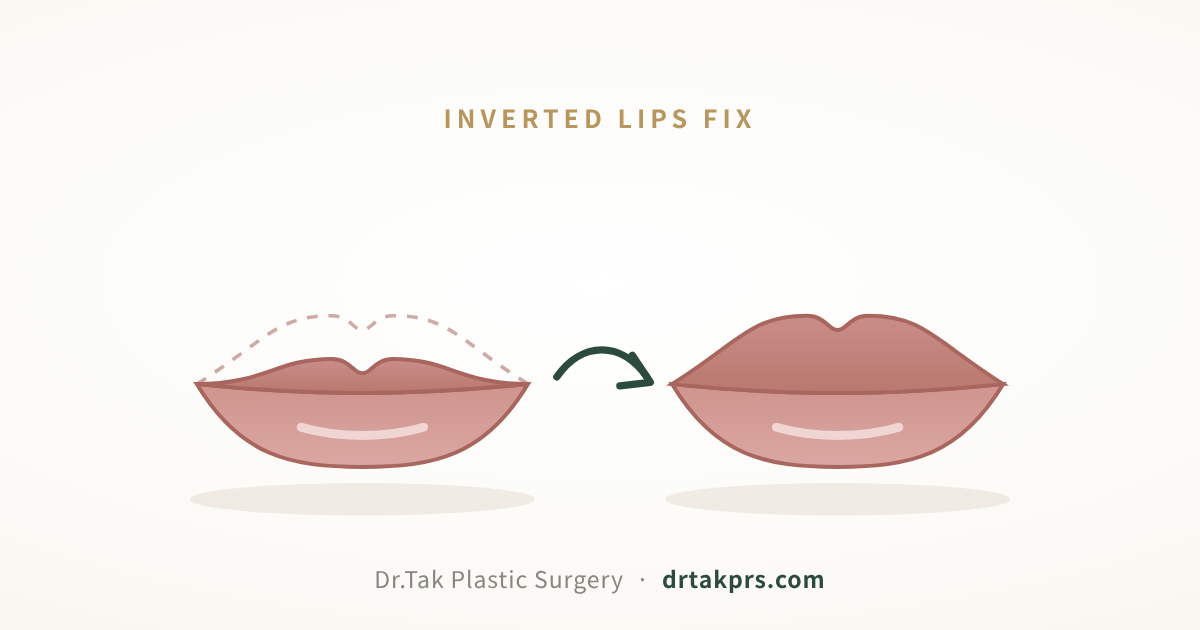
Here the red lip has little tissue, or it has tissue that faces inward rather than outward. From the side, the front of the upper lip drops in a flat line instead of curving forward. If you open your mouth slightly and lift your upper lip with a finger and quite a lot of red lip appears from the inside, it leans toward the inverted type. The detailed types of inversion are covered in the three causes of inverted lips and how to check yours.
② Philtrum layer — a long philtrum presses the lip down
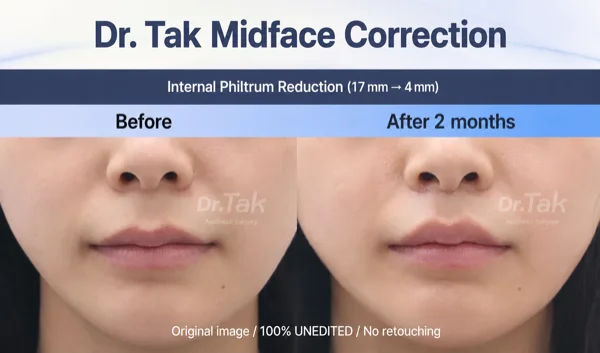
When the philtrum is long and slants inward, the red lip is pushed down and back and looks flat from the side. In this case the lip itself is often fine. If gently lifting the skin under your nose with a fingertip makes the upper lip roll forward and the profile line come back to life, the philtrum layer is the likely cause.
③ Support layer — the upper jaw and teeth sit too far back
The lips are soft tissue resting on the upper jaw and front teeth. If the supporting upper jaw sits back, or there is a bite in which the lower jaw comes forward, the lip lacks a base to come forward from and looks flat. In this case, however much the lip is enlarged, the support stays where it is and the profile does not change as much as hoped.
💡 When the lip has become flat with age, this is usually not a separate cause but a combination: volume in the lip layer falls while the philtrum layer lengthens. That is why I look at both layers together.
| Cause layer | Signs you can see in the mirror | Where the measurements are usually off |
|---|---|---|
| ① Lip layer | Lifting the upper lip reveals a lot of hidden red lip inside | Upper lip projection |
| ② Philtrum layer | Gently lifting under the nose rolls the lip forward and revives the profile | Philtrum slope · nasolabial angle |
| ③ Support layer | The lips are full, yet the whole mouth sits behind the facial line; upper front teeth bite behind the lower teeth | Nasolabial angle · front-back relation of upper and lower lips |
Many people have more than one layer involved. In those cases, deciding the order is half of the surgical plan.
Start with a 1:1 tailored consultation
✅✅ From a profile photo, we first identify whether the cause lies in the lip, philtrum or support layer, then compare and explain the options that fit
✅✅ An honest opinion, whether or not you choose surgery
📲 Chat icon at the bottom right of the Dr.Tak Plastic Surgery official site → live consultation
What fits each cause — filler, V-Y advancement, lip lift and orthodontic consultation
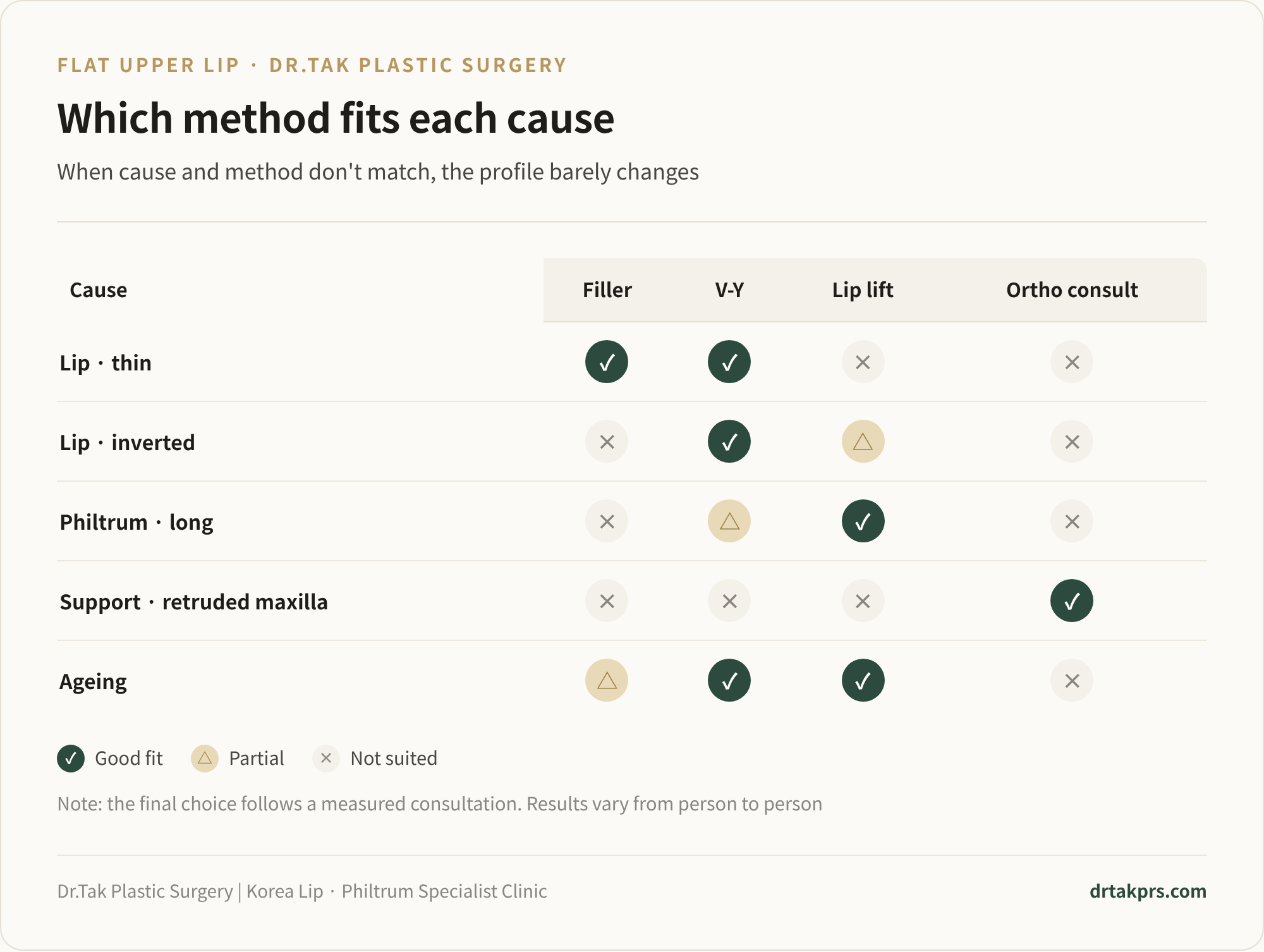
To put the answer first: for the lip layer, mucosal (V-Y) advancement — or filler in mild cases; for the philtrum layer, a lip lift (philtrum reduction); and for the support layer, an orthodontic consultation comes before any lip surgery. When the cause and the method do not match, the profile barely changes.
| Comparison | Filler | V-Y mucosal advancement | Lip lift (philtrum reduction) | Dental / skeletal orthodontic consultation |
|---|---|---|---|---|
| Cause it suits | Lip layer — slightly short of thickness, no inversion | Lip layer — thin or inverted red lip | Philtrum layer — lip pressed by a long philtrum | Support layer — recessed upper jaw / teeth |
| Direction the profile changes | Inflates forward | Tissue moved forward and outward | Lip rolled up and outward | The support itself moves forward |
| Change from the front | More thickness | More red lip showing | Shorter philtrum + more lip showing | Change to the whole mouth area |
| How long it lasts | About 6–12 months | Permanent | Permanent | Depends on the treatment plan |
| Scar | None | Inside the mouth (not visible outside) | Along the base of the nose | Not applicable |
| Downtime | Almost none | Stitches about 7 days · about 70% of swelling gone within 2 weeks | Stitches about 1 week · swelling 2–3 weeks | Several months or more |
| Problem if overdone | Puffy area around the mouth · filler migration | Lip looks flipped out | Profile can look flatter | — |
| Reversibility | Can be dissolved | Difficult | Difficult | — |
| What affects cost | Volume · number of sessions | One or both lips · number of Vs | Incision design · revision or not | Scope of treatment |
📍 Bottom line: the more the concern is about the profile, the more "which layer" comes before "how much". If the support layer is the cause and filler or mucosal advancement is added, the mouth tends to look pushed forward while the profile still feels lacking.
How mucosal advancement — the option that suits the lip layer — moves tissue is explained step by step in how V-Y advancement lip augmentation works. But the note in the lip-lift column, "profile can look flatter", needs a little more explanation.
When something else should come before lip surgery
To be honest, a flat upper lip in profile does not always mean lip surgery is the answer. If any of the following applies to you, I talk about the cause before I talk about surgery.
⚠️ Your upper front teeth bite behind the lower teeth, or your upper jaw looks set back — this is a support-layer problem, so an orthodontic consultation comes first
⚠️ Your whole mouth sits forward (bimaxillary protrusion) — protrusion pushes the lips forward, the opposite direction to flatness. Adding volume makes the mouth look even more prominent
⚠️ You have had filler several times — remaining filler hides the true lip shape. Dissolve it first, wait 2–4 weeks, then reassess
⚠️ Your nasal tip is upturned and the nasolabial angle is wide — the lip may look flat because of the angle of the nose, not the lip
⚠️ You want only a philtrum reduction although there is almost no lip volume — with too little lip to roll up, a lip lift alone can leave the profile flatter
This may feel like postponing surgery. In practice it is closer to choosing the right surgery.
How recovery differs — mucosal advancement versus lip lift
To put the answer first: for both operations, return to daily life takes 1–2 weeks and the final shape takes about 3 months, so the broad picture is similar. What differs is where the wound is, and the care that follows from that.
| Period | V-Y mucosal advancement | Lip lift |
|---|---|---|
| Day 0–3 | Lips swollen and tight · hard to open the mouth wide | Under the nose and upper lip swollen and tight |
| About 1 week | Stitches inside the mouth removed | Stitches under the nose removed |
| 2 weeks | About 70% of swelling gone | Most swelling gone · scar still in its red phase |
| 1–3 months | Firmness under the inner suture line gradually softens | Focused scar-care period (taping, laser, etc.) |
| About 3 months | Profile close to its final shape | Profile close to its final shape · scar keeps fading afterward |
The most common mistake when judging the profile is to decide the result at around two weeks while swelling remains. At this stage the lip looks further forward than it really is, and settles back a little as swelling fades. I tell patients in advance that we will judge the result together on the three-month photo.
📌 During recovery: for the first week avoid spicy and hot food, straws, and pursing the lips hard; please pause smoking and drinking until the wound has healed.
Choose the layer first, then the amount in millimetres — a principle kept for 15+ years
What I guard against most in profile consultations is trying to solve it with quantity regardless of the cause. The profile is an area where 1–2 mm changes the impression, so 3 mm in the wrong direction is worse than 1 mm in the right one.
So I keep to an order. First I choose the cause layer from profile measurements, and if several layers overlap I decide which to treat first. When both the philtrum and the lip are involved, I usually address the philtrum first and then reassess the remaining lip. Only then do I decide how far to move the mucosa, which in most cases I design within 3–4 mm. Move too little, and you can add. Move too much, and it is hard to undo.
🏥 Briefly, here is why we are able to keep to this order.
- As a clinic specialising in lips and philtrum, we have focused on this area for 15+ years
- 200+ Google reviews, rated 5.0 — covering not only results but how the consultation was handled
- In every consultation we first show you the profile measurements and the cause layer in a drawing before discussing whether to operate
- If we judge the cause to lie in the upper jaw or teeth, we tell you that before anything about lip surgery
💬 "To make people smile." Helping someone who used to avoid profile photos turn to the side and smile again — that is the purpose of this principle.
Before & after photographs are on our official page
Dr.Tak Plastic Surgery complies with medical advertising regulations, so we do not place before-and-after photographs inside blog articles. Actual pre- and post-operative changes are collected on the official before & after page.
🔗 View before & after — Dr.Tak Plastic Surgery official page
Results may vary from person to person.
The Dr.Tak 4S Patient Care System — focused on the person, not the procedure
We focus on the person, not the procedure.
Solution — a 1:1 master plan with Dr. Tak Seung-wan
- Genuine empathy and communication: your wishes reflected fully in the surgical plan
- Precise facial golden-ratio analysis, personalised: nasolabial angle, upper-lip projection and philtrum slope measured in profile, to decide whether to treat the lip, philtrum or support layer
- Post-operative change simulation provided
Support — a global 1:1 dedicated coordinator
- A dedicated coordinator assigned by country, no language barrier
- Accompanies you through consultation, surgery and aftercare
- 100% appointment-only, for a private clinical environment
Scar Care — six months of intensive scar management
| Item | Period | Content |
|---|---|---|
| Control taping | 3 to 6 months | Prevents scar widening |
| Scar-softening injection | 6 months, monthly | Softens raised scars |
| Laser treatment | 6 months | Reduces redness at the surgical site |
Service — one year of complimentary A/S
- Complimentary A/S within one year of surgery
- We see it through to the end
- Note: basic anaesthesia costs may apply when sedation is used
If you want to know more — official channels
🌐 The Dr.Tak Plastic Surgery official site carries detailed guides for each lip and philtrum procedure
📝 The blog collects articles by procedure — mucosal advancement, lip lift, lip augmentation, mouth corner correction
📹 Video lets you follow the surgical process and recovery course
Five things to settle for yourself before deciding
✅ One profile photo with your lips gently closed — head neither tilted down nor up gives the most accurate view
✅ How much red lip appears from inside when you lift your upper lip with a finger — a lip-layer sign
✅ Whether your profile line comes back when you gently lift under your nose — a philtrum-layer sign
✅ Whether your upper front teeth bite in front of or behind your lower teeth — a clue for the support layer
✅ Your lip filler history — if any, bring the date of the last treatment and photos from before it
You do not need to arrive with the answer. Even one profile photo makes the consultation far more concrete.
Frequently Asked Questions (FAQ)
These are the questions Dr.Tak Plastic Surgery hears most often.
Q1. I've read that a lip lift can make the upper lip look even flatter from the side. Is that true?
Opinions are divided even in overseas forums, so the worry is completely understandable. A lip lift shortens the philtrum while rolling the lip up and outward, so when there is enough red lip to roll, the profile actually comes to life. The problem arises when the philtrum is shortened a lot although there is almost no lip volume — the lip is only pulled upward and can look flat from the side. So before a lip lift I also measure upper-lip projection, and if the lip is lacking I plan mucosal advancement at the same time or stage the two.
Q2. My upper lip almost disappears when I smile. Is that a flat upper lip too?
It looks similar but is often a different concern. If your profile is fine at rest and the upper lip thins only when you smile, the cause is more likely the strength of the muscle that lifts the lip, or the angle at which the lip rolls in. For these patients I first consider a muscle-based approach rather than profile-changing surgery, and decide the next step after seeing that result. If, on the other hand, the profile is flat at rest and disappears further when you smile, I assume a lip-layer or philtrum-layer cause is also present and start with measurements.
Q3. I only want filler to bring out my profile, but I'm afraid of ending up with a "duck lip".
This is the fear I hear most often. Filler usually looks unnatural when the lip is inverted or the support is weak and the gap is filled with volume. Filler cannot change direction, so it only swells forward — the lip does not show much more, but the area around the mouth becomes puffy. If the lip has no inversion and is only slightly short of thickness, refining the profile with a small amount of filler is a perfectly reasonable choice, and in that case I recommend starting small and topping up if needed.
Q4. My upper lip has become flatter with age. Is the approach the same as for someone whose lip was always flat?
The starting point is different. In people whose lip was always flat, the cause is often concentrated in one layer — the lip or the support. In people whose lip flattened with age, red-lip volume falls while the philtrum lengthens at the same time, so two changes overlap. One method alone may therefore not restore the profile as expected, so I measure philtrum length and lip projection separately and plan both layers together. If you have older photos, bring them — they help a great deal in comparing which side has changed more.
Q5. When is surgery not suitable? And what should I expect to pay?
Lip surgery is unsuitable, or should wait, for people whose main cause is the support layer — upper jaw or tooth position — for those who also have protrusion, and for those whose filler has not been cleared. Cost is hard to state as an exact figure; the range depends on which surgery is done (mucosal advancement, lip lift or both), how many Vs are placed, whether remaining filler needs dissolving, whether it is a revision, and whether sedation is used. When two layers are treated, the total also depends on whether they are done together or in stages, so we first decide the cause layer in consultation and then explain the cost according to that plan.
Dr.Tak Plastic Surgery | Korea Face Lifting · Lip · Philtrum Specialist Clinic
"To make people smile"