Two or three dissolving injections later, the lump is still there
You had the dissolving injection, a week went by, and the lump in the mirror looks exactly the same. I imagine that was unsettling. You probably searched again and again, unsure whether one more shot would do it or whether something else was going on.
When I meet someone like this in consultation, I ask questions before I give another injection. When, where and which product you had. Whether the area ever turned red or hard afterwards. Those answers decide whether the next injection is worth giving at all.
To be honest from the start: a filler dissolving injection is not a cure-all that melts every filler. Only certain fillers can be dissolved, and even those can be in a state where they will not dissolve. Today I will sort those cases into four and explain what to do for each type of filler.
To do that, we first need to know exactly what this injection cuts.
What exactly is a filler dissolving injection — an enzyme that cuts only hyaluronic acid
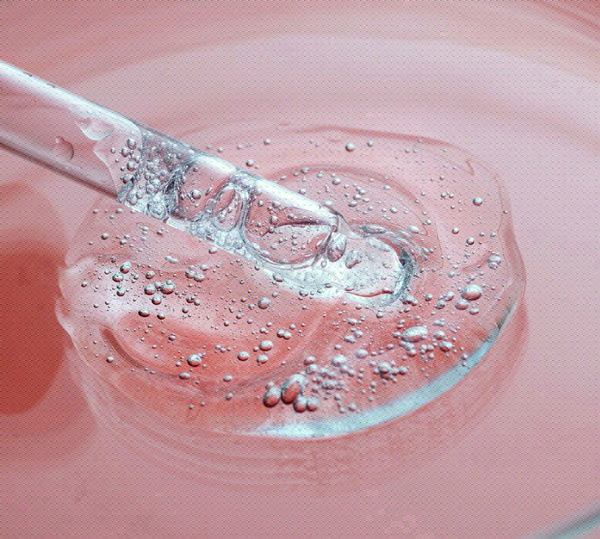
The short answer: a filler dissolving injection delivers an enzyme (hyaluronidase) that cuts the chains of hyaluronic acid, so it works only on fillers made of hyaluronic acid.
It is also called hyaluronidase, a filler dissolver or simply dissolving filler. Hyaluronic acid filler is made of long chains linked together into a gel; when the enzyme cuts those chains into small pieces, the gel loosens and the body absorbs it. Most of the action happens within 24–48 hours, and I reassess what is left after one to two weeks, once the swelling has settled.
A lock and key makes it easy to picture. This enzyme is a key that fits one lock only: hyaluronic acid.
If it is not the right lock, turning the key again will not open it.
The safety of the injection itself — side effects, allergy and vessel problems when dissolving lip filler — is covered separately in what to know before dissolving lip filler: side effects and safe conditions. Here I will focus on the cases where that key does not work.
4 cases where a dissolving injection does not work
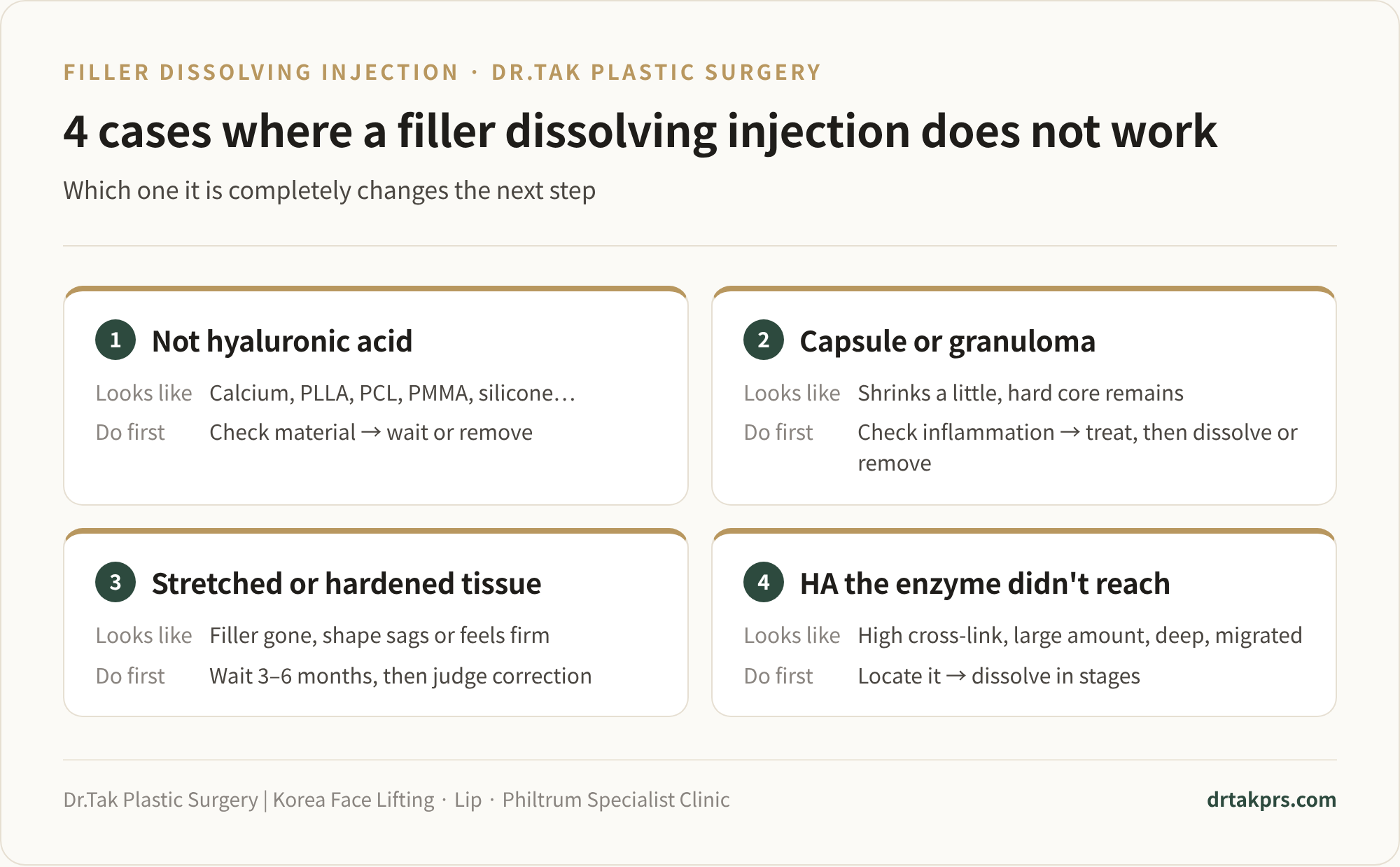
In short, a filler dissolving injection fails in four situations: (1) the filler was never hyaluronic acid, (2) the filler is sealed inside a capsule or granuloma, (3) the filler is gone but stretched or hardened tissue remains, and (4) it is hyaluronic acid filler but the enzyme could not reach enough of it.
(1) The filler is not hyaluronic acid
This is the most common and the most certain reason. Calcium-based filler (CaHA), PLLA and PCL fillers that stimulate collagen, and the permanent fillers once used — PMMA, silicone and polyacrylamide — are not hyaluronic acid, so they do not respond to the dissolving injection. If you had filler long ago or abroad and do not know the product, or were told it would "last a long time," I consider this possibility first. With hybrid fillers that mix hyaluronic acid and calcium, only the hyaluronic acid part dissolves; the rest stays.
(2) The filler is sealed inside a capsule or granuloma
The body recognises material that stays for a long time as foreign, and may build a thin fibrous membrane around it or form a lump of clustered inflammatory cells (a granuloma). Even hyaluronic acid filler, once sealed like this, keeps the enzyme from soaking in — the outside shrinks a little and a hard core remains. If an area filled months or years ago suddenly turns red or forms a hard lump, a bacterial film (biofilm) may be involved, so in that case I look at the inflammation before the enzyme.
(3) The filler is gone, but the tissue has stretched or hardened
When filler is placed for a long time and in large amounts, skin and mucosa stretch by that volume. Even after all the filler dissolves, the stretched tissue does not shrink back right away — lips can look crinkled or pushed forward, and other areas can look hollow or fold into wrinkles. If, on the other hand, the area around the filler has hardened into fibrous tissue, it still feels firm to the touch. This is not filler left behind but changed tissue, so more dissolving injections will not change it.
(4) It is hyaluronic acid filler, but the enzyme did not reach enough of it
Products whose chains are tied more tightly (highly cross-linked), large amounts pooled in one spot, or filler placed in a deep layer may need several sessions rather than one. If the filler has moved away from where it was first injected, the enzyme may simply have been placed in the wrong spot. In this case, finding the exact location often solves the problem.
Which of the four it is completely changes the next choice. So what is actually happening under the skin?
What happens under the skin — how capsules and fibrosis block the enzyme
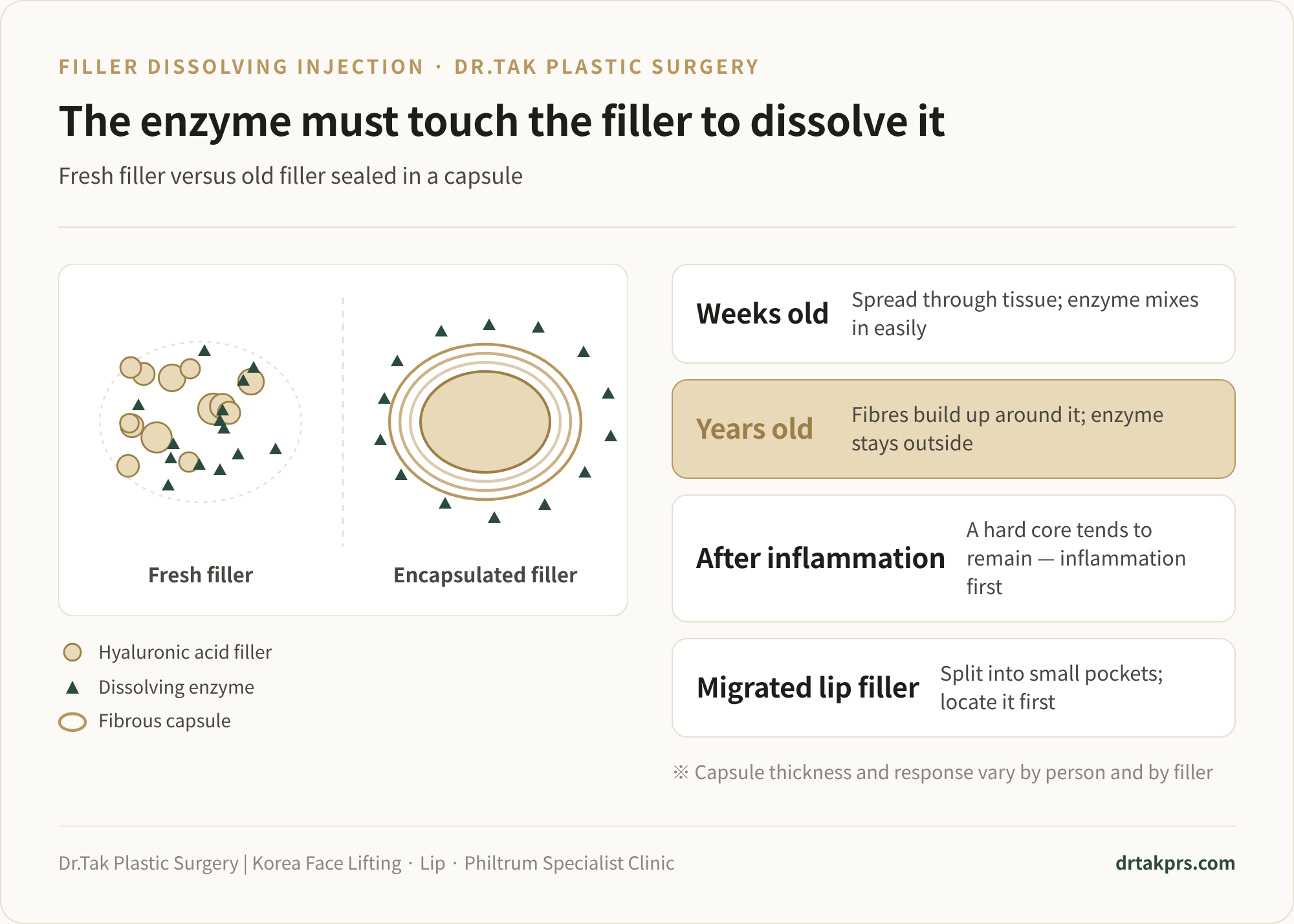
The short answer: the enzyme has to touch the filler directly to work, and a capsule or fibrous tissue becomes a wall that blocks the way.
Freshly injected hyaluronic acid filler spreads between the surrounding tissues, so the enzyme mixes in easily. Over time, the body lays down layer after layer of collagen fibres around the filler mass, and the thicker this membrane gets, the more the enzyme stays outside it. That is why I do not treat "filler from years ago" and "filler from a few weeks ago" with the same amount of enzyme.
The lips show this problem especially clearly. The orbicularis oris muscle moves all day and pushes filler around, so it easily migrates above the lip line or into the inner mucosa and clumps into small lumps. What looks like one lump on the outside is sometimes divided into several small pockets inside.
📍 Bottom line: The older the filler, and the more it has been through inflammation, the less likely it is that "one dissolving injection" will finish the job. In that case it is safer to confirm the cause first than to add more injections.
So, by filler type and condition, this is how the choice divides.
A 1:1 consultation you can start right now
✅✅ Whether to have more dissolving injections, wait, or consider removal or correction — explained by comparing options for the filler you had and its current state
✅✅ An honest opinion, whether or not you decide on surgery
📲 Chat icon at the bottom right of the Dr.Tak Plastic Surgery official website → live consultation
By filler type: does it dissolve, and how is it resolved
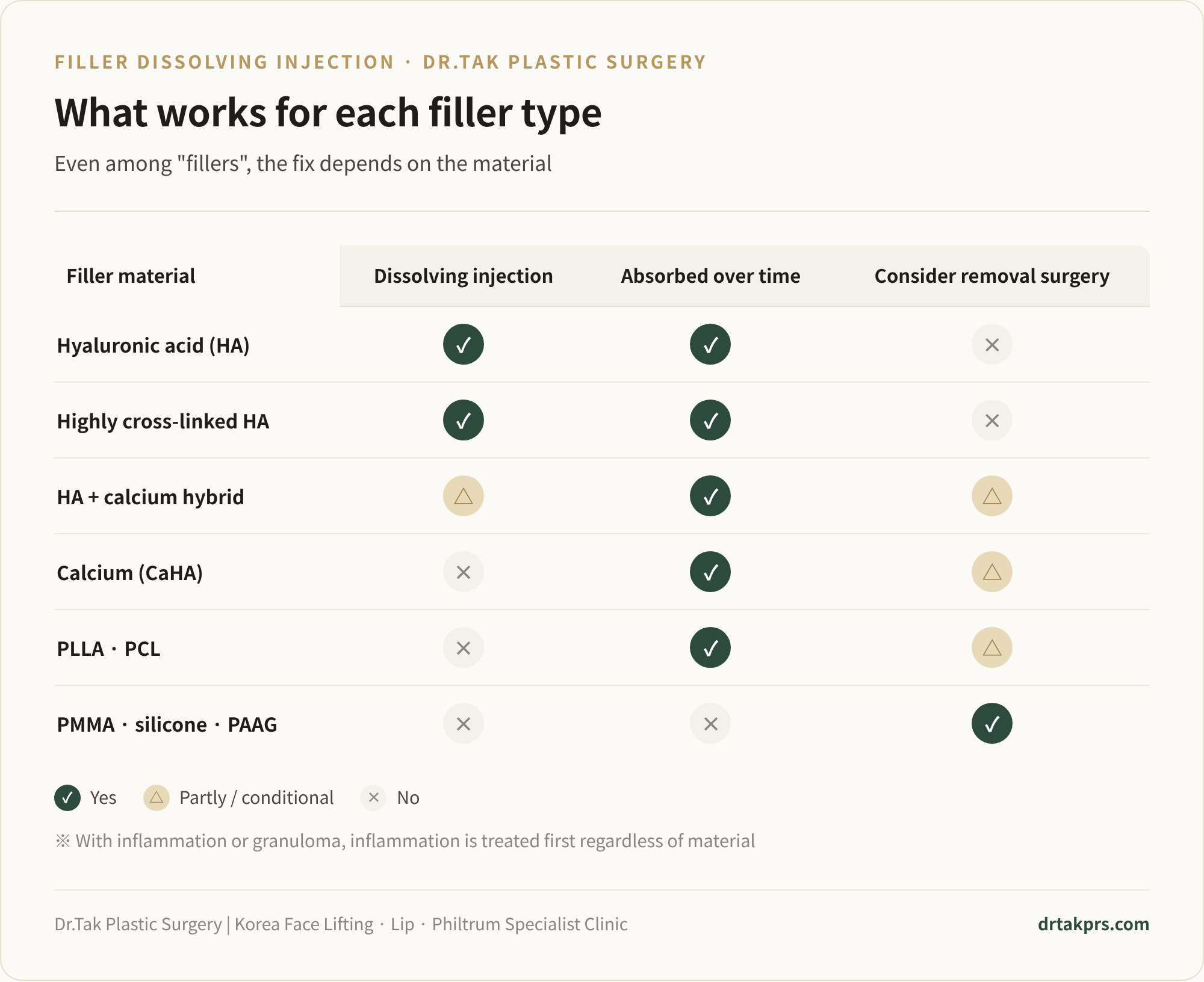
If you know the name of your filler, the table below is the fastest place to start. Even among "fillers," whether the dissolving injection works, whether it is absorbed over time, or whether it must be removed depends on the material.
| Filler material | Dissolving injection | Over time | Main options when it remains |
|---|---|---|---|
| Hyaluronic acid (HA) | ✅ Dissolves | Absorbed over months to over a year, depending on product | Dissolving injection, repeated in stages if needed |
| Highly cross-linked HA | ✅ Dissolves, may need several sessions | Absorbed more slowly | Confirm location, then dissolve in stages |
| HA + calcium hybrid | △ HA part only | Calcium part absorbed slowly | Dissolve + observe the remainder |
| Calcium (CaHA) | ❌ | Usually absorbed over 12–18 months | Observe; consider removal for clumps |
| PLLA | ❌ | Absorbed over about 2 years | Injection treatment or removal for nodules |
| PCL | ❌ | Absorbed over 1–4 years, by product | Injection treatment or removal for nodules |
| PMMA | ❌ | Not absorbed (permanent) | Consider removal surgery |
| Silicone / polyacrylamide | ❌ | Not absorbed (permanent) | Consider removal surgery — complete removal is often difficult |
| Filler of unknown material | ? | Unknown | Check location and shape → test response with a small dose → decide |
| Filler with inflammation or granuloma | Depends on material | May not resolve on its own | Treat inflammation first, then dissolve or remove |
The most important rows are the last two. If you keep repeating dissolving injections when the material is unknown or there is inflammation, time passes and the cause stays where it is.
Other drugs to dissolve calcium filler are being studied, but it is hard to call them standard treatment yet. So I explain non-dissolvable filler not as "a problem of finding a way to dissolve it" but as "a choice between waiting, taking it out, or correcting the surrounding tissue."
📍 Bottom line: A dissolving injection is the answer for hyaluronic acid filler — and specifically when there is no capsule or inflammation and the location can be found. In other cases, the more dissolving injections you have, the later other options may come.
Signs it is time to stop dissolving and move to the next step
There is no right number of dissolving injections. But if any of the following applies, it is time to recheck the cause before repeating the same injection.
✅ Two or three sessions spaced apart, and the size has barely changed — it is likely not hyaluronic acid, or it is sealed in a capsule
✅ It shrank, but a hard core remains — fibrosis or a granuloma is suspected
✅ An old filler site suddenly turns red, warm and painful — this may be inflammation, so do not wait; see a doctor right away
✅ You have no idea of the name or material of the filler — confirming the material comes first
✅ The filler seems fully dissolved, but the shape has stretched and crinkled further — what remains is stretched tissue, not filler
In these cases it helps to confirm the exact location. Touch alone cannot tell how much filler remains or in which layer, so ultrasound is also used to locate it.
So what should you do when the filler has dissolved but the tissue has stretched?
How to make up for stretching left after dissolving
The short answer: give stretched tissue about 3–6 months to shrink on its own first, then decide on correction based on the shape that remains.
| Period | Tissue state | What we look at |
|---|---|---|
| Right after dissolving – 2 weeks | Looks hollow or crinkled, with swelling | Reassess whether filler remains |
| 1–3 months | Stretched skin and mucosa slowly shrink | Not rushing back into filler, even if tempted |
| 3–6 months | Shrunk as much as it will | Judge remaining laxity, asymmetry, lack of volume |
| After 6 months | Shape has stabilised | Consider corrective surgery if needed |
This process matters especially for the lips. If lips stretched by years of filler still look thick and pushed forward after dissolving, lip reduction surgery for thick lips, which removes the stretched mucosa, can be considered; if, on the other hand, you do not want filler again but want to keep the volume, a method that moves your own mucosa to create volume can be considered. Putting filler back in right after dissolving is the most common start of the cycle, so I recommend taking a break during this period.
What we check before dissolving
The dissolving injection itself is a short procedure. That is why I spend more time deciding whether to give it than giving it.
First I ask about your treatment records. Without a product name, even the time, place and what you were told back then are clues. Next I feel the area to see whether the filler is spread out, clumped, or has a hard core. If inflammation is suspected, I postpone dissolving. For lips, I picture the shape after the filler is gone, and if laxity is likely to remain after dissolving, I tell you that first.
🏥 The grounds for saying this, briefly:
- As a lip and philtrum specialist clinic, we have focused on this field with over 15 years of experience
- 200+ Google reviews, 5.0 out of 5 — reflecting not only results but also how we explain and follow up
- We perform removal surgery ourselves for filler and foreign material that will not dissolve, and also judge the correction of lip shape left after dissolving or removal
- When a dissolving injection is enough, we do not suggest surgery
💬 "To make people smile." For anyone who has become uncomfortable looking in the mirror because of filler, I believe deciding together what to take away, rather than adding more, is how we keep this promise.
Before & after photographs are on our official page
Dr.Tak Plastic Surgery complies with medical advertising regulations, so we do not place before-and-after photographs inside blog articles. Actual pre- and post-operative changes are collected on the official before & after page.
🔗 View before & after — Dr.Tak Plastic Surgery official page
Results may vary from person to person.
Dr.Tak 4S Patient Care System — focused on people, not procedures
We focus on people, not procedures.
Solution — 1:1 master plan with Chief Director Dr. Tak Seung-wan
- Sincere empathy and communication: your wishes fully reflected in surgery
- Precise facial golden-ratio analysis (personalised): checking the location, material and tissue condition of remaining filler to plan the scope of dissolving and correction
- Simulation of expected post-operative changes
Support — Global 1:1 dedicated coordinator
- A dedicated coordinator for each country (no language barrier)
- Accompanied through every step from consultation to surgery and aftercare
- 100% advance booking (private clinical environment)
Scar Care — 6-month intensive scar management
| Care item | Period | Details |
|---|---|---|
| Control taping | 3–6 months | Prevents the scar from widening |
| Scar-softening injections | 6 months (once a month) | Softens raised scars |
| Laser treatment | 6 months | Reduces redness at the surgical site |
Service — 1-year free A/S guarantee
- Free A/S within 1 year after surgery
- Care through to the very end
- ※ If sedation is used, a basic anaesthesia fee may apply
Want to know more? — Official channels
🌐 The Dr.Tak Plastic Surgery official website has detailed guides for each lip and philtrum procedure
📝 The blog collects articles by procedure, including dissolving lip filler, lip reduction and mucosal advancement
📹 Videos show the surgical process and the recovery course
Five things to sort out before more dissolving injections
✅ Do you know the product name or material of your filler? — If not, write down at least when and where you had it and what you were told
✅ When and how many times did you have filler, and how many dissolving injections? — The intervals and number become the basis for the next decision
✅ Has there ever been redness, warmth or pain? — A history of inflammation needs checking before dissolving
✅ Is your goal "getting rid of the filler" or "correcting the shape"? — The two can call for different solutions
✅ Can you wait 3–6 months after dissolving? — It helps to fit the time stretched tissue needs to shrink into your schedule
You do not need answers to every item. Anything you are unsure of, we can check together in consultation.
Frequently Asked Questions (FAQ)
We have gathered the questions Dr.Tak Plastic Surgery hears most often.
Q1. I've had three dissolving injections and nothing changed. Can I keep having them?
Rather than continuing to a fourth and fifth injection, it is better to stop and find out why. If it really is hyaluronic acid filler, a visible change usually appears within one or two sessions; if three sessions changed nothing, it is likely a different material, sealed in a capsule, or the enzyme did not reach the filler. For people in this situation, I recheck the location and condition before giving more injections, and depending on the result, tell you whether to continue dissolving or move to another method.
Q2. Won't the injection also dissolve the hyaluronic acid my face naturally has, and leave it sunken?
The enzyme acts not only on filler but also on the hyaluronic acid already in your skin. However, the body's own hyaluronic acid is renewed within days, so with an appropriate dose the change is usually temporary. The problem arises when large doses are given repeatedly where little filler remains. That is why I check how much is left and use only as much as needed, in divided doses.
Q3. What if I don't know which filler I had?
More people are in this situation than you might think. The most important clues are when you had it, where, and whether you were told it would "last a long time" or was "permanent." Add to that how it feels and where it sits, check the remaining shape with imaging if needed, and if it may be hyaluronic acid, test the response with a small dose first. If there is no response, from then on we discuss whether to wait or take it out with removal surgery.
Q4. How is the cost decided? If it won't dissolve, will I end up needing surgery?
An exact figure is hard to state; the range depends on the area and amount to dissolve, the number of sessions, whether material checks or imaging are needed, whether removal or corrective surgery follows, and whether sedation is used. Not every non-dissolving filler means surgery. For fillers that are absorbed over time, such as calcium, PLLA and PCL, waiting is often the answer; surgery is considered when time will not solve it — permanent filler, lumps left after inflammation, or stretched tissue. In such cases we carry out filler and foreign-material removal surgery and the correction of the remaining shape together. Anyone who has had an allergic reaction to a dissolving injection before, or who currently has inflammation, does not start with a dissolving injection.
Q5. I've had filler for years. If I dissolve it all, won't I look older?
I know this worry is the biggest reason people hesitate to dissolve. In fact, for a few weeks right after dissolving, the swelling goes down and stretched tissue remains, so there is a period when the face looks rather empty. But that is not the final result — judge by the face after the tissue has shrunk over 3–6 months. I recommend dissolving in stages, starting with the parts that look unnatural, and checking the change together rather than dissolving everything at once.
Dr.Tak Plastic Surgery | Korea Face Lifting · Lip · Philtrum Specialist Clinic
"To make people smile"