"I have to be back at work next week — will I be okay?" — what to decide before you pick a date
You were probably counting how many days of leave you could take, started worrying whether you would really have recovered by then, and ended up here. In my consultation room I meet a great many people for whom deciding on surgery is less stressful than working out what to tell their employer and how many days to take off.
Search online and you will easily find claims like "back at work in two weeks" or "one week is enough". But watching the people I operate on, some go back to work after a week, while others have rested three weeks and still hesitate to stand in front of people. What made the difference, in most cases, was not the operation but the work they do.
That is why in consultation I ask "What kind of work do you do?" before "When would you like to have surgery?" This article follows the same order. I will explain exactly what facelift downtime is, then compare return timing for remote, office, client-facing and physical jobs, and finally cover what happens if you go back too soon and how to plan your schedule.
Let me be honest from the start: some of you will finish reading and conclude that you need more leave than you expected. Planning that way actually brings more peace of mind.
What facelift downtime is — the period when facing other people is hard
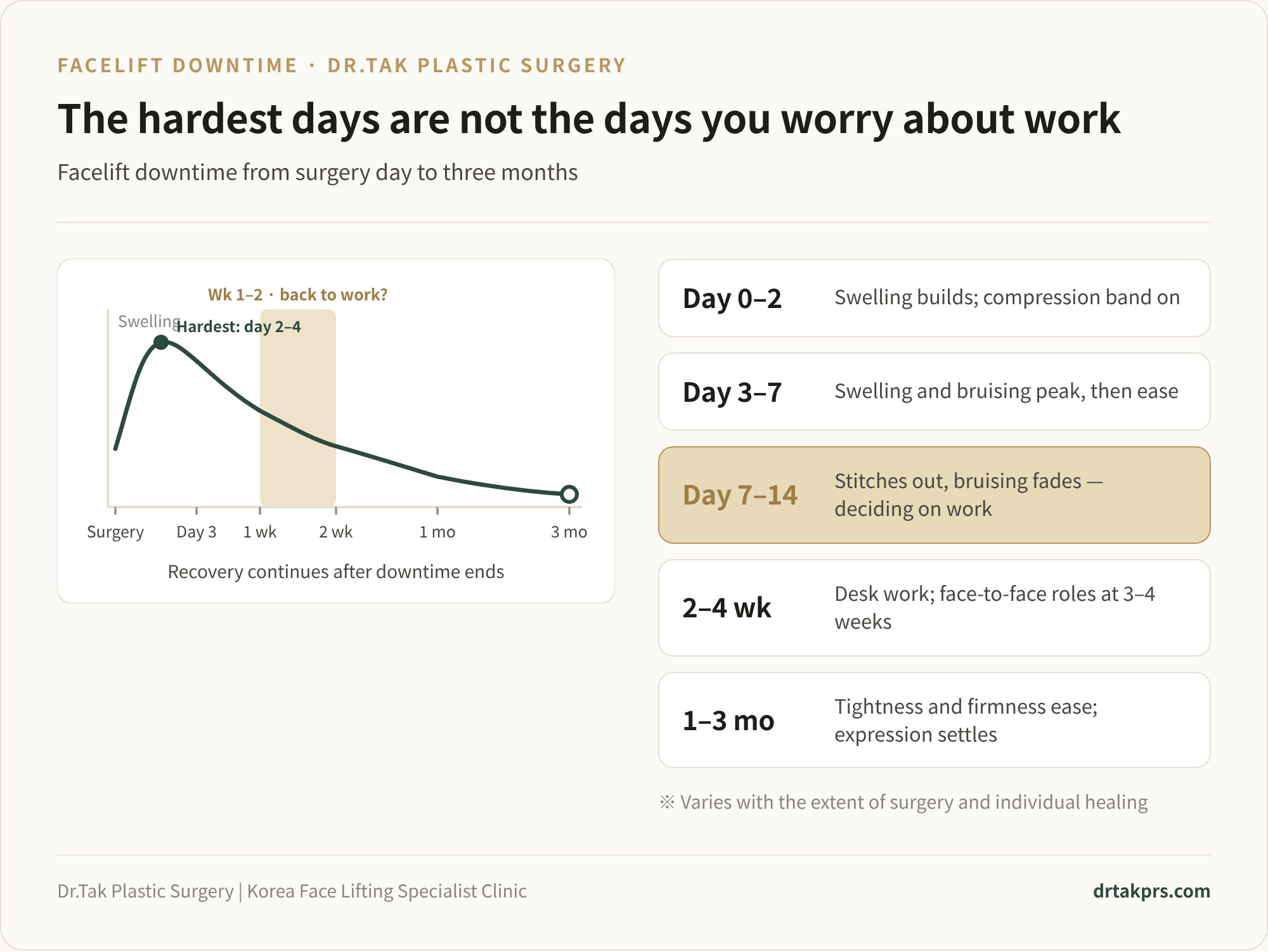
The short answer: facelift downtime is the period after surgery when swelling, bruising and tightness make it hard to meet people and work as usual, and most people return to daily life within two to three weeks. But this is not the point at which recovery ends. It is the point at which you have recovered enough that others will not readily notice.
Downtime originally meant the time a machine is out of action. In plastic surgery it refers to the period after a procedure or operation when daily life is restricted, and it is used much like "recovery period" or "time off". A facelift, also called a rhytidectomy, and known in Korea as 안면거상, is an operation that lifts sagging skin together with the deeper layers beneath it.
Facelift downtime is made up of three overlapping things.
① Visible recovery — swelling and bruising
These are worst in the first week, and around days 7–10, when the sutures come out, the bruising fades to yellow. Whether it can be covered with makeup or a mask is the biggest factor in whether you can go to work.
② Felt recovery — tightness and reduced sensation
The areas in front of and behind the ears and along the jawline feel tight, and the cheeks or the skin around the ears may feel numb. It may not show much from the outside, but if you have to talk a lot or smile often, you tire quickly.
③ Physical restrictions — bending, lifting and blood pressure
Keeping your head down for long periods or lifting heavy things sends blood to the face, increasing swelling and, rarely, leading to a haematoma, a collection of blood under the skin. The risk of haematoma is highest in the first 24–48 hours after surgery.
The key point is that these three do not fade at the same pace.
Bruising can mostly be covered by two weeks, but tightness and physical restrictions last longer. That is exactly why the return date differs from job to job.
Same operation, different return dates — five things that lengthen downtime
Before we look at jobs, let me explain why downtime itself varies from person to person. These are also the points I check when deciding the extent of surgery in consultation.
The first is the extent of dissection. Compared with a mini facelift that treats only the lower face through a short incision in front of the ear, a deep plane facelift that moves the deep layers of the face widely, or an operation that lifts the neck as well, produces swelling that spreads further and lasts longer. The second is combined procedures. If eyelid or forehead surgery is done at the same time, bruising comes down around the eyes and becomes harder to cover with makeup.
The third is the condition of your skin and blood vessels. In people with thin skin and visible vessels, bruising looks darker. The fourth is smoking and blood pressure. Smoking reduces blood flow to the skin and slows recovery, and uncontrolled blood pressure raises the risk of haematoma. The fifth, surprisingly, is how you live during recovery. I often see swelling last longer in people who pushed themselves in the first week with housework or sorting things out at home.
So it is not unusual for two people operated on the same day to return to work more than a week apart.
How, then, can you gauge your own case? The answer lies in the comparison by job type.
A 1:1 consultation you can start right now
✅✅ We first ask about your work and how much leave you can take, then compare the surgical approach that fits your extent of sagging alongside the downtime and return schedule that come with it
✅✅ We give you an honest opinion whether or not you proceed with surgery
📲 Dr.Tak Plastic Surgery official site, chat icon at the bottom right → live consultation
Return-to-work timing by job type — remote, office, client-facing and physical work
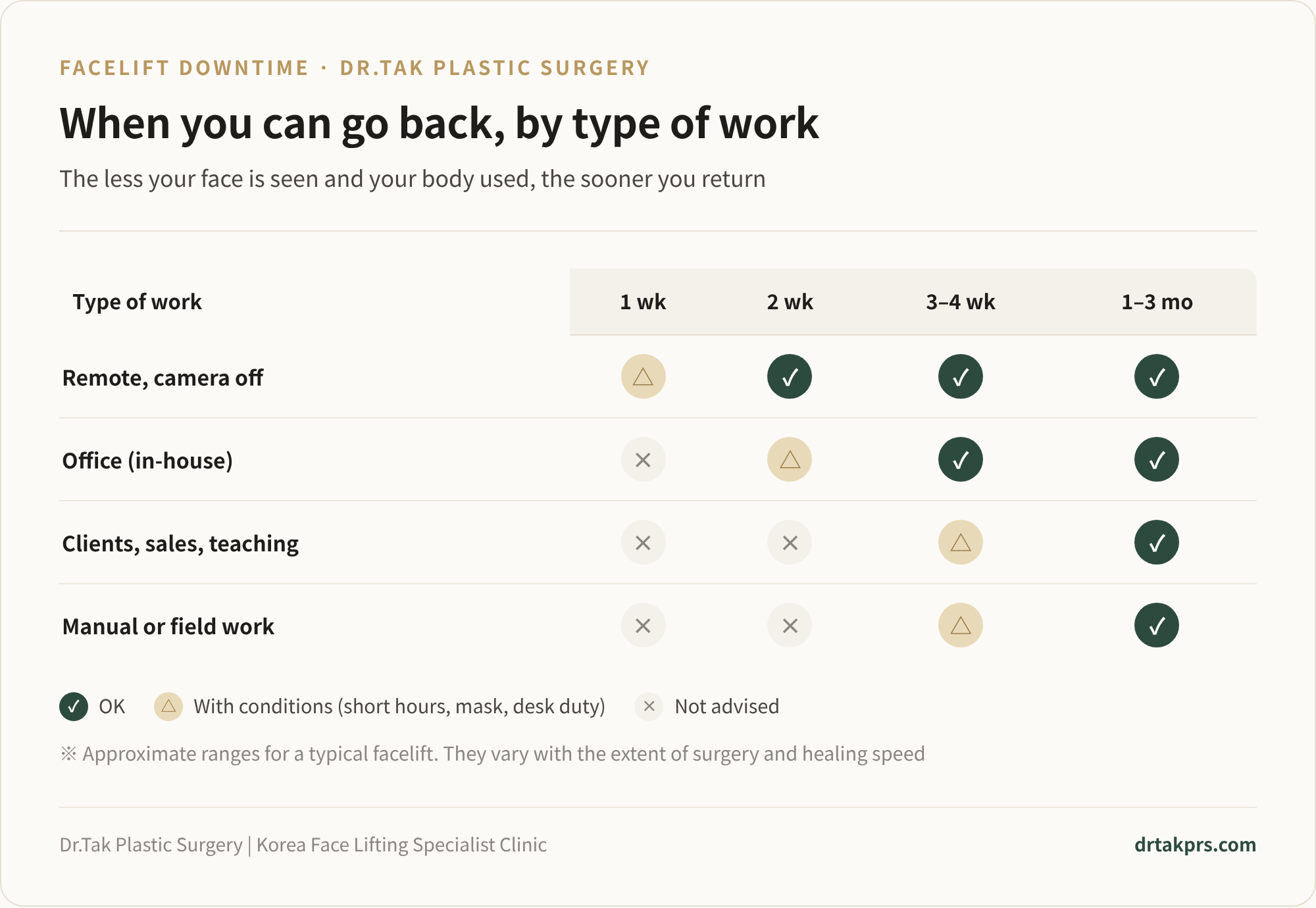
The short answer: the less your face is seen and the less physical your work, the sooner you return; the more you use your expressions and your stamina, the later. The timings below are approximate ranges for a standard facelift and vary with the extent of surgery and your individual recovery.
| Comparison | Remote work, no camera | Office work (desk-based, little face-to-face) | Client-facing work: sales, service, teaching | Physical or on-site work |
|---|---|---|---|---|
| When return begins (generally) | Short sessions from around 1 week | Around 2 weeks | 3–4 weeks | After 3–4 weeks; strenuous tasks later still |
| How noticeable to others | Hardly matters | After suture removal, mostly covered with makeup or a mask | Swelling or asymmetry may show up close | Physical strain matters more than visibility |
| Biggest burden | Tiring easily | Commuting and sitting for long hours | Constant talking and smiling | Bending and heavy lifting |
| Can a mask or makeup cover it? | Not needed | Mostly yes | Difficult if the mask has to come off | Sweat and dust make wound care difficult |
| Use of expression and speech | Low | Moderate | High — tightness is felt most | Moderate |
| Bending and exertion | Almost none | Almost none | Almost none | A lot — directly linked to swelling and haematoma risk |
| Fatigue | Tired by the afternoon at first | Even half a day feels long in the first week | Emotional labour adds to it | Greatest physical drain |
| What to prepare | Ask to keep your camera off in video calls | Set your return date after suture removal | If possible, switch to desk or paperwork duties for 1–2 weeks | Lighter duties, or extend your leave |
| Delay your return if | One side suddenly swells and hurts | Bruising spreads or the area feels warm | One side of your expression stays awkward | Swelling increases again or a wound opens |
📍 Bottom line: Your return date is not your surgery date plus a fixed number of days. It is set by what your job asks of your face and your body.
The row people overlook most in this table is "use of expression and speech". Even in an office job, if you are in meetings and talking all day, you should treat yourself as closer to client-facing work. Conversely, if your on-site role is mostly supervisory, you are closer to an office worker.
Where you place your work in this table can change the leave you need by a week.
From the day after surgery to exercise — what you can do at each stage
If the job comparison tells you "when", the table below shows "what" you can do in between. The short answer: think of the first week as rest, week two as the start of a short return, and weeks three to four as the return to most of daily life.
| Period | Condition | What you can do | What to avoid for now |
|---|---|---|---|
| ⏱ Day 0–2 | Swelling building. Compression garment worn | Rest lying down, short walks | Bending forward, heavy lifting, driving on the day of sedation |
| ⏱ Days 3–7 | Swelling and bruising peak, then start to subside | Light work from home, short walks outside | Crowded places, alcohol, sauna |
| ⏱ Days 7–10 | Sutures removed. Bruising fades to yellow | Face washing and light makeup as instructed, more remote work | Long outings, exercise that makes you sweat |
| ⏱ Around 2 weeks | Major swelling gone; noticeable only up close | Office work, going out with a mask | Work dinners, late nights, intense exercise |
| ⏱ 3–4 weeks | Mostly natural-looking, though jawline tightness remains | Client-facing work, resuming light exercise | High-intensity exercise, repeated heavy lifting |
| ⏱ 1–3 months | Expression and sensation return, firmness softens | Most daily activities and exercise | Firm massage pressing on the face |
| ⏱ 3–6 months | Swelling fully resolves, final contour emerges | Judging the result | — |
The longest row in this table is the last one. The end of downtime is not the end of recovery.
Even after you are back at work, there will be several weeks when your jawline feels firm or swelling returns each morning. Knowing this in advance makes your first week back far less worrying. That is why I advise resting for at least 30 minutes with your upper body raised as soon as you get home during your first week back. If you would like to see how the body itself changes day by day, you can read my day-by-day guide to facelift recovery in Korea.
What happens if you go back too soon — who should not plan a short downtime
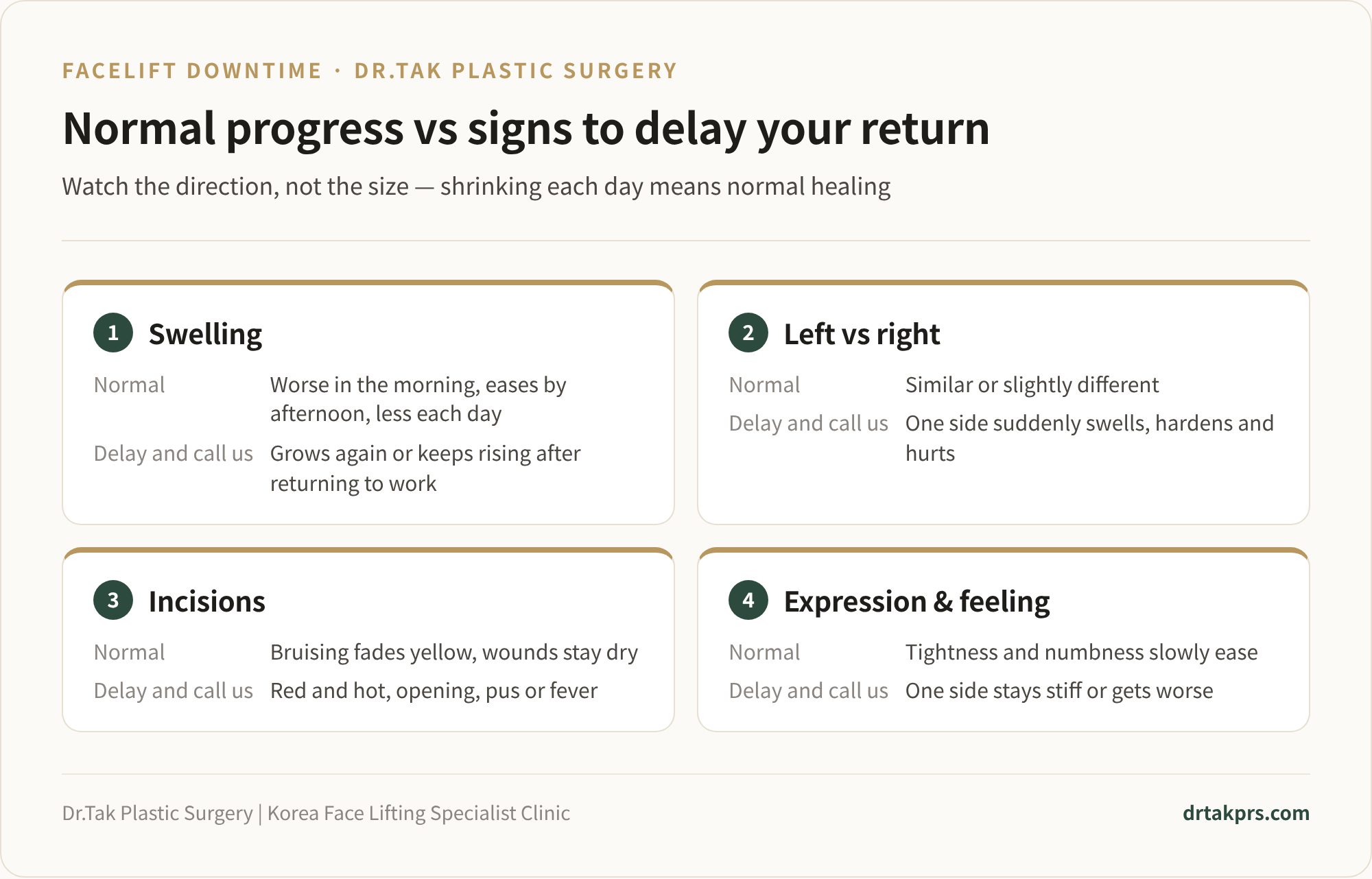
To be honest, rushing back to shorten downtime is the single biggest cause of slower recovery. When I find myself thinking in clinic, "it would have been better if you had rested a little longer", it is usually for one of the three reasons below.
① Swelling comes back
Many people find their face feels heavy from the afternoon of their first day back, and the swelling is worse the next morning. Sitting for long periods or working with your head down sends blood to the face.
② Rarely, a haematoma can form
A sudden rise in blood pressure, lifting heavy things and drinking all raise the risk of a haematoma, where blood collects at the surgical site. If one side suddenly swells, becomes firm and hurts, do not wait for your appointment — contact us right away.
③ Scars can widen
The incisions in front of and behind the ears and inside the scalp are under tension for the first few weeks. If you keep making big expressions or turning your head frequently beyond what is comfortable, the scars can open up or thicken.
So if any of the following applies to you, I recommend taking at least a week more leave than the table suggests.
- You are having a neck lift, or eyelid or forehead surgery, at the same time
- You smoke, or your blood pressure or diabetes is not yet well controlled
- You take blood-thinning medication such as aspirin (discuss whether to stop with the prescribing doctor first)
- Your work means you cannot wear a mask or must lift heavy things
If your sagging is still mild and you cannot take long leave, it is better to postpone surgery or first consider another option with shorter downtime. When you have surgery changes the result as much as the decision to have it.
Travelling from abroad — planning your flight home and return to work
If you are travelling from abroad, you need to set your flight home before your return-to-work date. The low cabin pressure and long hours sitting on a plane increase swelling, and once you are home it is hard to be seen quickly if a problem arises.
I usually recommend scheduling your departure after the sutures are out and the wounds have been checked once more. That generally means a stay in Korea of about 10 days–2 weeks, and it is better to allow a few extra days of rest at home rather than going straight back to work. If you are having a neck lift or other procedures at the same time, we plan a longer stay.
✈️ On long-haul flights, get up and walk often, drink plenty of water, and try not to fall asleep with your head bent too far forward.
The tighter your schedule, the more reliable it is to align the dates together in a consultation before surgery.
We build downtime into the surgical plan — a principle kept for more than 15 years
When I plan a facelift, I look at your schedule and your job alongside the extent of your sagging. If the sagging is concentrated in the lower face and you cannot take long leave, I recommend reducing the extent of dissection; if the whole face has sagged, I recommend taking the extent you need even if the downtime is longer. A surgery with short downtime is not always a good surgery. If it does not lift as much as you need, you will be facing the same question again in a few years.
Shortening recovery starts with the operation itself. Dissecting in the correct plane, controlling bleeding meticulously, and fixing the deep layers so that less tension falls on the incisions are the basics of reducing swelling, bruising and scarring.
🏥 Let me briefly explain why we are able to keep to this principle.
- Dr.Tak Plastic Surgery has more than 15 years of experience in facial lifting and lip and philtrum surgery in Korea
- We hold a 5.0/5 rating across more than 200 Google reviews
- Before deciding the extent of surgery, we first ask about your work and your leave schedule
- If the timing does not work, we will honestly suggest postponing your surgery date
💬 "To make people smile." Not anxiously getting through recovery, but returning on plan and smiling with ease — that is what we consider the result.
Before & after photographs are on our official page
Dr.Tak Plastic Surgery complies with medical advertising regulations, so we do not place before-and-after photographs inside blog articles. Actual pre- and post-operative changes are collected on the official before & after page.
🔗 View before & after — Dr.Tak Plastic Surgery official page
Results may vary from person to person.
The Dr.Tak 4S Patient Care System — focused on people, not procedures
We focus on people, not procedures.
Solution — a 1:1 master plan with Dr. Tak Seung-wan
- Genuine empathy and communication: your wishes reflected fully in the operation
- Precise golden-ratio facial analysis (personalised): considering your occupation and leave schedule along with the extent of sagging to design the dissection range and your return plan
- Post-operative change simulation provided
Support — a dedicated 1:1 global coordinator
- A coordinator assigned by country (no language barrier)
- Accompanying you through consultation, surgery and aftercare
- 100% appointment-only (private clinical environment)
Scar Care — six months of focused scar management
| Item | Period | Content |
|---|---|---|
| Control taping | 3–6 months | Prevents scar widening |
| Scar-softening injection | 6 months (monthly) | Softens raised scars |
| Laser treatment | 6 months | Reduces redness at the surgical site |
Service — one-year complimentary revision guarantee
- Complimentary revision within one year of surgery
- We see your care through to the end
- ※ Where sedation is used, a base anaesthesia fee may apply
If you would like to know more — official channels
🌐 Our official site carries technique-by-technique detail
📝 Our blog has related reading on deep plane facelift and the difference between mini and full facelift
📹 Video material shows the surgical process and recovery course
Five things to settle before you book a surgery date
✅ Which column of the table is your work closest to — judge by how much you talk and how physical your day is, rather than by your job title
✅ What is the maximum leave you can take — tell us how many days you have, and we will fit the extent of surgery within them together
✅ Do you have any unmissable commitments within four weeks of surgery — please tell us about weddings, presentations or business trips in advance
✅ Can you work in a mask, and can you switch to remote or desk-based work — this is the biggest variable that can bring your return forward by a week
✅ If you are travelling from abroad, how many days can you stay in Korea — departure after suture removal is the benchmark
You do not need to bring an answer to every question. Anything you are unsure of, we can work through together in consultation.
Frequently Asked Questions (FAQ)
The questions we receive most often at Dr.Tak Plastic Surgery.
Q1. Can I go back to work one week after a facelift?
If you work from home or on your own, you can start with short sessions, but if going back means facing people, one week is generally too early. Around one week, the sutures have either not yet come out or have only just been removed, so the wounds around the ears and some bruising remain, and your face tends to feel heavy again by the afternoon. If you really must go back, I recommend first discussing half-days or a switch to desk-based duties with your employer. The difference between one week and two feels far bigger than the numbers suggest.
Q2. What are the hardest days of facelift downtime?
Most people remember days 2–4 after surgery as the hardest. Swelling peaks at this point, the jawline feels tight so it is hard to open your mouth wide, and the position you have to rest in makes sleep uncomfortable. Knowing about this stage in advance eases the anxiety of wondering why it keeps getting more swollen. I advise preparing a place to rest with your upper body raised and soft food for these few days.
Q3. When can I wash my hair, and when can I colour or perm it?
Because the incisions sit inside the scalp and around the ears, this is asked almost as often as the question about work. Hair washing generally starts a few days after surgery, gently and with lukewarm water, as instructed, while colouring or perming is best postponed until generally 4–6 weeks or later, because the chemicals can irritate incisions that have not yet healed. If you need your roots coloured before going back to work, it is neatest to do it 1–2 weeks before surgery. We confirm the exact timing at your follow-up, based on where the incisions are and how the wounds look.
Q4. Can't I just choose a surgery with shorter downtime? And how is the cost determined?
There are certainly options with short downtime, such as a mini facelift or a thread lift. However, short downtime usually means a narrower area is treated, so for people with widespread sagging the result may fall short of expectations — I explain this in more detail in my article on the difference between a mini facelift and a full facelift. Conversely, if your sagging is limited to the lower face, reducing the extent can give you both a shorter downtime and a good result. It is also hard to give an exact figure for cost; the range depends on the extent of dissection, whether neck or eyelid surgery is combined, whether it is a revision, and whether sedation is used. We confirm your extent of sagging and your schedule in consultation and then guide you.
Q5. It has been four weeks and I still look swollen. I'm worried people at work can tell.
This is the worry people confide most often after going back to work. In most cases, swelling at around four weeks feels large mainly because you compare yourself in the mirror every day, and people seeing you fresh often just think you look well. Being more swollen in the morning and less in the afternoon, and the firm feeling along the jawline, ease over 1–3 months. However, if one side stays swollen or you can feel a firm lump, do not wait — get checked, and in such cases I will look at a photo first if needed.
Dr.Tak Plastic Surgery | Korea Face Lifting Specialist Clinic
"To make people smile"